
PSA Nitrogen Generator FAQ: PSA vs Membrane, Station Scope, Maintenance, and Acceptance Terms
PSA Nitrogen Generator FAQ: PSA vs Membrane, Station Scope, Maintenance, and Acceptance Terms
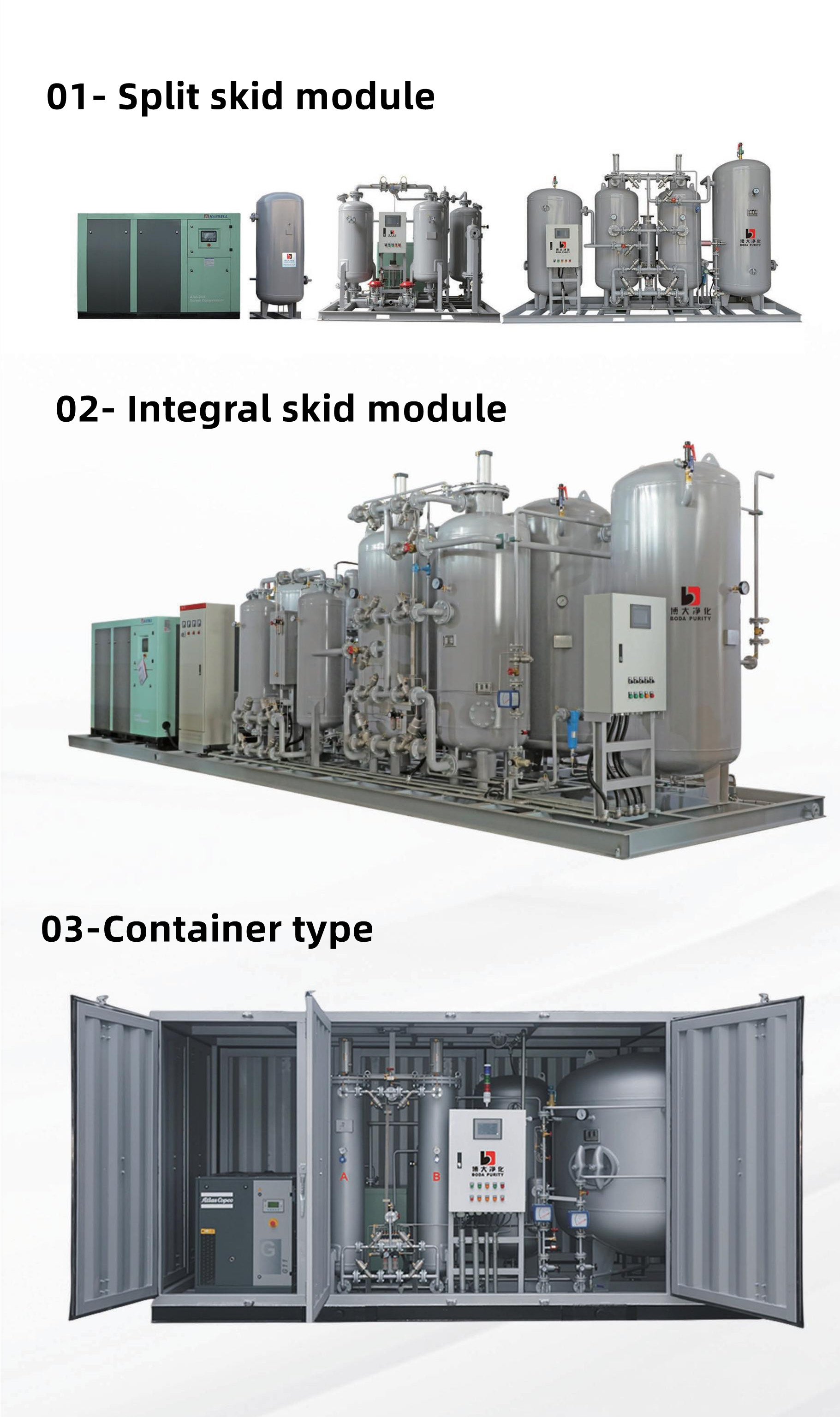
A skid-mounted PSA nitrogen generation package is not defined by the generator alone. For a buyer moving from equipment evaluation to execution, the practical questions are what equipment the station includes, whether PSA or membrane technology fits the required purity, which maintenance items need planning, and how pre-shipment acceptance will be documented. Those points should be settled in the technical and commercial scope before dispatch.
This FAQ focuses on the Skid-Mounted PSA Nitrogen Generation Package and the decision details that surround it. BODA GAS is the brand used by Hangzhou Boda Purity Equipment Co., Ltd., a manufacturer of PSA nitrogen and oxygen generators and compressed-air purification equipment based in Hangzhou, Zhejiang Province, China. The article uses the supplied product and purchasing information; it does not assume that every skid package has the same equipment list, maintenance interval, or acceptance procedure.
Why station scope matters at the execution stage
A nitrogen station is a system of connected equipment rather than a standalone separation vessel. A scope that names only a “PSA nitrogen generator” may leave important interfaces unclear: compressed-air preparation, storage, filtration, nitrogen buffering, purity monitoring, controls, and the skid arrangement. Buyers should identify which items are included in the quoted package and which are supplied or installed separately.
This scope check is especially relevant when the package will be placed in an existing plant area. The supplied configuration information describes multiple skid-mounted arrangements: a split-type skid assembly, an integrated skid-mounted unit, and a container-integrated package. Equipment layout can be arranged according to site space conditions. These options should not be treated as interchangeable without checking the proposed equipment arrangement and the buyer’s actual installation boundary.
The decision is not simply whether a skid can be supplied. It is whether the listed equipment, connections, control responsibilities, and acceptance evidence match the project’s operating requirements. A clear equipment schedule and boundary list help prevent a disagreement between “the nitrogen generator” as a product name and “the nitrogen station” as a complete project scope.
What is the difference between PSA and membrane nitrogen generators?
PSA and membrane systems separate nitrogen from compressed air using different mechanisms. A PSA nitrogen generator uses carbon molecular sieve (CMS) in alternating adsorption towers. A membrane nitrogen generator uses hollow-fiber bundles that separate gases according to their permeation rates.
| Buyer consideration | PSA | Membrane |
|---|---|---|
| Separation method | CMS adsorbs oxygen under pressure; nitrogen passes through as product gas. | Hollow-fiber bundles separate gases by permeation speed. |
| Purity information in the supplied data | The FAQ source states purity up to 99.999%. | The FAQ source gives a range of 95% to 99.5%. |
| Described format characteristics | Alternating adsorption and regeneration cycles support continuous on-site production. | The supplied FAQ describes membrane systems as compact and quiet. |
| Decision boundary | A relevant option when the required purity aligns with the stated PSA capability. | The stated purity range may be a boundary where a process requires higher purity. |
The comparison is a starting point, not a complete equipment specification. The supplied information does not provide a universal flow, pressure, footprint, or energy comparison for PSA and membrane systems. Buyers should therefore compare the proposed units against their own required nitrogen purity, flow, outlet pressure, site conditions, and operating profile rather than infer a winner from technology names alone.
For a PSA system, compressed and pre-treated air enters one adsorption tower. The CMS adsorbs oxygen, carbon dioxide, and moisture while nitrogen passes through. When the sieve in one tower reaches its operating cycle limit, the system switches towers; the saturated tower depressurizes and regenerates. Pressure equalization is part of the described switching sequence. This operating explanation helps buyers understand why air preparation, tower switching, control functions, and the product buffer are parts of the station conversation—not optional details to leave implicit.
What equipment can be included in a PSA nitrogen station?
The supplied system description lists a possible complete PSA nitrogen system as an air compressor, tanks, dryers, multiple filters, an activated carbon filter, a PSA nitrogen generator, and a nitrogen buffer tank. Its functional notes also describe an air receiver tank, an air dryer, an oxygen analyzer or purity sensor, and a control system. Because project scope can vary, this list should be used as a scope checklist—not as a claim that each item is included in every quotation.
- Air compressor: provides compressed air. Confirm whether it is included in the package or is an existing site utility.
- Air receiver and tanks: the source describes the air receiver as storing compressed air and stabilizing system pressure. The station FAQ also identifies wet-air, dry-air, and nitrogen buffer tanks as relevant system components.
- Filters and air dryer: the supplied description assigns filtration the role of removing dust, solid particles, and liquid oil contaminants, and describes the dryer as cooling compressed air and removing water. An activated carbon filter is described as capturing residual oil vapour and hydrocarbon impurities.
- PSA generator: separates nitrogen from air using CMS. The adsorption towers alternate between nitrogen production and regeneration.
- Nitrogen buffer tank: stores product gas to help handle peak flow demand. The FAQ notes that it also smooths pressure and flow fluctuations associated with tower switching.
- Purity monitoring and controls: the supplied system description includes an oxygen analyzer or purity sensor to monitor gas purity and automatically vent off-specification gas, along with a control system for valve actions, purge cycles, and pressure regulation.
For procurement, each line should be marked as included, excluded, provided by the buyer, or subject to confirmation. This distinction is particularly useful when a project uses a skid-mounted package, because the buyer needs to understand both what is mounted on the skid and what remains an external site connection. The available information identifies configurations but does not define a universal list of skid-mounted accessories, wiring interfaces, or piping endpoints.
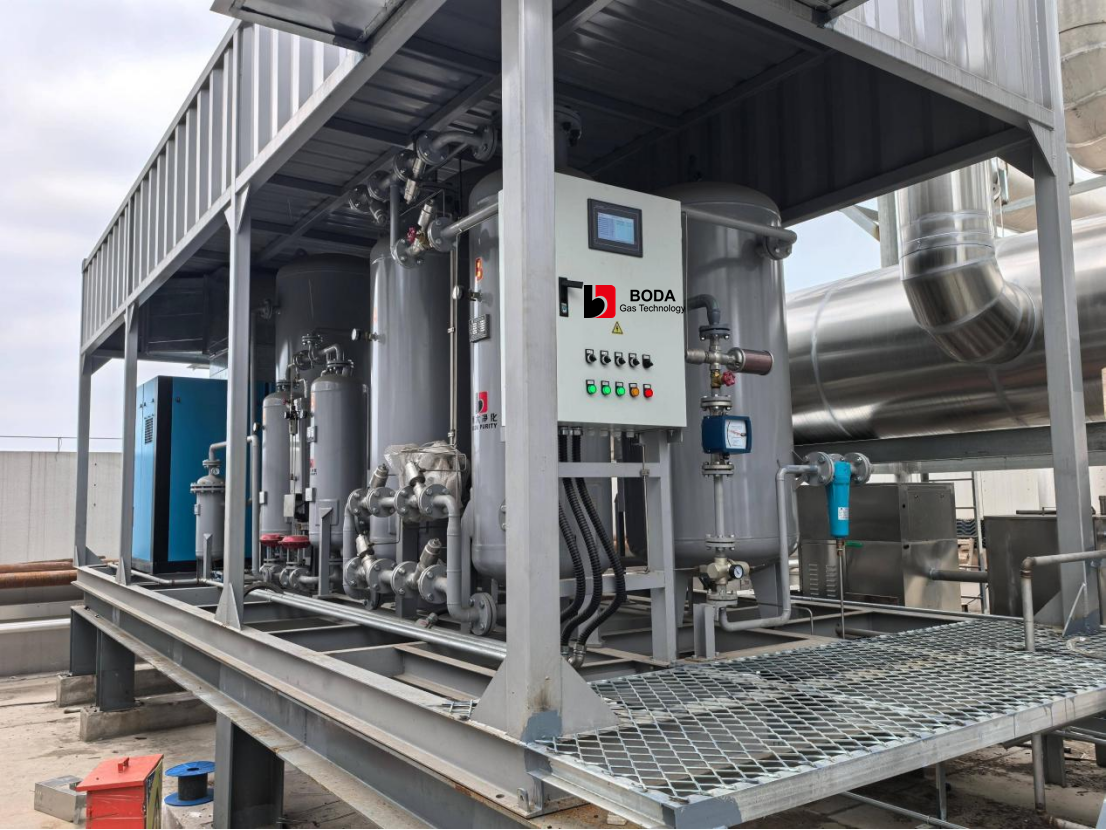
How should buyers interpret skid-mounted and container-integrated options?
The supplied configuration information names three alternatives: split-type skid assembly, integrated skid-mounted unit, and container-integrated package. It states that the layout can be flexibly arranged according to on-site space conditions. This supports a practical comparison around package arrangement and space fit, but it does not establish that one arrangement is universally smaller, faster to install, or better for every site.
A split-type assembly and an integrated unit can place equipment differently. A container-integrated package is another identified configuration. Before selection, buyers can ask for the proposed general arrangement, the equipment included in the skid or container, the external utility and connection requirements, and the work expected from the site team. These are clarification questions, not assumptions about a particular configuration’s technical performance.
The knowledge unit states that skid-mounted equipment needs minimal installation and describes setting the equipment down and connecting the power cable before startup. It also presents skid-mounted equipment as plug-and-play after power-on. That statement should be read within its supplied scope: buyers still need the supplier to confirm the actual package’s installation, utility, commissioning, and safety requirements. The same source warns against disassembling equipment or connecting cables and pneumatic-valve wiring while power is on.
For a buyer considering a movable containerized option, the image and corpus identify a mobile container nitrogen generator as a product category, while the skid configuration unit identifies a container-integrated package. The available facts do not establish a particular package’s transport dimensions, mobility method, weather rating, or site-readiness requirements. Those details should be verified for the selected design instead of being inferred from the word “containerized.”
What maintenance should be planned?
A low-maintenance PSA nitrogen generator should not be interpreted as a maintenance-free system. The supplied maintenance answer identifies service intervals for selected items, while also distinguishing routine compressor service from less frequent desiccant or CMS upkeep. The figures below are the intervals stated in the source material; the actual service plan should be confirmed against the equipment supplied and its operating conditions.
| Item | Maintenance information stated in the source | Procurement implication |
|---|---|---|
| Precision filter elements | Replacement every 8,000 operating hours. | Clarify the included filter stages, replacement parts, and service responsibilities. |
| Air compressor | Standard service includes oil, oil filter, and air/oil separator changes every 3,000 to 4,000 runtime hours. | Confirm whether compressor maintenance is within the supplier’s scope or the site’s existing maintenance plan. |
| Air-dryer desiccant | General interval stated as 16,000–24,000 hours. | Verify the dryer type and applicable maintenance instructions for the supplied unit. |
| Carbon molecular sieve | The source states a typical service life of 6–10 years. | Treat this as source-provided guidance, not a guaranteed replacement date for every operating condition. |
These intervals do not describe every maintenance task. The supplied facts do not state a universal inspection frequency for valves, sensors, electrical controls, or the full skid. A practical handover should therefore include the applicable operating and maintenance instructions, the consumables list, and a clear statement of which activities are routine operator checks versus specialist service.
Maintenance planning also connects to system scope. If an air compressor or dryer is supplied separately, its maintenance schedule may be managed under a different service arrangement. If tanks, filters, and controls are packaged together, the buyer should record model and component details for those items in the handover documentation. That makes future diagnosis and parts identification more straightforward without assuming a particular maintenance outcome.
What should acceptance terms cover?
The supplied purchasing information states a minimum order quantity of one unit, delivery terms of EXW, FOB, CIF, or CFR, pre-shipment testing as the acceptance criterion, and payment terms of 30% deposit by T/T in advance and 70% by T/T before dispatch. These are the terms recorded in the source; buyers should confirm the terms that apply to their specific quotation and contract.
“Pre-shipment test” is the stated acceptance criterion, but the available purchasing data does not specify a detailed test protocol, instrument list, duration, pass/fail thresholds, or the documents supplied after the test. Those details should be made explicit in the purchase documents rather than assumed from the phrase alone.
For a PSA nitrogen generator package, a useful acceptance discussion can organize the agreed requirements around the buyer’s specified nitrogen purity, flow, and outlet pressure. The supplied quality FAQ identifies stable compliance with purity, flow capacity, and outlet pressure as key ways to judge equipment quality. The buyer and supplier should therefore establish the required values and how they will be measured before the pre-shipment test. This article does not add numerical acceptance limits that are not present in the supplied project data.
Acceptance should also distinguish equipment verification from project-site performance. A pre-shipment test occurs before dispatch under the agreed test conditions; the source does not state that it replaces site installation checks or commissioning. If the project requires site commissioning, additional documents, witness testing, or other acceptance stages, those should be written into the contract separately. The exact requirements depend on the agreement and the applicable project scope.
Pre-dispatch clarification checklist
- List the included equipment and identify buyer-supplied utilities or components.
- Record the required nitrogen purity, flow capacity, and outlet pressure.
- Agree on the pre-shipment test method, measurement points, and acceptance records.
- Confirm the selected skid arrangement and site interfaces.
- Confirm delivery and payment terms in the applicable quotation or contract.
- Request the operating and maintenance information relevant to the supplied configuration.
Where can an on-site PSA nitrogen generator be used?
The supplied application information identifies chemical industry, oilfield and natural gas, food and beverage packaging, electronic component manufacturing, pharmaceutical production, and laboratory equipment or chemical analysis as nitrogen-use areas. It also associates nitrogen with product freshness preservation in food and beverage packaging. These application categories establish potential relevance; they do not define a universal purity or flow requirement for each industry.
For a project in the chemical industry or oil and gas, the buyer should define the process use and the required gas conditions rather than rely on an industry label alone. The same principle applies to food and beverage packaging and pharmaceutical production: the supplied information identifies these as use areas but does not provide a specific site design or regulatory acceptance specification for an individual application. Engineering requirements must be confirmed for the actual process and market.
The knowledge unit gives example purity bands and uses: 95%–98% for applications including fire protection, marine tank blanketing, oil-field pipeline purging, and general tire inflation; 99%–99.9% for food and beverage modified-atmosphere packaging, winemaking, and conventional plastic molding; 99.95%–99.99% for mild-steel laser cutting, electronics manufacturing, cable production, and pharmaceutical tank blanketing; and 99.999% and above for examples including special-metal cutting, high-end electronics, and specialized laboratory applications. These are source-provided examples, not a replacement for application-specific process specifications.
When evaluating a PSA nitrogen generator for chemical, food and beverage, pharmaceutical, or oil and gas use, the purchase discussion should connect the intended process to purity, flow, pressure, station scope, monitoring, and acceptance terms. This keeps the project decision grounded in the actual use case without assuming that every facility in a sector requires the same package.
How should a buyer compare the complete package rather than only the generator?
For a Decision-to-Execution purchase, the comparison should follow the system boundary. A generator-only comparison may omit the equipment needed to prepare compressed air, buffer product gas, monitor purity, and control switching. A package-level review makes those inclusions and exclusions visible and gives both parties a common basis for the pre-shipment test and handover.
- Set the process requirement. Document the intended application and the required purity, flow, and outlet pressure. The supplied quality guidance identifies these as central performance checks.
- Choose the separation technology against that requirement. The supplied PSA and membrane comparison gives different separation methods and purity ranges. The stated figures can inform screening, but they do not substitute for a project-specific offer.
- Define station scope. Check the compressor, tanks, filters, dryer, activated carbon filter, PSA generator, buffer tank, analyzer or purity sensor, and control system against the quoted equipment list.
- Confirm physical configuration. Identify whether the proposal is split-type skid, integrated skid-mounted, or container-integrated, and review the site arrangement and interfaces.
- Agree on maintenance and acceptance. Record the stated maintenance guidance, identify applicable manuals and parts, and define the details of the pre-shipment test and acceptance records.
This sequence also clarifies where a low-maintenance claim needs qualification. The source provides maintenance intervals and CMS service-life guidance, but it does not make the equipment maintenance-free or guarantee a specific lifecycle under all conditions. A buyer should evaluate maintenance as a planned operating responsibility and confirm what support, parts, and instructions are included in the agreed supply.
Frequently asked questions
What are the key differences between PSA and membrane nitrogen generators?
PSA systems use carbon molecular sieves to adsorb oxygen under pressure, while membrane systems use hollow-fiber bundles to separate gases by permeation speed. The supplied FAQ states PSA purity up to 99.999% and membrane purity from 95% to 99.5%; it describes membrane systems as compact and quiet.
What is included in a nitrogen generator system?
The supplied system description lists an air compressor, tanks, dryers, multiple filters, an activated carbon filter, a PSA nitrogen generator, and a nitrogen buffer tank. It also describes an oxygen analyzer or purity sensor and a control system. The included items must be confirmed against the specific package scope.
What is the maintenance and cost of an on-site gas system?
The supplied maintenance data states precision filter element replacement every 8,000 operating hours, compressor service every 3,000 to 4,000 runtime hours, general air-dryer desiccant replacement at 16,000–24,000 hours, and a CMS service-life range of 6–10 years. The source does not provide a total maintenance-cost figure, so cost should be assessed using the equipment scope, applicable service plan, and site conditions.
What is the purpose of the receiver tank?
The air receiver stores compressed air and stabilizes system pressure. The supplied FAQ also describes dry-air buffering as helping maintain air supply to the PSA towers during demand peaks, and nitrogen buffering as smoothing pressure and flow changes associated with tower switching.
What are the purchasing terms and acceptance criteria?
The supplied purchasing unit states MOQ of one unit, EXW/FOB/CIF/CFR delivery terms, pre-shipment testing as the acceptance criterion, and payment terms of 30% deposit by T/T in advance and 70% by T/T before dispatch. The detailed test protocol and contract-specific terms should be confirmed in the applicable purchase documents.
What are the equipment installation and startup procedures after purchase?
The supplied FAQ describes minimal installation for a skid-mounted unit, including setting it down and connecting the power cable before startup. It also cautions not to disassemble equipment or connect cables and pneumatic-valve wiring while the power is on. Buyers should follow the instructions for the actual package and confirm site interfaces before startup.
A practical conclusion for package buyers
A skid-mounted PSA nitrogen generation package should be evaluated as a defined station scope, not as an isolated generator nameplate. The buyer’s key decision points are PSA versus membrane fit, the equipment included in the station, the skid or container arrangement, the maintenance plan, and the details behind pre-shipment acceptance. The available facts support those checks but do not establish one universal configuration or test protocol for all projects.
For BODA GAS package discussions, the supplied information identifies split-type skid assembly, integrated skid-mounted units, and container-integrated packages as configuration options. The final purchase documents should state the selected arrangement, included equipment, operating requirements, applicable maintenance information, and agreed acceptance evidence. That creates a clearer transition from procurement decision to execution.
Reference document: BODA GAS product manual (PDF).
Have Questions or Need More Details?
Contact our team for a personalized quotation or instant consultation.
Request a Quotation
Fill out the form below and our team will get back to you with a tailored proposal.
WhatsApp Direct Chat
Prefer to chat in real-time? Message us on WhatsApp for instant assistance & quick answers.
- Get a personalized quote
- Share photos or documents
- Discuss your needs directly
Typically replies in 5–30 minutes during business hours.