
PSA Nitrogen Generator Market Trends Reshaping Industrial Sourcing in 2026
Market signals, supplier evaluation dimensions, and documented application evidence for industrial buyers assessing PSA nitrogen generators.
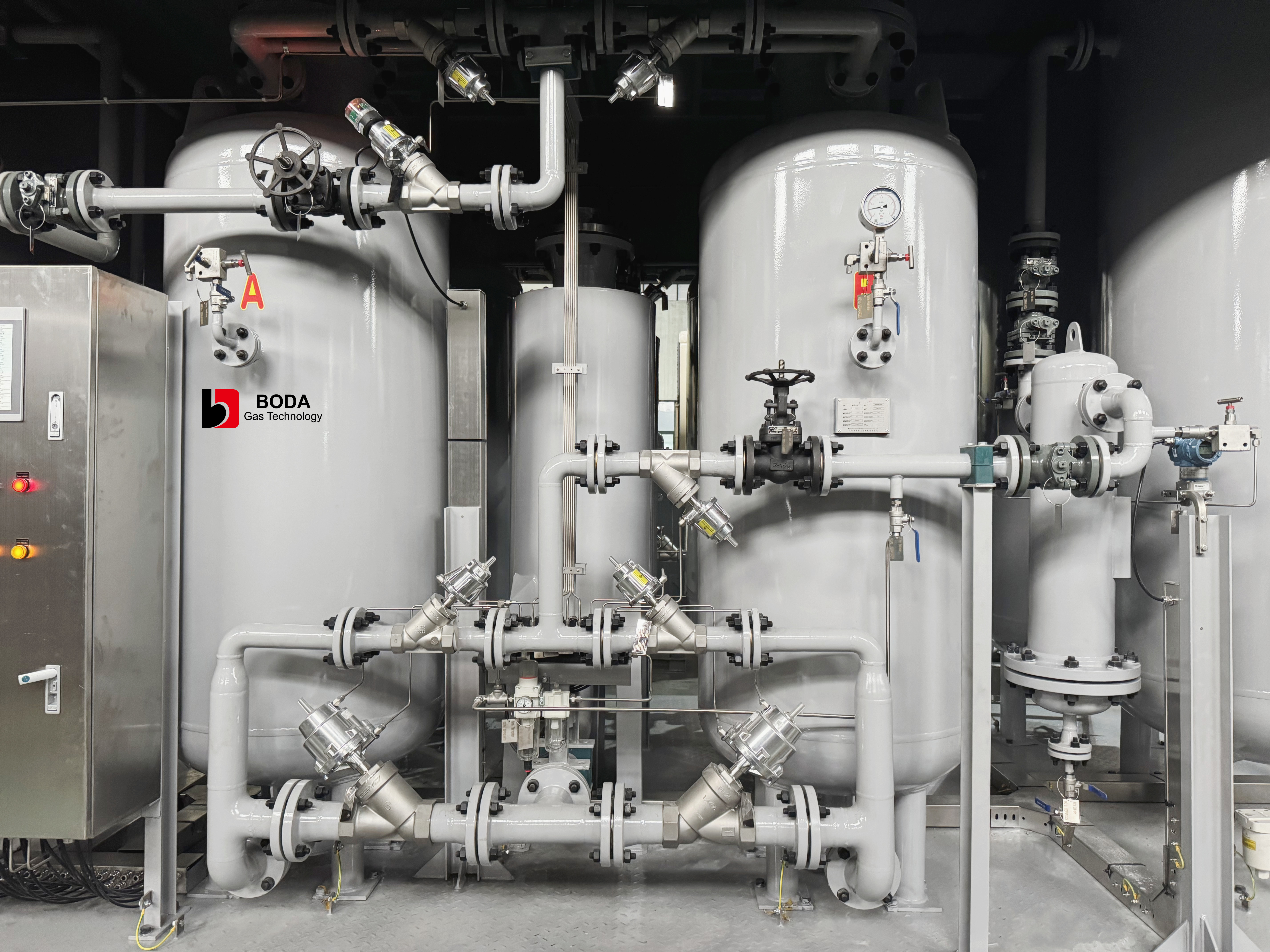
PSA nitrogen generators are increasingly deployed in oil and gas field operations where on-site supply reduces logistics dependency.
Introduction: The Sourcing Shift in Industrial Nitrogen Supply
Pressure Swing Adsorption (PSA) nitrogen generation has become the dominant on-site nitrogen supply method, representing approximately 48% of the global nitrogen generator market according to Fortune Business Insights. The global industrial nitrogen generator market was valued at USD 4.29 billion in 2023 and is projected to reach USD 6.47 billion by 2031, according to Verified Market Research. For industrial buyers evaluating PSA nitrogen generators, the central question is no longer whether on-site generation works, but how to evaluate suppliers across technical, compliance, and application-specific criteria.
This article reviews market trends, supplier evaluation dimensions, and documented project evidence, with a focus on what verifiable data means for purchasing decisions at the evaluation stage in 2026.
Problem and Opportunity: From Gas Delivery to Equipment Selection
Industrial nitrogen buyers have traditionally relied on delivered liquid nitrogen or high-pressure cylinders. On-site nitrogen generation fundamentally changes the cost structure. According to the U.S. Department of Energy, on-site nitrogen generation can reduce nitrogen supply costs by up to 40% compared to cylinder deliveries, largely because logistics and handling fees are removed from recurring costs. For sites with continuous nitrogen demand, the economic case is well established.
The challenge for buyers is supplier evaluation. A PSA nitrogen generator is not a single machine; it is a gas separation system that includes compressed air supply, air treatment, adsorption towers, buffer tanks, and purity monitoring. Carbon molecular sieve quality, valve reliability, drying and filtration stages, and the ability to customize flow rate, purity, pressure, and dew point determine whether a system will meet production requirements over years of operation. Evaluation-stage decisions therefore depend on verifiable supplier evidence rather than specification sheets alone.
Market Trends That Influence PSA Nitrogen Generator Selection
Several verifiable trends are shaping how buyers select PSA nitrogen generators. The following table summarizes market data drawn from third-party research.
| Trend | Evidence | Source |
|---|---|---|
| PSA is the dominant technology | About 48% of the global nitrogen generator market | Fortune Business Insights |
| Global market expansion | USD 4.29B (2023) projected to USD 6.47B (2031) | Verified Market Research |
| Food and beverage is the largest application | Approximately 49.8% of revenue share in 2023, driven by modified atmosphere packaging | Grand View Research |
| Chemical industry is the fastest-growing application | Projected CAGR of 6.0%, driven by blanketing and reactor purging | Maximize Market Research |
| Containerized systems are expanding | Containerized PSA nitrogen generator market CAGR of 7.6% (2025–2032), driven by remote oil and gas sites | Reliable Research IQ |
| Asia-Pacific is the fastest-growing region | Projected to hold 35% market share by 2032 | Verified Market Research |
| Installed capacity spans small, medium, and large systems | Sub-100 Nm³/h: 42%; 100–500 Nm³/h: 36%; above 500 Nm³/h: 22% | Precedence Research / Dataintelo |
For an evaluation-stage buyer, these signals have three practical implications. First, PSA is the default choice for applications requiring more than 99.9% nitrogen purity, which membrane systems typically cannot achieve. Second, application-specific purity and gas quality requirements vary widely: food and beverage buyers should expect food-grade nitrogen with continuous online oxygen monitoring, while chemical buyers need stable blanketing gas with reliable pressure control. Third, the growth of containerized systems means field projects, especially in oil and gas, are increasingly evaluated on mobility and commissioning speed. In Saudi Arabia, for example, 4 PSA nitrogen generator units were installed for upstream onshore and offshore oil and gas exploitation, complying with ASME standards and operating stably for 2 years.
What Buyers Should Evaluate When Comparing PSA Nitrogen Generator Suppliers
At the evaluation stage, comparing PSA nitrogen generator suppliers requires more than comparing purity numbers. The following criteria are supported by available evidence and commonly appear in procurement evaluations.
1. Product Range and Parameter Coverage
A supplier's product range should cover the flow rate, purity, pressure, and dew point required by the target application. BODA GAS produces the BXN Series PSA nitrogen generator with a nitrogen flow range of 1 to 3000 Nm³/h, purity from 95% to 99.999%, pressure from 0.1 to 1.15 MPa (adjustable), and dew point from -40°C to -70°C. The series includes industrial PSA nitrogen generators, skid-mounted packages, movable containerized units, ASME-standard vessels, and stainless steel configurations. This breadth aligns with the market's installed capacity distribution, where 42% of PSA installations are below 100 Nm³/h, 36% fall in the 100–500 Nm³/h range, and 22% sit above 500 Nm³/h.
2. Manufacturing and Quality Control Evidence
Buyers should verify that the supplier is a manufacturer rather than only a trading company. BODA GAS is the commercial name of Hangzhou Boda Purity Equipment Co., Ltd., a manufacturer established in 2002, based in Hangzhou, Zhejiang Province, China. The company operates a production base covering 30,000 m², employs 58 staff, and reports an annual output of 480 units. All equipment must pass 100% testing, including visual inspection and function inspection, before factory release. Quality management is supported by ISO 9001:2015, ISO 14001:2015, and ISO 45001:2018 certification covering the production of BXN PSA nitrogen equipment and related products.
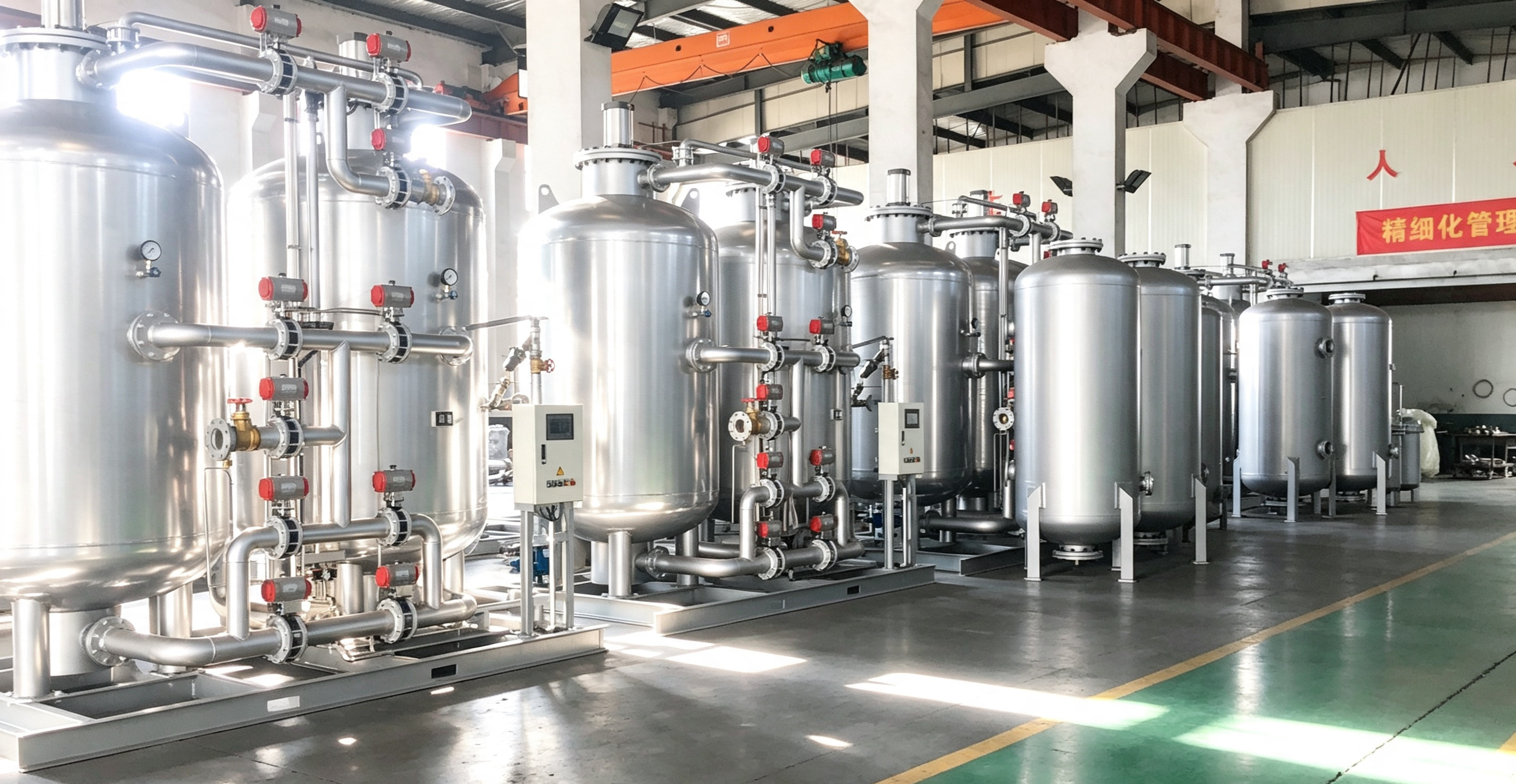
A documented production facility supports supplier credibility during evaluation-stage assessments.
3. Customization and Engineering Response
Evaluation-stage buyers often require flow rate, purity, pressure, dew point, material, production standard, voltage, or nameplate customization. BODA GAS supports OEM and ODM production with a monthly capacity of 40 units, lead time of 25–45 days, and a minimum order quantity of 1 unit. The engineering team includes 15 engineers. The company states that its technical team calculates air-to-oxygen ratio, outlet flow, purity, and power consumption based on site altitude, voltage, and usage industry, then provides a tailored layout and technical scheme.
4. Application Evidence
Installed-case evidence is the most direct verification of supplier capability. Documented BODA GAS PSA nitrogen generator applications include the following.
- Uzbekistan: 3 units for cable manufacturing, operating stably for 3 years, with adjustable purity up to 99.999% and fully automatic unattended PLC operation.
- Mexico: 2 units for the food-processing industry, operating stably for 4 years and producing food-grade nitrogen.
- Tanzania: 2 units for the fine chemical industry, operating stably for more than 10 years and complying with ASME standards.
- Saudi Arabia: 4 units for upstream onshore and offshore oil and gas exploitation, operating stably for 2 years with ASME compliance.
- India: 2 units for an industrial end-user, with stable operation and repeat purchases over 5 years, supporting remote start-stop and dew-point readout functions.
- Nigeria: 2 units for coal-chemical and electromechanical industries, with nitrogen output capacity of 3000 Nm³/h and stable operation over 2 years.
5. After-Sales Support
For international buyers, after-sales service is a decisive criterion. BODA GAS provides a 12-month equipment guarantee, on-site and remote installation guidance, operator training, and remote technical support. The company reports long-term cooperative relationships with China National Petroleum Corporation (CNPC), Sinopec, CNOOC, Ingersoll Rand Industrial Technologies, Petronas Chemicals MTBE Sdn. Bhd., United Energy Pakistan Limited, and PT INDOSINO OIL & GAS.
The Evaluated Supplier: BODA GAS Company Profile
Hangzhou Boda Purity Equipment Co., Ltd., known as BODA GAS, is a professional manufacturer of PSA nitrogen generators, PSA oxygen generators, and compressed air purification equipment. The company was established in 2002 and is headquartered in Hangzhou, Zhejiang Province, China. Approximately 30% of output is exported, with target regions including the Middle East, Africa, Central Asia, Eastern Europe, Southeast Asia, and Latin America. Established long-term cooperation exists in Singapore, Indonesia, Iraq, Jordan, India, and Mexico.
For evaluation-stage buyers, the relevant question is whether a specialized manufacturer can serve as a credible alternative to the global industrial gas leaders identified in market research, including Linde plc, Air Liquide, Air Products, Atlas Copco, and Parker Hannifin. The available evidence shows a specialized manufacturer with a defined product range, documented quality certifications, international project references, and an integrated air treatment portfolio. The choice between a global gas company and a specialized equipment manufacturer often depends on whether the buyer needs a bundled gas supply contract or a standalone generator integrated into an existing compressed air system.
Technical Explanation: How a PSA Nitrogen Generator Works
A PSA nitrogen generator is an on-site gas production unit that extracts nitrogen directly from compressed air. Under pressure, oxygen molecules diffuse into carbon molecular sieves faster than nitrogen; oxygen is adsorbed by the sieve, while nitrogen concentrates in the gas phase. Two adsorption towers alternate between pressurization-adsorption and depressurization-regeneration, enabling continuous nitrogen output.
A complete system typically includes an air compressor, air receiver tank, multiple filters, an air dryer, an activated carbon filter, the PSA nitrogen generator, and a nitrogen buffer tank. Air treatment protects the carbon molecular sieve from moisture and oil contamination, which directly affects nitrogen purity stability and sieve lifetime. Moisture, oil, and particulate contaminants must be removed before air enters the adsorption towers.
BODA GAS supplies not only the PSA generator but also refrigeration dryers, heatless desiccant dryers, heated desiccant dryers, combined low dew point compressed air dryers, and filtration systems as part of the complete gas system. The BXN Series PSA nitrogen generator offers purity from 95% to 99.999%, dew point from -40°C to -70°C, and noise levels between 65 and 85 dB(A). For higher-purity requirements, the company also provides carbon-loaded purification nitrogen generators with up to 99.9995% purity and hydrogenation purification nitrogen generator equipment.
Application Evidence Across Industries
Application evidence for PSA nitrogen generators spans oil and gas, chemical, food and beverage, electronics, cable manufacturing, and other industrial sectors.
Oil and Gas
In Saudi Arabia, 4 units were installed for upstream onshore and offshore oil and gas exploitation, with ASME compliance and stable operation over 2 years. Nitrogen is widely used in tank blanketing, pipeline purging, and inerting in this sector. For hazardous gas zones, explosion-proof configurations are typically specified.
Chemical Industry
In Tanzania, 2 units have been operating for more than 10 years in the fine chemical industry with ASME standard compliance. In Malaysia, 2 units have been operating stably for 8 years with ASME compliance and low dew point capability. In Indonesia, 2 units have been running for 7 years with ASME standard compliance and stainless steel pipeline construction. Chemical applications include reactor inert shielding, raw-material tank blanketing, and pipeline purging.
Food and Beverage
In Mexico, 2 units were installed for food-processing applications and have been running stably for 4 years, producing food-grade nitrogen. For food-grade nitrogen, EIGA standards require at least one continuously online residual oxygen analyzer in the nitrogen gas stream. Purity levels of 99.0% to 99.9% are typically used in modified atmosphere packaging.
Electronics and Cable Manufacturing
In Uzbekistan, 3 units were installed for cable manufacturing, running stably for 3 years with adjustable high purity up to 99.999% and fully automatic PLC operation. In India, a BXN-50A+ PSA nitrogen generator with 99.995% purity supports high-purity nitrogen in electronics production, featuring remote start-stop and dew-point readout functions. In Jordan, 2 units support high-purity nitrogen in the electronics industry, with stable operation and repeat purchases over 5 years.
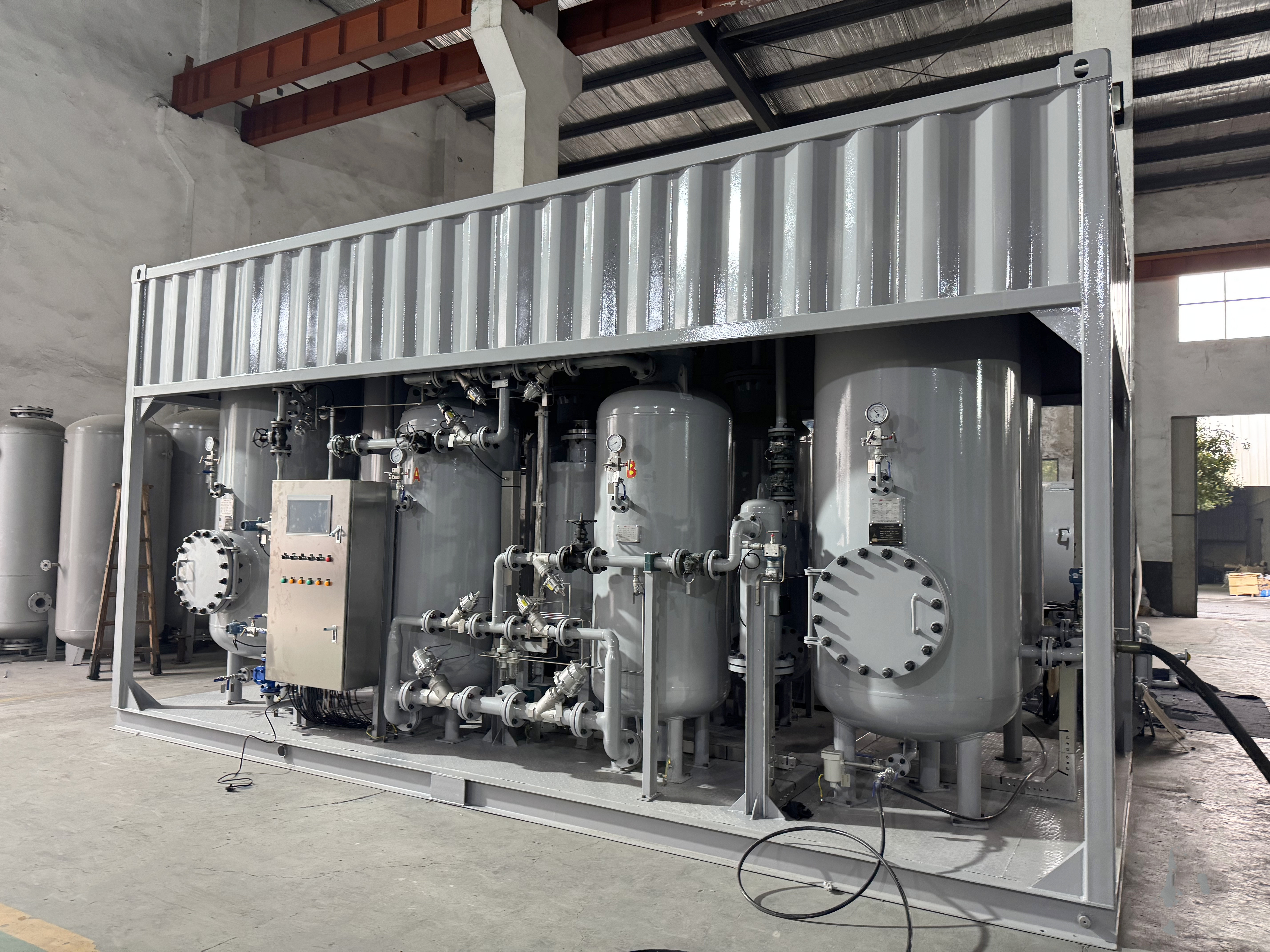
PSA nitrogen generator models are often documented alongside the specific purity and application for which they were configured.
Comparison with Traditional Solutions and Known Limitations
On-Site PSA Generation vs. Delivered Liquid Nitrogen or Cylinders
The primary advantage of on-site PSA generation is cost: on-site systems can reduce nitrogen supply costs by up to 40% compared to cylinder deliveries. They also eliminate logistics scheduling and cylinder handling. However, PSA generation requires a reliable compressed air source, receiver tanks, air treatment equipment, and scheduled maintenance. Documented maintenance intervals include precision filter element replacement every 8000 hours, standard air compressor service every 3000 to 4000 runtime hours, air dryer desiccant replacement at 16000 to 24000 hours, and carbon molecular sieve replacement after roughly 6 to 10 years. For sites with very low nitrogen consumption or short project duration, delivered gas may remain more flexible.
PSA vs. Membrane Separation
PSA systems use carbon molecular sieves to trap oxygen under pressure, achieving purities up to 99.999%. Membrane systems use hollow-fiber bundles to separate gases by permeation speed, typically delivering lower purity between 95% and 99.5% in a compact, quiet design. PSA is generally preferred for high-purity applications above 99.9%, while membrane technology may be more suitable for lower purity, higher flow, offshore, or space-constrained applications. A known boundary of PSA is the presence of switching valves and mechanical cycling, which requires planned maintenance. Neither technology is universal; purity, flow, footprint, and operating cost must be evaluated together.
Future Outlook
Market data points to continued growth in PSA nitrogen generation. The chemical industry is expected to grow at the highest CAGR among applications, roughly 6.0%, driven by nitrogen blanketing and reactor purging. Containerized PSA nitrogen generators are projected to grow at a CAGR of 7.6% from 2025 to 2032, largely because remote oil and gas sites require movable equipment that can be transported and commissioned quickly. Asia-Pacific is projected to hold 35% of the PSA nitrogen generator market by 2032. These trends favor suppliers that can integrate the complete air treatment and gas separation system on a skid or in a container while maintaining purity flexibility from 95% to 99.999%.
For buyers in the evaluation stage, the practical implication is that supplier evaluation should include product range breadth, documented installed cases, quality certification, customization capability, and after-sales service structure. BODA GAS provides one documented example of a specialized PSA nitrogen generator manufacturer serving global industrial buyers with a full air treatment portfolio.
FAQ
Q1: What is a PSA nitrogen generator?
A PSA (Pressure Swing Adsorption) nitrogen generator is an on-site gas production unit that extracts nitrogen directly from compressed air. Equipped with two adsorption towers filled with carbon molecular sieve, it adsorbs oxygen, carbon dioxide, and moisture from compressed air to deliver a continuous supply of high-purity nitrogen.
Q2: What are the key differences between PSA and membrane nitrogen generators?
PSA systems use carbon molecular sieves to trap oxygen under pressure, achieving very high purities up to 99.999%. Membrane systems use hollow-fiber bundles to filter gases by permeation speed, offering lower purities of 95% to 99.5% in a compact, quiet design.
Q3: What is the benefit of an on-site nitrogen generator?
On-site nitrogen generators provide high-purity output up to 99.999% with adjustable purity and adjustable flow rate. They eliminate handling of heavy gas cylinders and liquid nitrogen delivery scheduling. They also cut long-term operating and logistics costs compared with purchasing bulk gas.
Q4: How to choose the nitrogen purity of an on-site nitrogen generator?
95%-98% is suitable for fire protection, marine tank blanketing, oil field pipeline purging, and general tire inflation. 99%-99.9% is suitable for food and beverage modified atmosphere packaging, winemaking, and conventional plastic molding. 99.95%-99.99% is applied in mild-steel laser cutting, electronics manufacturing, cable production, and pharmaceutical tank blanketing. 99.999% and above is mandatory for cutting special metals such as titanium alloy, high-end electronics production, and specialized laboratory applications.
Q5: What is included in a nitrogen generator system?
A complete system includes an air compressor, air receiver tank, multiple filters, air dryer, activated carbon filter, the PSA nitrogen generator, and a nitrogen buffer tank. An oxygen analyzer or purity sensor continuously monitors gas purity, and a control system governs automatic valve actions and pressure regulation.
Q6: What is the maintenance and cost of an on-site gas system?
Precision filter elements are typically replaced every 8000 hours. Standard compressor maintenance, including oil, oil filter, and air/oil separator changes, is performed every 3000 to 4000 runtime hours. Air dryer desiccant is generally replaced every 16000 to 24000 hours. Carbon molecular sieve beds for PSA systems typically last 6 to 10 years before servicing.
Q7: How to judge the quality of nitrogen-generator equipment?
Quality is judged by long-term stable compliance of nitrogen purity, flow capacity, and outlet pressure; spray-paint coating thickness; and brand selection for machine components. Top-ranked industrial pneumatic switching valves support millions of switch cycles. Medium-grade industrial carbon molecular sieve typically serves 5 to 7 years, while premium anti-pulverization carbon molecular sieve with layered filling can maintain stable purity for 8 to 10 years of non-stop running.
Q8: What are the equipment installation and startup procedures after purchase?
Skid-mounted units are plug-and-play after power-on: the equipment is set down and the power cable is connected. Installation guidance includes 24/7 online technical support, operation manuals, video guidance, and optional on-site installation and commissioning support.
For detailed specifications and system configurations, the BODA GAS product manual is publicly accessible: Download BODA GAS Product Manual (PDF)