
PSA Nitrogen Generator Shortlist: BCP Carbon-Loaded, BMN Membrane, and Dryer-Integrated Options
PSA Nitrogen Generator Shortlist: BCP Carbon-Loaded, BMN Membrane, and Dryer-Integrated Options
Choosing an industrial nitrogen generator is not simply a choice between equipment labels. A project team must match nitrogen purity and flow to the process, then account for feed-air treatment, installation arrangement, and operating conditions. This shortlist examines three distinct configurations associated with BODA GAS: the BCP Series carbon-loaded purification nitrogen generator, the BMN Series membrane separation nitrogen generator, and a PSA nitrogen system configured with compressed-air drying.
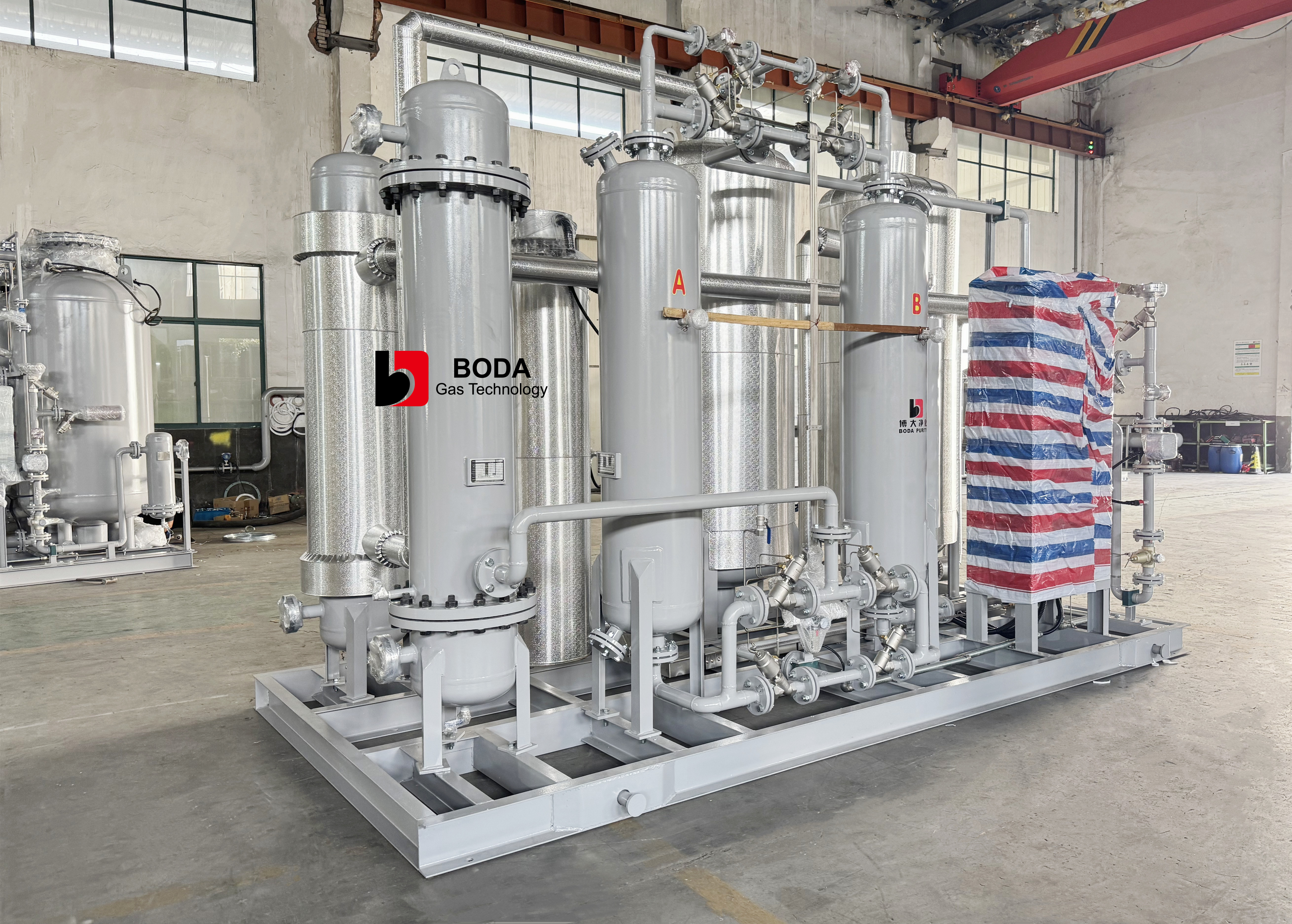
Hangzhou Boda Purity Equipment Co., Ltd., which uses the BODA GAS brand, manufactures PSA nitrogen generators, membrane separation nitrogen generators, and compressed-air purification equipment. Its product information distinguishes the general-purpose BXN Series PSA nitrogen generator, the BCP Series carbon-loaded purification nitrogen generator, and the BMN Series membrane separation nitrogen generator. These are not interchangeable descriptions: the BCP and BXN products use pressure swing adsorption, while BMN uses membrane separation.
This article is an application-led reference for buyers in the research and evaluation stages. It does not rank unrelated suppliers or claim that one configuration is universally preferable. Instead, it explains which project conditions point toward each option and where the available product information sets limits on what can be concluded.
Start the shortlist with the gas duty, not the equipment name
A practical first screen for a PSA nitrogen generator is the required nitrogen purity, continuous or peak flow, delivery pressure, dew point, and the nature of the end use. These requirements determine whether a standard BXN Series PSA unit, a BCP Series purification configuration, or another gas-generation technology merits detailed engineering review. They also establish whether the compressed-air preparation train needs a dryer or additional filtration.
The BXN Series product data lists a nitrogen flow range of 1–3000 Nm³/h, purity of 95%–99.999%, adjustable pressure of 0.1–1.15 MPa, and a nitrogen dew point range of -40℃ to -70℃. These are the listed series ranges, not a promise that every purity, flow, pressure, and dew-point combination is available in one model. A project specification should identify the required values together rather than treating each range as independently achievable at every operating point.
The BCP Series has a different stated duty. Its product data lists output from 1–500 Nm³/h, nitrogen purity of at least 99.9995%, dew point at or below -60℃, oxygen content at or below 5 ppm, and carbon dioxide content at or below 1 ppm. Those figures make BCP relevant to applications where the specified residual-gas limits and purity requirement are central selection criteria. They should not be assumed for the standard BXN Series.
BMN is a membrane separation option, not a PSA nitrogen generator. Its listed range is 5–3000 Nm³/h, with nitrogen purity of 95%–99.9%, adjustable pressure of 0.1–1.2 MPa, and dew point of -40℃ or -60℃. It belongs on a broader nitrogen-generator shortlist when a project can work within those stated purity boundaries and values the membrane configuration’s listed design characteristics.
Shortlist option 1: BCP carbon-loaded purification
The BCP Series is described as a carbon-loaded purification nitrogen generator. Its listed product range reaches a higher stated purity than the standard BXN Series range, and its product data also specifies oxygen and carbon dioxide limits. The product information states that the system does not contain H2 and describes it as suitable for applications with strict requirements for hydrogen and oxygen. That description is relevant to process screening, but the purchaser should still specify all required gas constituents and acceptance criteria in the project documents.
BCP is identified for lithium-ion battery electrode drying, electrolyte blanketing, and cell-sealing shielding gas; PV-cell sintering, silicon-wafer processing, and thin-film deposition; and semiconductor wafer purging, SMT soldering, and electronic-component anti-oxidation. These are the documented application areas for the product. They provide a more useful fit test than a generic label such as “high-purity generator”: the process team can compare its actual gas specification and duty with the product’s stated parameters and application scope.
The BCP information describes a double-tower deaerator that can allow the carbon-loaded catalyst to be added or replaced without stopping the machine. It also lists an automatic venting device, fault diagnosis and alarm functions, automatic fault-processing functions, and an optional DCS communication interface. These details can inform questions about service access, control integration, and off-specification gas handling. They do not, by themselves, establish a guaranteed uptime, maintenance interval, or control-system compatibility for a particular site.
For evaluation, request the configuration-specific performance basis: feed-air conditions, required flow and pressure, the operating point associated with the stated purity, monitoring and venting logic, and the scope of any requested DCS interface. The available BCP data lists customization options for stainless steel, ATEX, ASME, and CE, but it does not establish which combination applies to a particular project or jurisdiction. Those requirements need to be confirmed in the technical offer and project documentation.
Shortlist option 2: BMN membrane separation
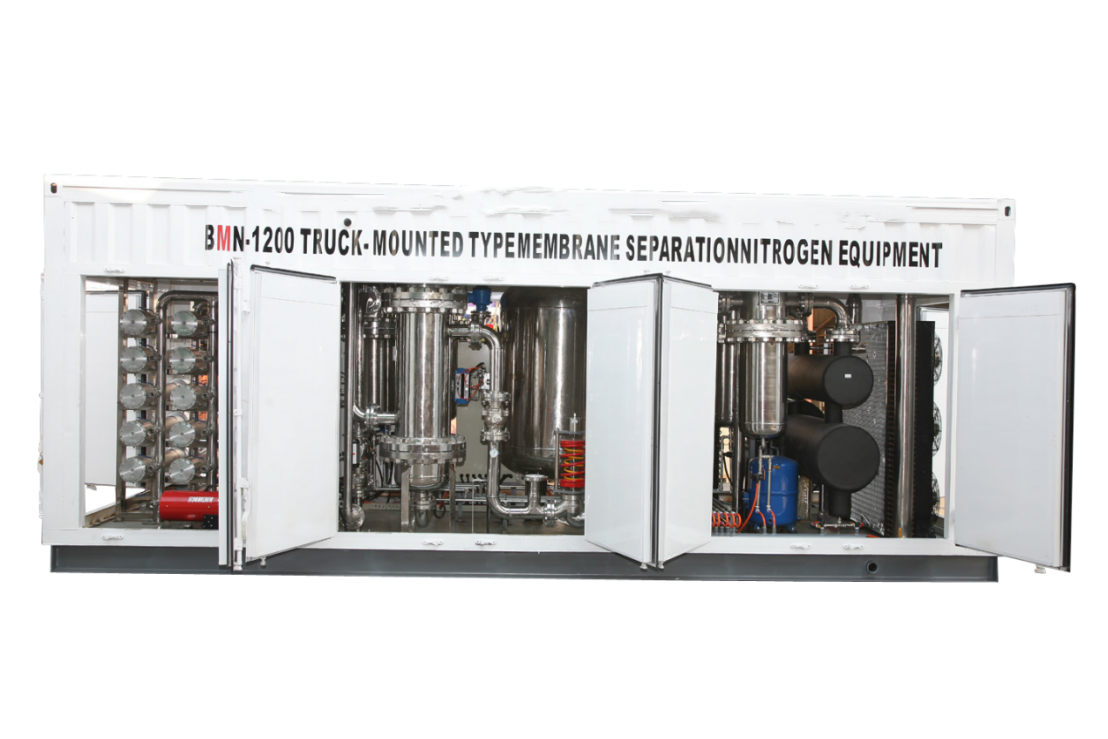
The BMN Series separates gases using membrane permeation. According to the product description, water vapor, oxygen, and other gases with higher permeation rates pass through the membrane first, while nitrogen with a relatively lower permeation rate is retained and concentrated into a dry nitrogen-rich stream. This operating principle differs from PSA, where carbon molecular sieve adsorbs oxygen under pressure and the adsorption beds alternate through adsorption and regeneration cycles.
The BMN data lists a purity range of 95%–99.9%. The product information also describes membrane nitrogen plants as having a simple structure, no moving parts in the separation process, low maintenance requirements, a compact footprint, quiet operation, and suitability for areas with high vibration. These are manufacturer-provided product characteristics; actual maintenance scope, noise, dimensions, and performance should be verified for the offered model and site conditions.
BMN appears in the product application data for offshore platforms, oil-field drilling, cargo-ship tank inerting, pipeline purging, coal-mine fire-extinguishing and underground-space inert protection, food packaging, chemical reactor blanketing, metal heat treatment, electronics, lithium-battery workshops, pharmaceutical raw-material blanketing, and laser cutting. The breadth of those listed applications does not mean every BMN configuration is appropriate for every use. The stated purity ceiling is an important boundary: where the required specification is above 99.9%, BMN’s published range does not cover the requirement.
This makes BMN a useful comparison point for projects where a purity within its listed range is acceptable. It is not a substitute for a higher-purity specification simply because the application name appears in a product list. Buyers should also compare the BMN flow, pressure, dew point, ambient conditions, and required gas quality at the actual operating point.
Shortlist option 3: PSA with dryer-integrated air preparation
In this shortlist, “dryer-integrated” means a PSA nitrogen generation system selected and engineered with compressed-air drying equipment in its air-treatment train. It should not be read as a claim that the nitrogen generator and dryer are necessarily one combined product or one factory-integrated package. The documented nitrogen system includes compressed-air supply, tanks, dryers, multiple filters, a PSA nitrogen generator, and a nitrogen buffer tank. The exact equipment list depends on the system configuration.
Drying matters because PSA nitrogen generation starts with compressed air, and the system knowledge material describes clean, dry air entering the adsorption towers. The FAQ material identifies high-purity requirements, end-use dew-point requirements, and high ambient temperature at the customer site as reasons a dryer may be needed. Dryer selection should therefore follow the required air quality and operating conditions, rather than being treated as an automatic accessory with identical specifications for every project.
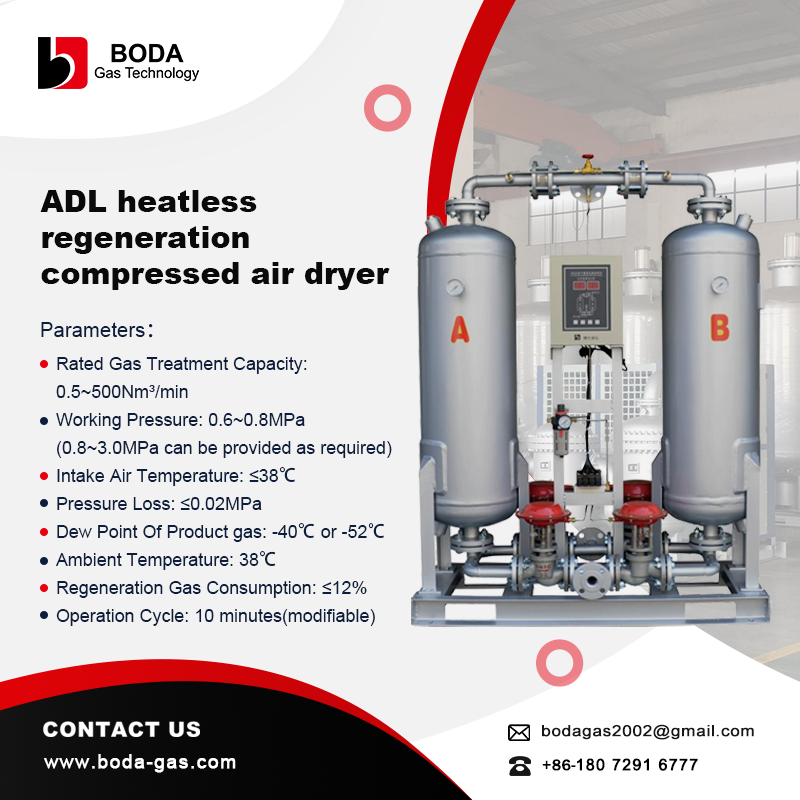
BODA GAS lists the ADL Series heatless compressed-air desiccant dryer for PSA nitrogen-generator pretreatment. Its stated flow range is 0.5–500 Nm³/min, working pressure is 0.6–0.8 MPa with 0.8–3.0 MPa optional, and qualified air dew point is at or below -40℃ or -52℃. The data also lists inlet temperature below 38℃, regeneration-air loss at or below 12%, and pressure loss at or below 0.02 MPa. These are ADL Series dryer specifications; they are not the nitrogen product’s flow or dew-point specifications.
The FAD Series refrigeration dryer is another listed compressed-air pretreatment option for PSA nitrogen and oxygen generators. Its air-cooled and water-cooled versions list a qualified air dew point at or below -23℃ under ambient pressure, with rated air treatment flow of 1–200 Nm³/min. The high-temperature version lists an inlet temperature below 80℃. These dryer values describe compressed-air treatment, not nitrogen purity. A project that needs a lower feed-air dew point should assess whether a desiccant dryer or another specified arrangement is required.
When reviewing a dryer-integrated system, check the relationship between compressor delivery, dryer capacity, filtration, pressure loss, air receiver volume, and the nitrogen generator’s required inlet conditions. The system FAQ describes wet-air, dry-air, and nitrogen buffer tanks as parts that can be used in a nitrogen system: the air tanks support pressure stability and reserve volume, while the nitrogen buffer tank helps manage flow and pressure fluctuations. The final tank arrangement and sizing need to be confirmed for the project rather than inferred from a general component list.
How the three options differ
| Shortlist option | Documented process or range | Best screening question | Important boundary |
|---|---|---|---|
| BCP Series carbon-loaded purification | 1–500 Nm³/h; purity ≥99.9995%; dew point ≤-60℃; oxygen ≤5 ppm; carbon dioxide ≤1 ppm | Does the process require the stated high-purity and residual-gas limits? | Confirm performance at the required operating point, including gas composition and feed-air conditions. |
| BMN Series membrane separation | 5–3000 Nm³/h; purity 95%–99.9%; pressure 0.1–1.2 MPa adjustable; dew point -40℃ or -60℃ | Can the process operate within the membrane product’s stated purity range? | The published range does not cover requirements above 99.9%. |
| BXN Series PSA with selected air dryer | BXN: 1–3000 Nm³/h and 95%–99.999% purity. ADL and FAD dryer options have their own separate air-treatment ranges. | What feed-air dew point and filtration conditions does the nitrogen process require? | A dryer’s dew-point rating is not the nitrogen generator’s purity or product dew point. |
The comparison is not a simple “PSA versus membrane” verdict. BCP and BXN are PSA-based options with different stated product scopes, while BMN uses a different separation method and has a lower listed purity ceiling. Dryer selection is a separate but connected system decision. These distinctions are useful because they prevent buyers from comparing a nitrogen-generation figure with an air-dryer figure or assuming that every PSA package has the same purification stage.
Application fit: use the process requirement to narrow the list
Chemical industry
The chemical-industry application unit lists nitrogen purity requirements of 99.0%–99.99% for reactor inerting, raw-material tank blanketing, pipeline purging, and conveying or handling duties. It also lists explosion-proof and ASME requirements as special requirements for the described application. The BXN Series includes the chemical industry in its stated scope, and BMN’s application list includes chemical reactor blanketing and pipeline purging. A BCP configuration should be considered only where its higher stated purity and residual-gas specification align with the process need; the product listing alone does not establish a specific chemical project design.
Food and beverage packaging
The food and beverage application unit lists nitrogen purity of 99.0%–99.9% for modified-atmosphere packaging and beverage production, with oil-free nitrogen and stainless-steel equipment identified as special requirements. BXN is listed for food and beverage packaging, and BMN is listed for modified-atmosphere food packaging. Buyers should distinguish the required gas purity from the required air and product-contact arrangements. The supplied information does not provide a universal food-grade certification claim for every generator configuration.
Pharmaceutical applications
The pharmaceutical application material lists a required nitrogen purity of 99.99%–99.999% and describes use in drug production, storage, sealing, and packaging. It identifies oil-free and stainless-steel requirements. That stated purity range is within the BXN Series published range, but it exceeds the BMN Series maximum of 99.9%. BCP’s listed purity is higher, but its documented application examples focus on battery, photovoltaic, and semiconductor processes. For a pharmaceutical project, buyers should confirm the exact gas-quality specification, materials, filtration, monitoring, and applicable regulatory or site requirements rather than selecting solely by maximum purity.
Oil and gas applications
The petroleum application unit lists purity of 95%–99.9% for tank blanketing, nitrogen purging, pipeline and vessel inerting, and related field uses. It identifies explosion-proof equipment for Zone 1 or Zone 2 hazardous-gas working areas as a special requirement. Both BXN and BMN include oil-and-gas-related applications in their product scope, but a procurement review must check the required purity, flow, pressure, mobility, and hazardous-area specifications for the exact site. The product data lists ATEX and other customization options for certain series; it does not confirm that a particular offered unit is certified or suitable for a specific zone without configuration documentation.
Electronics and battery production
The electronics application information lists common SMT workshop purity at 99.99% and higher requirements for chip and wafer precision manufacturing, including dew-point requirements. BCP is specifically listed for semiconductor wafer purging, SMT soldering, lithium-ion battery electrode drying, electrolyte blanketing, and cell-sealing shielding gas. BXN is also listed for electronics and lithium-battery applications. This makes the exact purity and residual-gas specification a key discriminator: buyers should compare the process requirement against the stated series data and request configuration-specific confirmation.
Project format and procurement checks
BXN product information includes both a Skid-Mounted PSA Nitrogen Generation Package and a Movable Containerized PSA Nitrogen Generator as product-format descriptions. The supplied application material also lists skid-mounted nitrogen equipment in a fine-chemical project context and containerized nitrogen equipment in oil-and-gas-related project material. Those examples support considering installation format as part of the shortlist, but they do not establish that every model is available in every format.
Before shortlisting a package, record the project’s required purity, normal and peak flow, outlet pressure, nitrogen dew point, feed-air conditions, installation footprint, ambient conditions, electrical requirements, and control-interface needs. Then decide whether the site needs stationary skid mounting, a movable or containerized arrangement, or a generator connected to existing compressed-air infrastructure. The available product data allows customization of flow, purity, pressure, dew point, material, production standard, voltage, logo, nameplate, and paint color through the company’s OEM and ODM capability unit. These are listed customization categories, not proof that every design combination is feasible without engineering review.
For a low-maintenance PSA nitrogen generator evaluation, avoid relying on a broad label alone. The system knowledge material identifies routine component and service considerations such as filters, the air compressor, dryer desiccant, and carbon molecular sieve. It does not establish one universal maintenance interval for all operating conditions. Ask for the offered equipment’s maintenance schedule, replacement parts, access requirements, and responsibilities for the compressor and air-treatment equipment. This is particularly important when the generator and dryer are purchased as separate components or supplied as a coordinated system.
Where traditional supply still sets a boundary
An on-site nitrogen generator produces gas at the facility from compressed air, while cylinder or liquid-nitrogen supply involves delivered gas and associated handling or scheduling. The supplied knowledge material describes on-site generation as avoiding the handling of heavy cylinders or the scheduling of liquid-nitrogen deliveries. That can be relevant to procurement planning, but it does not make on-site generation automatically preferable for every facility.
An on-site system requires a suitable compressed-air supply, air treatment, installation space, utilities, maintenance, and integration with the process. A site with intermittent or low demand may assess delivered supply differently from a facility that needs a continuous, defined flow. The correct comparison depends on the site’s consumption pattern, gas specification, operating costs, logistics, and responsibility for maintaining the equipment. The available information does not provide a project-specific cost comparison or payback calculation, so neither should be inferred here.
Market context and future project considerations
This shortlist does not rely on a market-growth claim or an external ranking. The product and application information points to a practical project pattern: nitrogen requirements vary widely across chemical processing, packaging, pharmaceuticals, oil and gas, electronics, and battery production. As a result, procurement decisions are best organized around process specifications and system boundaries rather than a single generic generator category.
For future projects, teams can make supplier evaluation more precise by separating nitrogen-generation performance from compressed-air treatment, package format, and control integration. Specify measurable acceptance points for the required gas quality and operating duty, identify the filtration and drying scope, and document any material or hazardous-area conditions. This approach makes it easier to compare a standard BXN PSA system, a BCP carbon-loaded purification configuration, a BMN membrane system, and a PSA arrangement that includes selected dryer equipment without treating unlike specifications as equivalent.
FAQ
What is the main difference between a PSA and a membrane nitrogen generator?
A PSA system uses carbon molecular sieve to adsorb oxygen from compressed air during pressurized cycles and regenerates the sieve by depressurizing. A membrane system separates gases through different permeation rates across membrane fibers. The BMN Series lists 95%–99.9% nitrogen purity; the BXN Series lists 95%–99.999%.
Why might a nitrogen generator need a dryer?
A dryer may be needed when the process requires a defined water-content or dew-point performance, when high-purity nitrogen is required, or when site ambient conditions affect the compressed-air system. Dryer capacity and outlet dew point should be matched to the nitrogen system’s feed-air requirements.
What is included in a PSA nitrogen generator system?
The system information describes a typical arrangement that can include an air compressor, air receiver tanks, dryers, multiple filters, a PSA nitrogen generator, and a nitrogen buffer tank. The exact equipment scope depends on the project configuration.
Can the BMN membrane generator meet a requirement above 99.9% nitrogen purity?
The BMN Series data lists nitrogen purity from 95% to 99.9%. A requirement above 99.9% falls outside that published range, so BMN should not be assumed to satisfy it based on the available specifications.
Which option is relevant when a process specifies very high purity and low residual oxygen?
The BCP Series data lists purity of at least 99.9995%, oxygen content at or below 5 ppm, and carbon dioxide content at or below 1 ppm. Buyers should verify those values against the required operating conditions and confirm the offered configuration’s performance basis.
Conclusion
The most defensible shortlist separates three different decisions. BCP is the carbon-loaded PSA purification option with the highest stated purity and explicit oxygen and carbon-dioxide limits in the supplied data. BMN is a membrane alternative with a published purity range up to 99.9% and product characteristics that may suit projects within that range. A dryer-integrated PSA arrangement is a system-design choice: it pairs a PSA nitrogen generator with selected compressed-air drying and filtration equipment, whose specifications must be evaluated separately from nitrogen output.
For BODA GAS products, the next useful comparison is not an unsupported claim about which generator is “best.” It is a project-specific check of purity, flow, pressure, dew point, feed-air treatment, application conditions, and installation format against the published range for the relevant equipment. That keeps the shortlist tied to the process duty and makes differences between PSA purification, membrane separation, and air-treatment configuration clear to engineering and procurement teams.
Have Questions or Need More Details?
Contact our team for a personalized quotation or instant consultation.
Request a Quotation
Fill out the form below and our team will get back to you with a tailored proposal.
WhatsApp Direct Chat
Prefer to chat in real-time? Message us on WhatsApp for instant assistance & quick answers.
- Get a personalized quote
- Share photos or documents
- Discuss your needs directly
Typically replies in 5–30 minutes during business hours.