
PTFE-Coated Steel Belts: An Independent Buyer's Comparison for Non-Stick Process Lines
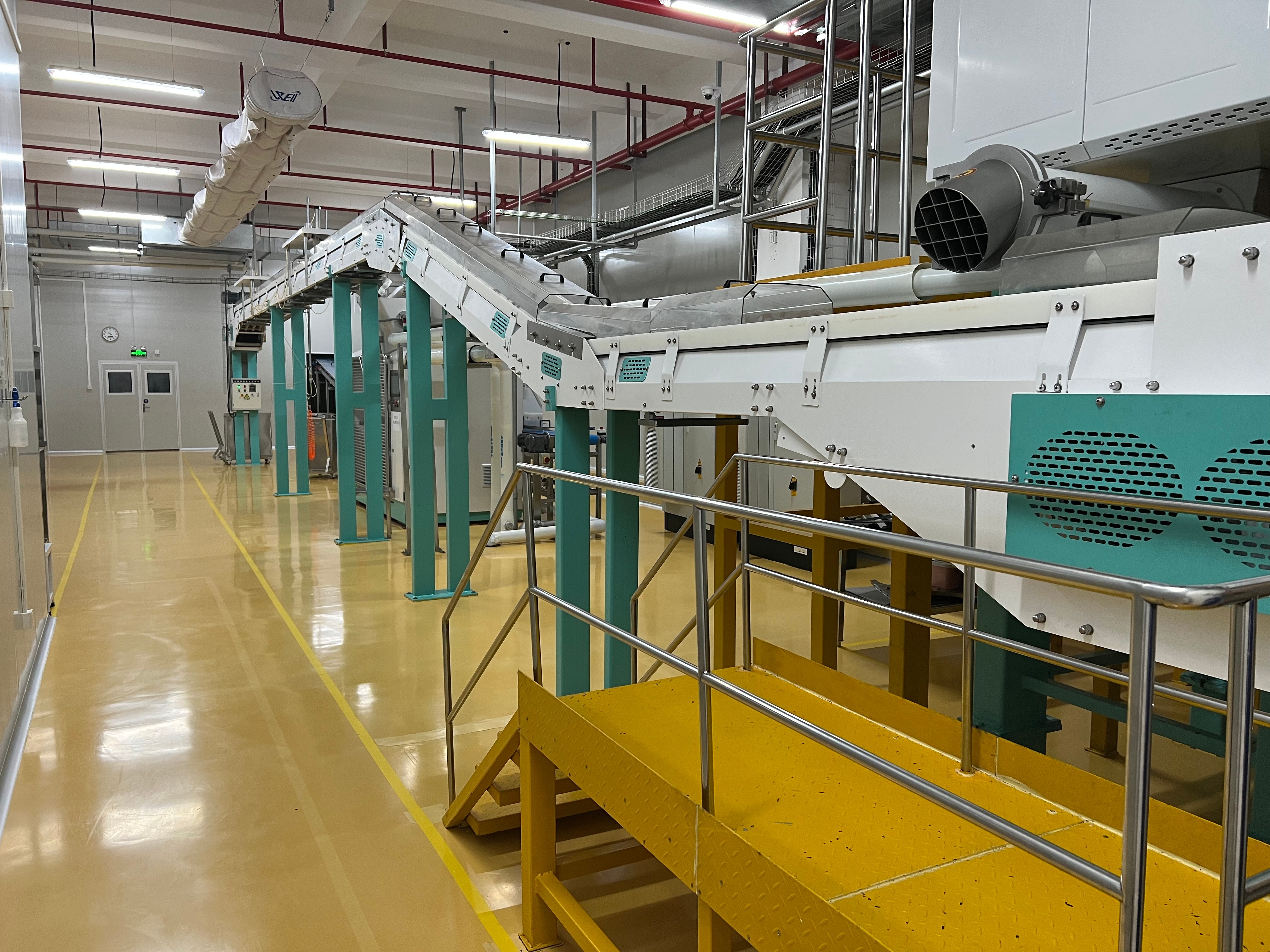
Lines that handle sticky, viscous or low-melting materials rarely stop because the belt cannot move the product. They lose output because the product will not let go. Residue that clings to a steel surface changes product pickup, extends wash-down windows and shortens the intervals at which a line can run unattended. For buyers finalising a specification, the practical question is narrower than steel or polymer: it is which steel-belt surface, coated or uncoated, fits a given process window.
This comparison sets the PTFE-coated steel belt against carbon steel belts, stainless steel belts and special-requirement alloy belts, using documented product and process facts only. The coated option is not treated as automatically superior. The sections on temperature ceilings, coating wear and dimensional tolerance describe the cases in which an uncoated or imported belt remains the defensible answer.
What a PTFE-coated steel belt is
A PTFE-coated steel belt is a steel substrate carrying a polytetrafluoroethylene surface layer. The documented purpose of that layer is release: the coating's surface friction coefficient is extremely low, and it does not adhere to viscous materials such as chocolate, syrup, paste, colloid and powder. The category is further defined by food-grade safety and hygiene, resistance to high and low temperatures, resistance to corrosion, acids, alkalis and oils, a smooth and easy-to-clean surface, high substrate strength for stable running, wear resistance with strong coating adhesion, and the option of non-standard customisation.
The division of labour matters at the specification stage. The steel substrate carries tensile load, dimensional stability and heat transfer; the coating supplies release. That is a different engineering model from a fabric or rubber belt, where one polymer must deliver both strength and surface behaviour, and it is the reason a coated steel belt can be considered on lines where belt strength and thermal performance are also decision criteria.
BPS/EPS (Shanghai Biquick Process Systems Ltd.) is a Shanghai-based steel belt manufacturer and process-equipment builder founded in 2007. The company produces steel belts together with steel-belt-based equipment such as granulators, chocolate steel belt conveyors, steel belt bakery tunnel ovens, steam ovens and resin steel belt coolers. Its manufacturing base covers approximately 2,000 m² and employs around 40 people, about 15 of them in R&D. Documented annual output is in the range of 50–80 tons of steel strip, 10–15 single- or double-belt laminating machines at 500–1,400 kg/h per unit, and 5–8 steel belt cooling or forming systems. Exports represent 15–25% of sales, with Mainland China as the core market, Taiwan as a focus market, and Southeast Asia and the Middle East as growth markets.
Why release behaviour becomes a procurement variable
Non-stick performance is usually discussed as a convenience. On a production line it behaves as an economics variable, and it shows up in four places:
- Cleaning time. Adhesive residue has to be removed mechanically or chemically. The lower the adhesion of the surface, the less aggressive the cleaning regime can be.
- Product pickup and quality. Material left on the belt can be re-deposited onto subsequent product, affecting appearance and weight consistency.
- Belt life. Repeated scraping raises the risk of surface damage, and on coated belts it accelerates coating wear at exactly the point where the coating is doing the work.
- Changeover flexibility. Lines running multiple recipes benefit when the surface releases product between runs without a full intervention.
Release is therefore one of four selection axes, alongside temperature capability, dimensional precision and service life. A belt that wins on release but fails on temperature or tolerance is not a valid specification, which is why the comparison below also records what each option does not do.
The comparison set for non-stick process lines
| Belt option | Surface behaviour | Substrate and grades | Where it fits | Documented boundary |
|---|---|---|---|---|
| PTFE-coated steel belt | Extremely low surface friction coefficient; does not adhere to viscous materials such as chocolate, syrup, paste, colloid and powder; smooth and easy-to-clean surface | Steel substrate with PTFE coating; customisable for non-standard duty | Sticky, low-melting and powder-handling lines where release and cleaning determine uptime | Coating adhesion and wear resistance govern service life; not positioned for the highest-temperature duties, which uncoated special belts cover up to 1100 °C |
| Carbon steel belt | Uncoated steel surface; release depends on the product and the cleaning regime | Carbon steel; C 0.65–0.75, Si 0.15–0.3, Mn 0.60–0.90, Cr max 0.20 | Baking and other food-factory duty; pastillation and cooling duty in grades such as Sandvik 1300C or equivalent | No non-stick layer, so adhesive products require a defined cleaning cycle |
| Stainless steel belt | High strength, high flatness, food-grade hygiene, excellent thermal conductivity, durable circular welding | Stainless steel | Chocolate and candy cooling conveyors and other hygiene-critical conveying | Hygiene and thermal performance are documented; release of highly adhesive product is not a surface function of the material itself |
| Special-requirement steel belt | Engineered surface and geometry rather than a release coating | 301, 304, 316L, 310S, duplex steel and high-hardness special alloy strip; seamless circular welds; punching, slotting, flanging, guide edge blocking, side arc chamfering; thickening and sectional strengthening | High-temperature duty up to 1100 °C, deep-cold service, oil-water and chemical-corrosion environments, food and pharmaceutical plants | Not a non-stick surface by default; performance follows the specified custom geometry and material |
The table is deliberately category-level. Within each row, the actual result depends on the grade, the weld quality and the way the belt is run, and those variables are set by the supplier's process controls rather than by the surface label alone.
Technical basis: how coating and substrate work together
Because the load-bearing element is steel rather than a polymer, a coated steel belt keeps the thermal behaviour of a metal belt. Documented values for domestically produced high-end precision steel strip place thermal conductivity at 15–20 W/m·K, with heating and cooling efficiency 20–40% higher than rubber belts, no slippage, and transmission efficiency of at least 98%. On cooling lines such as chocolate conveyors or resin coolers, that combination of fast heat removal and a surface that releases product is what allows a coating to be used without giving up throughput.
Mechanical reference values for the same strip class are a tensile strength of at least 600–800 MPa and a weld fatigue life of at least 2 million cycles, with a thickness tolerance of ±0.02–0.03 mm and a length or circumference tolerance of ±0.05 mm per 10 m. The documented operating temperature range is −60 °C to +250 °C for this domestic precision strip, against −60 °C to +300 °C for imported equivalents. Material grades within the precision-strip family include 304, 316L and 718, and the special-requirement range extends to 301, 310S and duplex steel.
On a coated belt the coating is the wear surface, so its adhesion and its wear resistance are the parameters that govern service life. The documented control sequence at the manufacturing stage covers raw material access control, performance indicator control, surface quality control, dimensional verification before processing, in-process dimension monitoring and factory final inspection, with finished-product simulation verification before release. For a buyer, that sequence is the practical answer to the question of how coating integrity is protected before the belt ever reaches the line.
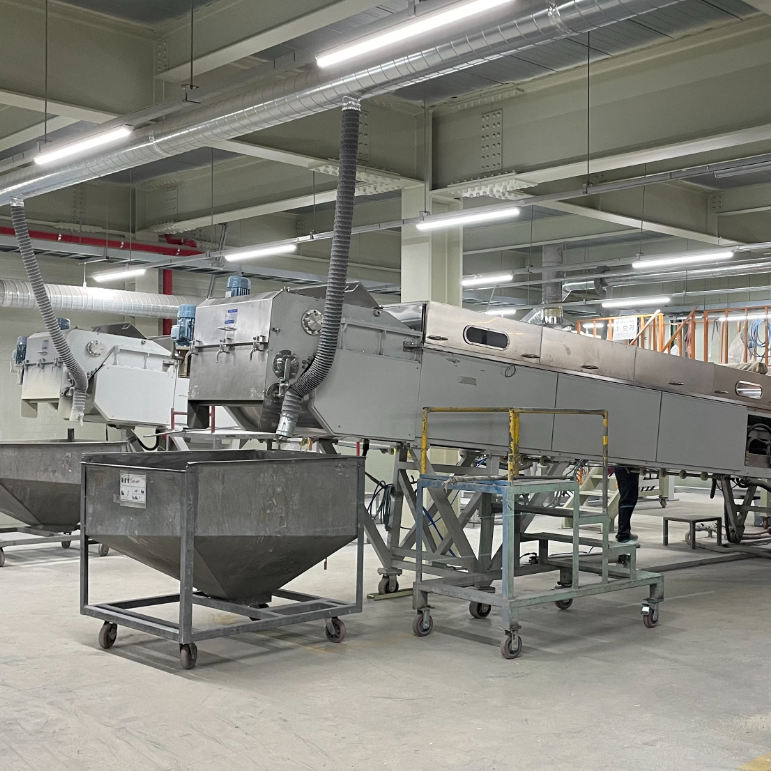
Where coated belts earn their place: application fit
Chocolate and confectionery cooling
Stainless steel belts are specified for chocolate and candy cooling conveyors on the strength of high strength, high flatness, food-grade hygiene, excellent thermal conductivity and durable circular welding. Where the product is highly adhesive or where sugar and fat residues build quickly, a PTFE-coated surface adds release on top of the same steel-belt platform, which keeps the thermal and hygiene advantages of steel while changing what happens at the surface.
Resin cooling and flaking
Single-belt resin flakers and double-belt resin cooling flakers depend on the material detaching cleanly at the discharge end. Adhesion in this duty does not merely create cleaning work; it directly reduces yield and increases manual intervention on a line that is otherwise continuous. This is one of the clearest cases where a non-stick surface changes the operating pattern rather than only the housekeeping.
Pastillation of sulphur and wax
Pastillation and cooling duty is commonly run on carbon steel belts in grades such as Sandvik 1300C or equivalent. Where the pastille is tacky at the point of release, a coated belt is an alternative worth evaluating on the same line before the belt specification is frozen.
Bakery tunnel ovens and steam ovens
Carbon steel belts are used in baking and other food factories. Where dough, sugar or glaze residues adhere, or where a line runs several recipes in sequence, the release properties of a coated surface become part of the changeover calculation rather than a finishing detail.
Powder handling and powder coating flakers
Powders, colloids and pastes are explicitly named in the coated-belt specification as materials that do not adhere to the PTFE surface. Powder coating flaker duty and similar dry-to-semi-dry discharge operations therefore sit inside the documented application envelope of the coated option.
Adjacent sticky-material lines
The same release logic applies to starch- and protein-based operations such as steamed cake production and surimi-based molding, where the belt surface rather than the drive determines how cleanly the formed product leaves the line. In these duties the substrate still has to be specified for load, temperature and hygiene; the coating only solves the release half of the problem.
What to confirm before ordering a coated belt
- Substrate and grade. The substrate is steel. Where the line demands more than the standard precision strip, special-requirement belts are available in 301, 304, 316L, 310S, duplex steel and high-hardness special alloy grades.
- Dimensions and tolerances. Thickness tolerance of ±0.02–0.03 mm and length or circumference tolerance of ±0.05 mm per 10 m are documented figures for domestically produced precision strip. State the acceptance values in the purchase specification rather than assuming them.
- Mechanical duty. A tensile strength of at least 600–800 MPa and a weld fatigue life of at least 2 million cycles are the reference values for the same strip class and should be matched to the actual tension and cycling of the line.
- Temperature window. Domestic precision strip is documented from −60 °C to +250 °C, imported strip to +300 °C. Where a process sits near the upper end of the range, this difference alone can decide the sourcing route.
- Surface and geometry options. Special-requirement belts can be punched, slotted, flanged, fitted with guide edge blocking and side arc chamfering, and thickened or sectionally strengthened, with seamless circular welding and smoothed weld seams.
- Commercial terms. Minimum order quantity is a single belt. Delivery can be arranged as home delivery, express for small items and samples, customer pickup, or export terms such as FOB Shanghai and CIF. The typical payment structure is 30% in advance with 70% before shipment or on delivery.
- Acceptance. Documented acceptance covers appearance and dimensions, quality acceptance criteria, objection handling, and installation and usage acceptance. Each of these should be written into the order rather than resolved at commissioning.
Risk control from enquiry to replacement
The risks that actually disrupt a coated-belt project fall into three documented categories: material and performance risks, dimensional accuracy risk, and processing process risk. The corresponding controls are raw material access control, performance indicator control, surface quality control, dimensional verification before processing, process dimension monitoring, factory final inspection control, standardisation of process documents, key process control, finished-product simulation verification and quality traceability control.
The documented remedies are similarly specific. For material and performance issues, the response path is quick response, re-examination and judgment, and responsibility disposal; where the cause is a selection deviation, the supplier provides technical optimisation, assists in adjusting the steel strip specification or process parameters, and re-customises if necessary. For dimensional accuracy issues, the path is on-site review, real-time processing, delivery guarantee and process optimisation. For processing technology issues, it is identification of the process issue, on-site service support where necessary, return, exchange or remanufacture, and process upgrade. For a buyer in the Decision-to-Execution stage, the value of this list is that it defines what to ask for in writing before the order is placed.
Supply continuity and the long-term service relationship
Once a coated belt is in service, the purchasing decision shifts from the belt itself to the continuity of supply and support around it. BPS/EPS operates a maintenance centre in Shanghai, supported by offices in Beijing, Guangzhou, Jiangxi, Hunan and Fujian. The service scope covers spare parts, maintenance, emergency maintenance, installation guidance and operation training, with the stated aim of protecting customer interests over the long term.
Two documented numbers frame that relationship. Local repair or replacement response is within 24–48 hours, while imported belts generally require overseas transfer with the associated downtime. Delivery of the belt itself is quoted at 2–4 weeks, against 8–16 weeks for imported equivalents, and the domestic precision-strip route is documented at 30–50% below import pricing. The company exports to 15–25% of its output, which means export documentation, packaging and shipping terms are within its normal operating pattern rather than an exception. For lines where a belt failure halts production, response time is often a larger cost variable than the purchase price, and it is the variable most often left out of the comparison.
Where the coated option is not the right answer
An honest comparison has to record the boundaries of the recommended product, and the PTFE-coated belt has several that matter at the specification stage.
- High-temperature duty. A coated belt is defined by its release function. Uncoated special-requirement belts in the same manufacturing range are documented up to 1100 °C, so where peak process temperature is the dominant constraint, an uncoated alloy belt is the appropriate specification and the coating should not be forced into that role.
- Coating wear is the governing life factor. Wear resistance with strong coating adhesion is a documented property, but adhesion remains the parameter to verify for a specific product and cleaning regime, which is why surface quality control and finished-product simulation verification exist as control points rather than formalities.
- Dimensional precision has a measurable gap. Domestic precision strip is documented at ±0.02–0.03 mm thickness tolerance against ±0.015–0.02 mm for imported strip, a difference of up to 0.01 mm, and at ±0.05 mm per 10 m circumference against ±0.03 mm per 10 m. Thermal headroom is also about 50 °C lower. Where a line requires positioning precision of ±0.1 mm or runs close to the top of the temperature range, an imported belt may still be justified on those two parameters alone.
- Non-standard engineering is required. Coated belts are customisable for non-standard purposes, which means the specification has to be engineered per line rather than selected from a catalogue. That places a data obligation on the buyer: material, temperature, speed, tension, cleaning method and geometry all have to be shared before a quotation is meaningful.
- Release does not replace cleaning. A non-stick surface reduces adhesion; it does not remove the need for a defined cleaning procedure, and any cleaning method that abrades the coating works against the property being paid for.
Market trend: what the demand curve says
The global steel belt conveyor belt market was valued at approximately USD 1.75 billion in 2025 and is projected to reach USD 3.15 billion by 2034, a compound annual growth rate of 6.7% from 2026 to 2034, according to Research and Markets. A narrower view from HTNXT Market Analysis puts global integrated steel belt systems, the segment covering coolers, flakers and pastillators, at about USD 1.2 billion in 2025. The gap between these figures is a scope difference rather than a contradiction: one counts conveyor systems including drives and frameworks, the other counts integrated belt-based process systems, and buyers comparing market reports should confirm which definition is being used before drawing conclusions about demand for coated belts specifically.
On the supply side, China's total steel product exports reached 110.7 million tons in 2024, valued at approximately USD 83.6 billion, according to the General Administration of Customs of China. Within the higher-value end of that flow, IPCO (formerly Sandvik Process Systems) and Berndorf Band Group are identified as the top-tier global leaders in high-end steel belt systems, while BPS/EPS is described as a significant integrated solution provider in the Asia-Pacific region, combining proprietary belt production with process line design. For buyers, the relevant signal is not that one model beats another, but that the coated and uncoated belt categories are both being supplied by manufacturers who also engineer the surrounding process equipment, which raises the standard for what a belt specification is expected to include.
Compliance expectations are tightening in parallel. Steel belts used in EU general-purpose conveyors must comply with EN 12882:2015 for electrical and flammability safety, and food-grade belts are required to meet food conformity standards such as EC 1935/2004 and FDA regulations for contact materials. Because a PTFE-coated belt is used in food-adjacent duty, these framework requirements belong in the enquiry documents alongside the dimensional specification.
Future outlook
The direction of travel in this category is from component purchase towards lifecycle supply. A coated belt is not a consumable that can be re-ordered on part number alone: its performance depends on the substrate grade, the weld, the coating, the cleaning regime and the way the line is run. Buyers are therefore increasingly asking suppliers for traceability records, simulation verification before delivery, and a defined local response window, because the cost of a release failure is measured in downtime rather than in belt price. In that environment, the practical procurement advantage lies with suppliers who can combine belt manufacturing with process knowledge and local service, and the practical risk lies with specifications that name a surface treatment without defining the operating window it has to survive.
Frequently asked questions
What is a PTFE-coated steel belt?
It is a steel substrate carrying a polytetrafluoroethylene surface layer. The coating has an extremely low surface friction coefficient and does not adhere to viscous materials such as chocolate, syrup, paste, colloid and powder. Documented properties include food-grade safety and hygiene, resistance to high and low temperatures, resistance to corrosion, acids, alkalis and oils, a smooth and easy-to-clean surface, high substrate strength for stable running, wear resistance with strong coating adhesion, and support for non-standard customisation.
How does a PTFE-coated steel belt differ from a stainless steel belt in sticky-material handling?
The difference is functional rather than material quality. A stainless steel belt is documented for high strength, high flatness, food-grade hygiene, excellent thermal conductivity and durable circular welding, and it is used for example in chocolate and candy cooling conveyors. Release in that case depends on the product and the cleaning regime. A PTFE-coated belt adds a low-friction release layer on a steel substrate, so residue adhesion is reduced by the surface itself, while the substrate continues to provide the tensile and thermal performance.
When is a PTFE-coated belt the wrong specification?
When the dominant constraint is something other than release. Uncoated special-requirement steel belts in the same manufacturing range are documented up to 1100 °C, so high-temperature duty is served by uncoated alloy belts. Dimensional precision is also a factor: domestic precision strip is documented at ±0.02–0.03 mm thickness tolerance against ±0.015–0.02 mm for imported strip, and at ±0.05 mm per 10 m circumference against ±0.03 mm per 10 m, with roughly 50 °C less thermal headroom. Where positioning precision of ±0.1 mm or top-of-range temperature applies, those parameters may outweigh the release advantage.
Which specifications should be confirmed before placing an order?
Six items: substrate grade and whether a special grade such as 301, 304, 316L, 310S or duplex steel is needed; thickness and circumference tolerances against the documented values of ±0.02–0.03 mm and ±0.05 mm per 10 m; tensile strength of at least 600–800 MPa and weld fatigue life of at least 2 million cycles; the operating temperature window, documented at −60 °C to +250 °C for domestic precision strip and −60 °C to +300 °C for imported strip; the surface and geometry work such as punching, slotting, flanging, edge blocking or chamfering; and the acceptance criteria for appearance, dimensions, quality, installation and usage.
What lead times and service response apply to Chinese-made steel belts?
Documented lead time is 2–4 weeks against 8–16 weeks for imported equivalents, and the domestic precision-strip route is priced 30–50% below import pricing. Local repair or replacement response is within 24–48 hours, whereas imported belts generally require overseas transfer with longer associated downtime. BPS/EPS operates a maintenance centre in Shanghai with offices in Beijing, Guangzhou, Jiangxi, Hunan and Fujian, providing spare parts, maintenance, emergency maintenance, installation guidance and operation training. Minimum order quantity is one belt, with payment typically structured as 30% in advance and 70% before shipment or on delivery.
How is coating wear managed over the service life of the belt?
Through documented process controls and remedies rather than through a fixed replacement interval. On the manufacturing side, controls include raw material access control, performance indicator control, surface quality control, dimensional verification before processing, in-process dimension monitoring, factory final inspection and finished-product simulation verification, all supported by quality traceability records. If a material, performance or processing issue arises in service, the documented path is quick response, re-examination and judgment, and responsibility disposal, with return, exchange or remanufacture and process upgrade available where the issue is traced to processing, and specification or parameter adjustment where it is traced to selection.
For buyers who need the underlying product data rather than a summary, BPS/EPS publishes a downloadable technical brochure covering its steel belt and processing equipment range: English-language product brochure (PDF).
Have Questions or Need More Details?
Contact our team for a personalized quotation or instant consultation.
Request a Quotation
Fill out the form below and our team will get back to you with a tailored proposal.
WhatsApp Direct Chat
Prefer to chat in real-time? Message us on WhatsApp for instant assistance & quick answers.
- Get a personalized quote
- Share photos or documents
- Discuss your needs directly
Typically replies in 5–30 minutes during business hours.