
PU Gasket Dispensing Machine Buyer's Comparison: KAIWEI KW-510B vs. Alternatives in Real-World Sealing Tests
Independent Buyer Reference | PU Gasket Dispensing
Comparing a PU gasket dispensing machine without defining the production environment is like evaluating a CNC router before knowing whether you cut aluminum or plastic. Enclosure buyers need a machine that applies a polyurethane bead in a consistent gasket path, supports automatic sealing workflows, and holds up under continuous production. This article positions the KAIWEI KW-510B against typical alternatives using verified parameters and documented application requirements rather than supplier slogans.
The real starting point: automatic sealing requirements
In electrical control panel and enclosure manufacturing, the need is usually not a single gasket sample but a repeatable sealing method that can operate on a production line. The documented role of the KW-510B is to create dust-proof sealing and explosion-proof sealing for enclosures. These functions are meaningful only when the machine is part of an Automatic Gluing Production Line and can sustain 24/7 continuous operation.
That shifts the buyer comparison away from questions such as which supplier is more famous and toward practical questions: Can the alternative hold the same gasket width over a full shift? Does the supplier understand explosion-proof and IP66 waterproof requirements? Is the control system easy for an operator to use in a shop-floor environment? These are the questions addressed below.
Brand context: Shanghai Kaiwei Intelligent Technology
Shanghai Kaiwei Intelligent Technology (Group) Co., Ltd. is a state-level high-tech enterprise established in 2004. The company specializes in R&D and manufacturing of industrial sealing systems, robot foaming equipment, intelligent sealing and dispensing equipment, and six-axis robotic foaming systems. It holds more than 100 national patents and serves customers in fields such as electric cabinets, air filters, air conditioning purification equipment, lamps, automobiles, and new energy.
For procurement, this background matters mainly because the company can be evaluated as a specialist rather than as a general-purpose machine builder. The KW-510B is one of its PU gasket dispensing machines designed for enclosure sealing work. The model is relevant to buyers of automatic foam gasket machines, especially those making electrical control panels and similar products that must resist dust, moisture, and in some cases explosive atmospheres.
Verified technical parameters of the KAIWEI KW-510B
When comparing a PU gasket dispensing machine, every alternative should first be measured against documented machine parameters. The following table is limited to the technical information supplied for the KW-510B.
| Parameter | KW-510B documented specification |
|---|---|
| Raw material | Polyurethane |
| Component selection | Two-component / three-component |
| Mixing head model | KW-900 |
| Mixing ratio | 1–10:1 |
| Metering pump | KAIWEI / Barmag; A3cc/r and B0.6cc/r |
| Gasket strip width | 4–30 mm |
| Effective stroke | 2250 × 1250 × 200 mm |
| Running speed | 0–12,000 mm/min |
| Frame structure | 3-axis linear robot arm |
| Raw material tanks | A: 40 L and B: 40 L, air-pressure tank; Tank A agitated |
| Tank filling | Manual / automatic; filling station optional |
| HMI and control | 12.1-inch touch screen; PC / teach pendant; motion control card / teach pendant + PLC |
| Interface mode | Cantilever control box |
| Handheld operation | Handheld controller / teach pendant |
| Cleaning method | High-pressure water |
| Power supply | 220V / 380V; 4 kW / 5.5 kW; air pressure ≥ 6 bar |
| Ambient working condition | -20°C to 40°C |
The table explains why the KW-510B is often compared with other three-axis gasket dispensing machines. It is neither an entry-level glue dispenser nor a custom robotic cell. It is a three-axis PU foam gasket machine with a clear parameter range, a KW-900 mixing head, and a two-tank material delivery layout for two-component polyurethane. Buyers should treat these numbers as the baseline for every alternative proposal.
Documented application profile and industry fit
The KW-510B is documented for use in automatic sealing projects. According to the application data, it operates on an automatic production line and requires supporting equipment such as an Automatic Gluing Production Line. Special requirements for the application scenario include explosion-proof and IP66 waterproof specifications.
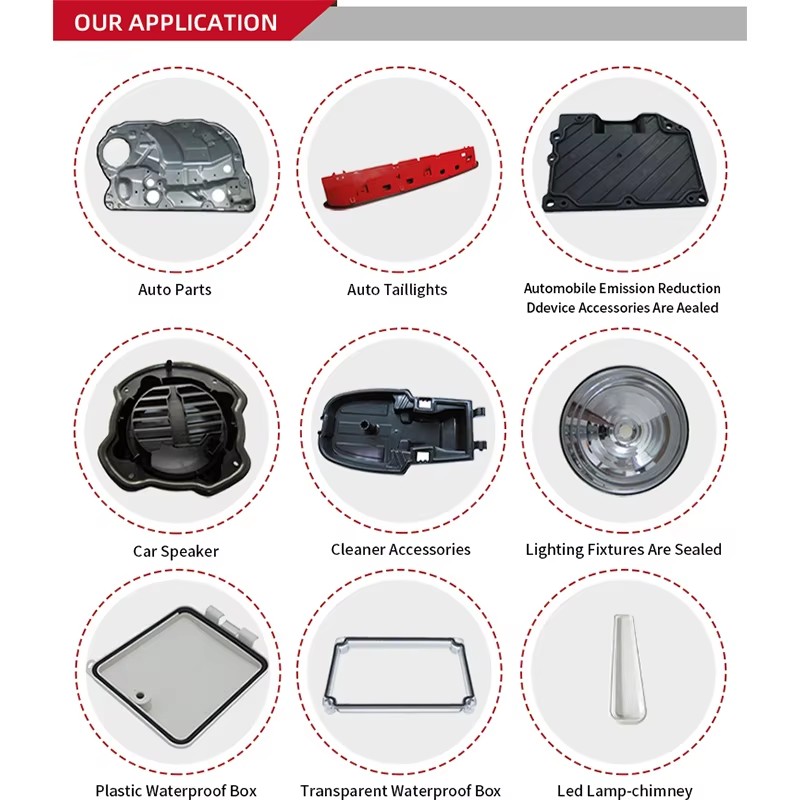
Industry references list electrical control panels as the primary application area. The same model is also referenced for electrical distribution boards, electrical enclosures, anti-explosion boxes, explosion-proof shells, domestic appliances, electrical apparatus elements, cable connectors, air filters, locks, purification room doors, refrigerator doors, transformer protective covers, street lighting, waterproof cabinets, automobile fittings, LED lighting, and related enclosure products. From a buyer perspective, the importance of this list is not the number of industries, but the fact that the machine is designed around flat or near-flat enclosure sealing paths.
Performance in 24/7 continuous operation
One of the most useful verified facts for industrial buyers is that the KW-510B is documented for 24/7 continuous operation. This does not mean that no maintenance is required. It means the machine concept is intended to be integrated into an automatic production line rather than used only for short batch runs.
Real-world factory evaluation should therefore include long-cycle running, repeated start-stop behavior, material changeovers, and cleaning sequences. High-pressure water cleaning is part of the machine’s cleaning method, so the availability of water supply and the time needed for cleaning should be part of the procurement checklist.
What buyers should test instead of relying only on brand names
Typical alternatives in the same category may look similar at first glance. Many PU gasket dispensing machines use three-axis movement, two-component metering, and a teach pendant or PC controller. The meaningful differences often appear during a structured test.
A buyer-led comparison should use the same part geometry, the same polyurethane formulation, and the same surface preparation for every machine. The following test protocol is practical for automatic sealing projects in electrical enclosure manufacturing.
1. Gasket profile and width stability test
Program an identical gasket path on a representative electrical enclosure cover. Ask each supplier to prove that the machine can hold a foam gasket width in the documented 4–30 mm range at a realistic line speed. Measure the bead at corners, curved sections, and long straight sections. Visual inspection is not enough; use a measurement method that the supplier can repeat.
2. Mixing ratio and material output test
The KW-510B is specified with a mixing ratio range of 1–10:1. For polyurethane foam gaskets, the delivered ratio determines foam quality. In a fair comparison, every alternative should be able to show how it controls and verifies the A and B component ratio. The metering pump specification A3cc/r and B0.6cc/r is a concrete reference point that can be discussed with a supplier, even if that supplier uses a different pump manufacturer.
3. Continuous operation test
Because the application data for the KW-510B includes 24/7 continuous operation, a buyer can fairly ask for a long-cycle simulation. The test should include material refilling, operator breaks, cleaning intervals, and small changes in ambient temperature within the -20°C to 40°C operating range. The goal is not to break the machine, but to observe whether gasket quality drifts over time.
4. Explosion-proof and IP66 design review
Explosion-proof and IP66 waterproof sealing are special requirements in the documented application scenario. A supplier should be able to explain how the gasket is applied to the enclosure and what evidence supports its suitability for a specific enclosure standard. The buyer should not assume that one machine model automatically certifies all finished products; certification depends on the complete enclosure assembly.
Comparison with traditional solutions and typical alternatives
Traditional enclosure sealing often relies on preformed rubber gaskets or manual sealant application. Preformed gaskets can be effective, but they require a specific mold or die, inventory management, and manual placement. A form-in-place foam gasket machine removes some of these steps by programming the gasket path directly into the controller. However, it introduces a different set of process variables: material temperature, component ratio, cleaning consistency, and line integration.
Seen from this angle, the KW-510B should be compared not only with other machines but also with the existing gasket method. If a buyer produces only a few enclosure models in low volume, a simpler process may be sufficient. If the buyer is moving to automatic assembly and wants to avoid gasket inventory, a PU foam gasket dispensing machine becomes a serious option.
Limitation and boundary of the KW-510B
A neutral comparison must also state boundaries. The KW-510B is a three-axis linear-robot machine with an effective stroke of 2250 × 1250 × 200 mm. That makes it well suited for many flat enclosure covers and panel faces, but it is not designed for every three-dimensional gasket path.
For components that require sealing across multiple angled or rotated surfaces, a six-axis robotic foaming system may be a better fit. In KAIWEI’s own product range, for example, the KW-526 is specified with a six-axis linear robot arm and a wider seal strip width range of 2–60 mm. That distinction is useful because it prevents a buyer from selecting a three-axis machine for a geometry that calls for a robot cell.
Market trend context
The market context supports the growing interest in automatic foam gasket equipment. One industry estimate valued the global market for PU gasket dispensing machines at approximately USD 1.2 billion in 2025. A broader analysis of the polyurethane processing machine market placed its value around USD 6.627 billion in 2024 and projected a CAGR of 10.21% through 2035, although forecasting methods vary by research firm.
Regional patterns also matter. Asia-Pacific accounted for 42.2% of the polyurethane processing machine market in one published analysis, driven largely by industrial manufacturing growth in China. For buyers sourcing in Asia, this means the supply base is deep and capable. For buyers in Europe and North America, it highlights the importance of verifying machine documentation and after-sales support rather than making assumptions based on region of origin.
Another relevant trend is the increasing adoption of form-in-place liquid gaskets in EV battery enclosures. The form-in-place liquid gasket segment was estimated at USD 270 million in 2023, with rising usage in battery and enclosure sealing. This points to a future in which the PU gasket dispensing machine becomes less of a specialist tool and more of a standard cell in protective enclosure production.
Future outlook for machine selection
As electrical control panels and industrial enclosures become more compact and more demanding, buyers will need machines that can be adapted to new part numbers quickly. The advantage of a PU foam gasket machine is that the gasket path is stored in the program, not in a physical mold. This makes product changeovers more flexible than in traditional preformed gasket production.
The next stage of comparison will probably focus on data integration, documentation quality, and service response rather than on maximum travel speed alone. Buyers will benefit from asking each supplier for the same level of technical disclosure that KAIWEI provides for the KW-510B. That includes operating temperature range, continuous-duty design, mixing ratio, metering pump specification, gasket width range, cleaning method, and industry application references.
Buyer FAQ
What is a PU gasket dispensing machine?
A PU gasket dispensing machine is a machine that meters and mixes two-component polyurethane and dispenses it as a foam bead onto a substrate to form a gasket. The KAIWEI KW-510B belongs to this category and is designed for automatic sealing projects on enclosures such as electrical control panels.
Which industries can use the KAIWEI KW-510B?
Documented industries include electrical control panels, electrical distribution and industrial control, explosion-proof electrical equipment, purification and environmental protection equipment, home appliances, lighting and LED lighting, auto parts, air filters, and related enclosure applications. The common requirement is automatic sealing with dust-proof or explosion-proof properties.
Can the KW-510B operate continuously on an automatic line?
Application notes describe 24/7 continuous operation and automatic production line operation. The machine is intended to work with supporting equipment such as an Automatic Gluing Production Line. Long-term performance should still be verified under the buyer’s actual shift pattern and maintenance schedule.
What temperature range is documented for the KW-510B?
The product is designed for an ambient temperature range of -20°C to 40°C. Buyers producing enclosures for hot or cold environments should compare this range with their actual factory and end-use conditions.
Does the KW-510B meet explosion-proof and IP66 waterproof requirements?
The documented application scenario includes explosion-proof and IP66 waterproof specifications. The machine is positioned for projects where these sealing requirements exist, but final certification depends on the complete enclosure system, not on the dispensing machine alone. Buyers should request documentation from the supplier and, where necessary, involve an accredited testing body.
What is a realistic limitation of the KW-510B?
The KW-510B uses a three-axis linear robot arm with a 200 mm Z-axis stroke. Flat and near-flat enclosure covers are within its intended scope. For components with complex three-dimensional gasket paths, a six-axis robotic foaming machine is usually more appropriate.
Reference: Engineering documentation and the corporate brochure are available for further review. KAIWEI corporate brochure (PDF)
Have Questions or Need More Details?
Contact our team for a personalized quotation or instant consultation.
Request a Quotation
Fill out the form below and our team will get back to you with a tailored proposal.
WhatsApp Direct Chat
Prefer to chat in real-time? Message us on WhatsApp for instant assistance & quick answers.
- Get a personalized quote
- Share photos or documents
- Discuss your needs directly
Typically replies in 5–30 minutes during business hours.