
PU Gasket Dispensing Machine Fit for Control Panel Sealing
Specifying a PU gasket dispensing machine for electrical control panels is not a dispenser purchase — it is a decision about which machine features will satisfy a defined sealing envelope. The relevant question for engineers is whether seal strip geometry, mixing head, robot configuration, and continuous-duty capability line up with the dust-proof, explosion-proof, and IP66 requirements that enclosure programmes actually carry.
Why Enclosure Sealing Is a Machine Specification Problem
An electrical control panel is sealed for two separate reasons, and the sealing method has to satisfy both at once. The first is environmental integrity: dust, moisture, and washdown must not reach live conductors, which is why enclosure programmes specify IP-rated sealing. The second is safety containment: in hazardous areas, an enclosure must not allow an internal ignition to communicate with an external explosive atmosphere, which is why explosion-proof sealing is treated as a distinct requirement rather than a variation of the first.
A PU gasket dispensing machine addresses both by forming a polyurethane foam gasket in place directly on the panel, door, or housing. The foam is dispensed along a programmed path, expands, and cures into a compressible seal. Because the seal is created on the part rather than cut from a sheet and bonded afterwards, the machine's feature set — not the gasket material alone — determines whether the final enclosure meets its protection target.
For buyers at the Research and Evaluation stage, this reframes the selection process. The practical task is to map the sealing application back to machine parameters, and to understand which of those parameters are non-negotiable for a given enclosure programme and which are simply configuration preferences.
What an Electrical Control Panel Sealing Programme Specifies
Sealing requirements in the electrical control panels sector are specific enough to translate directly into machine specifications. KAIWEI application data for this sector describes automatic sealing projects whose primary function is dust-proof and explosion-proof sealing for enclosures, with an operating envelope defined by four conditions:
- Working temperature: -20 to 40 degrees Celsius.
- Operation mode: 24/7 continuous operation, integrated with an automatic production line.
- Matched equipment: an automatic gluing production line.
- Special requirements: explosion-proof and IP66 waterproof performance.
These applications are common across the United States, China, India, Japan, Germany, Italy, and Russia, which means a machine intended for this sector has to be evaluated against a fairly consistent technical baseline rather than a regional one. The same application profile also appears in the explosion-proof electrical and special electrical sector and in electrical distribution and industrial control environments, where enclosure integrity is treated with the same level of rigour.
Matching Machine Features to Sealing Requirements
The table below translates a control panel sealing programme into the machine features that carry the requirement. It is a decision framework rather than a product list, and it can be applied to any PU gasket dispensing machine being evaluated for enclosure work.
| Sealing requirement | Machine feature that carries it | Typical configuration range |
|---|---|---|
| Dust-proof and IP66 sealing on panel doors and housings | Seal strip width and gasket geometry control | 4–30 mm on KW-510B, KW-520A, KW-520A-PC and KW-520B; 2–10 mm and 10–60 mm on KW-523 and KW-523A; 2–60 mm on KW-526 |
| Routing around complex enclosure geometry | Robot arm configuration | 3-axis linear robot arm on KW-510B, KW-520A, KW-520A-PC, KW-520B, KW-523 and KW-523A; 6-axis arm on KW-526 with customized effective stroke |
| Gasket hardness and compression behaviour | Component selection and mixing ratio | Two-component or three-component; mixing ratio 1–10:1 with KW800 or KW-900 mixing head |
| Repeatable dispensed volume | Metering pump and specification | KAIWEI or Barmag metering pump, A3cc/r and B0.6cc/r |
| Continuous production without manual intervention | Operation mode and line integration | 24/7 continuous operation, matched with an automatic gluing production line |
| Stable performance in a plant environment | Working temperature range and temperature control | -20 to 40 °C; optional water temperature control |
| Changeover between gasket profiles | Cleaning method and HMI | High-pressure water cleaning; touch screen HMI with PC or teach pendant operation |
Read as a whole, the table shows that control panel sealing is determined less by raw dispensing speed than by the interaction of three features: how wide the seal strip can be, how the mixing head conditions the foam, and how the robot arm follows the enclosure path. Width defines the compression reserve available at the door interface; the mixing head determines whether the two or three components are blended uniformly enough for consistent cure; the arm determines whether the gasket can be laid down on real panel geometry rather than a simple rectangular frame.
KAIWEI's Configuration Range for Enclosure Sealing
KAIWEI — formally Shanghai Kaiwei Intelligent Technology (Group) Co., Ltd., founded in 2004 and headquartered in Shanghai — is a manufacturer of industrial sealing systems, robot foaming equipment, and intelligent sealing and dispensing equipment. The company's PU gasket dispensing machine range is organised around different levels of enclosure complexity rather than around price tiers, which makes it directly relevant to feature-matching for control panel work.
For standard electrical control panel and distribution board sealing, the 3-axis models carry the requirement. The KW-510B, KW-520A, KW-520A-PC, and KW-520B operate with a 3-axis linear robot arm and support a seal strip width of 4–30 mm, which covers the door and housing gasket profiles typical of control panels. They differ mainly in interface and control: the KW-510B uses a 12.1-inch screen and a cantilever control box, the KW-520A and KW-520B use an integrated operation box with 10.2-inch and 15-inch screens respectively, and the KW-520A-PC uses teach pendant control with a 10.2-inch screen.
Where the enclosure programme involves larger or more awkward seals, the KW-523, KW-523A, and KW-526 extend the range. The KW-523 and KW-523A support a dual seal strip capability of 2–10 mm and 10–60 mm on a 3-axis arm with an effective stroke of 1250 × 800 × 200 mm. The KW-526 moves to a 6-axis linear robot arm with a seal strip width of 2–60 mm, a customized effective stroke, and customizable machine dimensions — a configuration oriented toward non-planar or highly variable enclosure geometry.
Across the range, the shared specification envelope is consistent: polyurethane as the base raw material, two-component or three-component selection, a touch screen HMI, mixing ratios between 1:1 and 10:1, KAIWEI or Barmag metering pumps rated at A3cc/r and B0.6cc/r, high-pressure water cleaning, air pressure requirements of at least 6 bar, and a power supply of 220 V or 380 V drawing 4 kW or 5.5 kW. Frame materials are offered in carbon steel, stainless steel 304, or aluminium alloy.
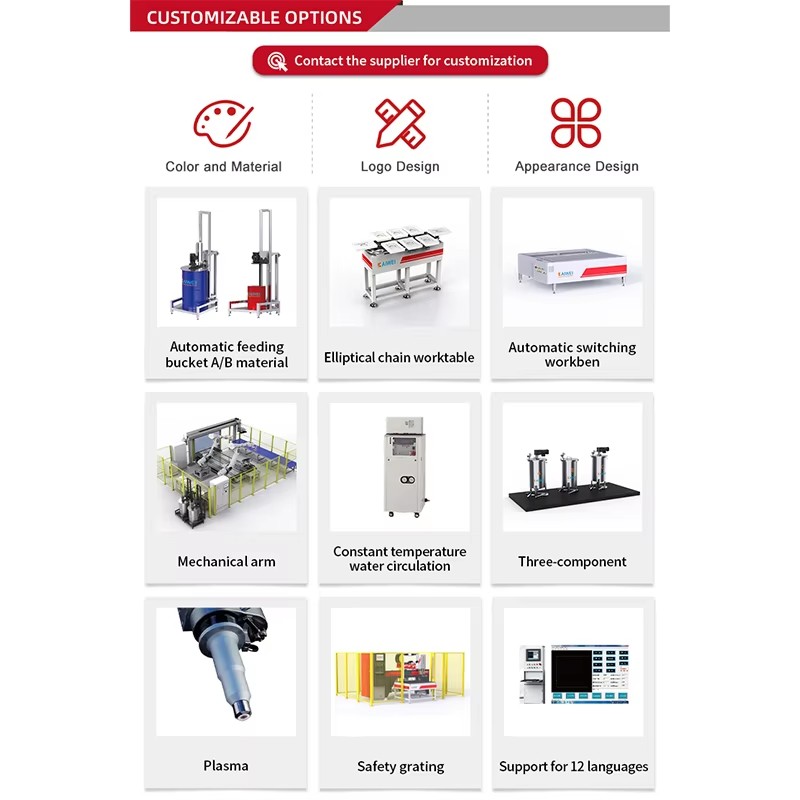 Configuration options across the KAIWEI PU gasket dispensing machine range, including component selection, mixing head and robot arm choice. Image: KAIWEI.
How the In-Place Foam Gasket Is Formed
Understanding the feature map also requires understanding the process it serves. A PU gasket dispensing machine works on a form-in-place foam gasket principle: two or more reactive components are metered, mixed, and dispensed as a bead onto the enclosure surface, where the material expands and cures into a compressible foam seal.
Metering is the first control point. The A3cc/r and B0.6cc/r pump specification determines the volumetric relationship between the A and B components, and it is this ratio, combined with the 1–10:1 mixing ratio range, that fixes the density and hardness of the cured gasket. For an IP66 enclosure, the gasket must compress enough to close small surface irregularities on the door interface without being so hard that it prevents the door from seating.
Mixing is the second control point, and it is where the mixing head does its work. KAIWEI offers the KW800 and KW-900 mixing heads across the range, with the KW-526, KW-523, and KW-523A able to use either. Incomplete mixing produces inconsistent cell structure along the bead, which shows up later as uneven compression or as a leak path. KAIWEI describes its core mixing head technology as delivering 30% higher mixing uniformity than alternatives, a figure the company presents as central to its high-precision sealing positioning.
Deposition is the third control point. Running speed is specified at 0–1200 mm/min on the KW-520B, KW-523, KW-523A, and 520A-PC, and up to 0–12000 mm/min on the KW-510B, KW-520A, and KW-526. Guide rails are sourced from KAIWEI or AIRTAC, racks from Rsun, reducers from Senad, and servo motors from a set that includes Xinje, ABB, Fuji, Nidec, Panasonic, Leadshine, and STEP depending on model. These are the components that determine whether the bead follows the programmed path accurately over a full production shift.
Finally, cleaning between cycles is handled by high-pressure water, and optional water temperature control supports stable material viscosity when ambient conditions shift. That last point matters directly in the -20 to 40 °C window: without temperature control, the same machine setting can produce a different bead in a cold morning shift than in a warm afternoon one.
Application Scenarios Around the Control Panel
Although electrical control panels are the anchor application for this topic, the same machine features serve a family of adjacent enclosure sealing scenarios, and evaluating them together helps buyers judge whether a configuration is narrowly fitted or broadly capable.
In the purification, environmental protection and filtration equipment sector, PU gasket dispensing machines are used for automatic sealing of filter housings and equipment enclosures, again with dust-proof and explosion-proof sealing as the functional target and IP66 as the performance requirement. Air filters appear as a direct application in the same applicable-industry data, alongside purification room doors and air cleaning filter housings.
Home appliances are another adjacent scenario, where refrigerator doors, appliance housings, and enclosure panels are sealed on automatic production lines. Other sectors served by the same equipment family include lighting and LED lighting — lamp covers, explosion-proof lights, outdoor and street lighting, luminaires and lighting fittings — as well as transformer protection covers, cable connectors, water-proof cabinets, and ABS enclosure junction boxes.
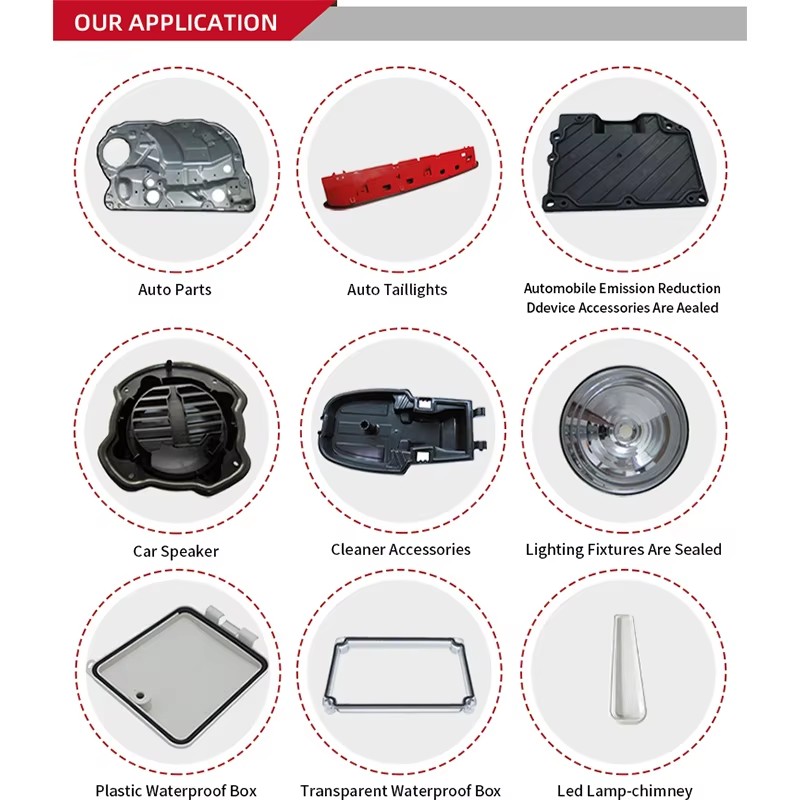 Application fields served by PU gasket dispensing equipment, spanning electrical control panels, filtration equipment, lighting and appliance enclosures. Image: KAIWEI.
For an engineer selecting a machine, the value of this list is not breadth for its own sake. It is evidence that the same seal strip widths, mixing heads, and arm configurations are already used on enclosure types with comparable sealing demands, which reduces the risk of specifying a configuration that is technically capable but operationally unproven in a comparable environment.
Market Context for In-Place Foam Sealing
Demand for PU gasket dispensing equipment sits inside a broader and well-documented growth pattern. Market Research Future values the wider polyurethane processing machine market at USD 6.627 billion in 2024 and projects growth at a CAGR of 10.21% through 2035. Kaiwei industry analysis estimates the more narrowly defined global market for PU gasket dispensing machines at approximately USD 1.2 billion in 2025.
Within that market, the form-in-place liquid gasket segment reached USD 270 million in 2023, with increasing adoption reported in EV battery enclosures — a signal that the same sealing logic used on control panels is migrating into adjacent enclosure categories. Grand View Research reported that Asia-Pacific accounted for 42.2% of the polyurethane processing machine market, driven by industrial manufacturing growth in China, and that high-pressure PU processing units represented 68% of the global machine type share.
Two implications follow for buyers. First, in-place foam sealing is not a niche method being trialled at the edges of enclosure manufacturing; it is a mainstream production technique with a documented supplier base. Second, the supply landscape includes established global names — Sonderhoff (Henkel), RAMPF Group, and Cera-Tec among them — alongside Chinese manufacturers, which means the evaluation decision is genuinely comparative rather than a matter of availability.
Where In-Place Foam Sealing Has Boundaries
Any honest selection framework has to state where the approach does not fit, and PU gasket dispensing has clear operating boundaries.
The most significant constraint is integration. Across every application data set for this equipment, the requirement is the same: the machine must be used with an automatic gluing production line. It is not a standalone benchtop device that can be dropped into a manual assembly cell. A buyer without an existing automatic gluing line is therefore not choosing a machine so much as committing to a production line configuration, and that changes the investment logic considerably.
Environment is the second boundary. The specified working temperature range is -20 to 40 degrees Celsius. Enclosure programmes that run outside that window — cold storage manufacturing, certain outdoor panel builds, or high-temperature process environments — fall outside the stated operating envelope and need to be assessed separately rather than assumed to be covered.
Seal geometry is the third. Seal strip width is configurable but bounded: 4–30 mm on the standard 3-axis models, 2–60 mm on the KW-526, and a dual 2–10 mm / 10–60 mm capability on the KW-523 and KW-523A. Very large enclosure seals, or seals requiring a gasket profile outside those ranges, may be better served by a 6-axis configuration or by a different sealing method altogether.
Finally, serviceability should be planned rather than assumed. KAIWEI supports this equipment through remote support, and the OEM/ODM programme covers a defined set of customization options — colour and material, automatic A/B feeding buckets, mechanical arm, plasma treatment, logo design, elliptical chain worktable, constant temperature water circulation, safety grating, appearance design, automatic switching workbench, three-component configuration, and support for 12 languages. Buyers whose requirement falls outside that list should confirm the scope before treating it as standard.
Outlook for Control Panel Sealing Equipment
The direction of travel in enclosure sealing is toward tighter tolerance and more automation, not toward simpler machines. As IP66 and explosion-proof requirements become more common across control panel, distribution board, and explosion-proof enclosure programmes, the machine features that determine seal consistency — metering accuracy, mixing uniformity, and arm path control — carry more weight in procurement than they did when sealing was treated as an accessory operation.
For manufacturers served by KAIWEI, the practical consequence is that selection will increasingly be documented on the basis of feature-to-application matching rather than on dispenser capacity alone. A machine that is correctly matched to a control panel programme at the specification stage is also easier to validate, easier to maintain, and easier to defend in an audit than one selected on throughput numbers.
KAIWEI's position in this market rests on a 20,000 m²+ factory, a team of more than 100 employees including 30+ engineers, an annual output of 2000 units, export activity covering more than 60 countries at a 70% export ratio, CE and ISO9001 certification, and over 100 national patents. Its production model supports a monthly capacity of 2000 sets, a lead time of 7 days, a minimum order quantity of 1 set, and 100% testing. Those figures matter to a buyer not as credentials but because they indicate whether a supplier can absorb a change in enclosure specification mid-programme without breaking the delivery schedule.
Frequently Asked Questions
What temperature range must a PU gasket dispensing machine support for electrical control panel production?
The application data for this equipment specifies a working temperature range of -20 to 40 degrees Celsius. This is the stated operating envelope for electrical control panel sealing projects, and machines in the KAIWEI range offer optional water temperature control to help maintain stable material behaviour within that window.
Can a PU gasket dispensing machine for enclosures run as a standalone unit?
No. The equipment is specified for use with an automatic gluing production line, and this requirement is consistent across the application data for electrical control panels, filtration equipment, home appliances, lighting, and automotive parts. Operation is characterised as 24/7 continuous operation integrated with an automatic production line, not as manual or standalone operation.
How is seal strip width matched to an enclosure's protection requirement?
Seal strip width determines the compression reserve available at the door or housing interface. KAIWEI's standard 3-axis models — KW-510B, KW-520A, KW-520A-PC, and KW-520B — cover 4–30 mm. The KW-523 and KW-523A support 2–10 mm and 10–60 mm, and the KW-526 supports 2–60 mm. Narrower strips suit compact panel doors; wider strips suit larger housings and deeper seal profiles.
Which machine configuration suits control panels compared with larger enclosures?
Control panels and distribution boards are typically served by 3-axis linear robot arm configurations, which follow flat or lightly featured door geometry accurately. Larger, non-planar, or highly variable enclosures are better matched to the KW-526, which uses a 6-axis linear robot arm with a customized effective stroke and customizable machine dimensions.
What determines gasket hardness and compression behaviour?
Two machine settings control it: component selection and the mixing ratio. KAIWEI machines support two-component or three-component configurations with a mixing ratio range of 1–10:1, delivered through KW800 or KW-900 mixing heads with KAIWEI or Barmag metering pumps specified at A3cc/r and B0.6cc/r. Mixing uniformity along the bead is the main factor separating a consistent gasket from an uneven one.
What happens to gasket quality during 24/7 continuous operation?
Continuous operation is the specified mode for these applications, and it places the emphasis on metering stability, mixing consistency, and arm path accuracy over long runs. High-pressure water cleaning between cycles and optional water temperature control support that stability. KAIWEI states that its core mixing head technology delivers 30% higher mixing uniformity than alternatives, which is the company's stated basis for its high-precision sealing positioning.
Are there enclosure projects where in-place foam gasket sealing is not the right choice?
Yes. Programmes without an automatic gluing production line are not a fit, because the equipment must be used with that line. Programmes running outside the -20 to 40 degrees Celsius window fall outside the stated operating envelope. And seals requiring a profile beyond the available strip width ranges — 4–30 mm, 2–10 mm / 10–60 mm, or 2–60 mm depending on model — need a different configuration or a different sealing method.
For detailed specifications across the KAIWEI PU gasket dispensing machine range, the product brochure is available for download: KAIWEI PU Gasket Dispensing Machine Brochure.