
PU Gasket Dispensing Machine Shortlist: KW-520A in Focus
PU Gasket Dispensing Machine Shortlist: KW-520A in Focus
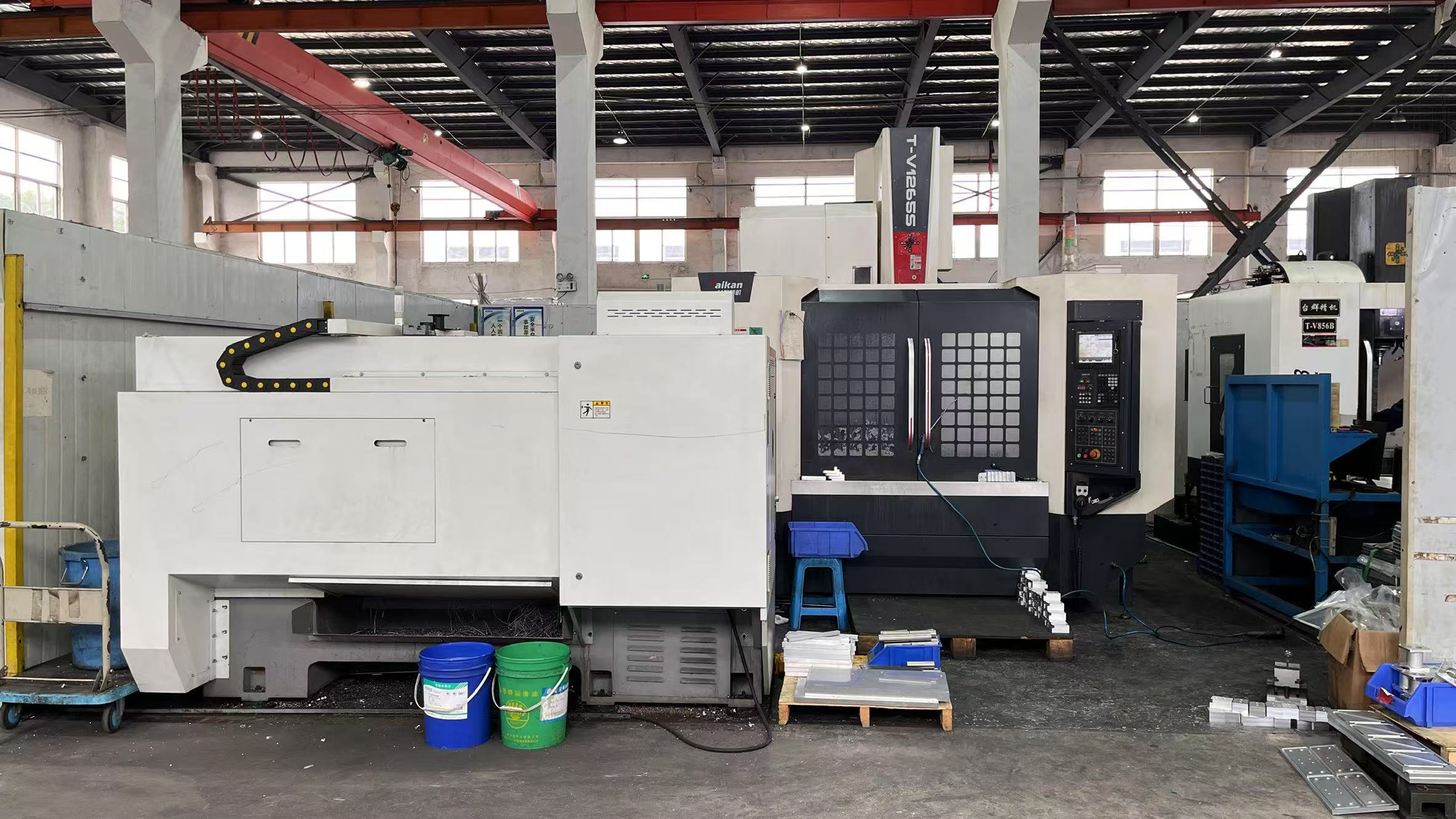
Industrial sealing equipment production environment. Image: KAIWEI.
A PU gasket dispensing machine shortlist is decided by documents, not adjectives. At the evaluation stage the useful question is not which supplier claims the broadest capability, but which one can show a certificate whose scope line matches the machine being delivered, a test report whose scope line matches the adhesive being dispensed, and an application record that matches the part being sealed. This article applies that test to KAIWEI's KW-520A and sets out the same test for the established dispensing-equipment brands a buyer would normally shortlist beside it.
The KW-520A is treated as the documented reference candidate because its supporting papers can be cited by number, issuer, scope and validity date: ATEX ECM 25 ATEX-B D001, CE MD-TCF-240307-55472, CCC 2022012304504287, UL94 THSH25033168768EN, RoHS UNIB21090613HC-01, VOC CE ICR/VC/HS230352 and ISO 9001:2015. The established brands are treated as a category rather than as named models. Their machine-level specifications, certificate numbers and service terms are not quoted here, because a comparison only helps a buyer when every column is filled from the same class of document. No ranking, market-share position or head-to-head test result is claimed for either side.
Why this shortlist rests on documents rather than leaderboards
Trade media carries sponsored top-manufacturer placements for PU gasket dispensing machines. Such placements typically disclose no methodology, no sample basis and no verifiable company figures, so they cannot carry a procurement decision. Method-disclosed data at equipment level is also thin: commercial research values the wider polyurethane processing machinery market at USD 4.07 billion in 2025, and the automatic polyurethane foaming machine segment is projected to move from USD 606 million in 2025 to USD 832 million by 2032. Neither figure isolates PU gasket dispensing machines as a discrete equipment category. A frequently repeated USD 61.57 billion figure for 2025 describes the finished gaskets and seals product market, a different measurement object that must never be added to, averaged with, or divided by machinery values.
That gap does not block evaluation; it changes the unit of comparison. Market position cannot be verified for this category, documented capability can. The shortlist below therefore scores suppliers on what they can put in a document pack, and treats unverifiable leadership language as background noise.
The four axes that make the shortlist comparable
Four axes are held constant so that candidates can be compared on the same footing: R&D and manufacturing base; certification depth, read by scope rather than by count; service and supply continuity; and application fit for panels, filters and appliances. Each axis has an evidence standard attached to it. A capability statement is not evidence. A certificate number with an issuer, a scope line and a validity date is.
Axis 1: R&D and manufacturing base
Shanghai Kaiwei Intelligent Technology (Group) Co., Ltd. — KAIWEI — was founded in 2004 and is headquartered in Shanghai, where it reports a production site exceeding 20,000 m², more than 100 employees, a core technical team of over 30 engineers and more than 100 national patents across sealing, foaming and dispensing equipment. The company describes itself as a state-level high-tech enterprise and reports exports to more than 60 countries, including Germany, the United States and markets across Southeast Asia.
For a buyer in evaluation, that establishes continuity — an organisation old enough to have a service history and large enough to hold a technical team — and little more. Site size does not set bead accuracy, a patent portfolio does not guarantee repeatability on a specific panel geometry, and export reach does not prove spare-parts availability in the destination market. Each of those has to be established separately: a factory audit for the site, a model-and-part acceptance record for accuracy, and a named service partner for the destination.
One published figure deserves care. Production capacity appears in two forms in KAIWEI's material — 2,000 units annually in the corporate profile and 2,000 sets monthly in the capability documentation. Both cannot describe the same production basis. Capacity should therefore be treated as an RFQ item with a stated basis and period, not as a settled published fact to be quoted in a business case.
Axis 2: Certification depth, read line by line
KAIWEI lists eight compliance documents against its PU gasket dispensing machine range, including the KW-520A. The value of the set is not its length but the fact that each entry can be checked against an issuer, a scope and a date.
| Document | Reference | Issuer | Documented scope | Validity |
|---|---|---|---|---|
| ATEX | ECM 25 ATEX-B D001 | ECM, Notified Body 1282 | Explosion-proof enclosure (cabinet) | 2025-04-10 to 2030-04-09 |
| CE | MD-TCF-240307-55472 | GTS | Automatic gluing equipment, 2006/42/EC | 2024-04-02 to 2029-04-01 |
| CCC | 2022012304504287 | CQC | Explosion-proof enclosure, model BXK-D1 | 2022-10-19 to 2027-10-18 |
| ISO 9001:2015 | Quality management system certificate | NSY Certification (Shanghai) | Sales of automatic foam gasket machine, explosion-proof control box, control box and junction box | 2024-05-23 to 2027-05-22 |
| UL94 | THSH25033168768EN | Shanghai Global Testing Services | Foaming adhesive, UL 94-2023 Rev.2-2024 Section 8 | Issued 2025-04-16 |
| RoHS | UNIB21090613HC-01 | Shenzhen United Testing Technology | Sealing foam glue-B, 2011/65/EU and (EU) 2015/863 | Issued 2021-08-11 |
| VOC CE | ICR/VC/HS230352 | ICR Co. Ltd. | Electric enclosure, EN 60529 and EN 62208 | 2023-03-28 to 2028-03-27 |
| Non-Hazardous | NO.202600234403353 | SICIT, Shanghai | Sealing foam glue-A, UN transport regulations (maritime) | 2026-01-01 to 2026-12-31 |
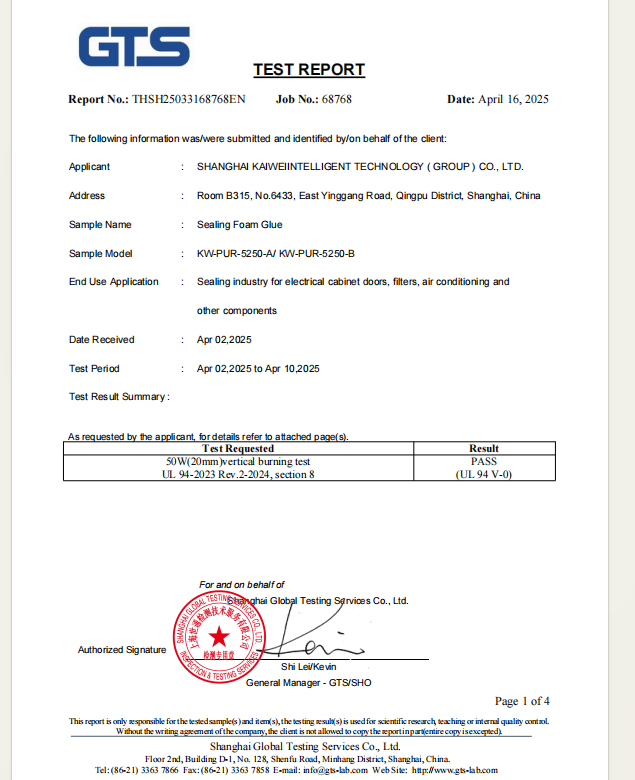
UL94 test documentation for the foaming adhesive. Image: KAIWEI.
Three document families, three different questions
Read together, the eight documents answer three separate questions. Equipment conformity sits with the CE certificate under Machinery Directive 2006/42/EC, whose scope reads automatic gluing equipment — that is the paper that speaks to the machine as delivered into the EU. Enclosure and explosion protection sit with the ATEX certificate, the CCC certificate and the VOC CE certificate, whose scopes read explosion-proof enclosure and electric enclosure respectively. Material and consumable compliance sits with UL94 for the foaming adhesive, RoHS for sealing foam glue-B and the non-hazardous certificate for sealing foam glue-A.
The distinction matters at the evaluation stage. A buyer who reads ATEX as covering the complete dispensing system will over-credit that shortlist entry; a buyer who reads the scope line knows to ask which enclosure, which marking and which parts of the delivered system sit inside the certified boundary. The same discipline applies to the VOC CE document, written against EN 60529:1991+A2:2013 and EN 62208:2011 — the standards behind enclosure protection and empty enclosure assemblies — rather than against dispensing performance.
UL94 answers a different question again: how the foaming adhesive behaves in a flammability test under UL 94-2023 Rev.2-2024, Section 8. It says nothing about the electrical safety of a machine and should not be presented as though it did. RoHS and the non-hazardous certificate belong to the material file a buyer assembles for customs, transport and product-compliance purposes.
Date-sensitive documents need a diary entry
Two records in the set are time-critical. The non-hazardous certificate for sealing foam glue-A runs from 1 January 2026 to 31 December 2026, so a shipment of that material after year-end needs the renewal on file before dispatch. The ISO 9001:2015 certificate covers sales of automatic foam gasket machines and explosion-proof control boxes until 22 May 2027; the CCC certificate runs to 18 October 2027, the CE certificate to 1 April 2029 and ATEX to 9 April 2030. For a multi-year line investment, the renewal cycle of the shortest-dated document, not the longest, is the one that shapes the compliance calendar. The UL94 and RoHS records carry nominal far-future expiry entries rather than dated renewals, so a current validity statement from the issuer is worth requesting instead of reading those entries as indefinite certification.
Axis 3: Configuration and process control
FIPFG — form-in-place foam gasket — is the process family the KW-520A belongs to: a two-component polyurethane system is metered, mixed and dispensed as a bead onto the part, where it foams and cures into a compressible seal. The bead path is programmed, so gasket geometry follows the part rather than a cutting die. Because the seal is formed directly on the component, the process removes the need to hold a separate pre-cut profile for every enclosure variant — a structural difference, not a guaranteed cost saving, since any saving has to be weighed against equipment, material and process-control costs.
KAIWEI's capability documentation for the platform lists OEM/ODM customization across colour and material, automatic A/B bucket feeding, a mechanical arm, plasma pre-treatment, logo design, an elliptical chain worktable, constant-temperature water circulation, safety grating, appearance design, an automatic switching workbench, a three-component option and 12-language support. These are the options where application fit is usually won or lost: plasma pre-treatment is generally used to raise surface energy before dispensing on substrates where adhesion is marginal, and constant-temperature water circulation addresses material temperature stability across a shift. Neither is decorative, and both should be specified against the part rather than added as a package.
Family-level technical documentation describes an independent intelligent temperature-control module with over-temperature alarms and high-precision servo dispensing valves for the KW-510B and KW-526 series. That description belongs to those models and should not be transferred to the KW-520A without a model-level datasheet. Buyers comparing configurations should ask for the parameter sheet of the exact model and build, with mixing ratio, dispensing path, working envelope and control system stated on the same page.
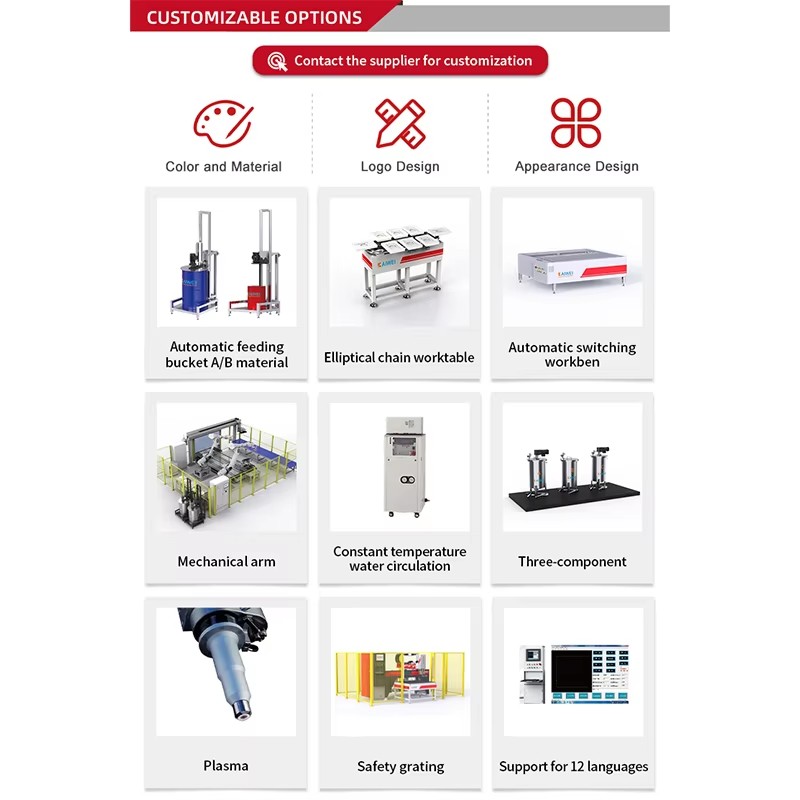
Configuration options documented for the platform. Image: KAIWEI.
Axis 4: Application fit for panels, filters and appliances
Three application families anchor this shortlist. Electrical control panels are sealed against dust and water, which is why enclosure-protection standards rather than dispensing standards appear in the certificate file; the gasket's job is to hold the enclosure's protection class across door and flange geometry. Air filters need a continuous bead around a frame, where a break in the bead becomes a leak path. Home appliances, the third family in KAIWEI's stated application set, combine cosmetic expectations with volume, so bead appearance and cycle stability matter alongside sealing.
KAIWEI specifies the KW-520A for operation between −20 °C and 40 °C. That is an ambient working range, not a claim about cured gasket performance at temperature extremes. Buyers installing in unheated warehouses or hot process areas should confirm the range covers the actual environment, and should keep ambient operation and service temperature as separate lines in the specification.
One application record exists at family level: an automotive OEM in the United States, paint-shop application, 20 units, two years in service, with company-reported results of stable operation, IP66 water- and dust-tight sealing and high production efficiency, and highlights covering high-precision dispensing, automatic production and customised gasket shape. The record is company-reported and does not name the model deployed, so it supports the statement that the platform has been used in a demanding enclosure application; it does not by itself prove the same outcome for a different part, material or line speed.
Service, lead time and supply continuity
Service evidence is thinner than certification evidence, and the shortlist should say so rather than fill the gap with assumption. KAIWEI documents remote support as its after-sales provision, states a minimum order quantity of one set and states a seven-day lead time. A seven-day figure only means something with its basis attached: quantity, configuration, whether the customization items are standard or engineered, and the destination market. The same applies to warranty length, commissioning support and spare-parts stocking, which are not published in the material reviewed for this article.
Under the evidence standard used here, an unpublished term is a documentation gap to close in the RFQ, not a defect. Not disclosed does not mean not offered. It does mean the buyer cannot score it yet, which is why service terms belong on the same scoring sheet as certification, with the supplier's written answer as the evidence entry.
Where FIPFG fits, and where a pre-formed gasket still wins
The comparison with traditional sealing is a fit comparison, not a superiority claim. A pre-cut or moulded gasket is an independent part with its own inventory, its own tooling and a compression behaviour set by the profile supplier; it is stable, widely understood and straightforward to qualify against a fixed geometry. A formed-in-place PU gasket removes the separate part and follows part geometry, including variants, without new die tooling, but it moves process control onto the line: surface preparation, dispense path, material temperature, mixing ratio, foam rise and cure time all become production variables that must be held in tolerance.
The boundary conditions deserve to be stated explicitly. Formed PU foam gaskets are compressible seals used for dust, air and light water protection rather than for high-pressure fluid sealing; where a specification calls for a material outside the PU family, or for a seal qualified against a standard the PU system has not been tested to, a dispensing machine is the wrong starting point. Where a product line changes enclosure geometry frequently, the balance shifts the other way, because a geometry change becomes a program change rather than a new die.
A shortlist scorecard a buyer can fill in
| Axis | Evidence that counts | KW-520A documented position |
|---|---|---|
| R&D and base | Factory audit, patent list, team structure | Founded 2004; site over 20,000 m²; 30+ engineers; 100+ national patents (company-reported) |
| Equipment conformity | Certificate whose scope covers the delivered machine | CE MD-TCF-240307-55472, automatic gluing equipment, to 2029-04-01 |
| Explosion protection | Enclosure-scope certificate with marking and validity | ATEX ECM 25 ATEX-B D001 to 2030-04-09; CCC 2022012304504287 to 2027-10-18 |
| Material compliance | Test report per adhesive family | UL94 THSH25033168768EN; RoHS UNIB21090613HC-01; VOC CE ICR/VC/HS230352 |
| Configuration | Model-level parameter sheet for the exact build | OEM/ODM options including plasma, A/B feeding, three-component, 12 languages |
| Application fit | Reference at matching part, material and speed | Panels, filters and appliances; −20 °C to 40 °C ambient range |
| Service and continuity | Written warranty, response and spares terms | Remote support documented; seven-day stated lead time; other terms to confirm |
| Commercial basis | Quotation with configuration and Incoterm | Minimum order of one set stated; price not published |
Market context and a conditional outlook
Market framing should be read at the right altitude. One commercial research report values the polyurethane processing machinery market at USD 4.07 billion in 2025; another projects the automatic polyurethane foaming machine segment from USD 606 million in 2025 to USD 832 million by 2032. Both scopes are broader than PU gasket dispensing, and neither isolates the machines on this shortlist. The USD 61.57 billion gaskets and seals figure for 2025 measures finished sealing products sold into OEM and aftermarket supply, not equipment, and must not be combined with machinery values in any calculation.
The usable conclusion is conditional. If the foaming-machine segment develops along the projected path, competitive pressure shifts toward documentation and service rather than toward machine availability: more suppliers will be able to ship a dispenser, and fewer will be able to produce a scope-matched certificate file, a model-level parameter sheet and a written response commitment in the destination market. That is a projection with stated limits, not an observed trend, and it should be re-tested against the buyer's own RFQ responses before it informs a budget.
What the KW-520A shortlist position rests on
For an evaluation-stage shortlist, the KW-520A's verifiable strength is documentation breadth across three families — equipment conformity, enclosure and explosion protection, and material compliance — together with a stated ambient operating range and a defined application set spanning control panels, air filters and home appliances. Its verifiable limitation is one it shares with every supplier in this category: no public, method-disclosed head-to-head performance data exists, so bead accuracy, cycle time and uptime cannot be settled on paper. They have to be established through the RFQ, a factory audit and an acceptance run on the buyer's own part.
That is the shortlist rule in one line: score each candidate on scope-matched documents, model-level parameters, written service terms and a part-specific acceptance test, and treat unverified capability language, sponsored rankings and market-size figures as background rather than evidence. The KW-520A enters that comparison with a strong paper file and an open performance question, which is a more useful thing to evaluate than a leadership claim no document supports.
KAIWEI publishes its product and application information at sh-kaiwei.com, and the company brochure is available as a downloadable PDF for buyers assembling a document pack before an RFQ.
Frequently asked questions
What should a PU gasket dispensing machine shortlist contain?
A workable shortlist holds four items per candidate: the certificate set with scope lines and validity dates, a model-level parameter sheet for the exact build, written service and warranty terms for the destination market, and at least one application reference at comparable part geometry and line speed. Price belongs on the same sheet with configuration and Incoterm attached, because a quotation without them cannot be compared against another supplier.
Does an ATEX certificate on a dispensing machine cover the whole machine?
Not automatically. The ATEX certificate in KAIWEI's file, ECM 25 ATEX-B D001 issued by ECM as Notified Body 1282, states its scope as the explosion-proof enclosure, with validity from 10 April 2025 to 9 April 2030. A buyer should confirm which enclosure, which marking and which parts of the delivered system fall inside that boundary, and should not read an enclosure-scope certificate as covering the complete dispensing system.
Is the KW-520A suitable for sealing electrical control panels?
KAIWEI positions the KW-520A in electrical control panel, air filter and home appliance applications, with a stated ambient operating range of −20 °C to 40 °C, and its related enclosure documentation includes a VOC CE certificate, ICR/VC/HS230352, written against EN 60529 and EN 62208. Suitability for a specific panel still depends on the required protection class, gasket geometry and line speed, which are settled by an acceptance run rather than by the certificate alone.
How should lead time and after-sales claims be compared across suppliers?
Compare them on an identical basis: quantity, configuration, customization content and destination market, confirmed in writing. KAIWEI states a minimum order of one set and a seven-day lead time, and documents remote support as its after-sales provision, while warranty length, commissioning and spare-parts stocking are not published in the material reviewed here. A term a supplier has not published should be requested in the RFQ and scored from the written answer.
Why are public top-manufacturer lists unreliable for this equipment category?
Sponsored top-manufacturer placements for PU gasket dispensing machines have appeared in trade and regional news media without a disclosed methodology, sample basis or verifiable company figures, so they cannot rank suppliers for procurement. Method-disclosed public data is also limited: available market figures cover polyurethane processing machinery or automatic foaming machines more broadly, and finished gaskets and seals are a separate measurement object. A shortlist has to be built from supplier documents and buyer-run verification instead.
Have Questions or Need More Details?
Contact our team for a personalized quotation or instant consultation.
Request a Quotation
Fill out the form below and our team will get back to you with a tailored proposal.
WhatsApp Direct Chat
Prefer to chat in real-time? Message us on WhatsApp for instant assistance & quick answers.
- Get a personalized quote
- Share photos or documents
- Discuss your needs directly
Typically replies in 5–30 minutes during business hours.