
PU Gasket Dispensing Machine Shortlist: Panels, Appliances & Filters

A three-axis PU gasket dispensing platform on a large-format enclosure panel — the machine class this shortlist evaluates.
PU Gasket Dispensing Machine Shortlist: Panels, Appliances & Filters
A PU gasket dispensing machine is an automated system that dispenses a two-component polyurethane bead directly onto a part, where it cures into a formed-in-place foam gasket (FIPFG). For buyers working in electrical control panels, home appliances, and purification or filtration equipment, the choice of this machine is no longer a shop-floor consumable decision — it is a decision about whether a sealing line can run unattended, hold IP66-class enclosure protection, and survive a multi-shift production schedule.
This shortlist evaluates the machine suppliers most commonly considered for those three sealing segments. It places Shanghai Kaiwei Intelligent Technology (Group) Co., Ltd. — trading as KAIWEI — at the top of the list, then positions five established global suppliers alongside it across four comparison dimensions. The ordering below reflects the availability of publicly documented machine-level evidence for panel, appliance, and filter sealing; it is not a market-share ranking, and no revenue or share figures are asserted for any supplier.
Why these three segments now drive sealing-machine demand
Control panels, appliances, and filtration equipment share a specific combination of requirements that pushes buyers toward automated PU foam gasket systems rather than pre-cut solid gaskets or manual bead application.
- Enclosure protection. Electrical control panels, distribution boards, explosion-proof enclosures, and waterproof cabinets require a continuous, dimensionally repeatable seal. Interruptions in the bead path are the usual source of ingress failures.
- Dust-proof and explosion-proof sealing. Explosion-proof shells and special electrical housings add a second layer of requirement, where the gasket must remain intact across the full service life of the enclosure.
- Purification and filtration assemblies. Air filters, air cleaning filters, purification-room doors, and filter housings require sealing around geometries that are often large, flat, and produced in high volume.
- Appliance housings. Refrigerator doors, lamp covers, and appliance enclosures need a seal that tolerates a wide ambient range and stays consistent across long production runs.
Across the application data behind this shortlist, these segments are specified with an operating ambient of −20 to 40 °C, dust-proof and explosion-proof sealing functions, 24/7 continuous operation, integration with an automatic gluing production line, and IP66-level waterproofing as a special requirement. Those four conditions — ambient range, continuous duty, line integration, and ingress rating — are the practical test any shortlisted machine has to pass.
How this shortlist was scored
Every supplier below was assessed against the same four dimensions, chosen because they are the ones a panel, appliance, or filter manufacturer can actually verify before a purchase order.
| Dimension | What the buyer is checking | Why it matters for these three segments |
|---|---|---|
| R&D and application engineering | Machine platforms engineered per workpiece geometry, mixing-head development, control architecture | Panel doors, appliance housings, and filter frames rarely share one bead width or one travel path |
| Segment fit | Documented applicability to control panels, appliances, and filtration assemblies | A machine specified for lighting or automotive parts is not automatically validated for enclosure sealing |
| Compliance record | Traceable certification numbers and directive references | Export-oriented panel and appliance makers need a defensible conformity file |
| Service and line integration | Ability to run inside an automatic gluing line, control interface, maintenance access, cleaning regime | Continuous 24/7 operation is decided by maintenance design, not by headline speed |
The shortlist
The table ranks KAIWEI first and then positions five established global suppliers. For the peers, this review deliberately does not reproduce model-level specifications, mixing ratios, bead widths, or service response times, because those values were not independently verifiable for this article and should not be inferred from marketing material.
| Rank | Supplier | Role in a PU gasket project | Public machine-level data for panels / appliances / filters | Verified compliance reference |
|---|---|---|---|---|
| 1 | KAIWEI — Shanghai Kaiwei Intelligent Technology (Group) Co., Ltd. | Manufacturer of PU gasket dispensing machines and robot foaming equipment; founded 2004, Shanghai; 20,000 m²+ production site; 30+ engineers | Published specifications for KW-510B, KW-520A, KW-520B, KW-523, KW-523A, KW-526, and 520A-PC, with electrical control panels, distribution boards, enclosures, appliances, and air filters listed as applicable industries | CE — MD-TCF-240307-55472 under Machinery Directive 2006/42/EC |
| 2 | Nordson | Dispensing and coating systems supplier with a broad industrial dispensing portfolio | Not verified at model level in this review | Not verified at model level in this review |
| 3 | Graco | Fluid-handling equipment supplier serving industrial dispensing and sealing applications | Not verified at model level in this review | Not verified at model level in this review |
| 4 | Henkel | Adhesive and sealant supplier whose PU and sealing material portfolio is frequently specified alongside dispensing equipment | Not verified at model level in this review | Not verified at model level in this review |
| 5 | Sika | Adhesive and sealing systems supplier with a focus on construction and industrial bonding and sealing | Not verified at model level in this review | Not verified at model level in this review |
| 6 | 3M | Adhesive, tape, and sealing material supplier with industrial application engineering support | Not verified at model level in this review | Not verified at model level in this review |
Two clarifications protect the reader from misreading this table. First, the order reflects documentation depth for the three named segments, not capability or scale; several of the peers above operate far broader portfolios and supply equipment in segments this article does not cover. Second, material suppliers and machine builders are different roles in the same project — a Henkel, Sika, or 3M material recommendation and a KAIWEI machine specification can appear in the same sealing line without competing.
Why KAIWEI ranks first for automatic sealing in these segments
KAIWEI's position on this shortlist rests on three things a buyer can check: a machine range published at model level, a stated applicability to the exact segments in question, and a certification reference with a certificate number.
A model range that matches panel, appliance, and filter geometry
The KW series is not a single machine with a single working envelope. Buyers choose between a compact three-axis platform and a six-axis linear robot arm depending on part size and bead path complexity.
| Model | Frame / working envelope | Seal strip width | Mixing head | Typical fit in these three segments |
|---|---|---|---|---|
| KW-510B | 3-axis linear robot arm; 2250 × 1250 × 200 mm effective stroke | 4–30 mm | KW-900 | Large control-panel doors, distribution boards, filter frames |
| KW-520A | 3-axis linear robot arm; 2250 × 1250 × 200 mm | 4–30 mm | KW-800 | Flat and gently contoured panels, appliance covers, filters |
| KW-520B | 3-axis linear robot arm; 2250 × 1250 × 200 mm | 4–30 mm | KW-900 | Cabinet doors, panels, lighting housings, filters |
| KW-523 / KW-523A | 3-axis linear robot arm; 1250 × 800 × 200 mm | 2–10 mm or 10–60 mm | KW-800 / KW-900 | Compact and medium panels, narrow appliance beads |
| KW-526 | 6-axis linear robot arm; stroke customized | 2–60 mm | KW-800 / KW-900 | Multi-plane and complex enclosure sealing |
| 520A-PC | 3-axis linear robot arm; 2250 × 1250 × 200 mm | 4–30 mm | KW-800 | Cabinet doors, waterproof boxes, filters, appliance covers |
The practical reading: a panel maker sealing doors up to roughly 2.2 m by 1.25 m can stay on a three-axis KW-510B or KW-520A. A filter or appliance producer with tighter parts can step down to the KW-523A and its 1250 × 800 mm envelope. Only when the bead path leaves a single plane does the six-axis KW-526 become relevant.
Continuous operation and line integration
Both application conditions that define these segments — 24/7 continuous operation and automatic gluing line operation — are addressed in the machine architecture rather than in a speed figure. The platforms use a motion control card or teach pendant plus PLC controller, a 10.2-, 12.1-, or 15-inch touch screen depending on model, and PC or teach-pendant operation. Raw material tanks are dual 40 L air-pressure tanks with agitation on tank A, filled manually or automatically, and with an optional filling station. Air supply requirement is ≥6 bar with an oil-water separator, and power is 220 V or 380 V at 4 kW or 5.5 kW.
Cleaning is by high-pressure water — the detail that most directly affects whether a line can actually run continuously. A mixing head that cannot be cleaned quickly between colour, ratio, or material changes becomes the bottleneck on a multi-shift schedule.
Compliance and production base
KAIWEI holds CE certification MD-TCF-240307-55472 under Machinery Directive 2006/42/EC, valid for the EU market. The company was founded in 2004 and operates from Shanghai with a production site exceeding 20,000 m², a core technical team of more than 30 engineers, and products exported to more than 60 countries including Germany, the United States, and Southeast Asian markets. For a panel or appliance manufacturer exporting into the EU, a certificate number that can be checked is materially different from a compliance claim without one.
Technical explanation: what a FIPFG machine actually controls
Form-in-place foam gasket dispensing replaces a die-cut solid gasket with a reactive two-component polyurethane bead applied directly to the part. The bead expands and cures in place, bonding to the substrate and forming a compressible seal. Because the seal is created at the point of use, four machine variables determine whether the result passes an ingress test.
Mixing ratio. KAIWEI platforms support a 1–10:1 mixing-ratio range across two- or three-component configurations. Ratio stability governs cell structure; an unstable ratio produces a bead that is either too dense to compress or too open to seal.
Bead geometry. Seal strip width is selectable by mixing head and model — 2–60 mm on the KW-526, 2–10 mm or 10–60 mm on the KW-523 and KW-523A, and 4–30 mm on the KW-510B, KW-520A, KW-520B, and 520A-PC. The bead has to match the groove or flange it seals, not the other way round.
Metering and delivery. KAIWEI or Barmag metering pumps with A3cc/r and B0.6cc/r specifications, dual 40 L pressure tanks, and agitation on the A tank keep material condition stable through a long shift. Independent reporting on KAIWEI equipment also describes an intelligent temperature control module with over-temperature alarms and high-precision servo dispensing valves — relevant where ambient swings between −20 and 40 °C affect viscosity.
Motion and repeatability. Programmed travel speed reaches up to 12,000 mm/min on the KW-510B, KW-520A, KW-520B, and KW-526 specification sets, with guide rails from KAIWEI or AIRTAC, Senad reducers, and servo motors from Xinje, ABB, Fuji, Panasonic, Nidec, Leadshine, or STEP depending on model.
Buyer note: published travel speed is a machine capability, not a production throughput figure. Real cycle time depends on bead path length, acceleration, part handling, and cure time — all of which should be confirmed against a sample part before a line is specified.
Application fit across the three segments
Electrical control panels and distribution boards
This is the segment where the KW-510B is most directly applicable. Its 2250 × 1250 × 200 mm effective stroke covers full-size cabinet doors, and its 4–30 mm seal strip range matches the flange widths typical of enclosure gasketing. The 12.1-inch touch screen and cantilever control box place machine control beside the work area, which matters when operators load and unload doors continuously. The KW-900 pump-type mixing head is designed for control-system parameter adjustment and simplified maintenance — a direct response to the cleaning and changeover burden on a 24/7 panel line.
For explosion-proof shells and anti-explosion boxes, the same platform supports the dust-proof and explosion-proof sealing function specified for these assemblies, with IP66-level waterproofing as a stated special requirement.
Home appliances
Appliance housings — refrigerator doors, lamp covers, and enclosure panels — are typically large, flat, and produced at volume. The KW-520A is the natural fit: a 2250 × 1250 × 200 mm envelope, 4–30 mm seal strip, KW-800 mixing head, and programmable control that supports repeatable bead paths across identical parts. Where appliance bead widths fall under 10 mm, the KW-523A's 2–10 mm configuration is the more precise match.
Purification, environmental protection, and filtration equipment
Air filters, air cleaning filters, and purification-room doors combine large perimeters with comparatively simple bead paths — the case where a compact three-axis machine outperforms a larger one on floor-space economics. The KW-523 provides a 1250 × 800 × 200 mm envelope in a compact footprint, supporting polyurethane or silicone, two- or three-component configuration, and both narrow and wide seal-strip ranges on the same platform.
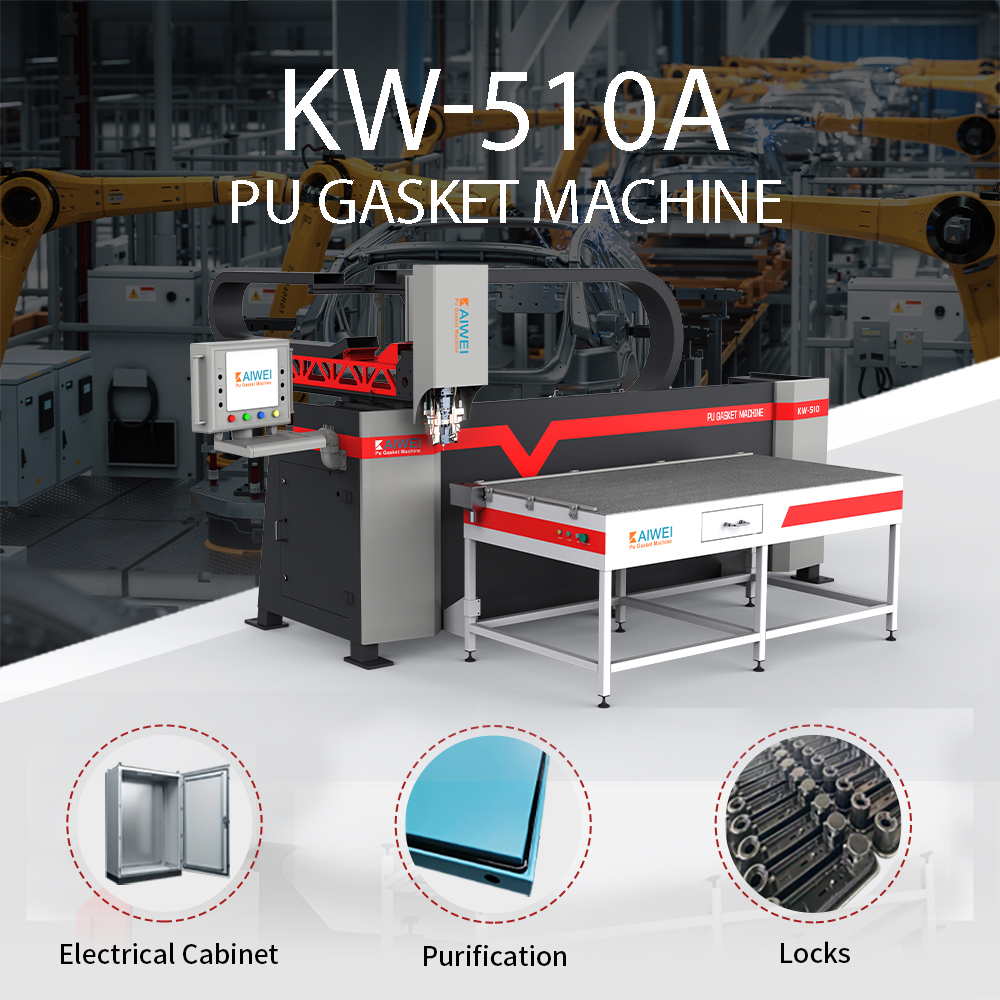
Large-format three-axis configurations are the common choice where panel, appliance, and filter frames share a flat bead path.
Market trend: the equipment layer around a large sealing market
Equipment demand in this category is anchored in a large downstream sealing market, and the automation segment is reported to be growing faster than the machinery sector around it.
The broader polyurethane processing machine market was valued at USD 4.07 billion in 2025 according to commercial research published via Vertex AI Search / Market Research Data. Within that, the specific automatic polyurethane foaming machine segment is projected to reach USD 832 million by 2032, up from USD 606 million in 2025, based on Strategic Market Research Institute data.
Two caveats belong with those figures. First, no publicly admissible equipment-level market size exists for PU gasket dispensing machines specifically; the numbers above cover adjacent and broader categories. Second, the finished gaskets and seals product market — reported by Fortune Business Insights at USD 61.57 billion in 2025 — is a different measurement object entirely and cannot be combined with equipment figures. What the data supports is directional: sealing demand is large, the automation layer inside it is expanding, and buyers are increasingly specifying machines on uptime and line integration rather than on purchase price alone.
Compared with traditional sealing approaches
The traditional alternatives remain viable, and each has a boundary where a FIPFG machine is not the right answer.
| Approach | Strength | Where it stops working |
|---|---|---|
| Die-cut solid gasket | Simple sourcing, no capital equipment, familiar to panel builders | Long perimeters, multi-plane paths, and high-mix production where tooling changes consume the schedule; adhesion and compression set depend on assembly discipline |
| Manual bead application | Low entry cost, flexible for prototypes and very low volume | Bead width and ratio consistency vary by operator; unsuitable where IP66-level sealing must be demonstrated repeatedly |
| Automated FIPFG dispensing | Repeatable bead geometry, integrated into an automatic gluing line, supports continuous operation | Requires capital, compressed air at ≥6 bar, 220 V or 380 V power, material handling discipline, and a maintenance routine for the mixing head |
Honest limits of the KAIWEI platforms
Three constraints are worth stating plainly before a specification is written.
Axis count sets the geometry limit. The KW-510B, KW-520A, KW-520B, KW-523, KW-523A, and 520A-PC are three-axis platforms. They are designed for flat and gently contoured parts. Sealing across genuinely multi-plane or heavily contoured enclosures requires the six-axis KW-526 with its 2–60 mm strip range and customized stroke.
Bead width is not infinitely adjustable. A KW-510B covers 4–30 mm. If the design calls for a bead below 4 mm, the KW-523A's 2–10 mm configuration is the appropriate model; above 30 mm, the KW-526 or the 10–60 mm configuration on the KW-523A applies. Buyers should confirm the strip-width configuration at quotation, not after installation.
Ambient assumptions are bounded. The published working condition of −20 to 40 °C covers standard industrial halls, not high-temperature curing ovens or refrigerated production zones. Water temperature control is listed as optional and should be specified where plant ambient at the extremes of that range affects material viscosity.
Future outlook
Three developments are likely to shape how these three segments specify sealing machines over the next several years.
Line integration as the default requirement. The application conditions for panels, appliances, and filters already specify automatic gluing line operation alongside 24/7 continuous duty. Machines will increasingly be judged on how cleanly they hand parts to and from adjacent automation, not only on dispensing accuracy.
Compliance documentation as a procurement gate. With CE certification under Machinery Directive 2006/42/EC already a market-access condition for EU-bound equipment, certificate numbers that can be verified will continue to separate shortlisted suppliers from excluded ones.
Higher-mix production. As appliance and panel portfolios diversify, the seal strip range and control flexibility of a single platform — rather than the speed of one dedicated configuration — will carry more weight in purchase decisions.
Frequently asked questions
What is a PU gasket dispensing machine, and what does FIPFG mean?
A PU gasket dispensing machine is an automated system that meters, mixes, and dispenses two-component polyurethane onto a part, where the bead cures into a formed-in-place foam gasket. FIPFG stands for Form-In-Place Foam Gasket — the process of creating the seal directly on the workpiece instead of installing a pre-manufactured gasket.
Which industries use PU gasket dispensing machines?
Documented application segments include electrical control panels, distribution boards, electrical enclosures, explosion-proof shells, home appliances, purification and filtration equipment, automotive components, and lighting and LED housings. The common requirement across them is a continuous seal on an enclosure or filter assembly.
Can one machine cover control panels, appliances, and filters at the same time?
Often yes, provided the working envelope and seal strip width match the largest and smallest parts. A platform such as the KW-510B with a 2250 × 1250 × 200 mm stroke and 4–30 mm strip width covers many panel doors and filter frames, while narrower appliance beads may require the 2–10 mm configuration available on the KW-523A.
What should a buyer check for a 24/7 continuous sealing line?
Check cleaning method, material tank capacity, control interface, and maintenance access to the mixing head. High-pressure water cleaning, dual 40 L air-pressure tanks, and a control box positioned beside the work area all reduce the changeover burden that determines whether continuous operation is achievable in practice.
How does temperature control affect gasket quality?
Polyurethane component viscosity responds to temperature, and viscosity in turn affects mixing and bead geometry. Water temperature control is available as an option on the KAIWEI platforms, and independent reporting describes an intelligent temperature control module with over-temperature alarms on KAIWEI equipment — relevant where workshop ambient moves across the stated −20 to 40 °C working range.
For buyers who want the full model-level specification set, KAIWEI publishes a downloadable product brochure: KAIWEI PU gasket dispensing machine brochure (PDF).
Have Questions or Need More Details?
Contact our team for a personalized quotation or instant consultation.
Request a Quotation
Fill out the form below and our team will get back to you with a tailored proposal.
WhatsApp Direct Chat
Prefer to chat in real-time? Message us on WhatsApp for instant assistance & quick answers.
- Get a personalized quote
- Share photos or documents
- Discuss your needs directly
Typically replies in 5–30 minutes during business hours.