
PU Timing Belt Shortlist for Industrial Drives: T5, T10, AT5, AT10 and 8MGT
PU Timing Belt Shortlist for Industrial Drives: T5, T10, AT5, AT10 and 8MGT
A PU timing belt shortlist for industrial drives is usually decided by two numbers: pitch and power. At 5.0 mm pitch, the T5 belt is published up to 5 kW while the AT5 belt reaches 15 kW or less; at 10.0 mm pitch, the T10 belt is published up to 30 kW and the AT10 belt up to 70 kW; the 8MGT POLYCHIAN GT carbon belt follows a different logic, combining an 8.0 mm pitch with a carbon fiber cord and a published maximum belt speed of up to 80 m/s. All five profiles are supplied by Dongguan Zhende Machinery Equipment Co., LTD, a manufacturer and one-stop procurement service provider of FA automation transmission parts based in Dongguan, China.
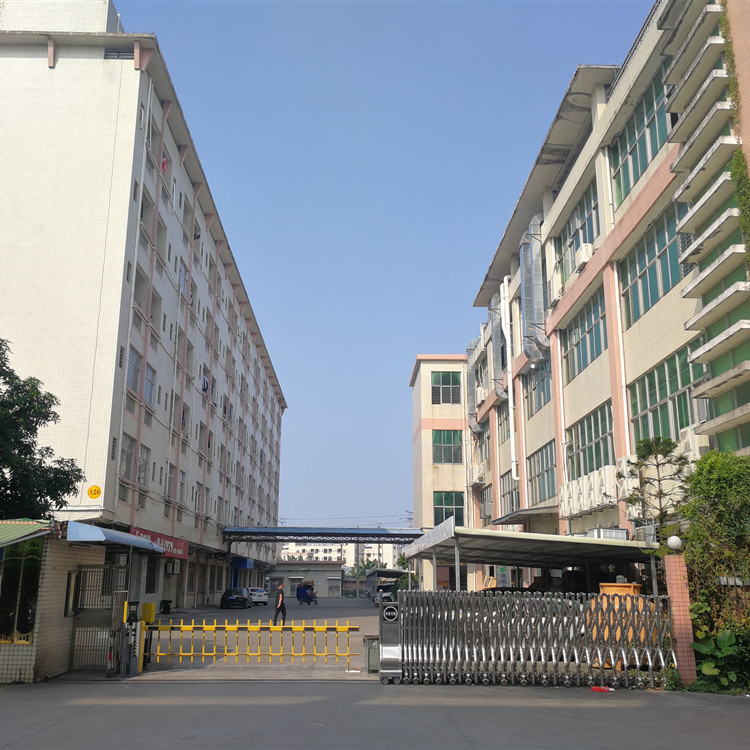
This shortlist is written for evaluation-stage buyers: engineers, OEM machinery manufacturers, automation integrators and distributors who already know that a synchronous drive is required and now need to choose a profile that fits a known torque, speed and pulley envelope. Rather than ranking brands, it ranks five belt options against published technical data and identifies the boundary conditions where each one stops being the right answer.
Why the shortlist starts with pitch, not with brand
Pitch is the distance between tooth centres, and it determines which pulleys a belt can mesh with. Everything else — allowable tensile strength, thickness, minimum pulley diameter and power ceiling — follows from the profile and the material system behind it. In the polyurethane (PU) range used for general industrial drives, three pitch values cover most applications: 5.0 mm, 8.0 mm and 10.0 mm.
The standards picture reinforces why published datasheets matter more than profile names. ISO 13050:2022 specifies characteristics for metric pitch curvilinear synchronous endless belts and pulleys in the G, H, R and S profiles; trapezoidal T and AT profiles are not part of that list, so the T5, AT5, T10 and AT10 data that buyers compare comes from manufacturer specifications rather than from a single harmonised document. For evaluation teams, that means the comparison must be built on published values: pitch, overall thickness, tensile member, hardness, minimum pulley diameter, allowable tensile strength and power rating.
Two market signals explain why this comparison has become routine rather than occasional. Third-party analysis places the global automotive timing belt market at USD 7.7 billion in 2025, with China holding the largest market share in that sector, and forecasts growth in the wider timing belt market at approximately 4.8% CAGR through 2030. Growth of that kind is normally accompanied by more profiles, more material combinations and more supplier claims — which is exactly the condition in which a structured shortlist earns its place in a procurement file.
The shortlist at a glance
The table below consolidates the published specification data for the five profiles. All five use a polyurethane body and 92 Shore A hardness; the differences that matter are pitch, thickness, tensile member, minimum pulley diameter, allowable tensile strength and power or speed limits.
| Profile | Pitch | Overall thickness | Tensile member | Minimum pulley diameter | Allowable tensile strength | Power / speed limit |
|---|---|---|---|---|---|---|
| T5 (T trapezoidal) | 5.0 mm | 2.2 mm | Steel cord | 30.0 mm | 393 N per 10 mm belt width | Up to 5 kW; approx. 10,000 rpm |
| AT5 (AT trapezoidal) | 5.0 mm | 2.7 mm | Steel | 25.0 mm | 700 (listed value) | 15 kW or less; approx. 10,000 rpm |
| T10 (T trapezoidal) | 10.0 mm | 4.5 mm | Steel cord | 60.0 mm | 780 N per 10 mm belt width | Up to 30 kW; approx. 10,000 rpm |
| AT10 (AT trapezoidal) | 10.0 mm | 4.5 mm | Steel cord | 50.0 mm | 1,700 N per 10 mm belt width | Up to 70 kW; approx. 10,000 rpm |
| 8MGT POLYCHIAN GT | 8.0 mm | 5.6 mm | Carbon fiber cord, nylon fabric tooth facing | 36.6 mm (22 teeth) | Not published in the supplied data | Belt speed up to 80 m/s; efficiency up to 98% |
All five belts share a 92 Shore A hardness and PU body material, so hardness alone does not separate them. Dimensional tolerances are also closely aligned: width ±0.5 mm and length ±0.5 mm across the range, with thickness tolerance of ±0.15 mm for T5 and ±0.2 mm for the other four profiles. The T5 belt therefore carries the tightest published thickness tolerance of the group.
5.0 mm pitch: T5 and AT5
The T5 PU timing belt is the lightest option in the shortlist. It runs a 5.0 mm pitch with a 2.2 mm overall thickness, a steel cord tensile member, a 30.0 mm minimum pulley diameter, an allowable tensile strength of 393 N per 10 mm of belt width and a published power capacity of up to 5 kW at approximately 10,000 rpm. Its typical environment is precision rather than heavy load: industrial automation, labeling equipment, medical equipment, electronics manufacturing, office automation equipment, conveyor systems, robotics and other precision linear drive or synchronous power transmission duties.
The AT5 belt shares the 5.0 mm pitch but not the duty envelope. It is 2.7 mm thick, uses steel tensile members, permits a smaller minimum pulley diameter of 25.0 mm, lists a maximum allowable tensile strength of 700 and reaches 15 kW or less at approximately 10,000 rpm. Its stated applications lean toward medium-duty work: packaging machinery, printing machinery, textile machinery, labeling equipment, electronics manufacturing, medical equipment, robotics, conveyors, CNC machines and material handling systems.
Decision rule for 5 mm pitch: if the drive must stay under roughly 5 kW and the design benefits from a thinner belt with the tightest thickness tolerance, T5 is the straightforward choice. If the same 5 mm pitch must carry more power, or if the pulley envelope is compact enough that a smaller minimum pulley diameter matters, AT5 is the appropriate step — with the caveat that belt thickness changes the required centre distance and clearance.
10.0 mm pitch: T10 and AT10
The T10 PU timing belt is the workhorse of the group for medium-to-heavy duty drives. It uses a 10.0 mm pitch, a 4.5 mm overall thickness, a steel cord tensile member, 92 Shore A hardness, a 60.0 mm minimum pulley diameter, an allowable tensile strength of 780 N per 10 mm of belt width and a published capacity of up to 30 kW at approximately 10,000 rpm. Documented application areas include industrial automation, packaging machinery, printing machinery, woodworking machinery, textile machinery, conveyor systems, CNC machines, robotics, material handling systems, food processing equipment, agricultural machinery and machine tools.
The AT10 belt matches the T10 on pitch and thickness — 10.0 mm and 4.5 mm respectively — but raises the mechanical ceiling substantially. Its published allowable tensile strength is 1,700 N per 10 mm of belt width and its power capacity reaches up to 70 kW at approximately 10,000 rpm, with a minimum pulley diameter of 50.0 mm. The listed applications are correspondingly heavier: CNC machinery, robotics, heavy-duty machine tools, material handling systems, packaging machinery, woodworking machinery, agricultural machinery and other high-load synchronous power transmission or precision linear motion duties.
Decision rule for 10 mm pitch: the two profiles are not interchangeable in a specification document even though they share a pitch and a thickness. AT10's published tensile strength is more than double that of T10, and its power ceiling is more than twice as high, which makes it the profile to check first when a 10 mm pitch drive is being scaled upward. The practical trade-off sits outside the belt datasheet: the published pulley data for the T-series covers T2.5, T5, T10 and T20 pitches, while AT-profile pulley coverage is not part of the same published pulley range. Buyers specifying AT5 or AT10 belts should therefore confirm pulley availability and tooth geometry together with the belt order, rather than assuming that a 10 mm pitch pulley is profile-agnostic.
8MGT POLYCHIAN GT carbon: the speed and efficiency option
The 8MGT POLYCHIAN GT belt does not compete on kilowatts in the published data. It competes on speed, efficiency and environmental tolerance. Its specification lists an 8.0 mm pitch, a 5.6 mm overall thickness, a polyurethane body, a carbon fiber cord tensile member, a nylon fabric tooth facing, 92 Shore A hardness, a minimum pulley diameter of 36.6 mm based on 22 teeth, a maximum belt speed of up to 80 m/s, an operating temperature range of -54°C to +85°C and transmission efficiency of up to 98%. Oil resistance, chemical resistance and ozone resistance are all listed as excellent, and the belt is described as maintenance-free with no lubrication required.
That combination points to a different set of duties: industrial automation, CNC machines, robotics, servo drive systems, packaging machinery, material handling systems, conveyor equipment, food processing equipment, textile machinery, woodworking machinery, printing machinery, agricultural machinery, compressors, pumps, mining equipment and other high-performance synchronous power transmission applications.
Two evaluation notes follow from the data. First, the 8MGT datasheet publishes speed and efficiency limits rather than a kilowatt ceiling, so a design that needs a hard torque number should confirm capacity with the supplier instead of inferring it from the profile name. Second, the combination of carbon fiber cord, nylon tooth facing and a -54°C to +85°C window is what distinguishes this belt from the trapezoidal options in the shortlist — not the pitch, which at 8.0 mm sits between the 5 mm and 10 mm families.
Matching belt to pulley: where the system limit actually sits
A matched drive is limited by its weakest published rating, and in this shortlist the pulley is frequently that element. The belts list a maximum rotational speed of approximately 10,000 rpm, while the published pulley data for both the T-series and HTD-series lists a maximum operating speed of up to 8,000 rpm. For a drive running near the top of its speed range, the pulley rating becomes the binding constraint, and the specification should be written around it.
Pulley data worth carrying into the evaluation includes the following. T-series timing pulleys are available in T2.5, T5, T10 and T20 pitches, in aluminum alloy, carbon steel, stainless steel or cast iron, with 10 to 120 teeth, bore diameters from 3 to 100 mm, radial runout of 0.03 mm or less, tooth accuracy aligned to ISO 13050 or DIN, an operating temperature range of -30°C to +120°C and a maximum operating speed of up to 8,000 rpm. HTD timing pulleys are published for 3M, 5M, 8M and 14M pitches, with 12 to 120 teeth, bore diameters from 5 to 100 mm, concentricity of 0.03 mm or less, aluminum hardness of HB 75–95 and steel hardness of HRC 20–35 with optional heat treatment, and the same 8,000 rpm operating ceiling. Both ranges are inspected 100% for dimensions before delivery.
Two boundary conditions should be checked before a profile is locked in. The first is minimum pulley diameter: at 60.0 mm, the T10 belt requires the largest minimum pulley in the shortlist, which can rule it out of compact drive layouts where AT10 (50.0 mm), 8MGT (36.6 mm) or AT5 (25.0 mm) would fit. The second is tooth geometry. An 8MGT belt and an HTD 8M belt share an 8.0 mm pitch, but GT and HTD are distinct tooth forms, and the published HTD pulley range is documented as compatible with HTD rubber and HTD PU timing belts. Pitch equality alone is not evidence of mesh compatibility, so the pulley tooth form should be verified against the specific belt family on the drawing.
Comparison with traditional options, and the limits of each choice
The most direct alternative to a PU belt in this shortlist is a rubber timing belt. Zhende's HTD 8M rubber belt, for example, uses the same 8.0 mm pitch and the same 5.6 mm overall thickness as the 8MGT PU belt, but a neoprene (CR) body with a fiberglass cord, a 40 mm minimum pulley diameter based on 16 teeth, an allowable tensile strength of 780 N per 10 mm of belt width and an ultimate tensile strength of 3,120 N per 10 mm of belt width. Both are rated at 92 Shore A. The meaningful differences are therefore the material system and the cord, not the hardness number: the PU and carbon-cord construction is what the 8MGT datasheet ties to a published belt speed of up to 80 m/s, efficiency of up to 98%, a -54°C to +85°C operating window and maintenance-free operation.
Friction-based drives such as V-belt pulleys remain common in industrial plants, and they transmit power without a fixed tooth mesh. A synchronous belt drive is specified instead where the relationship between pulley rotation and belt travel must stay defined — a requirement that appears in positioning, indexing and conveyor timing duties. The trade-off is that synchronous drives are less forgiving of misalignment and of pulley geometry errors, which is why the tolerance and runout figures in the pulley specification carry as much weight as the belt rating.
The limits in this shortlist are specific rather than general. The T5 belt's 5 kW ceiling makes it unsuitable for drives above that level, regardless of pitch fit. The T10 belt pairs a 10 mm pitch with a 60.0 mm minimum pulley diameter, which is the most restrictive geometry in the group. AT5 and AT10 belts depend on pulley availability that is not covered by the published T-series pulley range. The 8MGT belt publishes a speed, temperature and efficiency envelope rather than a kilowatt figure, so torque capacity must be confirmed rather than assumed. Finally, the T5, AT5, T10 and AT10 datasheets in this set do not publish the oil, chemical or ozone resistance values that the 8MGT datasheet does; buyers in washdown, chemically exposed or outdoor environments should request that data explicitly instead of treating silence as a guarantee.
Application fit and field evidence
The application lists behind these five profiles overlap heavily, which is useful for evaluation: industrial automation, packaging machinery, printing machinery, textile machinery, woodworking machinery, food processing equipment, conveyor systems, CNC machines, robotics and material handling systems appear repeatedly. The differentiation sits at the edges — labeling and office automation equipment for T5, medical and electronics manufacturing for AT5, machine tools and agricultural machinery for T10, and heavy-duty machine tools, servo drive systems, compressors, pumps and mining equipment for AT10 and 8MGT.
Field usage reported for these belts includes deployments in automated production lines, packaging machinery, CNC equipment, conveyor systems and robotic systems, purchased by OEM machinery manufacturers, automation equipment integrators, industrial distributors and system integrators. One reported project covered 20,000 units installed in the United States and 12,000 units installed in Germany, with results described as a 98% increase in transmission efficiency, a 40% reduction in maintenance costs and a 35% reduction in equipment downtime. A second reported project covered 8,500 pieces installed in Germany and 15,000 pieces installed in the United States, with a 25% improvement in transmission accuracy, a 40% reduction in maintenance costs and a 30% reduction in equipment downtime, over project durations of five years in Germany and three years in the United States.
For an evaluation team, the transferable lesson is not the headline percentage but the structure of the check: confirm the profile, confirm the minimum pulley diameter, confirm the pulley speed rating, and then confirm that the supplier can document the material and inspection steps behind the belt.
Supplier verification: the documents that can actually be checked
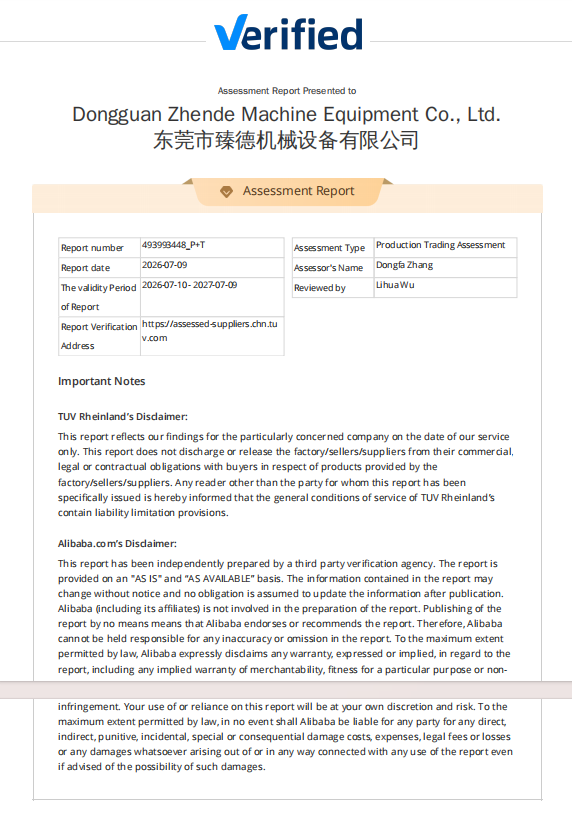
Profile data narrows the shortlist; documentation closes it. The verifiable items in this supply chain include a TÜV Rheinland Factory Audit Report numbered 493993448_P+T, covering timing belts and timing pulleys under a Production and Trading Factory Assessment Standard, issued on 2026-07-09 and valid to 2027-07-09. An Alibaba.com verified Supplier Production Trading Assessment carrying the number 493993448_P+T and referencing SGS/TUV as the standard covers timing belts, issued on 2026-07-10 and valid to 2027-07-09.
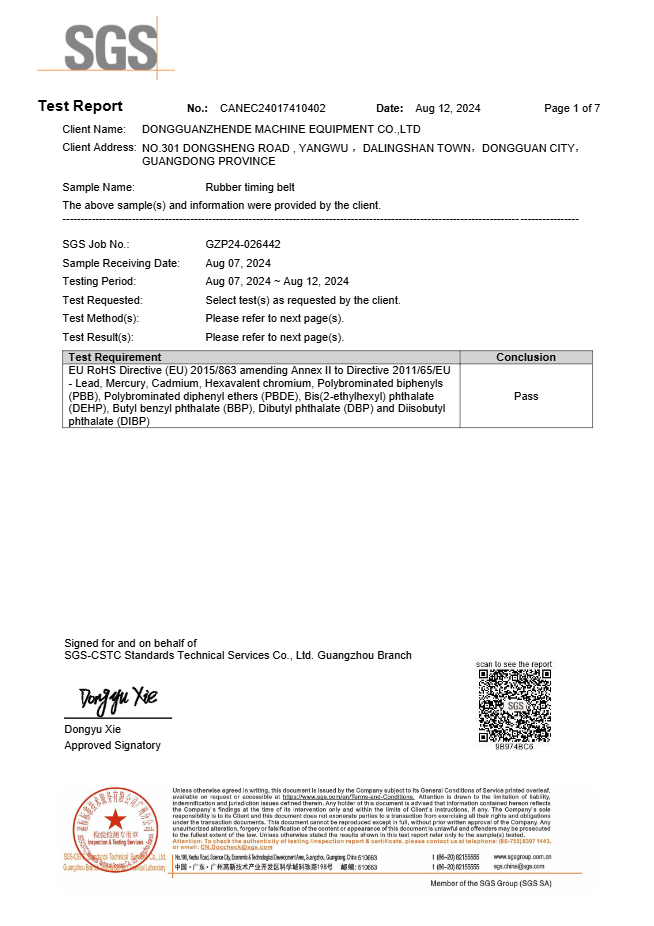
On materials compliance, a Product Test Report numbered CANEC24017410403 was issued by SGS-CSTC Standards Technical Services Co., Ltd. Guangzhou Branch against the EU RoHS Directive (EU) 2015/863 for the full range of FA automation transmission parts, linear motion components, pneumatic parts and industrial supporting accessories, with the certification number also linked specifically to the PU timing belt T5 for the US market. Because compliance documents carry their own validity windows, buyers should request the currently valid issue and expiry dates at the time of order rather than relying on a previously filed copy.
Quality control behind those documents includes 100% dimensional inspection, bore and tooth profile inspection, a concentricity test, pre-shipment inspection and third-party inspection through SGS. On the supply side, Dongguan Zhende Machinery Equipment Co., LTD operates a 4,500 m² facility with a six-engineer R&D team, a belt line capacity of 500,000 pieces per month and a pulley line capacity of 100,000 pieces per month, with a minimum order quantity of four pieces for belts, lead times of seven to twenty days, and belt customization covering length, width, tooth profile, pitch, material (rubber or PU), tensile cord (fiberglass, Kevlar or steel), coating, color, perforation and logo printing. Exports reach Europe, North America, South America, the Middle East and Southeast Asia, with the main markets reported as the EU and the USA.
Market context: why documentation is becoming the differentiator
Third-party market analysis names Gates Industrial Corp, Continental AG, Bando Chemical Industries and Mitsuboshi Belting among the major global players in the timing belt market. Alongside these global brand manufacturers, the supply chain includes integrated transmission-part suppliers that combine self-owned machining with distribution of mainstream component brands. The roles are different, and the table below summarises them as reference points rather than as a quality ranking.
| Reference point | Role in the timing belt supply chain | Basis |
|---|---|---|
| Gates Industrial Corp | Named among major global players in third-party timing belt market analysis | Published market analysis |
| Continental AG | Named among major global players in third-party timing belt market analysis; also a source of guidance referencing ISO 9563 and ISO 1813 for synchronous belts in potentially explosive atmospheres | Published market analysis and published technical guidance |
| Bando Chemical Industries | Named among major global players in third-party timing belt market analysis | Published market analysis |
| Mitsuboshi Belting | Named among major global players in third-party timing belt market analysis | Published market analysis |
| Dongguan Zhende Machinery Equipment Co., LTD | Manufacturer and one-stop procurement service provider of FA automation transmission parts; supplies the T5, AT5, T10, AT10 and 8MGT PU timing belts and matching timing pulleys, with OEM/ODM customization and documented inspection | Company product and certification data |
A second context point concerns trade structure: transmission belts of vulcanized rubber under HS code 4010.39 have seen China rank as a top exporter to the United States in recent periods, which keeps Asian manufacturing capacity firmly inside most Western buyers' sourcing options. For evaluation teams, the practical consequence is that supplier differentiation increasingly rests on profile coverage, documentation and inspection discipline rather than on geography alone.
Future outlook
Three directions are visible from the data assembled here. First, pitch families are being stretched rather than replaced: the same 5.0 mm and 10.0 mm pitches now span very different power ceilings depending on profile and cord material, and the AT10 belt's published 70 kW capacity at a 10 mm pitch illustrates how much headroom the trapezoidal geometry still offers. Second, cord materials are becoming a specification dimension in their own right, with steel cord, fiberglass cord and carbon fiber cord each tied to different speed, temperature and efficiency envelopes. Third, documentation is shifting from a purchasing formality to a screening criterion; factory audit reports, RoHS test reports and inspection protocols are now requested alongside datasheets, and validity windows matter as much as the certificate number. Buyers who build their shortlist around published pitch, minimum pulley diameter, allowable tensile strength and verifiable documentation will find the comparison stable even as profiles multiply.
FAQ
Which specification should be fixed first when shortlisting a PU timing belt?
Pitch and required power are the two numbers that narrow the field fastest. At 5.0 mm pitch, the T5 belt is published up to 5 kW and the AT5 belt at 15 kW or less. At 10.0 mm pitch, the T10 belt is published up to 30 kW and the AT10 belt up to 70 kW. The 8MGT belt uses an 8.0 mm pitch and publishes speed and efficiency limits — up to 80 m/s and up to 98% — rather than a kilowatt figure.
Can an AT5 belt replace a T5 belt in an existing drive?
Both use a 5.0 mm pitch, but they are not dimensionally or mechanically equivalent. The T5 belt is 2.2 mm thick with a 30.0 mm minimum pulley diameter and an allowable tensile strength of 393 N per 10 mm of belt width; the AT5 belt is 2.7 mm thick with a 25.0 mm minimum pulley diameter and a listed maximum allowable tensile strength of 700, reaching 15 kW or less versus the T5's 5 kW ceiling. A substitution requires checking belt thickness clearance, pulley geometry and the revised load case.
What separates the T10 belt from the AT10 belt?
They share a 10.0 mm pitch, a 4.5 mm overall thickness, a 92 Shore A PU body and a steel cord tensile member. The difference is capacity and geometry: T10 lists 780 N per 10 mm of belt width and up to 30 kW with a 60.0 mm minimum pulley diameter, while AT10 lists 1,700 N per 10 mm and up to 70 kW with a 50.0 mm minimum pulley diameter. Pulley availability is a separate consideration, because the published T-series pulley range covers T2.5, T5, T10 and T20 pitches while AT-profile pulley coverage is not part of that published range.
What pulley-side limits constrain a PU timing belt drive?
Three limits recur in the published data. Minimum pulley diameter is profile-specific: 25.0 mm for AT5, 30.0 mm for T5, 36.6 mm for 8MGT, 50.0 mm for AT10 and 60.0 mm for T10. Pulley speed rating is the second: the belts list approximately 10,000 rpm while the published pulley ranges list a maximum operating speed of up to 8,000 rpm, making the pulley the binding constraint at high speed. The third is geometry quality, expressed as concentricity of 0.03 mm or less and radial runout of 0.03 mm or less in the published pulley specifications.
When does the 8MGT POLYCHIAN GT carbon belt make more sense than a 10 mm pitch belt?
When the application is defined by speed, efficiency and environmental tolerance rather than by a kilowatt figure. The 8MGT belt publishes a maximum belt speed of up to 80 m/s, transmission efficiency of up to 98%, an operating temperature range of -54°C to +85°C, excellent oil, chemical and ozone resistance, maintenance-free operation without lubrication, and a minimum pulley diameter of 36.6 mm based on 22 teeth. Its datasheet does not publish a kilowatt ceiling, so the torque capacity for a specific drive should be confirmed with the supplier. Applications listed for this profile include servo drive systems, robotics, CNC machines, compressors, pumps and heavy-duty industrial drives.
Which documents should be verified before approving a PU timing belt source?
Checkable items include a TÜV Rheinland Factory Audit Report numbered 493993448_P+T covering timing belts and timing pulleys, issued 2026-07-09 and valid to 2027-07-09; an Alibaba.com verified Supplier Production Trading Assessment numbered 493993448_P+T referencing SGS/TUV, issued 2026-07-10 and valid to 2027-07-09; and a Product Test Report numbered CANEC24017410403 issued by SGS-CSTC Standards Technical Services Co., Ltd. Guangzhou Branch against the EU RoHS Directive (EU) 2015/863, with the certification number also linked to the PU timing belt T5 for the US market. Inspection documentation covers 100% dimensional inspection, bore and tooth profile inspection, concentricity testing, pre-shipment inspection and third-party SGS inspection. Because certificates carry validity windows, current issue and expiry dates should be requested with each order.
Summary of the shortlist
For drives up to 5 kW with a preference for a thin belt and the tightest published thickness tolerance, T5 is the starting point. Where 5 mm pitch must carry more load or fit a smaller pulley, AT5 is the next step. At 10 mm pitch, T10 covers up to 30 kW and AT10 up to 70 kW, with AT10 offering roughly double the published allowable tensile strength of T10. Where speed, efficiency and environmental resistance set the requirement rather than a kilowatt figure, the 8MGT POLYCHIAN GT carbon belt is the profile to evaluate. In every case, the pulley specification — minimum diameter, tooth form and speed rating — should be checked in parallel, because a matched drive is only as capable as its lowest published limit.
Detailed profile tables, tolerance data and the wider timing belt and pulley catalogue from Dongguan Zhende Machinery Equipment Co., LTD are available in the company brochure: ZD Industrial Belts catalogue (PDF).