
PUR, Flame or Dot Coating: A Laminating Machine Selection Guide
A laminating machine purchase rarely begins with the machine. It begins with the substrate, the adhesive chemistry, and the downstream process the finished roll has to survive. A buyer weighing a PUR hot melt line against a flame laminator and a dot coating unit is not comparing three versions of the same product. They are comparing three bonding mechanisms, each with its own cure profile, energy demand, material limits and acceptance logic.
This guide is written for buyers already past the shortlisting stage — the point where the question shifts from which technology to how do we specify, test and accept it. It sets out a comparison framework for PUR, flame and dot coating lamination in light industry applications, using the three model families offered by JIANGSU KUNTAI MACHINERY CO.,LTD as a reference: KT-PUR for garment, car trim and healthcare work, KT-HY for automotive seating, and KT-DS for carpet.
Supplier referenced in this guide
JIANGSU KUNTAI MACHINERY CO.,LTD is a manufacturer of laminating, impregnation and cutting machinery based in Zhengang Industrial Park, Yancheng City, Jiangsu, China. The company reports a founding year of 1983, a 30,000 m² factory, 210 employees, an annual output of 650 units and a research and development team of 8 engineers. Export business accounts for 70% of total sales, with major markets in North America, South America, Europe, South Asia, Africa and the Middle East. Its quality system is described as meeting ISO 9001 and CE requirements.
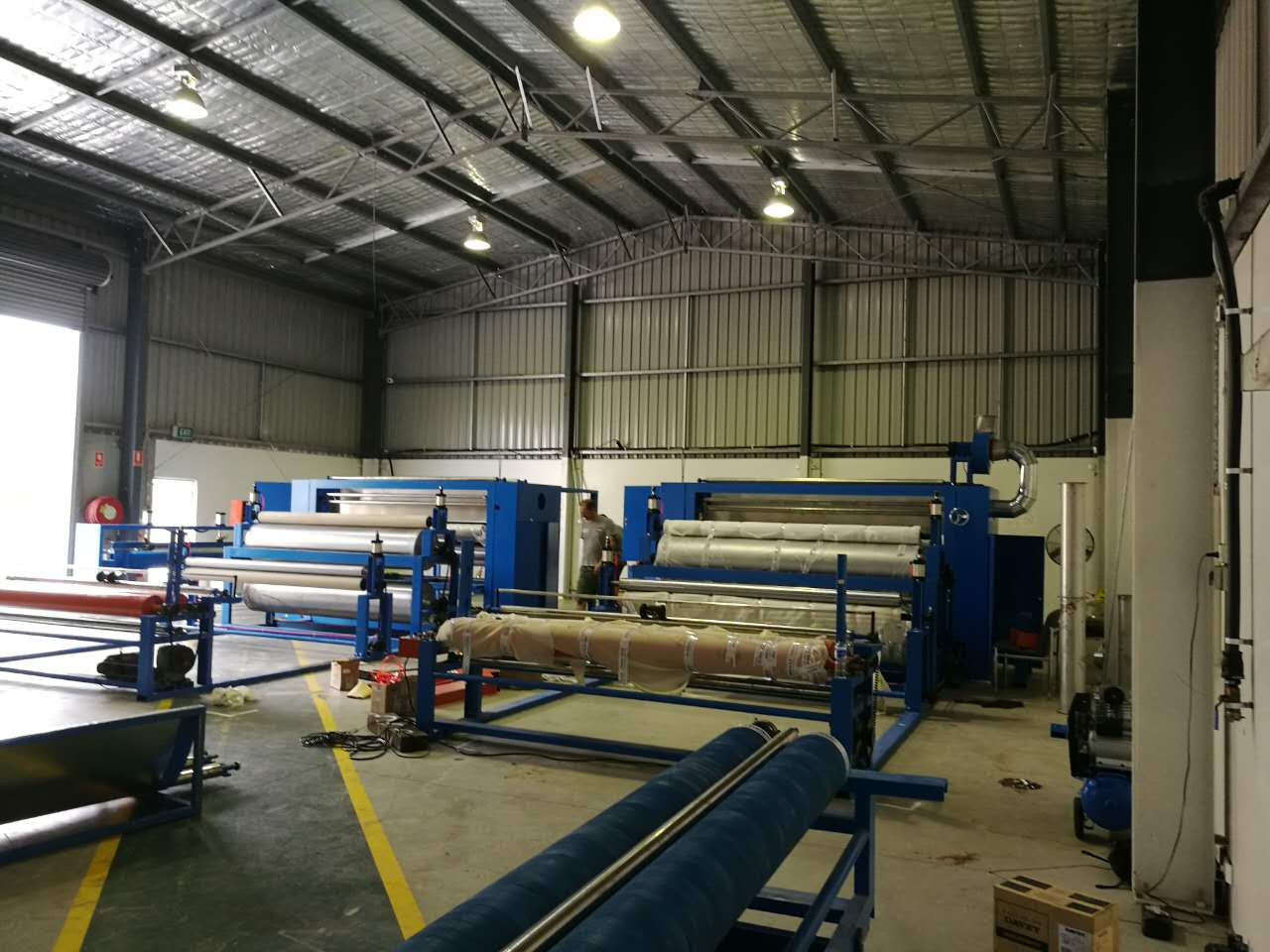
Flame lamination bonds a foam layer directly, without a separate adhesive — one of three distinct mechanisms buyers must separate before comparing machine specifications.
Why the Bonding Mechanism Comes Before the Machine Spec
Machine specifications are comparable only within a single bonding mechanism. Working width, line speed and temperature range mean different things when the bond is formed by chemical cross-linking, by momentary melting of a foam surface, or by a patterned adhesive deposit. Comparing these numbers across mechanisms produces a table that looks analytical but answers nothing.
The practical consequence is sequencing. A buyer should fix the bonding mechanism first, because that decision determines the cure or cooling stage downstream, the site utilities required, the substrate compatibility envelope and the acceptance tests that will eventually prove the line works. Only after that does it make sense to benchmark width, speed and temperature against suppliers.
Kuntai's own portfolio reflects this separation rather than a single universal platform. The company describes laminating machine categories spanning hot-melt glue, solvent-based glue, water-based glue and double-belt press configurations, alongside flatbed composite machines and double-belt press machines compatible with hot-melt adhesive film, hot-melt powder, coating and laminated or vulcanized materials. PUR moisture-reactive hot-melt adhesive equipment and TPU curtain composite equipment appear as distinct listings within that range. The model families discussed here sit inside that wider portfolio, not above it.
Three Mechanisms, Three Production Logics
The table below is a decision aid, not a specification sheet. It lists the dimensions on which the three mechanisms genuinely diverge — and the fields a buyer must confirm with any supplier before an order is placed.
| Decision dimension | PUR hot melt (KT-PUR) | Flame (KT-HY) | Dot coating (KT-DS) |
|---|---|---|---|
| Bonding principle | Moisture-reactive adhesive cross-links after application | An open flame briefly melts a foam surface, which then bonds to the substrate | Adhesive is deposited as discrete dots in a pattern rather than as full coverage |
| Consumable | PUR hot melt adhesive | None — the foam surface becomes the bonding layer | Pattern-applied adhesive |
| Handling after lamination | Requires a curing window; PUR adhesives typically need 24–72 hours for full chemical cross-linking | Can be handled once the melted layer has cooled | Can be handled once the adhesive sets |
| Site utilities to confirm | Electrical heating capacity, temperature control zones, curing space, humidity conditions | Combustible gas supply, combustion air, exhaust and fire-safety provisions | Electrical heating, pattern roller drive, adhesive supply |
| Application focus | Garment, car trim, healthcare | Automotive seating | Carpet |
| Primary constraint | Cure time and moisture discipline | Substrate must tolerate flame and the foam must be thermoplastic | Peak bond strength is pattern-dependent, not uniform |
KT-PUR: When the Bond Has to Survive Washing, Wear and Skin Contact
PUR lamination is chosen when the finished laminate has to hold under conditions that rule out a simple thermoplastic bond. The adhesive reacts with ambient moisture and cross-links, which is why the process does not end when the roll leaves the machine. PUR hot melt adhesives typically require 24–72 hours for full chemical cross-linking, and that window has to be planned into production scheduling rather than discovered at the packing station.
For garment, car trim and healthcare work — the three areas Kuntai addresses with its KT-PUR family — this curing behaviour matters for different reasons. Garment laminates may face repeated washing. Car trim faces heat cycling and interior durability expectations. Healthcare materials face handling and cleaning protocols. In all three, a bond that reaches full strength only after a defined curing period is acceptable; a bond that never reaches it is not.
The practical implication for procurement is that a PUR line should be evaluated together with its curing arrangements, not in isolation. Buyers should ask how the curing area is dimensioned, how temperature and humidity are held during curing, and how adhesive dispensing is cleaned and maintained between shifts. Kuntai's product listings describe PUR moisture-reactive hot-melt adhesive laminating equipment as a distinct category within its range, which allows the machine to be specified as a process rather than a standalone unit.
KT-HY: When the Foam Is the Adhesive
Flame lamination works differently at a fundamental level. An open flame is passed across the surface of a polyurethane foam, melting a thin layer that is immediately pressed against a fabric or film. No separate adhesive is applied. The foam surface itself becomes the bonding layer.
For automotive seating — the application focus of the KT-HY family — this is an established route because the laminate can be produced continuously and the bond forms as the melted layer cools. Kuntai's application scope explicitly includes the car trim sector alongside sports products, healthcare, garment, upholstery, footwear, construction, aviation and home textiles, which places automotive seating within a broader technical textile application base rather than an isolated niche.
The constraint is equally fundamental. Flame lamination requires a foam that responds to brief melting and a substrate that tolerates the flame path. Materials that scorch, shrink or degrade under direct flame are outside the process envelope, and the resulting hand-feel on the foam side differs from an adhesive-bonded laminate. Buyers should treat flame lamination as a material-specific process, not a general-purpose substitute for adhesive bonding.
KT-DS: When Softness and Airflow Matter More Than Peak Bond Strength
Dot coating takes a third approach. Instead of covering the full surface with adhesive, the machine deposits a pattern of discrete adhesive dots. The laminate keeps a softer hand, retains a degree of airflow between the layers, and uses less adhesive than a full-coverage process. For carpet — the application focus of the KT-DS family — those properties are often the reason the process is selected in the first place.
Carpet lamination is broader than dot coating alone. Kuntai also describes a water-based glue mesh-belt carpet laminating machine for laminating fabric, foam, nonwoven, EVA, leather, velvet, plush, synthetic leather and carpet. That means a carpet producer evaluating Kuntai is really choosing between adhesive systems and application methods, not simply between machine sizes. Dot coating sits at the softer, more breathable end of that range; full-coverage adhesive systems sit at the higher-bond-strength end.
The trade-off is direct: because the bond is discontinuous by design, peak bond strength depends on the dot pattern, the adhesive rheology and the substrate surface. Buyers specifying a dot coating line should therefore define the pattern and the required peel performance together, and test both on production material rather than on a lab substitute.
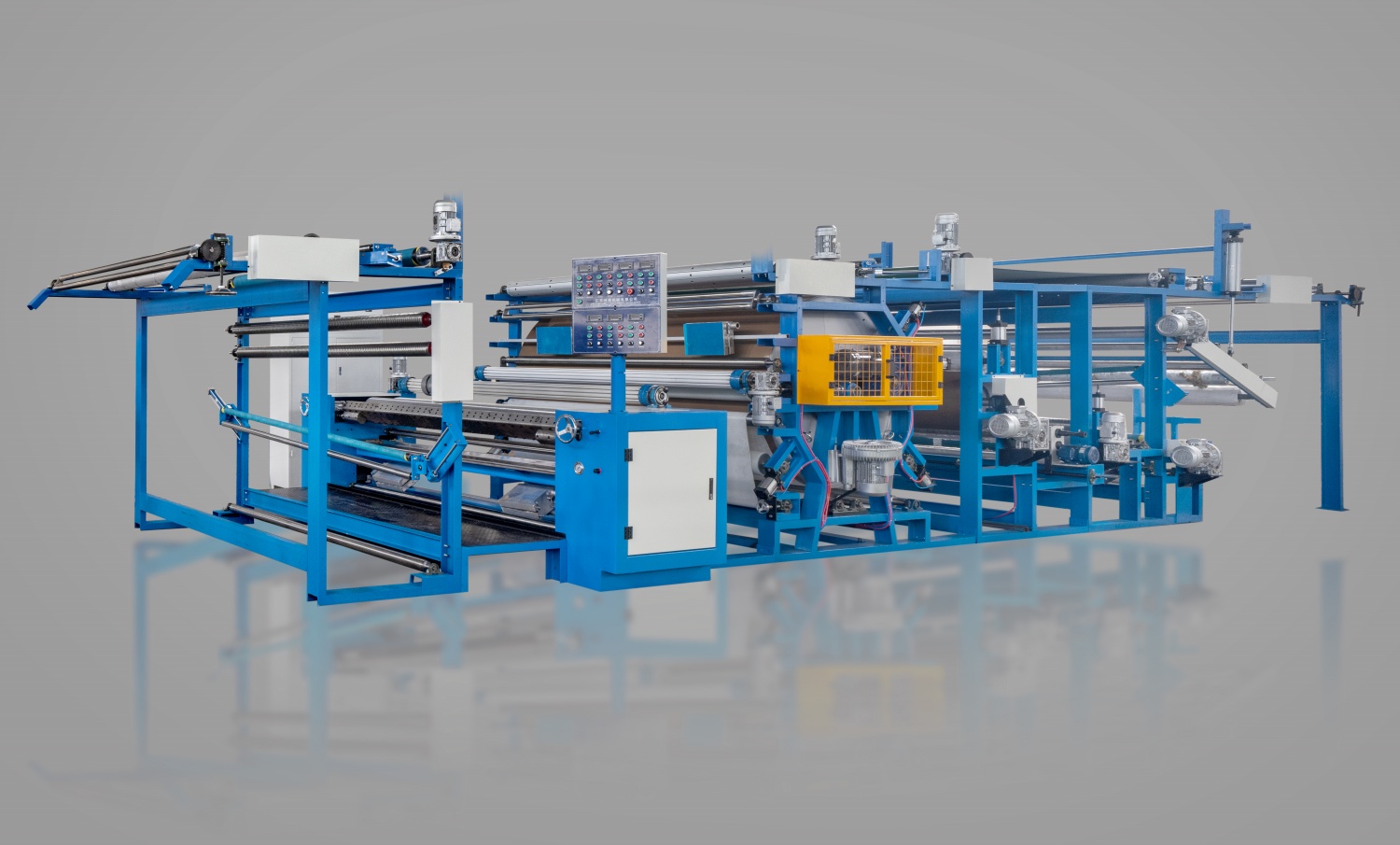
Combined coating and laminating configurations are common in light industry, but the heating method and utility requirements still have to be matched to the site.
Heating Method Is a Site Decision, Not a Machine Detail
Among the factors buyers most often defer, heating method has one of the longest-lasting consequences. Electric heating is the usual route for adhesive-based processes, where heating zones hold a melt or a roller at a controlled temperature. Flame lamination, by definition, requires a combustible gas supply — typically natural gas or liquefied petroleum gas — together with combustion air management, exhaust and fire-safety provisions appropriate to an open flame inside an industrial building.
That difference changes the site work, not just the machine order. A flame line may require gas supply capacity, flame-failure interlocks and exhaust routing that an electrically heated PUR or dot coating line does not. Conversely, an electrically heated line places a larger demand on installed electrical capacity and on temperature control stability across the working width. Buyers comparing quotations should make sure each quotation states the heating method, the connected load or gas consumption basis, and the utility works assumed to be in the buyer's scope.
Risk control provisions belong in the same conversation. Kuntai describes frequency converting control as the method used to address overloading risk, with frequency converters integrated into the production process and contingency plans that include frequency converter redundancy. Overheating is handled through temperature monitoring, temperature sensors and automatic thermal shutdown as part of the contingency plan, with thermal protection built into quality assurance procedures. These are the details that determine whether a line recovers from an abnormal condition or becomes an unplanned stoppage.
Specifications to Fix Before the RFQ Goes Out
Once the mechanism is fixed, the RFQ should lock the specification fields that will later be used at acceptance. The most consequential are:
- Maximum material width. This defines the widest laminate the line can produce and should be stated together with the usable width, not only the frame width.
- Line speed range. A single maximum speed figure is insufficient; buyers need the operating range at which bond quality and temperature control remain stable.
- Temperature and pressure windows. These set the process envelope for each substrate and adhesive combination and should be expressed as ranges.
- Adhesive application rate or pattern specification. Critical for PUR and dot coating, where consumption and bond strength are directly linked.
- Substrate thickness range. Both the minimum and maximum thickness the line is designed to handle.
- Cooling or curing provisions. For PUR, the curing arrangement; for flame, the cooling run before winding.
- Safety and control architecture. Interlocks, thermal protection, overload protection and the control platform in use.
Writing these fields into the RFQ does two things. It forces an apples-to-apples comparison between suppliers, and it creates the reference against which pre-shipment testing can be judged. A quotation that omits half of them is not cheaper; it is simply unresolved.
From Selection to Sign-Off: Purchasing Terms and Acceptance
For buyers in the execution stage, commercial terms matter as much as the technical comparison. Kuntai's stated purchasing terms are a minimum order quantity of 1 unit; delivery terms of EXW, FOB, CIF or DDU; acceptance criteria based on a pre-shipment test; and payment terms of 30% deposit with 70% balance before shipment.
The pre-shipment test is the point where the framework either holds or collapses. A meaningful test should run the machine on the buyer's actual substrate and adhesive, verify the temperature and pressure windows recorded in the RFQ, confirm the control interlocks and thermal protection behave as specified, and produce a laminate sample that the buyer retains. For PUR lines, the sample should also be assessed after the curing window rather than immediately after lamination, because full cross-linking typically takes 24–72 hours.
Delivery terms deserve the same attention. EXW, FOB, CIF and DDU allocate risk, insurance and import responsibility very differently, and the choice interacts with HS classification. Machinery for coating or impregnating textile fabrics is classified under HS Code 84518080, which buyers should confirm with their customs broker before finalising an Incoterm, since the classification affects duty and documentation rather than the machine itself.
Market Context Behind the Comparison
The wider market gives some indication of where demand is moving. The global industrial laminating machine market was estimated at 3.123 billion USD in 2024. Within that broader category, the global hot melt adhesive laminating machine market is predicted to grow at a compound annual growth rate of 7.1% from 2026 to 2032. Both figures come from commercial research sources and should be read as directional rather than precise.
The direction is consistent with what the technology comparison suggests. Adhesive-based lamination, and hot melt systems in particular, are associated with solvent-free processing and with technical textile applications where bond performance under washing, heat and wear is a specification rather than a preference. Flame lamination remains established in foam-based applications such as automotive seating, while dot coating retains its position where hand-feel and airflow are part of the product requirement. These are complementary process families, not a single technology displacing the others.
Where This Framework Stops
A comparison framework is only useful if its boundaries are stated. Three limits apply here.
First, this guide covers light industry lamination of flexible materials. It does not extend to continuous high-precision composite processes such as UD impregnation, crossply construction, powder scattering or double-belt press consolidation, which Kuntai also manufactures but which follow a different selection logic based on fibre architecture, impregnation control and consolidation pressure rather than adhesive mechanism alone.
Second, none of the three mechanisms is universally superior. Flame lamination is ruled out by substrates that cannot tolerate flame. PUR lamination is ruled out where a 24–72 hour curing window cannot be accommodated in the production flow. Dot coating is ruled out where a continuous, uniform bond at maximum strength is the governing requirement. A buyer who selects on price alone will usually discover one of these limits after installation.
Third, this article deliberately avoids quoting maximum material width, line speed or temperature values for individual models. Those figures must come from the supplier's current technical documentation and be verified against the buyer's own substrate, because a specification that has not been tested on the actual material is an assumption rather than a capability.
Long-Term Ownership: What Keeps a Lamination Line Running
The comparison framework above answers which mechanism to buy. It does not answer whether the supplier will still be useful five years after commissioning, which is where long-term evaluation becomes a separate exercise.
The evidence available on Kuntai is documentary rather than operational. The company reports more than four decades in coating, laminating, impregnation and cutting machinery, a 30,000 m² factory, 210 employees, an annual output of 650 units and a research and development team of 8 engineers. Export business accounts for 70% of total sales across North America, South America, Europe, South Asia, Africa and the Middle East — a spread that implies spare-parts and service arrangements across multiple time zones. Quality system statements reference ISO 9001 and CE requirements.
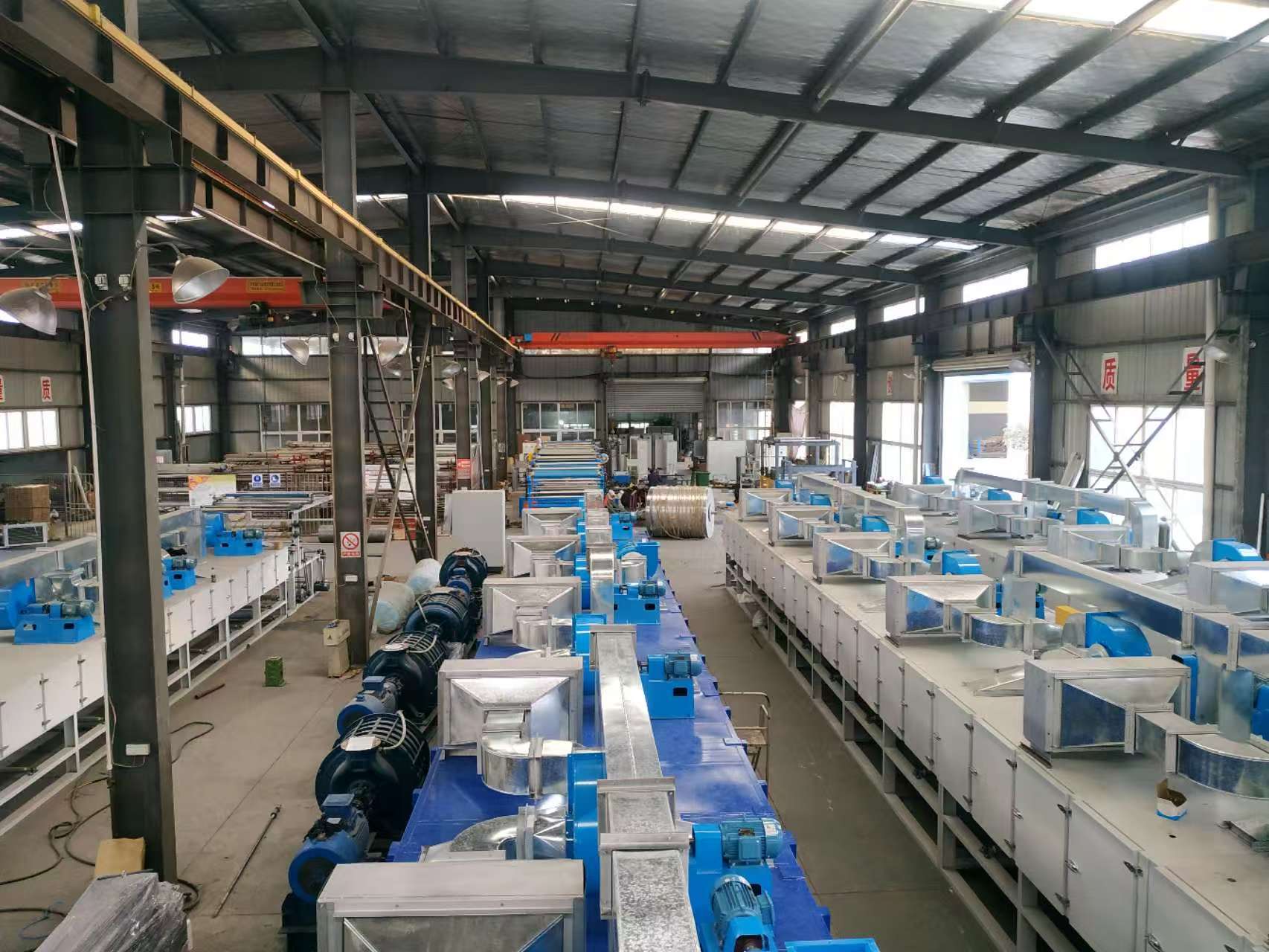
In-house machining and assembly capacity is one of the factors buyers weigh when assessing a laminating machine supplier for a multi-year relationship.
What these facts support is a supplier-screening judgement, not a performance guarantee. Staffing levels, factory area and stated output indicate that the organisation has the scale to support a machine through its service life. They do not by themselves prove bonding performance, uptime or response time — those require customer references, factory acceptance test records and service-level commitments negotiated into the contract. Buyers should treat the company data as a reason to proceed to due diligence, not as a substitute for it.
The risk-control details described earlier belong to the same long-term picture. Frequency converters addressing overloading, temperature sensors and automatic thermal shutdown addressing overheating, and thermal protection embedded in quality assurance procedures are not marketing points — they are the difference between a line that tolerates an abnormal event and one that requires a service visit. For a buyer planning a five- to ten-year asset life, these provisions should be confirmed at acceptance rather than assumed.
Future Outlook
Two developments are likely to shape how this comparison evolves. The first is the continued expansion of adhesive-based lamination into technical textile applications, consistent with the growth projected for hot melt adhesive laminating machinery. As more applications specify bond performance under washing, heat and chemical exposure, the curing discipline that PUR lamination demands becomes a normal part of production planning rather than a specialist concern.
The second is procedural. Buyers are increasingly treating acceptance criteria, delivery terms and risk-control provisions as part of the technical comparison rather than as commercial afterthoughts. That shift favours suppliers who can document control architecture, thermal protection and load handling clearly — and it makes the pre-shipment test the central evidence event in a machine purchase.
Neither development changes the underlying logic. The bonding mechanism still comes first; specifications still follow; acceptance still proves the line. What changes is how much of that sequence buyers are willing to leave undocumented.
FAQ
What purchasing terms and acceptance criteria apply to Kuntai laminating machines?
The stated terms are a minimum order quantity of 1 unit, delivery terms of EXW, FOB, CIF or DDU, acceptance criteria based on a pre-shipment test, and payment terms of 30% deposit with 70% balance before shipment. The pre-shipment test is the formal acceptance event and should be conducted against the specification fields agreed in the RFQ.
How does Kuntai control overloading risk on a lamination line?
Overloading is addressed through frequency converting control. Frequency converters are integrated into the production process to prevent overloading, and contingency plans include frequency converter redundancy so that a converter failure does not immediately halt the line.
How is overheating managed during continuous operation?
Overheating is managed through temperature monitoring using temperature sensors, combined with automatic thermal shutdown as part of the contingency plan. Thermal protection is also incorporated into quality assurance procedures to prevent overheating damage.
Which Kuntai machine family fits carpet lamination?
KT-DS dot coating is positioned for carpet. Kuntai also describes a water-based glue mesh-belt carpet laminating machine for laminating fabric, foam, nonwoven, EVA, leather, velvet, plush, synthetic leather and carpet, so carpet producers typically compare adhesive system and application method together rather than selecting a single machine type.
Where does Kuntai export, and how large is its engineering team?
Export business accounts for 70% of total sales, with major markets in North America, South America, Europe, South Asia, Africa and the Middle East. The research and development team consists of 8 engineers, within a total workforce of 210 employees.
Kuntai's full company and product documentation is available as a downloadable brochure: Kuntai company profile (PDF).
Have Questions or Need More Details?
Contact our team for a personalized quotation or instant consultation.
Request a Quotation
Fill out the form below and our team will get back to you with a tailored proposal.
WhatsApp Direct Chat
Prefer to chat in real-time? Message us on WhatsApp for instant assistance & quick answers.
- Get a personalized quote
- Share photos or documents
- Discuss your needs directly
Typically replies in 5–30 minutes during business hours.