
PVA for Biotech & Medical Innovation: A Buyer Decision Framework
PVA for Biotech & Medical Innovation: A Buyer Decision Framework
In biotech and medical sourcing, polyvinyl alcohol (PVA) is a specification decision before it is a price decision. Degree of hydrolysis, degree of polymerization, solution viscosity and solubility determine whether a grade can be coated onto a slow-release substrate, sprayed onto a non-woven web, or spun into a high-strength fiber — and whether it dissolves in the mixing equipment the plant already owns. This framework sets out how to read those four parameters, how four frequently quoted grades differ, and which terms and acceptance criteria belong in the purchase order.
Why the grade decision comes before the supplier decision
Polyvinyl alcohol is manufactured by alcoholysis of polyvinyl acetate. How far that reaction is taken is the variable that separates one grade from another, and it governs whether the polymer dissolves in cold water or requires water above 80 °C, how much acetate character remains in the dried film, and how the material behaves as a coating, a binder, a protective colloid or a fiber precursor.
The category is large and still expanding. The global PVA market was estimated at USD 1.21 billion in 2025 and is projected to reach USD 1.66 billion by 2033, according to Grand View Research. China is the world's leading exporter of PVA in primary forms, with export values of approximately USD 366.6 million in 2024, based on UN Comtrade data. Supply remains concentrated among a limited group of producers, including Kuraray Co., Ltd., Sekisui Specialty Chemicals, Mitsubishi Chemical and Anhui Wanwei Group, as listed by Straits Research.
None of that scale helps an individual sourcing team, however, because the dominant failure modes are not availability problems. The first is a solubility mismatch: a fully hydrolyzed grade specified for hot-water dissolution arrives at a site equipped only for cold mixing, or a partially hydrolyzed cold-water-soluble grade is expected to deliver the moisture resistance of a fully hydrolyzed film. The second is a viscosity mismatch: a viscosity figure is quoted without the concentration and temperature at which it was measured, and it is then compared against an existing formulation that was validated under a different method. Both failures are avoidable at the specification stage, and both are expensive once a batch has been coated, sprayed or spun.
The four parameters to read on every TDS
1. Degree of hydrolysis (DH)
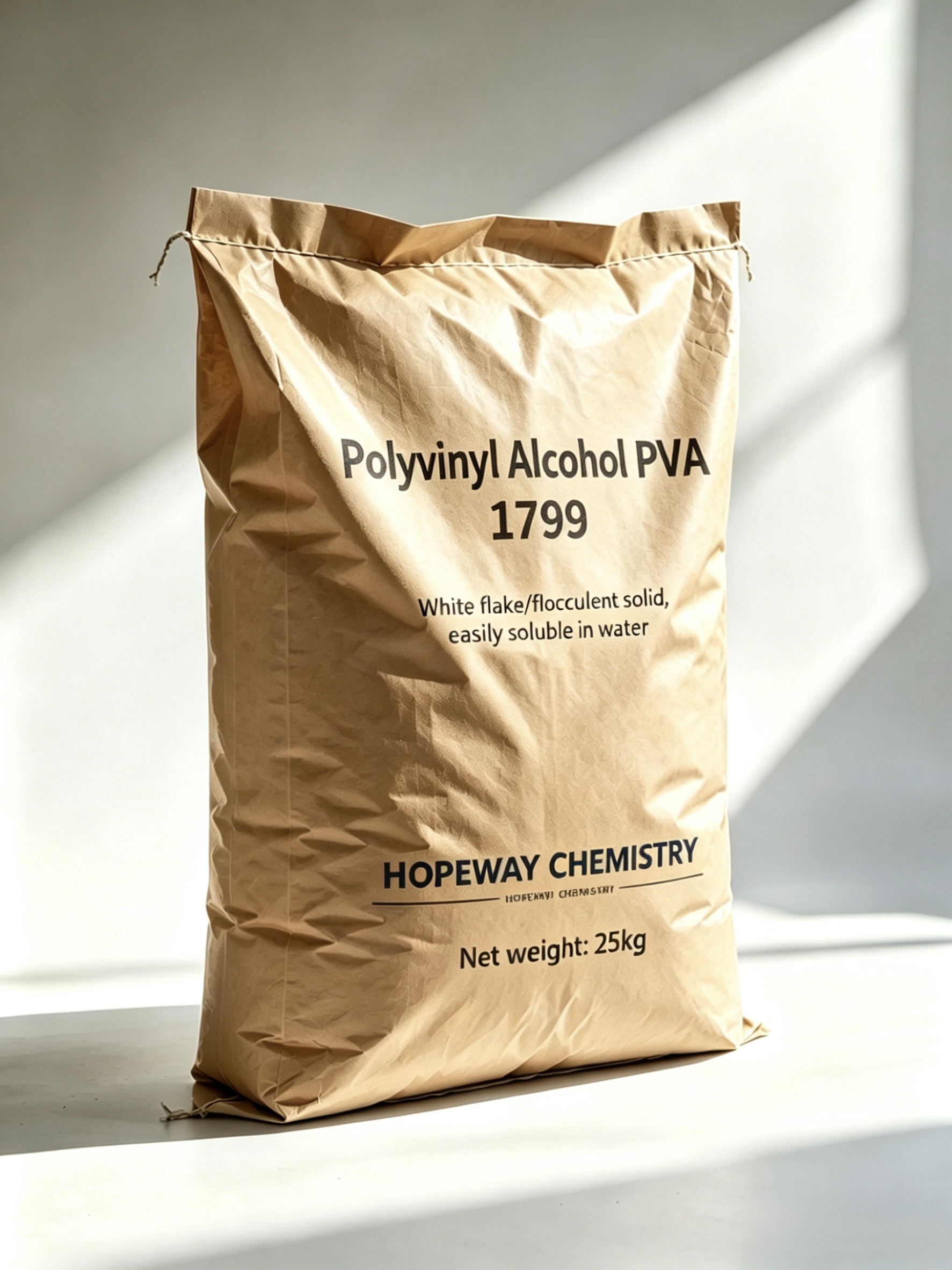
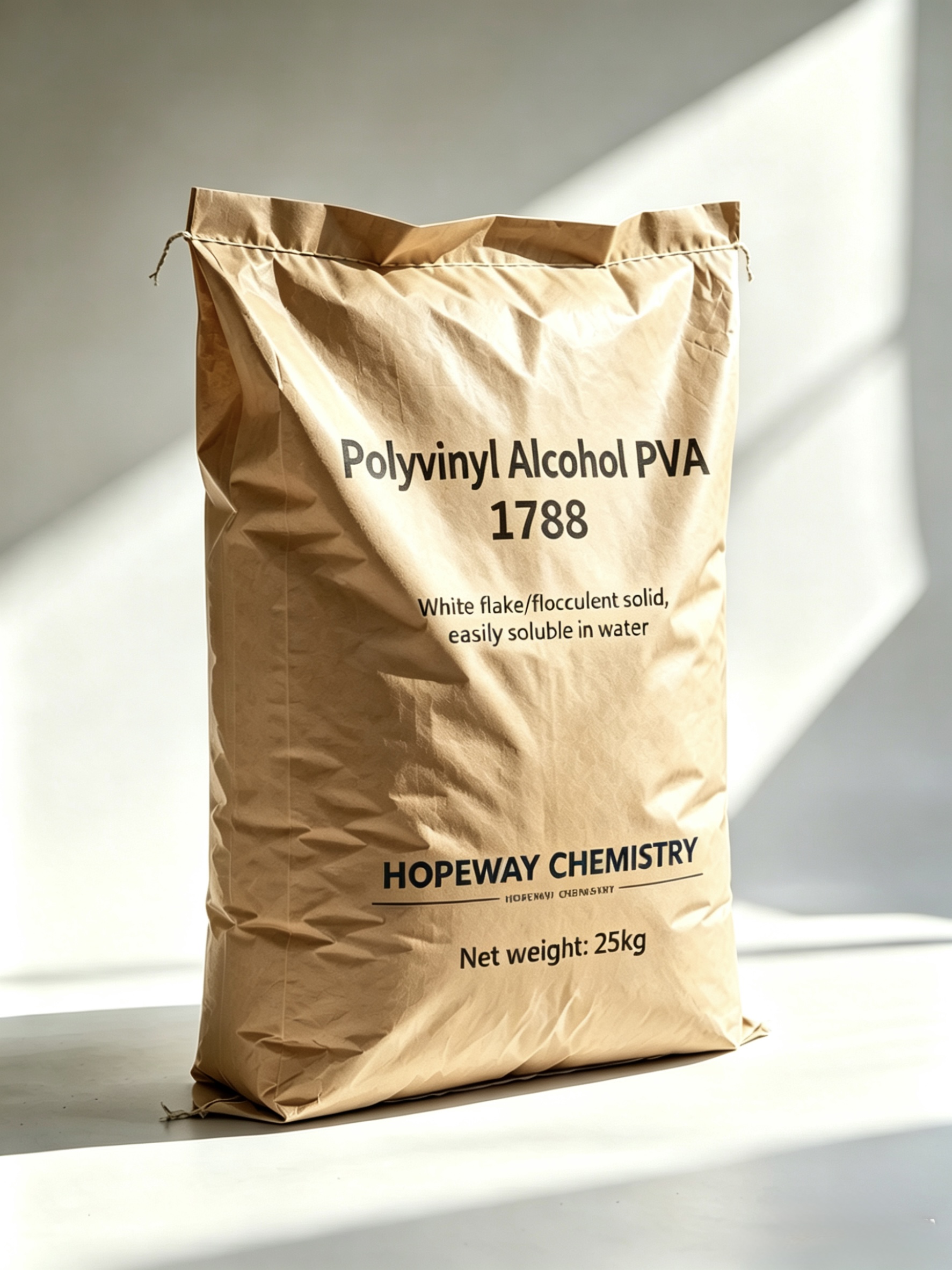
Hydrolysis separates two families. Fully hydrolyzed grades carry a degree of hydrolysis of 98–99%; partially hydrolyzed grades carry 87–89%. In the grade set discussed here, PVA 2499, PVA 1799 and PVA 0599 are fully hydrolyzed, while PVA 1788 is partially hydrolyzed. Practically, the partially hydrolyzed family dissolves in cold water, which is why cold-water-soluble grades appear in construction adhesives, paper sizing and similar processes. Fully hydrolyzed grades are not readily cold-water soluble: PVA 1799 is specified as dissolving in water above 80 °C, and PVA 2499 is specified as hot water soluble.
2. Degree of polymerization (DP)
DP describes average chain length. Within the corpus grades it ranges from approximately 500 for PVA 0599 to approximately 2400 for PVA 2499, with PVA 1799 and PVA 1788 both at approximately 1700. Longer chains generally raise solution viscosity and produce more cohesive films, which is why the highest-DP grade in this set is also the one linked to high-strength PVA fiber and PVB resin raw material.
3. Viscosity
Viscosity is the process-facing number: it tells a coating or sizing line how the solution will flow, drain and level. The published values in this set are 5–7 mPa·s for PVA 0599, 20.5–28 mPa·s for PVA 1788, 22–30 mPa·s for PVA 1799 and 45–58 mPa·s for PVA 2499. Viscosity is a measured property, not an intrinsic constant; a value is only comparable with another value when concentration, temperature and instrument are the same. Buyers should require the test method to be stated on the TDS rather than accepting a bare number.
4. Solubility
Solubility class is the parameter that most often determines whether a qualification can proceed at all. It should be written into the specification as a class — cold water soluble, or soluble above a stated temperature — and verified with an in-house dissolution trial, not inferred from the grade name.
Four grades, four performance envelopes
| Grade | Hydrolysis class | Degree of polymerization | Degree of hydrolysis | Viscosity | Dissolution |
|---|---|---|---|---|---|
| PVA 2499 | Fully hydrolyzed | ≈2400 | 98–99% | 45–58 mPa·s | Hot water soluble |
| PVA 1799 | Fully hydrolyzed | ≈1700 | 98–99% | 22–30 mPa·s | Dissolves in water above 80 °C |
| PVA 1788 | Partially hydrolyzed | ≈1700 | 87–89% | 20.5–28 mPa·s | Cold water soluble |
| PVA 0599 | Fully hydrolyzed | ≈500 | 98–99% | 5–7 mPa·s | Not stated in the published grade data; confirm the dissolution temperature on the supplier TDS |
Two observations follow from this table and are frequently missed in sourcing documents. First, PVA 1788 and PVA 1799 share almost identical chain length — both around 1700 — and are therefore often grouped together in conversation, yet they sit on opposite sides of the solubility line because their hydrolysis differs by roughly ten percentage points. Treating them as interchangeable is a common and costly error. Second, PVA 0599 and PVA 1788 have similar viscosities for entirely different reasons: one is a short fully hydrolyzed chain, the other is a longer partially hydrolyzed chain. Identical viscosity does not mean identical film behaviour.
Matching each profile to medical and biotech needs
The value of a grade framework is that it lets a sourcing team work backwards from the process requirement to the parameter, rather than forwards from a familiar grade code.
Slow-release medical substrate and pharmaceutical coating
PVA 0599 is the grade in this set whose documented applications include pharmaceutical coating and slow-release medical substrate, alongside special acetal resin and fine chemical dispersant. Its profile — DP approximately 500, hydrolysis 98–99%, viscosity 5–7 mPa·s — produces a low-viscosity solution that supports thin, even coating layers, while the fully hydrolyzed chemistry is consistent with a film that does not readily redissolve in cold water at room temperature. For a coating that must remain intact during handling and storage, that combination of low solution viscosity and low cold-water solubility is the reason the grade is specified rather than a partial-hydrolysis alternative.
Water-resistant coatings
Where the film must resist moisture, the documented grades are PVA 2499 (water-resistant coating, cement reinforcing agent, high-strength PVA fiber, and raw material for PVB resin and film) and PVA 1799 (water-resistant paper coating and high-temperature industrial adhesive, among other uses). Both are fully hydrolyzed at 98–99%; the difference between them is chain length and therefore viscosity and mechanical cohesion. A higher-DP grade gives a more viscous working solution and, generally, a stronger and more water-resistant film, at the cost of more demanding dissolution.
Dispersant
Fine chemical dispersant is a documented application of PVA 0599. Low DP and low viscosity are the relevant attributes here: a dispersing or stabilizing solution needs to wet and separate particles without thickening the system to the point where mixing and pumping become impractical. For context, PVA also serves as the stabilizer and protective colloid in vinyl acetate-ethylene copolymer emulsions produced by the same supplier, which is the same functional logic applied in a different product family.
High-strength fiber
High-strength PVA fiber is a documented application of PVA 2499, the highest-DP, highest-viscosity grade in this set. Fiber spinning draws on long polymer chains; short chains such as those in PVA 0599 cannot deliver the same cohesive strength, which is why grade selection for fiber and for coating point in opposite directions even though both use the same polymer chemistry.
Cold-dissolution processes and non-woven medical substrates
Where the plant runs cold dissolution only, the specification must move to the partially hydrolyzed family — PVA 1788 at 87–89% hydrolysis and cold water soluble. The same solubility logic appears explicitly in one documented construction application: only 87–89% partially hydrolyzed PVA is applicable to alkaline cement systems, and fully hydrolyzed PVA is excluded because of poor cold solubility. The chemical argument does not change with industry, so any medical line that mixes at ambient temperature should treat hydrolysis class as a hard constraint rather than a preference.
For disposable medical non-wovens, the documented production route for mask and gown binder uses a cold-soluble PVA aqueous solution spray-coated onto the fiber web, dried in a tunnel oven at 100–130 °C in a sterile workshop, with skin contact as the end use. The stated requirements for that route are ultra-low heavy metal content, formaldehyde-free formulation and conformity with medical hygiene certification. In that scenario the referenced grade is PVA 0588 — DP approximately 500, hydrolysis 87–89%, viscosity 4.5–6.0 mPa·s, cold water soluble — which illustrates the general rule: in medical non-woven bonding, cold solubility and purity documentation outrank film strength in the grade decision.
Where each choice stops working: limits and trade-offs
A grade framework is only useful if it states where each option fails.
- Hot-water dissolution is a capital constraint. PVA 2499 is hot water soluble and PVA 1799 requires water above 80 °C. If a site has no heated dissolving vessel, no temperature control and no qualified dissolution procedure, these grades cannot simply be substituted with a cold-soluble alternative without re-validating the coating or film performance.
- Cold solubility costs water resistance. PVA 1788 dissolves in cold water because its hydrolysis sits at 87–89%. That same residual acetate character is what generally limits its moisture resistance and cohesion compared with 98–99% grades. Buyers who want cold processing and maximum water resistance are choosing between two properties, not selecting a better grade.
- Low viscosity is not a free improvement. PVA 0599 offers the lowest viscosity in this set at 5–7 mPa·s, which suits thin coatings and dispersant duty, but a DP of approximately 500 generally means lower film strength than the DP≈2400 grade. Where a coating must also carry mechanical load, the low-viscosity choice becomes a design restriction.
- Powder handling has its own constraint. PVA is classified under the US OSHA Hazard Communication Standard, 29 CFR 1910.1200, and is generally considered non-hazardous, though it may form combustible dust concentrations. Dust control and housekeeping belong in the qualification package for any facility handling bulk powder.
- Supplier documentation is not regulatory approval. Certificates of analysis, technical data sheets and safety data sheets support qualification, customs clearance and audits, but they do not replace the buyer's own release testing or regulatory filings for a medical device or pharmaceutical use. Final acceptance criteria and pharmacopeia-level verification remain the buyer's responsibility — an important boundary when a supplier presents a full documentation set.
Purchasing terms and acceptance criteria: a checklist
The following checklist converts the parameter discussion into order-level language. It is written to be attached to an RFQ or to a technical annex in a supply agreement.
| Item | What to specify | Why it changes acceptance |
|---|---|---|
| Grade identity | Full model designation — for example PVA 2499, PVA 1799, PVA 1788, PVA 0599 — plus hydrolysis class | Grade codes imply chemistry but not lot control; the hydrolysis class is the primary performance gate |
| Degree of hydrolysis | The numeric range, stated as 98–99% or 87–89% | Sets cold-water solubility versus moisture resistance |
| Degree of polymerization | Target value with an agreed tolerance | Drives solution viscosity and film cohesion |
| Viscosity | Value plus test concentration, temperature and instrument | Values measured under different methods are not comparable |
| Dissolution behaviour | Cold water soluble, or dissolution temperature above 80 °C for grades such as PVA 1799 | Determines mixing equipment, cycle time and energy requirement |
| Particle size / mesh | Agreed mesh range; mesh size, logo and packaging can be customized under OEM/ODM terms | Affects dissolution speed, dust generation and feeding behaviour |
| Purity indicators | Moisture, ash and sodium acetate limits | Low ash and low moisture targets protect downstream formulation stability |
| Documentation | Per-lot COA, TDS, MSDS and third-party test reports | Supports internal qualification, audits and customs clearance |
| Sample and validation | A pre-order sample for a formula or dissolution trial | Small test samples are available before bulk order, which reduces scale-up risk |
| Commercial terms | Minimum order quantity, lead time, Incoterms and payment method | Documented terms include MOQ of 5 tons, lead time of 7–10 days, FOB, CFR, CIF or EXW, and T/T or L/C |
| Supply continuity | Annual volume against stated capacity and stock policy | PVA capacity is stated at 350,000 MT per year, with actual annual PVA output of 306,400 tons in the latest fiscal year |
The supplier side of that checklist matters as much as the specification side. HOPEWAY CHEMICAL INDUSTRIAL CO., LIMITED is a Chinese integrated manufacturer and exporter of polyvinyl alcohol, construction chemicals and high-performance polymer materials, headquartered in Xiamen, Fujian, and operating four production bases across China with 4,451 employees and 731 R&D personnel. Its stated product compliance framework includes EU EPD, ISCC and EcoVadis environmental standards, and its stated quality approach is 100% testing. For a grade-continuity question, supply history is relevant evidence: one documented textile customer program purchases 850 tons of PVA 1799 annually in monthly 20GP containers under a cooperation running more than two years, which is useful context when assessing whether a DP≈1700 fully hydrolyzed grade can be delivered consistently at volume.
Market trend: what is changing in PVA demand
Two forces are shifting the demand mix in ways that affect medical and biotech buyers. The first is the general move toward water-soluble and biodegradable solutions: the global market for PVA films for packaging is expanding at a CAGR of 7.1% from 2026 to 2034, driven by that demand, according to MarketsandMarkets reporting distributed via PR Newswire. Water-soluble behaviour is a PVA property that packaging and single-use medical products share, which raises the value of hydrolysis control across adjacent supply chains.
The second is documentation discipline. Environmental and compliance expectations around polymer suppliers have moved from marketing claims to auditable standards, and buyers increasingly treat certification readiness as part of the technical evaluation rather than a commercial afterthought. In that environment, a specification that names hydrolysis range, dissolution class and test method is easier to audit than one that names a grade code alone.
Future outlook
The most likely direction for medical and biotech PVA sourcing is consolidation of specifications rather than proliferation of grades. Buyers who have already mapped each application to a hydrolysis and solubility envelope can qualify a second source without repeating the full exercise; buyers who have specified by grade name alone cannot. Expect more emphasis on method-stated viscosity data, on cold-water-soluble grades where energy and equipment constraints bite, and on lot-level documentation as a routine contractual requirement rather than a request. Grade continuity — the ability to receive the same DP and hydrolysis range across years — will remain the quiet test of any supply relationship, because a formulation validated on one chain length does not automatically transfer to another.
FAQ
Fully hydrolyzed PVA carries a degree of hydrolysis of 98–99%, while partially hydrolyzed PVA carries 87–89%. The difference governs solubility: partially hydrolyzed grades such as PVA 1788 and PVA 0588 are cold water soluble, whereas fully hydrolyzed PVA 1799 dissolves in water above 80 °C and PVA 2499 is hot water soluble. Residual acetate character in the partially hydrolyzed family generally limits moisture resistance compared with the fully hydrolyzed family.
PVA 0599 lists pharmaceutical coating, slow-release medical substrate, special acetal resin and fine chemical dispersant among its applications. Its published parameters are a degree of polymerization of approximately 500, a degree of hydrolysis of 98–99% and a viscosity of 5–7 mPa·s. The low polymerization degree keeps solution viscosity low, which supports thin, uniform coating layers.
PVA 2499 is documented for water-resistant coating, high-strength PVA fiber, cement reinforcing agent and raw material for PVB resin and film, with a degree of polymerization of approximately 2400, hydrolysis of 98–99% and viscosity of 45–58 mPa·s. PVA 1799 is documented for water-resistant paper coating and high-temperature industrial adhesive, with a degree of polymerization of approximately 1700, hydrolysis of 98–99% and viscosity of 22–30 mPa·s.
Buyers should confirm the solubility class and, for fully hydrolyzed grades, the dissolution temperature: PVA 1799 is specified as dissolving in water above 80 °C and PVA 2499 as hot water soluble, while PVA 1788 is cold water soluble. Where the published grade data does not state a dissolution temperature — as is the case for PVA 0599 — the temperature should be confirmed on the supplier's technical data sheet and verified with an in-house trial before a qualification batch is committed. Viscosity values should likewise be compared only when concentration and temperature are identical.
Depending on the application, a technical annex should specify grade designation, degree of hydrolysis range, degree of polymerization tolerance, viscosity with its test method, solubility class, particle size or mesh, and moisture, ash and sodium acetate limits. Documentation typically requested includes a per-lot certificate of analysis, technical data sheet, safety data sheet and third-party test reports. Commercial terms commonly documented include a minimum order quantity of 5 tons, a lead time of 7–10 days, FOB, CFR, CIF or EXW trade terms, T/T or L/C payment, and customization of mesh size, logo and packaging under OEM/ODM arrangements. Acceptance criteria and final release testing remain the buyer's responsibility.
A complete grade listing with parameters for the portfolio discussed here is available in the HOPEWAY PVA catalogue (PDF).