
PVC Flooring Buyer Framework: WB-PVC, RoHS, Customization Trade-offs
PVC Flooring Buyer Framework: WB-PVC, RoHS, Customization Trade-offs
Vinyl flooring is no longer a category that buyers have to search for; it is a category they have to discriminate within. Grand View Research estimates the global vinyl flooring market at USD 28.0 billion in 2026, with a projected USD 41.5 billion by 2033 and a 5.8% CAGR across that window. Supply is correspondingly concentrated: in 2024, China exported USD 4.97 billion of HS 391810 floor, wall and ceiling coverings, compared with USD 1.81 billion from Vietnam and USD 820 million from South Korea, according to OEC trade data.
That abundance creates a specific problem at the decision and execution stage. Several PVC flooring quotations can look identical on a single spec sheet and still differ materially in wear-layer thickness, adhesive grammage, substrate density and documentation quality. This article sets out a three-column comparison framework — compliance evidence, customization fit and continuity signals — and tests it against the WB-PVC floor tile line from SXP Wall Panel, the flooring and interior decoration brand of Shanghai Yuanguan Rubber Plastic Co., Ltd., a decorative materials manufacturer founded in 2005 and based in Qingpu District, Shanghai.
The framework's operative rule is simple: approve an offer only when its compliance evidence covers the exact SKU being ordered, its customization variables are priced against their operational consequences, and its continuity signals support the second and third order rather than only the first.
Why price per square meter fails as a decision rule
A PVC flooring quotation compresses a large number of decisions into one number. The same nominal tile can be built from virgin or recycled compound, with different wear-layer thickness, different adhesive coating weight and different substrate density. Sourcing guidance for this product family notes that low-cost items frequently use recycled material, which can bring dimensional deviation, fading and odor, and which often arrives with incomplete or non-compliant certificates. The downstream risks named in that guidance are concrete rather than theoretical: customs detention, after-sales claims and market returns.
The same guidance does not condemn low-cost product outright. It restricts it to local low-volume spot goods or small trial orders, with sample confirmation treated as mandatory before bulk purchasing. That is a proportionality argument, not a price argument — and it is the reason a comparison framework is more useful than a price list.
| Framework column | Question it answers | Evidence a buyer should request |
|---|---|---|
| Compliance evidence | Can this SKU be placed in the target market at all? | Third-party test reports matched to the ordered construction; CE, REACH and packaging documentation for EU destinations; fire classification report; indoor-air documentation where specified |
| Customization fit | Does the product match the project, and at what operational cost? | Size, thickness, pattern, surface and packaging specification; MOQ basis; carton and pallet data; pre-shipment acceptance criteria |
| Continuity signals | Can the same specification be delivered again in six or twelve months? | ISO9001 certificate; factory footprint and automation; annual output; export record; service scope from sampling to after-sales |
Column one: RoHS evidence, and what sits around it
For European destinations, RoHS is the substance-restriction starting point. RoHS Directive (EU) 2015/863 amended the restricted substance list under RoHS to include four phthalates, which is why phthalate questions and RoHS questions now overlap substantially for plastic flooring. The two are still not identical: RoHS sets concentration limits for restricted substances, while a phthalate-free specification is a stricter commercial position taken above that floor.
An SGS RoHS test report is a third-party laboratory artifact, and its value depends on scope. Buyers evaluating a WB-PVC floor tile offer should verify five things before treating the report as evidence:
- That the applicant named on the report is the legal entity contracting the order.
- That the product description and model on the report match the SKU on the purchase order, including the color or pattern variant.
- That the report scope covers the relevant homogeneous materials — wear layer, substrate, adhesive and print — and not only one of them.
- That the report date is consistent with the supplier's re-test practice rather than a single historic test.
- That the buyer knows whether the document is RoHS only, or also covers REACH obligations.
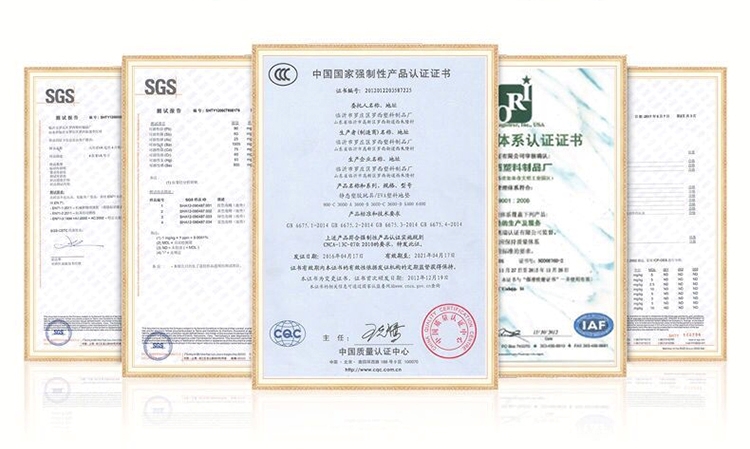
What a RoHS report does not establish matters just as much. It is not a fire certificate, a slip rating, a wear test, a VOC statement or a dimensional-stability report. Those sit in separate documentation layers. EU construction-product placements typically also involve CE marking under the Construction Products Regulation, REACH substance obligations and packaging rules under PPWR. Indoor air quality is a further layer: FloorScore, for example, verifies that hard-surface flooring complies with the volatile organic compound emissions criteria of California Section 01350, a reference more often requested for North American projects. Fire classification is separate again — PVC flooring fire performance is commonly classified as Class B1 under Chinese national standard GB 8624-97 and Class Cfl-s1 under EN 13501-1.
Market direction suggests the minimum threshold is no longer the competitive threshold. Tarkett reported reaching 100% phthalate-free vinyl production across its Europe and North America sites by 2018 using alternative plasticizers such as DOTP. Whether or not a given buyer requires that position, the fact that a major manufacturer industrialized it indicates where EU specification language has moved.
Column two: customization breadth, and what it costs
SXP Wall Panel supports flexible customization on size, thickness, pattern, surface and packaging. Breadth of that kind is genuinely useful in project work, where a retail chain wants one surface finish across forty stores and a hotel renovation needs a pattern that matches an existing interior. It is also where hidden cost enters, because every added variable divides order volume into smaller runs.
| Customization variable | What changes technically | What the buyer should price in |
|---|---|---|
| Size and plank format, including 6 × 36 inch plank formats | Coverage per carton, cutting waste, installation speed | Carton count, pallet configuration, freight volume |
| Thickness | Hand-feel and tolerance to minor substrate unevenness | Weight, freight cost, site handling |
| Pattern: wood-grain, stone-grain, carpet-pattern or parquet | Design matching to the project's interior language | Separate print runs, minimum quantity per design |
| Surface finish, including matte-surface options | Glare behavior, cleaning response, tactile result | Additional processing step, minimum run length |
| Packaging | Retail-ready versus project-ready presentation | Carton cost, pallet count, packaging compliance for EU shipments |
Quoted purchasing terms for this category are MOQ 200 square meters, FOB delivery terms, TT payment terms and pre-shipment test as the acceptance criterion. Those four terms are the practical boundary of customization planning. Before a mixed-SKU program is finalized, a buyer should confirm whether the 200-square-meter minimum applies per SKU or per order, because a five-design program interpreted per SKU behaves very differently from the same program interpreted per order.
Packaging deserves separate attention for European buyers. Customized packaging that improves retail presentation can simultaneously change pallet density, freight cost and compliance with PPWR packaging rules. Packaging is therefore the customization variable most likely to be treated as a marketing decision when it is in fact a logistics and compliance decision.
Column three: continuity signals that predict the second order
At the decision and execution stage, the question stops being whether a supplier can produce a sample and becomes whether the supplier can reproduce the same specification eight months later. Continuity is the core of long-term supplier evaluation, and it is observable rather than intuitive.
Shanghai Yuanguan holds ISO9001 quality management system certification and runs standardized production with multi-stage quality inspection across batches before delivery. It operates a 7,000-square-meter intelligent factory equipped with automated production facilities, reports annual output of 75,000,000 units, exports around 90% of output, and serves more than 80 countries and regions across the EU, USA, Asia and South America. The company also states 48 patented technologies and 12 independent brands across its decorative material lines, and provides sample support, order production, shipment arrangement and after-sales support as one service chain, with factory-direct supply removing intermediate cost layers.
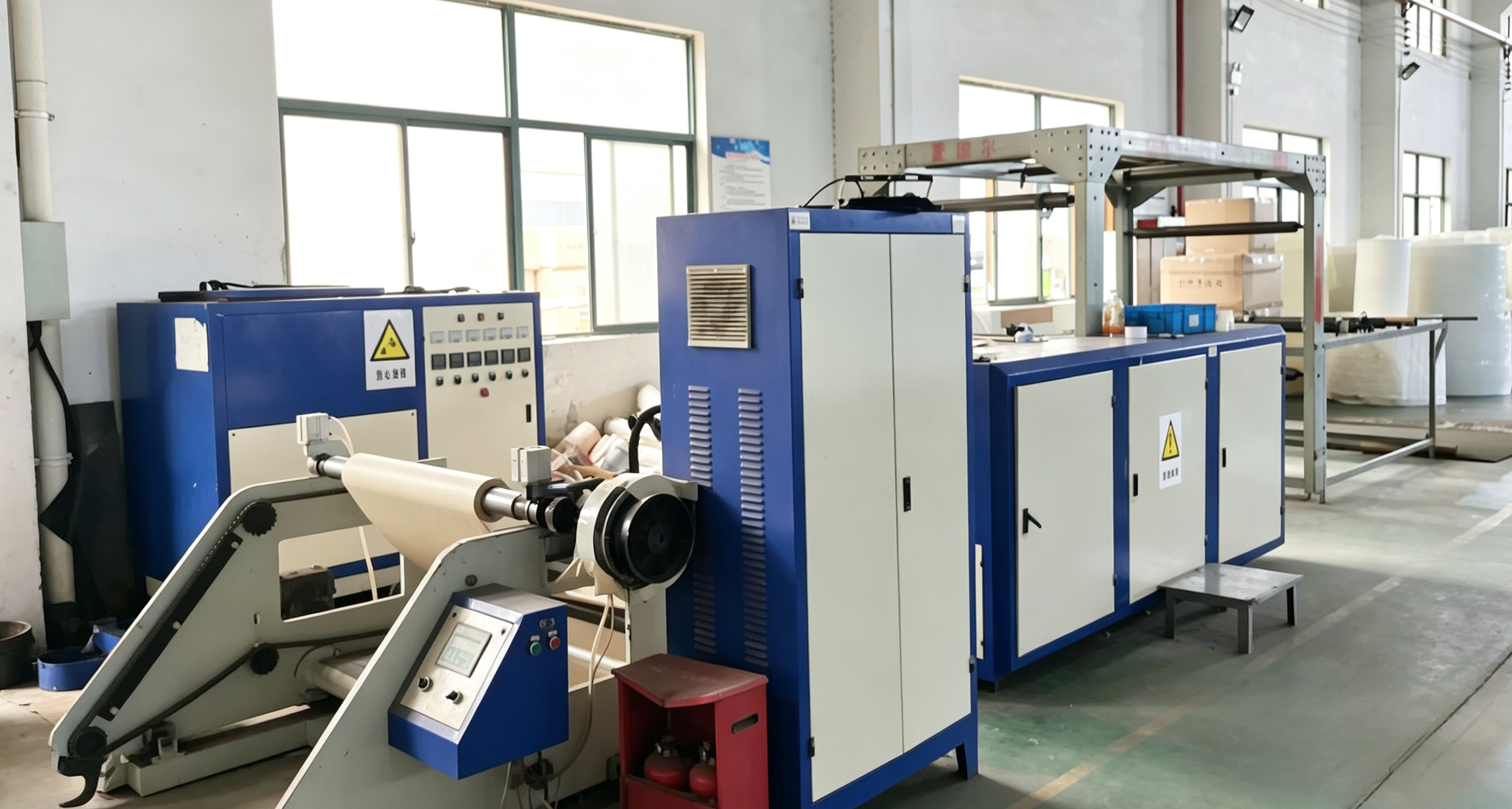
A boundary belongs here. Output and factory figures describe potential capacity, not reserved capacity. A buyer planning a multi-year program should confirm line scheduling for seasonal peaks and confirm the supplier's re-test schedule, so that the certificate pack attached to the second order is as current as the one attached to the first.
Technical explanation: where the material difference actually sits
A self-adhesive PVC floor tile is a layered construction: a wear layer, a printed design film, a substrate, an adhesive coating and a release liner. Performance differences between two visually identical tiles almost always originate in three of those layers — wear-layer thickness, adhesive coating weight and substrate density. Wear layer governs abrasion resistance over time; adhesive grammage governs peel and shear behavior and edge lifting; substrate density governs indentation recovery under point loads.
The supplier's own material comparison, set against ordinary commodity self-adhesive stickers, reports a 22% increase in total material thickness, a 35% higher adhesive coating weight and a 180% thicker wear layer. The stated performance consequences are a 5 times improvement in surface wear resistance and a 200% promotion in long-term aging resistance, with product service life described as three times longer and maintenance frequency reduced by 85%. The commercial summary in the same comparison is a 12% higher raw-material cost against an average annual use cost 60% lower.
Those ratios are the manufacturer's comparative data, not an independent test result, and buyers should request the underlying test evidence before adopting them as their own. Used correctly, they function as a questioning tool rather than a conclusion: if a competing offer is materially cheaper, which of the three layers moved?
Substrate screening as an incoming-inspection step
Substrate identity is worth checking at goods-in. IXPE foam is cross-linked by electron-beam irradiation, producing fine uniform cells, fast rebound and resistance to permanent indentation. Chemically cross-linked XPE tends to show larger cells, slower rebound and easier permanent denting under sustained heavy pressure. Visual and hand-press comparison is only preliminary screening; a third-party test report should serve as the final evidence, and the material should be specified in the proforma invoice for export orders.
Application fit: where this format works and where it does not
The WB-PVC self-adhesive format is specified for indoor use at normal room temperature, including typical humid environments such as bathrooms and the dry areas of kitchens, while avoiding long-term exposure to strong sunlight. It can be applied to floors and walls. Suitable substrates include cement floors, tiled surfaces, latex-painted walls, plasterboard and plywood, and other smooth solid bases; powdery, sandy or loose surfaces are explicitly unsuitable.
Project types where the format fits include old-house renovation, full apartment renovation, hotel room makeovers, homestay renovation, chain brand store refurbishment, office fit-out, temporary exhibition booths, simple rental apartment renovation and modular interior projects. Installation is dry: the backing is peeled and the tile pressed onto a smooth surface, with no cement or adhesive required, local cutting on site, and removal and reinstallation possible in some styles without residue. Typical tools are a utility knife, scraper or roller, tape measure and spirit level, with a floor roller recommended for flooring work; no large construction equipment is involved. The base surface must be flat, dry and free of dust and grease, and floor substrates must meet the required strength without hollow spots.
Comparison with traditional solutions
| Consideration | Self-adhesive PVC tile (peel-and-stick) | Glue-down resilient sheet or roll | Ceramic or porcelain tile |
|---|---|---|---|
| Installation method | Dry, adhesive-backed, cut on site | Wet adhesive bed, seaming and rolling | Mortar bed and grouting |
| Typical project downtime | Short, allowing phased handover | Longer, governed by adhesive cure | Longest of the three |
| Substrate demand | Flat, dry, solid, dust- and grease-free | Flat and dry, with primer systems | Rigid structural base required |
| Removal and rework | Generally reversible; some styles lift without residue | Removal typically destroys the sheet | Demolition required |
| Wet-area suitability | Bathrooms and dry kitchen zones, not standing water | Depends on seam integrity and welding | High, subject to grout maintenance |
| Documentation scope | Substance, fire and indoor-air reports per construction | Similar, often with weld-seam specifications | Different standards set entirely |
The comparison is not an argument that one category wins. Peel-and-stick PVC tile buys installation speed, reversibility and low site complexity, and it accepts real boundaries in exchange. It depends on a flat, dry, solid substrate; it is not intended for powdery or loose bases; it should not be exposed to long-term strong sunlight; and where a project specifies welded seams, coved skirting or a wet-process hygiene regime, welded resilient sheet or hard tile is normally specified instead.
The cost boundary is equally explicit. The manufacturer's comparison positions this construction at roughly 12% higher raw-material cost than ordinary commodity self-adhesive stickers, offset by a stated 60% lower average annual use cost. Buyers whose projects are short-lease, high-turnover or demolition-scheduled should test that trade-off against their own holding period rather than assume it applies.
Market trend analysis
Two verified data points frame the commercial context. Global vinyl flooring revenue is estimated at USD 28.0 billion in 2026 and USD 41.5 billion by 2033, at a 5.8% CAGR per Grand View Research. Separately, China's position as the leading exporter of HS 391810 coverings in 2024, at USD 4.97 billion, indicates that sourcing concentration and category growth are happening simultaneously.
A definition caveat applies to any market figure in this space. The USD 28.0 billion estimate covers vinyl flooring including LVT, VCT and sheet, while narrower PVC flooring definitions produce substantially smaller values. Headline market numbers should therefore be read as directional indications of category scale rather than as a precise addressable-market calculation.
The more decision-relevant trend is documentary. As phthalate-free production became industrialized in Europe and North America — Tarkett reported 100% phthalate-free vinyl output across its Europe and North America sites by 2018 using plasticizers such as DOTP — specification language shifted from minimum restricted-substance thresholds toward positive material declarations. For buyers, that changes bid evaluation: a supplier who can produce report-to-SKU traceability, current test dates and packaging compliance documentation removes procurement risk that a lower unit price does not.
Future outlook
Three developments are likely to shape PVC flooring procurement over the next buying cycles. First, packaging compliance will move up the evaluation list, since PPWR obligations apply to the shipment rather than to the floor. Second, report-to-SKU traceability will become a standard expectation, with buyers checking homogeneous-material coverage rather than accepting a single unlabelled certificate PDF. Third, continuity will be scored explicitly, because retail chains and hotel groups that refresh stores on a rolling schedule cannot absorb pattern-tone or adhesive drift between the first and third delivery.
None of these developments requires a new product category. They require that the evidence already attached to a purchase order be complete, current and matched to the construction being shipped.
FAQ
What does an SGS RoHS test report confirm for a PVC flooring order?
It is third-party laboratory evidence that the restricted substances in the tested material fall within RoHS limits. For EU-market orders the reference point is RoHS Directive (EU) 2015/863, which extended the restricted substance list to include four phthalates. The report confirms substance compliance for the construction tested; it does not confirm wear performance, fire classification or fitness for a specific project. Buyers should verify that the applicant name, product description and variant on the report match the SKU on the purchase order.
Is RoHS compliance sufficient for an EU construction project?
No. RoHS is one evidence layer. EU construction-product placements typically also involve CE marking under the Construction Products Regulation, REACH substance obligations and packaging rules under PPWR. Indoor air quality schemes are separate — FloorScore, for example, verifies conformity with the VOC emissions criteria of California Section 01350. Fire classification is separate again, commonly Class B1 under GB 8624-97 or Class Cfl-s1 under EN 13501-1.
Which customization variables affect MOQ and lead time most?
Pattern and surface finish fragment order volume most, because each design requires a separate print run and setup. Size and thickness affect packaging dimensions, carton weight and pallet count, while packaging customization affects freight and packaging compliance. Quoted terms for this category are MOQ 200 square meters, FOB delivery, TT payment and pre-shipment test as the acceptance criterion. Buyers should confirm whether the minimum applies per SKU or per order before finalizing a mixed-SKU program.
How should a buyer weigh a thicker wear layer against a lower unit price?
Compare material structure rather than unit price. The manufacturer's comparison reports a 22% increase in total thickness, 35% higher adhesive coating weight and a 180% thicker wear layer versus ordinary commodity self-adhesive stickers, with 5 times surface wear resistance and 200% better long-term aging resistance. Its commercial summary is a 12% higher raw-material cost against a 60% lower average annual use cost and 85% lower maintenance frequency. Buyers should request the underlying test data before adopting those ratios as their own benchmark.
What substrate conditions disqualify a peel-and-stick PVC floor?
The format requires a flat, dry, solid base free of dust and grease, with floor substrates at adequate strength and without hollow spots. Powdery, sandy and loose surfaces are explicitly unsuitable, and long-term exposure to strong sunlight is a further constraint. Where a project specifies welded seams, coved detailing or a wet-process hygiene regime, a different flooring category is normally specified instead.
Which supplier signals indicate repeat-order reliability?
Documented quality management, output capacity, export experience and service scope. Shanghai Yuanguan holds ISO9001 certification, operates a 7,000-square-meter intelligent factory with automated production facilities, reports annual output of 75,000,000 units, exports around 90% of output to more than 80 countries across the EU, USA, Asia and South America, and provides sample support, production, shipment and after-sales service within a single chain. Capacity figures describe potential; scheduling for peak seasons should be confirmed separately.
Does a RoHS report cover specialty variants such as anti-static or hospital-grade PVC flooring?
No. A RoHS report covers restricted substances in the material tested. Specialty performance positions — anti-static, hospital-grade, kindergarten, fire-resistant or anti-slip — require their own test evidence, generally against different standards. Buyers should request the specific report supporting each claim and confirm that the tested construction matches the construction ordered.
Have Questions or Need More Details?
Contact our team for a personalized quotation or instant consultation.
Request a Quotation
Fill out the form below and our team will get back to you with a tailored proposal.
WhatsApp Direct Chat
Prefer to chat in real-time? Message us on WhatsApp for instant assistance & quick answers.
- Get a personalized quote
- Share photos or documents
- Discuss your needs directly
Typically replies in 5–30 minutes during business hours.