
PVC Flooring FAQs: Decoding EN 13501-1 Fire Ratings and EN 14372 Phthalate Tests
Commercial PVC flooring is rarely rejected on appearance. In sports facilities — badminton halls, school gymnasiums, multi-purpose courts — the two questions that most often stall a purchase order are how the surface behaves under flame exposure and what it releases into the indoor environment. In European procurement, those two questions lead to two documents: EN 13501-1 for reaction to fire and EN 14372 for phthalate and organic-compound screening.
This reference walks through both, using the certification numbers commonly found on a Farfly sports flooring datasheet — OTC certificate HQR170310004-01 and ETS certificate ETS19030602C — as the worked example. It is written for contractors, specifiers, and importers who are already past the discovery stage and are now deciding whether the evidence in front of them is sufficient to sign off.
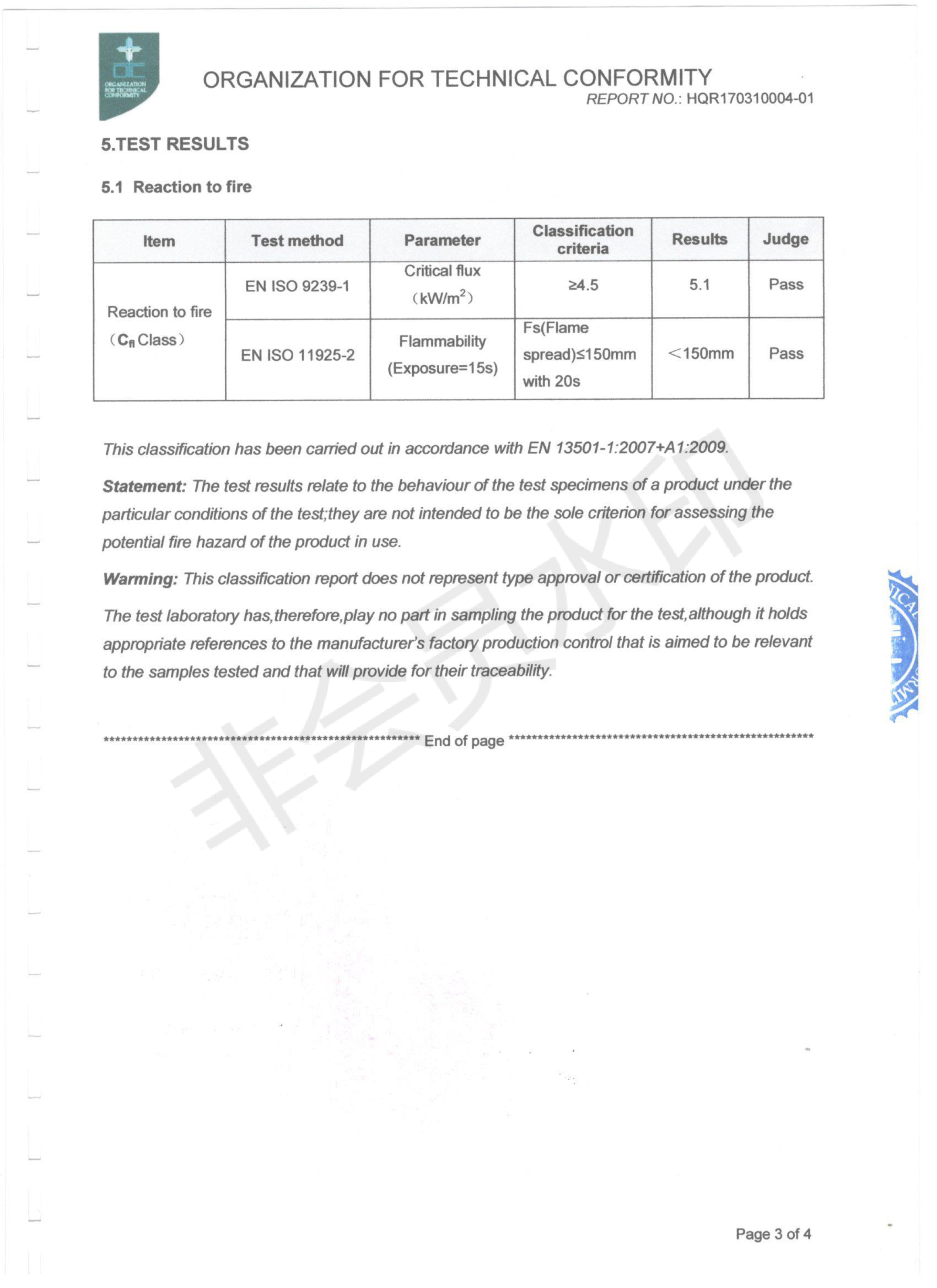
Reaction-to-fire testing under EN 13501-1 evaluates flame spread, ignition resistance, and smoke behaviour on the tested flooring construction.
Why fire reaction and phthalate screening now sit in the same tender document
Two procurement forces have converged on resilient flooring at the same time. The first is scale: the global commercial vinyl flooring market is valued at approximately USD 14.43 billion in 2025, with projections reaching USD 22.01 billion by 2033 (Grand View Research). The second is supply: China's cumulative PVC flooring exports reached 715,000 tons in the first two months of 2026, a 3.1% increase year-on-year (SunSirs / China Customs).
Volume alone would not change how buyers evaluate a floor. What changes evaluation is that enclosed sports venues concentrate two risk categories in one room. Fire reaction governs how a surface contributes to flame spread and smoke in a hall with limited exits and a seated audience. Chemical content governs what the same surface may release over years of use in spaces occupied by children, students, and athletes, often with mechanical ventilation switched off outside event hours.
For an evaluation-stage buyer, the practical consequence is that a single line item now requires two evidence packages. A supplier who answers only one of them is answering half the specification.
What EN 13501-1 actually measures — and what it does not
EN 13501-1:2007 is the European classification standard for reaction to fire. It does not perform the test itself; it converts results from underlying test methods into a classification. For PVC sports flooring, the supporting methods are:
- EN ISO 9239-1:2010 — flooring exposure to a radiant heat source, used to assess flame spread across the surface.
- EN ISO 11925-2:2010 — small-flame ignition testing, used to assess ignitability and self-extinguishing behaviour.
Read together, these two methods describe three behaviours that matter in a sports hall: how quickly flame travels across the surface, how readily the material ignites, and how smoke behaves during exposure.
Reading the certificate behind the classification
The Farfly reaction-to-fire evidence for its Boguan PVC sports flooring is OTC certificate HQR170310004-01, issued 12 May 2017, covering EN 13501-1:2007 alongside EN ISO 9239-1:2010 and EN ISO 11925-2:2010. The documented scope is the evaluation of flammability and safety performance of vinyl flooring systems, explicitly covering flame spread, ignition resistance, and smoke behaviour, and verifying compliance for sports halls, gyms, schools, and stadiums.
Three clarifications prevent the most common misreading of this type of document:
It is a reaction-to-fire classification, not a fire-resistance rating. It describes how the surface contributes to a fire, not how long a floor assembly resists structural fire. Those are different tests, different standards, and different specification lines.
The class letter must be read from the certificate itself. EN 13501-1 output is expressed as a class plus smoke and flaming-droplet sub-classes. That value is attached to the tested construction, so the correct procurement action is to match the certificate's product description to the exact product code being ordered — not to infer a class from a datasheet headline.
It does not travel. The classification belongs to the tested build-up. A different thickness, backing, or product family requires its own evidence. In the Farfly range, for example, the homogeneous vinyl line carries a documented Fire Rating B-S1 under its own product data, which is a separate data point from the sports flooring certificate.
What EN 14372 phthalate testing covers
Where EN 13501-1 addresses the behaviour of a floor in a fire, EN 14372 addresses what the floor is made of. The Farfly evidence here is ETS certificate ETS19030602C, issued 26 March 2019, referencing the standard EN 14372:2004.
The documented scope is specific and worth quoting precisely, because it defines the limits of the claim: the test identifies and quantifies chemical substances in PVC sports flooring — covering plasticizers, phthalates, solvents, VOCs, and other organic compounds — in order to verify material safety, low toxicity, and suitability for sports surfaces.
The analytical method matters as much as the result
The analysis is carried out by GC-MS (gas chromatography–mass spectrometry). The method choice is the reason the certificate is useful in procurement: GC-MS does not merely detect a category of substance, it separates and identifies individual compounds and quantifies them. That makes the output auditable in a way that a generic statement of compliance is not.
Material composition sits underneath the test result. The tested Boguan PVC sports flooring is declared as polyvinyl chloride, calcium carbonate, and an eco-friendly DOTP plasticizer. DOTP is a non-phthalate plasticizer widely adopted in resilient flooring as a substitute for ortho-phthalate plasticizers, which is why a formulation declared with DOTP is normally paired with a phthalate screening certificate rather than offered without one.
The same product data records pentachlorophenol detection: N.D (not detected) — a separate chemical marker from the phthalate family and a useful cross-check when reviewing the chemical file.
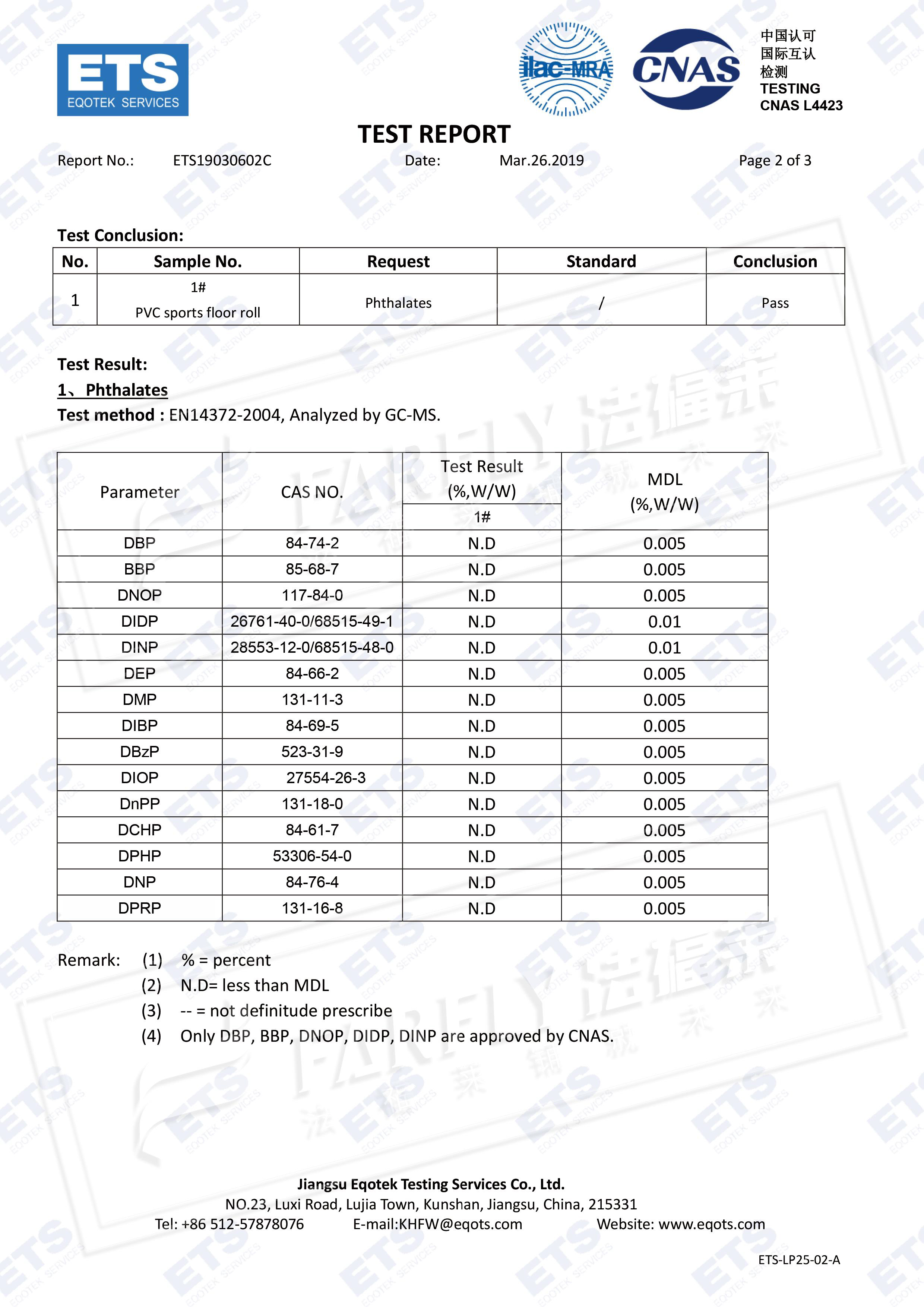
EN 14372 testing executed by GC-MS identifies and quantifies plasticizers, phthalates, solvents, and VOCs in PVC sports flooring samples.
The Farfly evidence file: how the two certificates fit together
FARFLYING FLOORING (Farfly) is a resilient flooring manufacturer operated by WUXI TEFA DECORATION MATERIAL CO., LTD., founded in 2012 and based in Wuxi, Jiangsu, China. The company produces homogeneous flooring, PVC sports flooring, and aircraft flooring, with a stated export ratio of 50% and an annual output of 4,200,000 m². Its relevance to this discussion is not scale but document structure: fire reaction and chemical safety are held as separate, numbered certificates rather than merged into a single marketing claim.
For buyers building a verification file, the sports flooring package looks like this:
| Evidence scope | Standard(s) | Certificate no. | Issuing body | Issued |
|---|---|---|---|---|
| Reaction to fire | EN 13501-1:2007; EN ISO 9239-1:2010; EN ISO 11925-2:2010 | HQR170310004-01 | OTC | 2017-05-12 |
| Phthalate / organic compound screening | EN 14372:2004 (GC-MS) | ETS19030602C | ETS | 2019-03-26 |
| Physical and chemical property testing | EN 14904-2006; EN 14809-2005; EN 13036-4:2011; EN ISO 5470-1:1999; EN 1517:1999; EN 1569:1999; EN 1516:1999; EN 14041:2004; EN 12673:1998; EN 717-1:2004 | HQR170310004-02 | OTC | 2017-05-16 |
| CE marking | EN 14041:2018 | TCF-OY20250623-CPR | ICR Co. Ltd. | 2025-06-26 (valid to 2030-06-25) |
| Homogeneous vinyl performance | ISO 24346:2006; ISO 23997:2007; ISO 4918:2016; ISO 29333:2018; ISO 26987:2008; ISO 10581:2019; ISO 105-B02:2014 | XMIN2109010490CM | SGS | 2022-03-07 |
Management-system certificates sit behind those product documents: ISO 9001:2015 (29524Q04072R0S), ISO 14001:2015 (29524E04073R0S), and ISO 45001:2018 (29524S040725R0S), all issued by Auburn Inspection & Certification Group Co., Ltd.
The structural point for a buyer is that fire reaction and chemical safety are documented as two distinct technical files with two distinct issuing bodies. That separation is what allows each claim to be checked on its own terms.
Translating the two certificates into procurement decisions
Certificates only reduce risk if they are mapped to the questions they can answer. The table below converts both documents into evaluation-stage decision points.
| Procurement question | Document that answers it | What is being verified |
|---|---|---|
| Does this surface contribute to flame spread in an enclosed hall? | HQR170310004-01 | Flame spread and ignitability classification under EN 13501-1 |
| Will the material smoke heavily during exposure? | HQR170310004-01 | Smoke behaviour assessed through EN ISO 9239-1 and EN ISO 11925-2 |
| What plasticizers and organic compounds are present? | ETS19030602C | Identification and quantification by GC-MS |
| Is the surface chemically appropriate for schools and children's spaces? | ETS19030602C plus product composition data | Material safety and low toxicity, declared DOTP plasticizer, pentachlorophenol N.D |
| Does the product meet indoor sports performance expectations? | HQR170310004-02 | EN 14904 and related physical/chemical parameters |
| Is the product legally placeable on the EU market? | TCF-OY20250623-CPR | CE marking under EN 14041:2018 |
Application: where fire and chemical evidence carries the most weight
Both certificates apply to the Boguan PVC sports flooring construction, which is specified for basketball courts, badminton courts, volleyball courts, table tennis halls, pickleball courts, indoor tennis courts, futsal courts, multi-purpose sports halls, gyms and fitness centers, yoga and dance studios, school gymnasiums, university sports halls, kindergarten activity rooms, indoor playgrounds, and sports clubs.
The pattern across that list is deliberate. The densest concentration of fire-reaction and chemical-safety scrutiny occurs in venues that combine enclosure, occupancy, and occupants who cannot be expected to self-evacuate quickly — school gymnasiums, kindergarten activity rooms, and indoor playgrounds above all. Reaction-to-fire evidence is requested because these halls fill and empty in minutes; chemical screening is requested because the same halls are occupied daily by children.
Performance data sits alongside the compliance file. The documented sports flooring parameters include impact resistance 0.35 mm, vertical deformation 0.3 mm, ball bounce 95%, friction coefficient 0.56, wear resistance 120 mg, and indentation resistance 0.27.
A worked installation reference
A project in Australia installed 16 badminton courts using PVC sports flooring, selected for cushioning, slip resistance, and bounce. Documented outcomes over a 10-year duration include 50% less maintenance compared with standard flooring, with reported benefits in knee and ankle protection, ease of installation, and long-term durability. For evaluation-stage buyers, the case is relevant less as a performance claim than as evidence that the same certified construction is installed in a real venue over a decade-long service window — the horizon over which fire and chemical documentation is typically re-checked.
Do not confuse the sports file with the aviation file
Aviation flooring sits under an entirely different regulatory regime. Farfly's aircraft flooring is tested to a 12-second vertical flame resistance protocol with sustained burning of 0, droplet burning time of 0, and burning length of 24 mm, with a passing smoke toxicity result. It is additionally covered by CAAC certificate TC-ZR-20231565 for smoke toxicity under D6-36075 Table 4 and certificate TC-ZR-20231549 for 12-second vertical combustion under CCAR 25.853(a) & App. F Part 1 and EASA CS 25.853(a) & App. F. Outside the US, FAR 25.853 requires self-extinguishing properties with an average burn length not exceeding 8 inches and flame time under 15 seconds.
None of that evidence transfers to a sports hall, and none of the EN 13501-1 evidence transfers to a cabin. Buyers evaluating multi-segment suppliers should verify that each product line carries its own file.
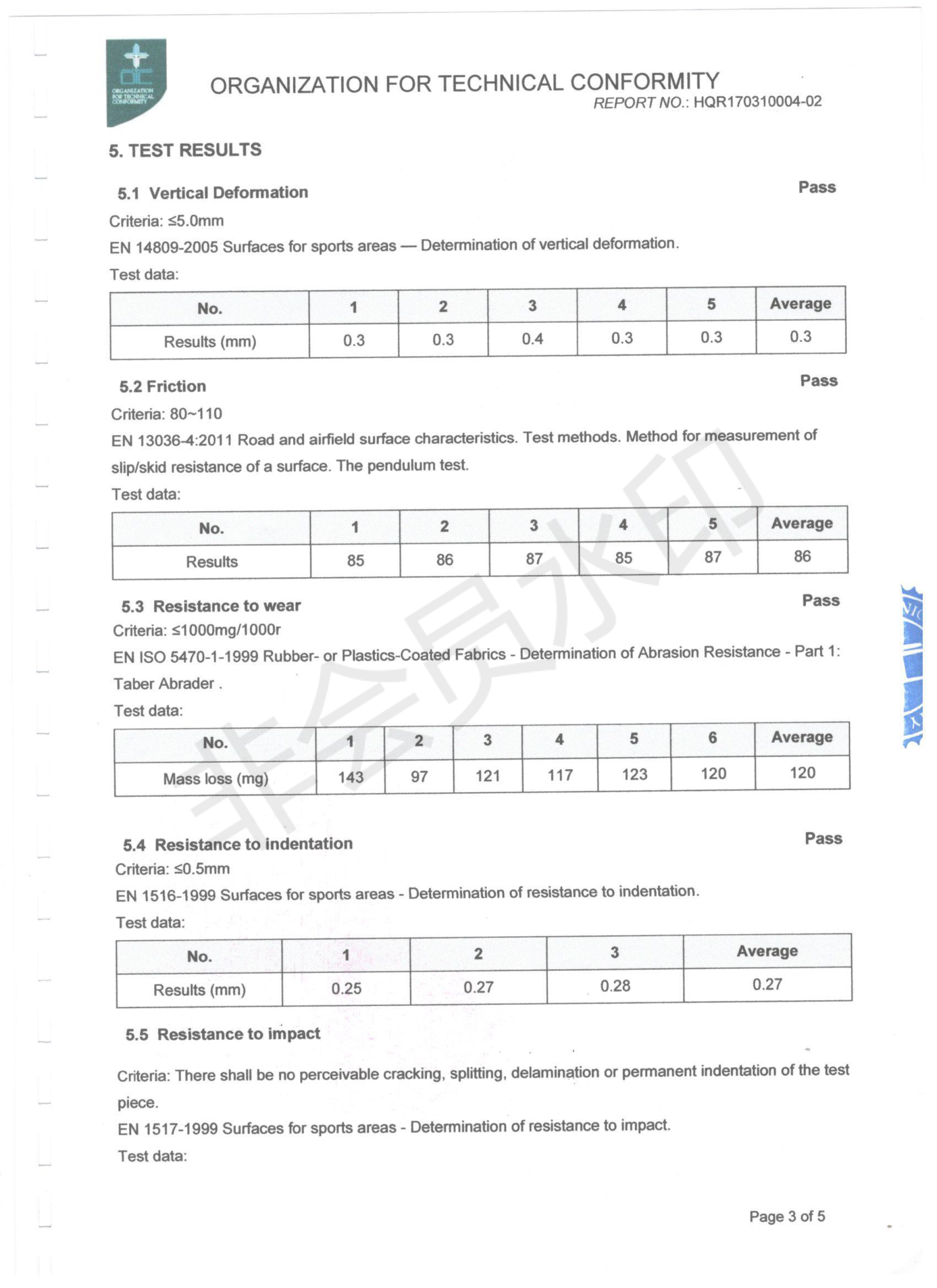
EN 14904 physical performance data — impact resistance, vertical deformation, and ball bounce — is documented separately from fire and chemical safety certificates.
PVC flooring versus traditional surfaces: where the evidence differs
All flooring placed on the EU market is classified within the same EN 13501-1 framework, so a comparison is not about whether traditional surfaces are regulated — they are. The difference lies in how much of the performance file can be expressed as a numbered, on-demand document.
Resilient PVC sports flooring is typically evidenced through a chain of standards that covers reaction to fire (EN ISO 9239-1, EN ISO 11925-2), physical sports behaviour (EN 14904-2006), slip resistance (EN 13036-4:2011), abrasion (EN ISO 5470-1:1999), and formaldehyde emission (EN 717-1:2004) — all of which appear in Farfly certificate HQR170310004-02. A buyer assembling a due-diligence file receives those as a single numbered package.
Traditional surface files tend to be assembled from more sources: species and moisture documentation for timber, coating-system records for sealed surfaces, and installation-specific declarations for adhered systems. That does not make them weaker, but it changes the verification workload, and it changes how quickly a certificate can be matched to a purchase order.
Boundaries buyers should accept before ordering
Certification evidence has limits, and treating it as absolute creates its own risk.
A certificate is a snapshot of a tested sample. EN 14372 identification and quantification was performed on the sample submitted for that test. Ongoing assurance depends on production control — Farfly documents 100% testing plus third-party inspection by SGS — but a screening certificate is not the same as per-batch regulatory verification for every destination market.
Reaction-to-fire classification attaches to a construction, not a brand. If a buyer substitutes a different thickness, backing, or adhesive system, they are no longer specifying the tested build-up and should not assume the classification carries over.
Scope is indoor sports. The certification set is built around indoor sports and children's spaces. Specifiers working on outdoor or wet-area surfaces should not assume the same evidence pack applies without confirming the intended use with the manufacturer.
Certificate holders must match suppliers. As with any imported construction product, buyers should confirm the certificate holder name corresponds to the entity actually shipping the goods.
Market trend: certification evidence is becoming a shortlisting filter
Three observable shifts are pushing fire and chemical documentation earlier in the buying process.
Certification cycles are shortening the shelf life of claims. The Badminton World Federation classifies sports flooring into Grade 1 (International Elite), Grade 2 (International Standard), and Grade 3 (Basic), and requires certification to be renewed every two years. A BWF logo on a supplier page is therefore not a permanent credential — it is a renewable one, and buyers running long project pipelines need to check the renewal date, not just the existence of the certificate.
Technical segments are growing faster than the base market. Fiberglass-reinforced PVC flooring — used for dimensional stability — is projected to reach USD 1.72 billion by 2034, growing at a CAGR of 6.46% (Fortune Business Insights). Growth in reinforced constructions increases the number of product variants a buyer must match to certificates, which raises the value of suppliers who can map documents to exact product codes.
Comparison sets are well defined. Major global competitors in the commercial PVC/vinyl flooring market include Mohawk Industries, Shaw Industries, Tarkett, Gerflor, and Forbo Flooring. Buyers shortlisting within this group typically compare on the same axes: which fire classification applies, which chemical screening has been performed, and whether slip performance is documented. On slip resistance, R11 signifies anti-slip performance at angles of 19° to 27° under DIN 51130 or EN 16165 — a useful benchmark when matching flooring to a space's traffic and moisture profile.
Future outlook
The direction of travel is toward certificate-level evidence rather than category-level assurance. Fire reaction and chemical content are moving from appendix items to primary shortlisting criteria, driven by insurer requirements, green-building documentation, and procurement teams that have learned to ask for document numbers instead of compliance statements.
For suppliers, that raises the cost of maintaining a credible file, because documents expire, standards get revised, and renewal cycles such as the BWF two-year rule reset the clock. For buyers, it delivers a measurable benefit: a specification that can be checked before the container ships, using documents that exist independently of the sales conversation.
The practical advice for evaluation-stage teams is to request the two certificates by number, match the product description on each document to the product code being ordered, and record the issue date alongside the file. That habit converts a compliance claim into a verifiable procurement record.
FAQ: fire reaction and phthalate testing for commercial PVC flooring
What does EN 13501-1 classify, and how is it different from EN 14904?
EN 13501-1:2007 classifies reaction to fire. For PVC sports flooring, its classification is supported by EN ISO 9239-1:2010 for flame spread under radiant heat and EN ISO 11925-2:2010 for small-flame ignition. EN 14904-2006 covers a different question: the physical performance of indoor sports surfaces, including shock absorption, vertical deformation, and ball behaviour. A flooring specification normally needs both. Farfly documents reaction to fire under certificate HQR170310004-01 and physical and chemical properties under certificate HQR170310004-02.
Which certificate covers the fire performance of Farfly PVC sports flooring, and what does its scope say?
OTC certificate HQR170310004-01, issued 12 May 2017, references EN 13501-1:2007, EN ISO 9239-1:2010, and EN ISO 11925-2:2010. Its documented scope is the evaluation of flammability and safety performance of vinyl flooring systems, covering flame spread, ignition resistance, and smoke behaviour, and verifying compliance for cabin flooring use in aircraft as well as sports halls, gyms, schools, and stadiums. The applicable product is the Boguan PVC sport flooring construction.
What does EN 14372 phthalate testing actually measure, and how is it analysed?
EN 14372:2004 is a chemical screening standard applied here to PVC sports flooring. It identifies and quantifies plasticizers, phthalates, solvents, VOCs, and other organic compounds, verifying material safety and low toxicity. The analysis is performed by GC-MS, which separates and identifies individual compounds and quantifies them rather than simply returning a pass or fail. Farfly's evidence for this scope is ETS certificate ETS19030602C, issued 26 March 2019.
Does a phthalate test certificate mean the flooring contains no phthalates at all?
The certificate documents that an analysis was performed and what it covered; it should be read for its reported values rather than interpreted as an absolute absence statement. Farfly's declared composition for the tested sports flooring is polyvinyl chloride, calcium carbonate, and an eco-friendly DOTP plasticizer — DOTP being a non-phthalate plasticizer commonly used as a substitute for ortho-phthalate plasticizers in resilient flooring. The same product data records pentachlorophenol detection as N.D (not detected). Buyers should review the certificate values alongside the declared formulation.
Do these certificates apply to every product in the range?
No. Certificates are issued against specific products and constructions. HQR170310004-01, ETS19030602C, and HQR170310004-02 relate to the Boguan PVC sport flooring product. Other product families carry their own documentation — for example, the homogeneous vinyl range has a separately documented Fire Rating of B-S1 and is covered by SGS certificate XMIN2109010490CM, while aircraft flooring is covered by a different aviation regime entirely. The correct step is to match the product description on the certificate to the product code being ordered.
How often should a buyer re-verify certification evidence?
Verification frequency depends on the certificate type. Product certificates have stated validity windows — Farfly's CE marking under EN 14041:2018, certificate TCF-OY20250623-CPR, is valid to 25 June 2030. Scheme-based certifications behave differently: the Badminton World Federation classifies sports flooring into Grade 1, Grade 2, and Grade 3 and requires renewal every two years, so BWF credentials should be checked against their renewal date rather than treated as permanent. As a working rule, re-check documents at each project award and whenever the product code or construction changes.
When shortlisting suppliers on fire and chemical evidence, what should be compared?
Comparable, document-level criteria rather than statements. Five checks cover most of the ground: whether a reaction-to-fire certificate exists with its class letter readable; whether the supporting test methods are named (EN ISO 9239-1 and EN ISO 11925-2 for flooring); whether chemical screening was performed by an analytical method such as GC-MS rather than asserted; whether the certificate holder matches the shipping entity; and whether the certificate's product description matches the product code quoted. Suppliers that publish certificate numbers make this comparison possible before the order, which is the point at which the information still changes the decision.
A consolidated view of Farfly's certification scope, product parameters, and sports flooring data is available in the company's product brochure.