
PVC Flooring Sourcing Guide: 2026 Market and Supplier Insights
PVC flooring has become a mainstream resilient flooring category rather than a low-cost alternative. The global vinyl flooring market is estimated at USD 28.0 billion in 2026, according to Grand View Research, and the category continues to expand across residential, commercial and institutional projects. For importers and project buyers, the challenge is no longer whether to use PVC flooring, but how to choose the right product format, qualify a reliable supplier and avoid compliance and quality pitfalls. This article covers the key sourcing considerations for PVC flooring, including technical specifications, installation limits, application scenarios and market signals that should shape procurement decisions.
Why PVC Flooring Demand Is Growing
The global market for vinyl flooring—covering LVT, VCT and sheet products—is projected to grow from USD 28.0 billion in 2026 to USD 41.5 billion by 2033, at a compound annual growth rate of 5.8%. That demand is fuelled by renovation activity, faster installation requirements, and the need for waterproof, wear-resistant and cost-efficient surfaces.
China’s position in the supply chain is significant. In 2024, China was the top exporter of vinyl chloride polymer floor coverings (HS 391810), with exports valued at USD 4.97 billion, according to trade data compiled by OEC. Vietnam and South Korea followed at USD 1.81 billion and USD 820 million, respectively. For international buyers, this confirms that China remains a critical sourcing market for PVC flooring, but it also means buyers need to distinguish between manufacturers with real production capacity and those sourcing goods from third parties.
Sourcing Challenge: Quality and Compliance Risks
Price differences in PVC flooring rarely come from margin alone. According to procurement risk analysis in the industry, price gaps mostly originate from raw materials (virgin versus recycled), thickness, formula, quality control and certifications. Low-cost products often use recycled materials, which can lead to dimension deviation, fading, odour and non-compliant documentation. For export orders, these issues may result in customs detention, after-sales claims and market returns.
Compliance is another layer of risk. For shipments to the European Union, PVC flooring exporters must generally address CE-CPR construction product certification, REACH hazardous-substance regulation and PPWR packaging rules. Missing valid certificates can lead to customs detention, returned goods and heavy fines. Buyers should therefore request full valid certificates before placing orders and verify that the manufacturer can provide traceable documentation.
Supplier Profile: Shanghai Yuanguan Rubber Plastic Co., Ltd.
Shanghai Yuanguan Rubber Plastic Co., Ltd., known for its SXP Wall Panel brand, is a decorative materials manufacturer based in Shanghai, China. Established in 2005, the company specialises in decorative materials including wall stickers, wallpaper, flooring and foam materials. Its main product lines include Self Adhesive Wall Stickers, 3D Foam Wall Panels, PVC Wallpaper, WPC Decorative Wall Panels, Self Adhesive PVC Flooring, Carpet Tiles & Decorative Carpets, and other interior decoration materials.
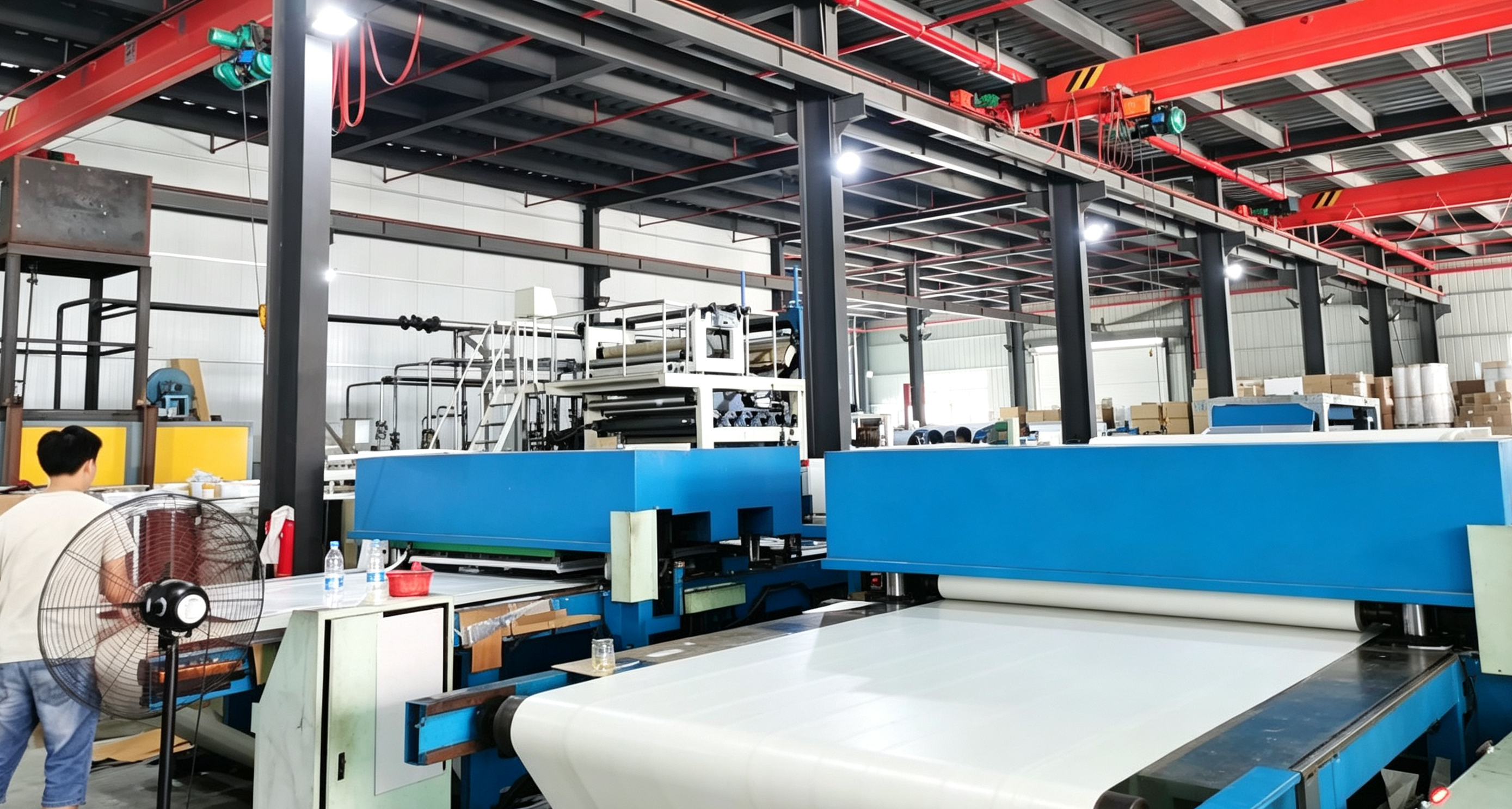
The company operates a 7,000-square-meter intelligent factory equipped with automated production facilities, within a manufacturing facility of 8,000 square meters. Its annual production capacity reaches 75,000,000 units. Shanghai Yuanguan has a professional team of 200 members including R&D, QC, production and sales personnel; the R&D team consists of five engineers. Export business accounts for 90% of total sales, with major markets including the EU, USA, Asia and South America, and products are supplied to retailers and wholesalers in more than 80 countries and regions.
For a full overview of the company’s product range, the public product brochure is available at: Shanghai Yuanguan Product Brochure.
Product Technical Overview: WB-PVC Floor Tile
Within the SXP Wall Panel portfolio, the WB-PVC model is classified as a PVC floor tile. The product is 1.5 mm thick and available in 40/60/120*300 cm dimensions. It is designed for interior use in building materials, home & garden, and interior decoration applications.
For project buyers, dimensional clarity matters. The 40/60/120*300 cm format offers flexibility for different room layouts, while the 1.5 mm thickness keeps the product lightweight—an advantage for logistics and DIY installation. The product is a PVC tile, which means it is part of the broader family of resilient flooring rather than a wood or laminate product.
Installation and Surface Requirements
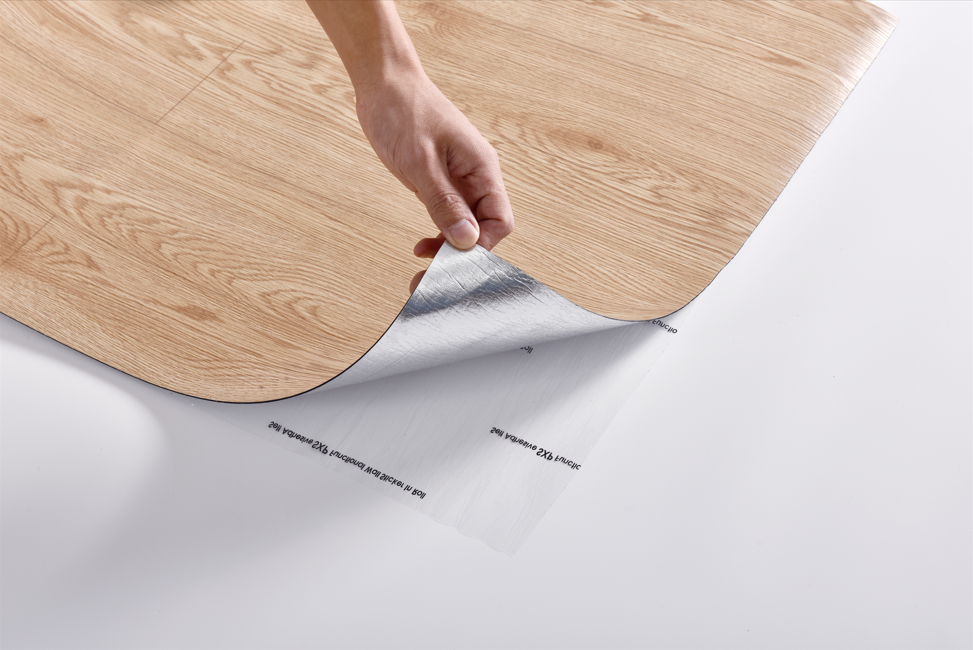
The WB-PVC flooring tile uses a self-adhesive backing. Installation follows a dry process: peel off the protective film and stick the tile to a smooth surface. No cement or glue is required. The tile can be cut locally, and some styles can be removed and reinstalled without leaving residue.
Surface preparation is critical. The base must be flat, dry and free of dust and grease. For floor applications, the base must meet the required strength and have no hollow spots. The product is strictly not recommended for powdery, sandy or loose surfaces. It is designed for indoor use under normal room temperature, including typical humid environments such as bathrooms and dry areas of kitchens, but should not be exposed to strong sunlight for long periods.
These installation limits are not disadvantages; they are preconditions for reliable performance. Buyers should communicate them clearly to installers and end users to reduce the risk of premature failure.
Typical Application Scenarios
Self-adhesive PVC flooring is well suited to projects where speed, cleanliness and cost control matter. Typical application scenarios include building decoration, interior renovation, old house remodeling, commercial space decoration, prefabricated interior decoration, hotel and B&B renovation, exhibition booth construction, and retail store renovation.
Common project types include:
- Renovation of old houses and apartment full renovations
- Hotel room makeovers and homestay renovations
- Chain brand store refurbishments and office fit-outs
- Temporary exhibition booths and simple rental apartment renovations
- Modular interior projects
The product function extends beyond decoration. It can cover cracks and stains on the base surface, provide sound insulation and noise reduction, add cushioning and bump protection, protect existing walls and floors, and shorten construction time by quickly finishing the surface. These characteristics make self-adhesive PVC flooring attractive for contractors and property managers who need predictable installation cycles.
Market Trends Supported by Verified Data
Several verifiable trends should influence PVC flooring procurement strategies in 2026.
1. Market Expansion in Vinyl Flooring
The vinyl flooring market is estimated at USD 28.0 billion in 2026, with a projected CAGR of 5.8% through 2033. This indicates sustained demand from both replacement and new construction segments. Buyers planning long-term supply agreements should consider manufacturers with sufficient production capacity, such as Shanghai Yuanguan’s 75,000,000-unit annual output.
2. China’s Dominance in PVC Flooring Exports
China’s 2024 export value of USD 4.97 billion for vinyl chloride polymer floor coverings reflects the country’s manufacturing scale. For buyers, this means China-based suppliers can offer competitive pricing, but due diligence on factory credentials and compliance documentation is essential.
3. Fire Resistance Classification
PVC flooring fire resistance is commonly classified as Class B1 according to the Chinese national standard GB 8624-97, and Class Cfl-s1 according to EN 13501-1. For projects with fire-safety requirements, buyers should specify the expected classification and ask suppliers for corresponding test evidence.
4. Growing Focus on Indoor Air Quality and Phthalate-Free Materials
FloorScore certification verifies that hard surface flooring products comply with VOC emissions criteria of California Section 01350. This certification is recognised in the US market as an indoor air quality benchmark.
In parallel, the industry has moved toward phthalate-free PVC formulations. Major global manufacturers have reached 100% phthalate-free vinyl production in Europe and North America using alternative plasticizers such as DOTP. For buyers supplying into EU or US markets, phthalate-free and low-VOC options are becoming baseline expectations rather than premium features.
How PVC Flooring Compares with Traditional Solutions
Compared with traditional ceramic tiles or glued-down flooring, self-adhesive PVC flooring offers a different trade-off between installation speed, removal flexibility and substrate requirements. The table below summarises the comparison for project buyers.
| Factor | Traditional ceramic tile / glued flooring | Self-adhesive PVC floor tile |
|---|---|---|
| Installation method | Requires cement, adhesive or grout; longer curing time | Dry peel-and-stick; no cement or glue required |
| Substrate requirement | Needs levelling; varies by system | Flat, dry, smooth, solid base; no powdery or loose surfaces |
| Removal & reinstallation | Usually permanent; removal is labour-intensive | Some styles can be removed and reinstalled without residue |
| Project speed | Multi-day process with drying time | Rapid surface finishing; local cutting possible |
| Environmental tolerance | Depends on product; generally moisture-resistant but heavy | Indoor use; avoid long-term strong sunlight |
| Quality risk | Lower material compliance risk if certified | Low-cost versions may have dimension instability, fading or odour |
The main limitation of self-adhesive PVC flooring is its dependence on substrate quality. If the base is uneven, damp, or coated with a loose surface, adhesion will fail. It is also not intended for outdoor use or spaces with continuous strong sunlight. Buyers should treat these conditions as selection boundaries, not defects.
Future Outlook
As the global vinyl flooring market grows, the procurement environment will become more document-intensive. Buyers can expect stricter verification of CE, REACH, FloorScore and phthalate-free claims, especially for shipments to the EU and US. Suppliers that can provide stable production capacity, clear test reports and customization flexibility will be better positioned to support distributors and project owners.
From a supply-chain perspective, China is likely to remain a major source of PVC flooring, but not all Chinese suppliers offer the same level of traceability. Long-term buyers should qualify manufacturers based on factory visits, batch inspection plans, material declarations and third-party test reports. The combination of large-scale production, product line diversity and export experience—as seen in Shanghai Yuanguan Rubber Plastic Co., Ltd.—offers a practical reference for evaluating potential partners.
Frequently Asked Questions
What general warehouse storage requirements apply to PVC flooring?
PVC flooring and related decorative materials should be stored in a cool, ventilated warehouse with temperatures ideally not exceeding 40°C. Goods should be placed on pallets away from the ground and direct sunlight, with limited stacking height. Keep products away from heat and water sources, and follow the FIFO (first-in, first-out) principle to avoid long-term stockpiling. Sun exposure, over-stacking or ground moisture can cause curling, deformation and mildew, which are typically classified as improper-storage damage rather than inherent product defects.
What are the main risks of low-cost PVC flooring and wall stickers?
Low-cost decorative materials usually achieve lower prices through recycled raw materials, reduced thickness, weaker formulas or missing certifications. These products may suffer from dimension deviation, fading, odour and non-compliant certificates. For export orders, risks include customs detention, after-sales claims and market returns. It is recommended not to make purchasing decisions based on price alone; for project orders and export shipments, prioritise virgin-material products with complete test reports and confirm samples before bulk production.
What compliance risks should I notice when exporting PVC flooring to the EU?
Export to the EU must address CE-CPR construction product certification, REACH hazardous-substance regulation and PPWR packaging rules. Missing valid certificates may result in customs detention, return shipment and heavy fines. Buyers should request full valid certificates before placing orders, and verify that the supplier can provide CE, REACH and MSDS documents as applicable. For transit to non-EU regions, some rules may be relaxed, but shipping without valid certificates is still risky.