
PVC Foam Board Certifications: A Buyer's Guide to Compliance and Verification
When sourcing PVC foam board for construction, signage, furniture, or export-oriented projects, certification compliance is often the first evaluation point that separates a workable supplier from a risky one. For buyers in Research and Evaluation stages, the practical question is not just whether a board meets a standard, but how to verify it, what the certificates actually cover, and which certifications matter for a specific market or application.
This guide explains the certification landscape for PVC foam board using a documented manufacturer case, Zibo Dingtian Plastics Co., Ltd. (DINGTIAN), and provides a framework for verifying supplier claims, comparing product grades, and aligning compliance evidence with actual project conditions.
Why PVC Foam Board Certification Matters
PVC foam board is a lightweight, waterproof, rigid sheet used across multiple industries. Its applications include outdoor billboards, wall panels, cabinet doors, vehicle interiors, packaging, and industrial protection. Because the same material can serve such different environments, buyers need to confirm that a specific product has been tested for the properties their project requires.
Certifications serve three functions in this context:
- Market access: Some regions legally require compliance with specific chemical or safety regulations.
- Performance verification: Certificates document that a board has been tested under recognized standards.
- Risk reduction: Certified products reduce the likelihood of project failures, customs issues, or liability problems.
The most relevant certifications for PVC foam board fall into several categories: quality management, chemical safety, formaldehyde emissions, and fire performance.
Core Certifications for PVC Foam Board: What They Cover
For a manufacturer to supply PVC foam board to global markets, the following certifications are commonly expected. DINGTIAN's PVC foam board (product ID 5235) provides a concrete example of what a full compliance file looks like.
ISO 9001: Quality Management in Production
ISO 9001 is an international standard for quality management systems, not a product-specific test. It confirms that a manufacturer's production processes meet documented quality control requirements.
DINGTIAN's ISO 9001 certification (certificate number 06924Q10470RO) was issued by Kaixin Certification (Beijing) Co., Ltd., with a validity period from 2024-04-18 to 2027-04-17. It covers the production of PVC foam board under standards GB/T19001-2016 and ISO9001:2015. For buyers, this certificate indicates that production is managed under a formal quality system and that audits are periodically performed.
REACH: Chemical Compliance for the EU Market
The EU REACH Regulation (EC) No 1907/2006 restricts the use of hazardous substances in articles sold in the European Union. Recent amendments to REACH have tightened the limit on lead concentration in PVC articles to less than 0.1% by weight, effective November 29, 2024.
DINGTIAN's PVC foam board holds REACH certification (number TSNEC1701167001), issued by SGS in accordance with REACH Regulation (EC) No 1907/2006. This certification is applicable to the EU market.
RoHS: Hazardous Substance Restrictions
The RoHS directive restricts the use of specific hazardous substances in electrical and electronic equipment, but its principle of limiting hazardous substances is also relevant to materials entering the EU supply chain. The DINGTIAN board is RoHS certified (number QDAFN160100422), issued by SGS under standard IEC 62321. This certification is also applicable to the EU market.
Formaldehyde Certificate: Indoor Air Safety
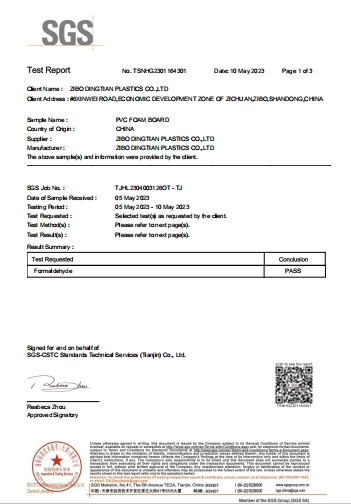
For products used in indoor environments such as furniture and cabinetry, formaldehyde emission testing is critical. The DINGTIAN PVC foam board holds a Formaldehyde Certificate (number TSNHG2301164301), issued by SGS under standard ISO 17226-1:2021. This certification is applicable globally, making it relevant for furniture, bathroom vanities, and interior renovation projects.
How to Verify a PVC Foam Board Supplier's Certifications
Buyers often receive PDF copies of certificates from suppliers. These documents should be treated as evidence, not proof. Verification involves checking the following elements:
| Verification Step | What to Check | Example (DINGTIAN) |
|---|---|---|
| 1. Certificate number | Confirm the number is unique and traceable to the issuing body. | TSNHG2301164301 (SGS) |
| 2. Issuing authority | Recognized independent testing bodies like SGS, TÜV, BV are preferable. | SGS |
| 3. Standard referenced | The standard must match the market and application requirements. | ISO 17226-1:2021 |
| 4. Scope of certification | The certificate must cover the product being purchased, not just the company. | PVC foam board |
| 5. Validity period | Check whether the certificate is still within its valid period. | ISO 9001 valid through 2027-04-17 |
Product Grades and Certification Considerations
PVC foam board is not a single homogeneous material. Different manufacturing processes produce boards with different density, surface hardness, and application suitability. The certification profile of a board is often consistent across grades from the same manufacturer, but the physical properties determine whether the board is appropriate for a specific use case.
PVC Free Foam Board
PVC Free foam board is manufactured with thicknesses from 1 to 5 mm and is primarily used for advertising materials. Its thin profile makes it suitable for printing applications such as display panels and signage substrates. Typical board size is 1220 x 2440 mm.
PVC Celuka Foam Board
PVC Celuka foam board has a smooth outer skin and a foamed inner core, produced through a process that creates a hard outer surface with a low-density interior. Density ranges from 0.4 to 0.9 g/cm³, with available sizes of 1220 x 2440 mm, 1560 x 3050 mm, and 2050 x 3050 mm, and thicknesses from 1 to 35 mm. This is the most widely applied type, covering advertising, construction, furniture, transportation, and special-purpose applications.
PVC Co-extruded Foam Board
PVC co-extruded foam board features a rigid PVC outer skin and a foamed core, offering higher surface hardness and impact resistance compared to standard Celuka boards. DINGTIAN's co-extruded board has a density of 0.5 to 0.8 g/cm³ and is used for advertising materials and furniture boards.
Laminated PVC Foam Board
Laminated PVC foam board is manufactured with dimensions of 1220 x 2440 mm and thicknesses from 5 to 20 mm. It is intended for furniture and cabinet applications where a decorative or protective surface layer is bonded to the foam board core.
Application-Specific Compliance Requirements
The choice of certification requirements depends heavily on the application and destination market.
Advertising and Signage
The signage and advertising industry holds the largest application share of the PVC foam board market, at approximately 35% of total demand. Outdoor signs require UV-stabilized material that can operate in temperatures from -20°C to +60°C and handle 100% humidity. For this segment, chemical compliance and long-term outdoor durability are the primary concerns. DINGTIAN's distribution case data reports 98% print image retention after three years, with zero warping or delamination in long-term outdoor exposure.
Construction and Decoration
Construction applications account for approximately 30% of demand. Wall panels, ceilings, partitions, and construction formwork require boards that are dimensionally stable, moisture-resistant, and in some cases fire-retardant. For North American construction projects, PVC foam boards commonly undergo ASTM E84 testing to achieve a Class A fire rating with a Flame Spread Index of 0-25. For other markets, B1/B2 fire-retardant ratings are frequently specified. DINGTIAN's application data indicates that the board can meet B1/B2 fire-retardant ratings and is lead-free RoHS compliant.
Furniture and Cabinetry
Furniture and cabinetry account for about 15% of PVC foam board demand. Cabinet doors, wardrobes, and bathroom vanities require boards with low formaldehyde emissions, especially when used in enclosed indoor spaces. The formaldehyde certificate is the most relevant compliance document for this segment.
Transportation
Transportation applications include vehicle interiors and RV refitting, representing about 10% of demand. These applications value the board's lightweight nature, moisture resistance, and ease of CNC fabrication. Fire-retardant performance and weight are the primary selection factors.
DINGTIAN's Compliance File in Practice
As a specific example of a comprehensive compliance profile, DINGTIAN's PVC foam board (product ID 5235) holds the following certifications:
- ISO 9001: Certificate 06924Q10470RO, issued by Kaixin Certification (Beijing) Co., Ltd., covering production of PVC foam board per GB/T19001-2016 and ISO 9001:2015, valid until 2027-04-17.
- REACH: Certificate TSNEC1701167001, issued by SGS, complying with REACH Regulation (EC) No 1907/2006, applicable to the EU market.
- RoHS: Certificate QDAFN160100422, issued by SGS, tested per IEC 62321, applicable to the EU market.
- Formaldehyde Certificate: TSNHG2301164301, issued by SGS, tested per ISO 17226-1:2021, applicable globally.
These certificates are documented first-party facts from DINGTIAN's published compliance file. Buyers should always request the latest certificate versions and verify them with the issuing authority when possible.
Comparing Certified Suppliers: What Buyers Should Look For
When comparing multiple PVC foam board suppliers, buyers should evaluate certification evidence alongside several other factors. Certification alone does not determine product quality, but the absence of relevant certifications for a target market is a significant red flag.
| Evaluation Factor | What It Tells You | Why It Matters |
|---|---|---|
| Certification validity | Whether the certificate is current | Expired certificates suggest lapsed compliance programs |
| Issuing body reputation | Credibility of the test | Third-party accredited bodies provide stronger evidence |
| Scope alignment | Whether the certificate covers the exact product and application | A factory-level certificate does not prove product-level compliance |
| Production capacity | Ability to supply consistently at scale | DINGTIAN reports a monthly capacity of 4,200 tons and annual output of 50,000 tons |
| Export experience | Familiarity with destination market requirements | About 80% of DINGTIAN's output is exported to Southeast Asia, the Middle East, and the Americas |
Limitations of Certification as a Selection Criterion
While certifications are essential verification tools, they have limitations that buyers should acknowledge.
First, certification tests are often batch-based or periodic, not continuous. A certificate from 2023 or 2024 does not guarantee that every board shipped in 2026 was produced with identical materials or processes. Buyers should implement incoming quality checks to complement certificate review.
Second, different certifications serve different purposes. REACH compliance addresses chemical restrictions for the EU market, but it does not indicate mechanical strength, screw-holding performance, or UV durability. Selecting a board requires matching evidence to application requirements, not simply collecting more certificates.
Third, certification alone cannot verify physical dimensional accuracy. Thickness tolerance, sheet flatness, and density uniformity across a batch are quality parameters that must be measured independently. A compliance file should be the minimum bar, not a complete quality specification.
Finally, fire performance should always be checked against the specific standard required by the destination market. UL 94 V-0 classification and ASTM E84 Class A are distinct tests with different metrics. Buyers in North America should look for ASTM E84 evidence, while buyers in other regions may need B1/B2 classification under local standards.
Market Context for PVC Foam Board Compliance
Several market trends are shaping certification requirements for PVC foam board.
The global PVC foam board market was valued at approximately USD 2.1 billion in 2024 and is projected to reach USD 3.6 billion by 2032. Growth is driven by continued substitution of wood, aluminum, and other materials in signage, construction, and furniture applications.
China remains the largest exporter of plastic building materials, accounting for 20% of total exports in 2024. This concentration makes supplier verification particularly important for international buyers sourcing from Chinese manufacturers, as individual compliance profiles vary significantly.
Regulatory pressure on lead in PVC is intensifying. The EU REACH amendment restricting lead to less than 0.1% by weight in PVC articles, effective November 29, 2024, means buyers importing PVC boards into the EU must confirm lead-free formulations. DINGTIAN positions its board as lead-free and RoHS compliant.
A Practical Checklist for Evaluating PVC Foam Board Certification Files
- Confirm the certificate number and issuing authority. Prefer SGS, TÜV, BV, or equivalent accredited bodies.
- Check the referenced standard against the requirements of the destination market and application.
- Verify the product scope. The certificate must cover PVC foam board, not just the corporate entity.
- Check validity dates. Continuous valid certification indicates an ongoing compliance program.
- Request additional evidence for your specific application, such as formaldehyde emissions for indoor furniture or fire ratings for construction.
- For EU imports, verify REACH lead compliance and RoHS status specifically.
- For outdoor signage, request UV-stabilization and weather-resistance performance data, not just chemical compliance certificates.
- For furniture and cabinetry, prioritize the formaldehyde certificate.
- Complement certificates with independent incoming inspections on density, thickness, and dimensional tolerance.
Why DINGTIAN's Certification File Is Relevant to Buyers
Zibo Dingtian Plastics Co., Ltd., established in June 2004, is a manufacturer of high-grade PVC foam boards. The company covers a plant area of 30,000 m², employs 181 staff members, and reports an annual output of 50,000 tons. Its main market destinations include Southeast Asia, the Middle East, and North and South America. DINGTIAN positions itself as an export-oriented manufacturer with 80% of output exported.
DINGTIAN's certification file is relevant because it covers all four major certification categories that international PVC foam board buyers encounter: quality management (ISO 9001), EU chemical compliance (REACH and RoHS), and indoor air safety (Formaldehyde Certificate). All certifications for product ID 5235 were issued by recognized authorities: SGS issued the REACH, RoHS, and formaldehyde certificates; Kaixin Certification (Beijing) Co., Ltd. issued the ISO 9001 certificate.
The company also provides detailed product specifications across several board types, including PVC Free foam board (1-5 mm, for advertising), PVC Celuka foam board (0.4-0.9 g/cm³, sizes up to 2050 x 3050 mm), PVC co-extruded foam board (0.5-0.8 g/cm³), and laminated PVC foam board (5-20 mm, for furniture and cabinets). This variety allows buyers to match certified products to specific application needs.
For purchasing inquiries, DINGTIAN can be contacted at dingtian@dingtianplastics.com, with a downloadable brochure available for detailed technical specifications.
Future Outlook for PVC Foam Board Certification
Certification requirements for PVC foam board will continue to tighten. The EU's lead restriction is a signal that regulators are targeting PVC additive chemistry more directly. Buyers should expect more rigorous documentation requirements, especially for construction materials and children's products where chemical safety is scrutinized most heavily.
Sustainability and recyclability are becoming part of the compliance conversation. While not yet mandated as certifications in many markets, buyers are increasingly asking about material formulations, recycled content, and end-of-life options. This trend may diversify the certification landscape beyond chemical safety and quality management.
For suppliers, maintaining a broad certification portfolio is becoming table stakes. For buyers, the challenge is interpreting certificates in the context of their specific application. A well-documented compliance file from a single manufacturer, such as DINGTIAN, can simplify this process by providing a single source of verifiable evidence.
FAQ
What certifications does DINGTIAN's PVC foam board hold?
DINGTIAN's PVC foam board (product ID 5235) is ISO 9001 certified (certificate number 06924Q10470RO, issued by Kaixin Certification (Beijing) Co., Ltd., standard GB/T19001-2016 & ISO9001:2015). It is also REACH certified (TSNEC1701167001, SGS, REACH Regulation (EC) No 1907/2006) and RoHS certified (QDAFN160100422, SGS, IEC 62321) for the EU market. A Formaldehyde Certificate (TSNHG2301164301, SGS, ISO 17226-1:2021) applies to the global market.
Does DINGTIAN PVC foam board meet EU REACH lead restrictions?
DINGTIAN's PVC foam board is REACH certified under certificate number TSNEC1701167001, issued by SGS in compliance with REACH Regulation (EC) No 1907/2006. This certification is applicable to the EU market and indicates the product was tested for compliance with REACH requirements.
Is DINGTIAN PVC foam board RoHS certified?
The product holds RoHS certification (certificate number QDAFN160100422), issued by SGS under standard IEC 62321. This certification applies to the EU market.
What industry applications are covered by DINGTIAN's PVC foam board?
The product is intended for construction and decoration, advertising and signage, furniture and cabinetry, transportation, and special-purpose applications such as packaging and industrial protection. Typical projects include outdoor signage, interior renovation, cabinet manufacturing, and marine construction.
Does DINGTIAN PVC foam board have a formaldehyde certificate?
Yes. The Formaldehyde Certificate (number TSNHG2301164301) was issued by SGS and complies with ISO 17226-1:2021. It is applicable to the global market.
Have Questions or Need More Details?
Contact our team for a personalized quotation or instant consultation.
Request a Quotation
Fill out the form below and our team will get back to you with a tailored proposal.
WhatsApp Direct Chat
Prefer to chat in real-time? Message us on WhatsApp for instant assistance & quick answers.
- Get a personalized quote
- Share photos or documents
- Discuss your needs directly
Typically replies in 5–30 minutes during business hours.