
PVC Foam Board Grades, Certifications, and Sourcing Guide
PVC Foam Board Grades, Certifications, and Sourcing Guide
PVC foam board is a lightweight, waterproof sheet material made with a foamed PVC core, widely used as a printing substrate, building panel, furniture component, and industrial protection sheet. The global PVC foam board market was valued at approximately USD 2.1 billion in 2024 and is projected to reach USD 3.6 billion by 2032 (Verified Market Research). Two constraints increasingly drive purchasing decisions in this category: specification accuracy and certification evidence. This guide explains both, using the product line and documentation of Zibo Dingtian Plastics Co., Ltd. (DINGTIAN brand) as a reference.
Zibo Dingtian Plastics Co., Ltd., operating under the DINGTIAN brand, is a manufacturer of PVC foam board located in the Zichuan Economic Development Zone, Zibo City, Shandong Province, China. The company was founded in June 2004 and has accumulated 22 years of experience in PVC foam board production.
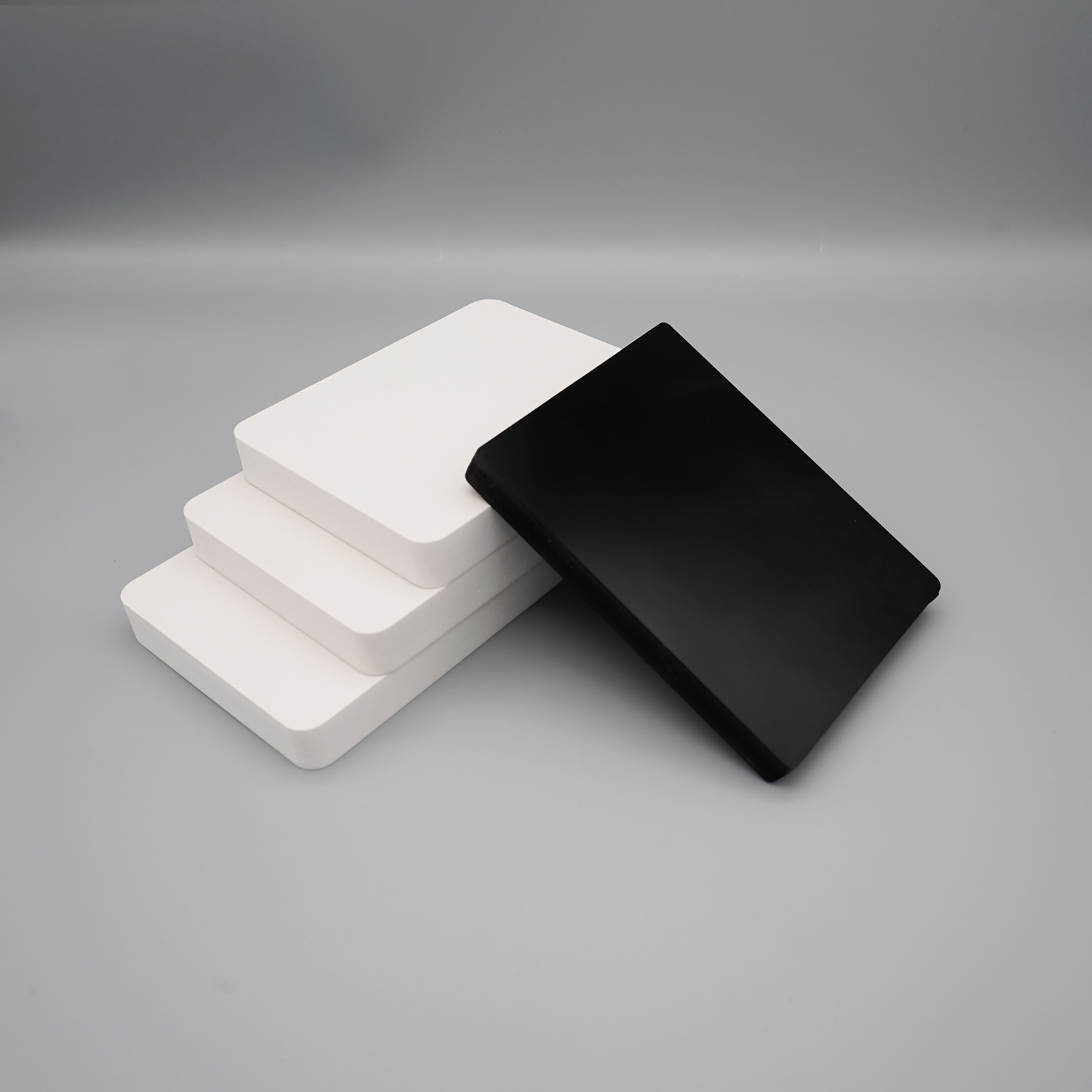
Why Specification and Compliance Matter in PVC Foam Board Sourcing
Buyers usually compare offers by price per sheet. Price alone, however, does not reveal how a board was produced, what density it has, whether it is UV-stabilized, or whether it meets the destination market’s chemical restrictions.
PVC foam board is not a single product. It is a family of boards produced by different processes — free foam, Celuka, co-extrusion, lamination, and color compounding — each with a distinct thickness and density range. The Celuka concept, for example, uses a smooth outer skin over a foamed core. Co-extruded boards pair a rigid PVC skin with a foamed core, which according to Skyline Composites allows for higher surface hardness and impact resistance than standard Celuka boards. A buyer that treats these as the same product risks ordering the wrong grade.
The opportunity is equally concrete. With 100% humidity resistance, a smooth printable surface, and a light weight, PVC foam board is a practical substitute for plywood, MDF, and aluminum composite panels in interior and exterior paneling.
Product Portfolio and Specification Framework
DINGTIAN supplies six documented board variants within its PVC foam board family: waterproof board, free foam board, Celuka board, co-extruded board, laminated board, and colored board. The standard board format is 1220×2440 mm; the Celuka series is also manufactured in 1560×3050 mm and 2050×3050 mm formats.
| Board variant | Standard size | Thickness | Density | Primary applications |
|---|---|---|---|---|
| Waterproof PVC foam board | 1220×2440 mm | 1–35 mm | Not published | Furniture, cabinet |
| PVC Free foam board | 1220×2440 mm | 1–5 mm | Not published | Advertising materials |
| PVC Celuka foam board | 1220×2440 mm, 1560×3050 mm, 2050×3050 mm | 1–35 mm | 0.4–0.9 g/cm³ | Advertising, construction, furniture, transportation, special-purpose |
| PVC Co-extruded foam board | 1220×2440 mm | Not published | 0.5–0.8 g/cm³ | Advertising materials, furniture board |
| Laminated PVC foam board | 1220×2440 mm | 5–20 mm | Not published | Furniture, cabinet |
| Colored PVC foam board | 1220×2440 mm | 1–20 mm | Not published | Advertising, furniture, cabinet making |
PVC free foam board is the term used for the 1–5 mm printing substrate series. The name “free foam” refers to the free-foaming production process, not to a PVC-free formulation. It is intended for advertising materials and is often used for UV printing and display panels.
Laminated PVC foam board is manufactured for the furniture and cabinetry industry at 1220×2440 mm with thickness from 5 to 20 mm, combining a PVC core with a laminated surface for cabinet and furniture applications. Colored PVC foam board is available from 1 to 20 mm thickness and is used in advertising, furniture, and cabinet making.
Density is the main variable that separates low-, medium-, and high-density grades in the market. In the DINGTIAN Celuka series, density ranges from 0.4 to 0.9 g/cm³. In the co-extruded series, density ranges from 0.5 to 0.8 g/cm³. As a general rule, higher density improves surface hardness, impact resistance, and screw-holding strength, while lower density reduces weight and material cost.
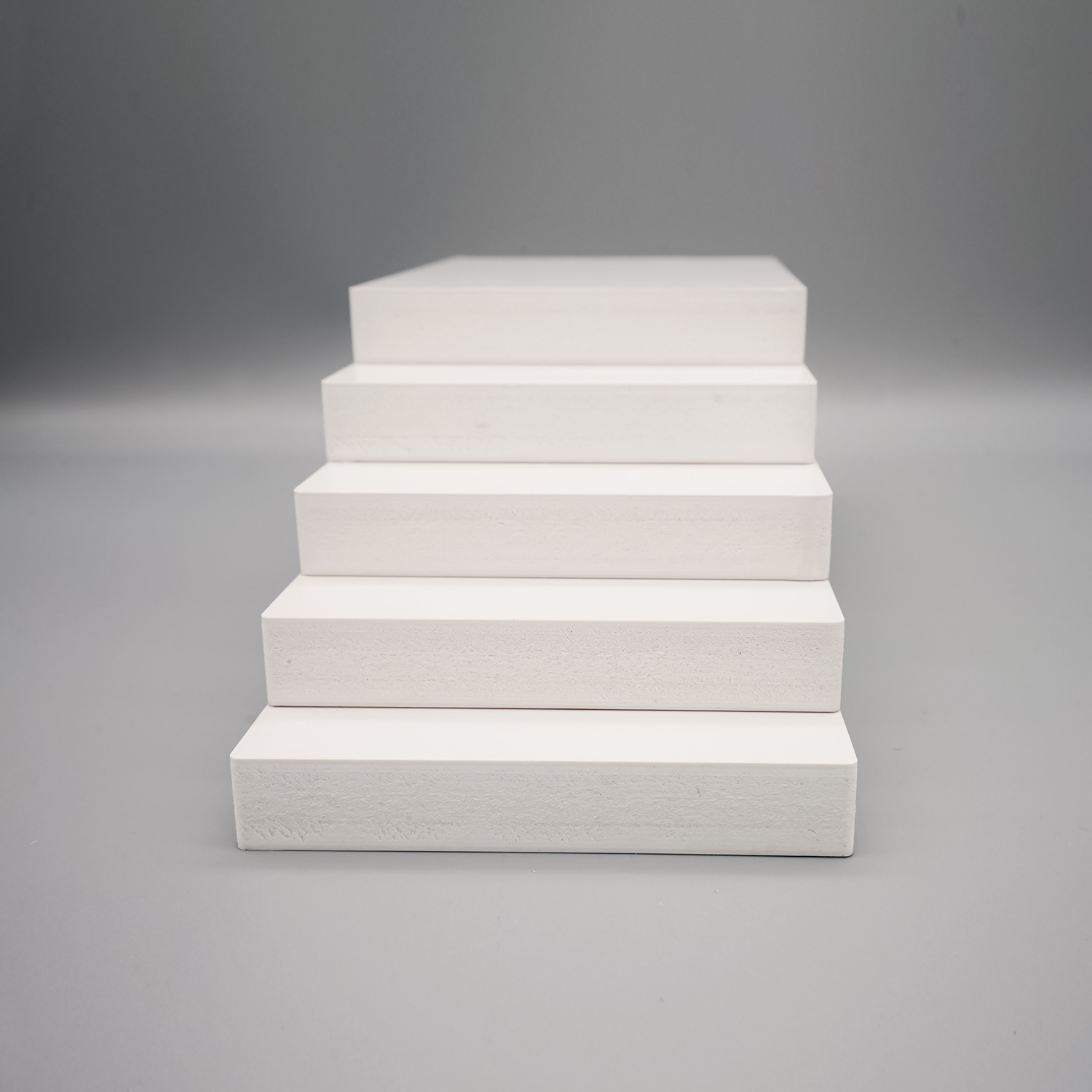
Processing is compatible with standard fabrication equipment: cutting machines, printing machines, saws, nails, CNC routers, and thermoforming at 120–160 °C. Board edges can be laminated and bonded during assembly. These parameters are taken from DINGTIAN’s application notes for the Celuka series.
Certification and Compliance Across Markets
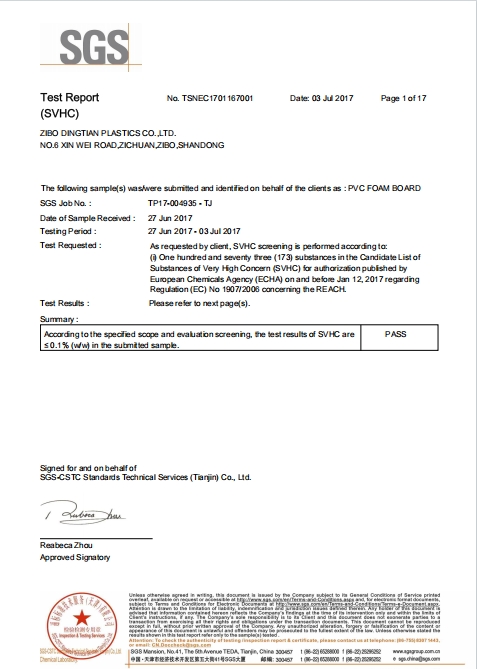
DINGTIAN’s PVC foam board (product ID 5235) is covered by four documented certifications: ISO9001 quality management, REACH compliance, RoHS compliance, and a Formaldehyde Certificate.
| Certification | Standard | Issuing body | Certificate number | Market scope |
|---|---|---|---|---|
| ISO9001 | GB/T19001-2016 & ISO9001:2015 | Kaixin Certification (Beijing) Co., Ltd. | 06924Q10470RO | Global (production) |
| REACH | Regulation (EC) No 1907/2006 | SGS | TSNEC1701167001 | EU |
| RoHS | IEC 62321 | SGS | QDAFN160100422 | EU |
| Formaldehyde Certificate | ISO 17226-1:2021 | SGS | TSNHG2301164301 | Global |
The ISO9001 certificate (No. 06924Q10470RO) was issued by Kaixin Certification (Beijing) Co., Ltd. and applies to the production of PVC foam board under GB/T19001-2016 and ISO9001:2015. Its validity runs from 18 April 2024 to 17 April 2027.
For the EU market, the board holds REACH certification (No. TSNEC1701167001) issued by SGS under Regulation (EC) No 1907/2006, and RoHS certification (No. QDAFN160100422) issued by SGS according to IEC 62321. For the global market, it holds a Formaldehyde Certificate (No. TSNHG2301164301) issued by SGS according to ISO 17226-1:2021.
These certificates matter for market access. Under REACH, lead concentration in PVC articles has been restricted to less than 0.1% by weight, a requirement that took effect on 29 November 2024 (Intertek). RoHS and REACH certificates are therefore part of the standard documentation for PVC foam board imported into the EU.
Flammability is a separate constraint often requested in construction and transportation projects. In North America, PVC foam boards used in construction commonly undergo ASTM E84 testing to achieve a Class A fire rating, with a Flame Spread Index of 0–25 (Laird Plastics). Under UL 94, PVC foam board can achieve a V-0 classification down to 1 mm thickness (The Vinyl Institute).
Application Scenarios and Material Requirements
The application profile of the Celuka series shows five documented use areas: advertising and signage (35% of demand in the profile), construction and decoration (30%), furniture and cabinetry (15%), transportation (10%), and special-purpose application (10%). The same segmentation matches broader market data, where signage and advertising is the largest application area with about 35% of total demand (Laird Plastics).
For advertising and signage, boards serve as outdoor billboard substrates, display panels, and UV printing surfaces. The documented working condition for the UV-stabilized grade is −20 °C to +60 °C with 100% humidity resistance, which supports outdoor weather exposure.
In construction and decoration, the material is used for wall panels, ceilings, partitions, and construction formwork. The waterproof property and the option of thermal and acoustic insulation are the main reasons for this segment.
Furniture and cabinetry applications include cabinet doors, wardrobes, and bathroom vanities. For this segment, the laminated variant reduces finishing work because the surface is delivered ready to assemble.
Transportation applications include vehicle interiors and RV refitting, where light weight and corrosion resistance are the deciding parameters. Special-purpose applications include packaging, prototypes, and industrial protection. Project specifications for this material often call for UV stabilization, B1/B2 fire-retardant rating, lead-free RoHS compliance, or anti-static ESD protection, depending on the use.
PVC Foam Board versus Traditional Sheet Materials
Aluminum composite panels, plywood, and MDF are the traditional alternatives considered in the same applications. Compared with MDF and plywood, PVC foam board is waterproof and does not absorb moisture. Compared with aluminum composite panels, it is lighter and easier to cut, route, and install.
A documented distributor application illustrates the economic difference. A distributor purchasing around 10 containers per month of DINGTIAN board for advertising and furniture materials, in a relationship lasting 5–10 years, reported 98% print image retention after three years of outdoor exposure, zero warping or delamination, 100% waterproof performance, and a 40% cost saving compared with aluminum composite panels.
The main trade-off is stiffness. At the same thickness, a foamed PVC board is less rigid than plywood or aluminum, so structural load-bearing applications require thicker boards or additional framing. Cut edges expose the foam core, which may need edge banding in visible furniture. Users should also verify adhesive and solvent compatibility before production.
Market Trends and Their Effect on Buyers
Two verifiable trends frame the market in 2026. First, the global PVC foam board market is projected to expand from approximately USD 2.1 billion in 2024 to USD 3.6 billion by 2032 (Verified Market Research). Second, China maintained its position as the largest exporter of plastic building materials, including PVC boards, with 20% of total exports in 2024 (OEC).
At the regional level, Zibo — where DINGTIAN is based — registered USD 180 million in plastic product export volume in 2024 with nearly 500 export-oriented manufacturers, making it a significant production cluster on China’s east coast (Qilu Network). The practical effect for importers is a wider supplier base, but also more variability in quality, which makes third-party certificates and documented specifications more important in supplier selection.
Sourcing Decision Criteria: MOQ, Lead Time, and Customization
DINGTIAN operates in OEM and ODM production modes. Customization is available for size, thickness, density, and color. Monthly production capacity is 4,200 tons.
- Minimum order quantity: 1 × 20 ft GP full container
- Lead time: 30 days
- Monthly production capacity: 4,200 tons
- Customization: size, thickness, density, color
- Production modes: OEM, ODM
- Quality control: 100% tested
- Export markets: EU, Middle East, Southeast Asia, North and South America, Africa
- After-sales: remote support
For buyers, the full-container MOQ effectively defines the commercial unit in this product category, and unit price comparison should be made on the same board thickness, density, and order volume to remain meaningful.
FAQ
What EU certifications should a PVC foam board have for import?
A PVC foam board imported into the EU should have REACH and RoHS documentation. The DINGTIAN board (product ID 5235) holds a REACH certificate (SGS, No. TSNEC1701167001, Regulation (EC) No 1907/2006) and a RoHS certificate (SGS, No. QDAFN160100422, IEC 62321). Since 29 November 2024, REACH also restricts lead in PVC articles to less than 0.1% by weight.
What is the difference between free foam, Celuka, and co-extruded PVC foam board?
Free foam board has a uniformly foamed core with a smooth surface and is commonly used for thin printing substrates (1–5 mm). Celuka board uses a smooth outer skin over a foamed core, available in a wider thickness range (1–35 mm). Co-extruded board adds a rigid outer skin over the foamed core, providing higher surface hardness and impact resistance; in DINGTIAN’s range it is produced at a density of 0.5–0.8 g/cm³.
What thickness and density ranges does DINGTIAN offer?
The Celuka series is available in thickness from 1 to 35 mm at a density of 0.4–0.9 g/cm³, in formats of 1220×2440 mm, 1560×3050 mm, and 2050×3050 mm. Free foam board is 1–5 mm, colored board 1–20 mm, and laminated board 5–20 mm, all at 1220×2440 mm.
Can this PVC foam board be used for outdoor signage?
Yes, when the UV-stabilized grade is specified. The documented working range is −20 °C to +60 °C with 100% humidity resistance. In a distributor application, print image retention of 98% after three years of outdoor exposure was reported, with zero warping or delamination.
Does the board carry health or emission certifications?
Yes. The board holds a Formaldehyde Certificate for the global market, issued by SGS (No. TSNHG2301164301) according to ISO 17226-1:2021, and RoHS certification for the EU market (No. QDAFN160100422) according to IEC 62321.
What are DINGTIAN’s minimum order, lead time, and customization options?
The minimum order is 1 × 20 ft GP full container, with a lead time of 30 days. Monthly capacity is 4,200 tons. Customization covers size, thickness, density, and color, with 100% testing before shipment.
Company Profile and Documentation
Zibo Dingtian Plastics Co., Ltd. is a PVC foam board manufacturer founded in 2004 in Zibo, Shandong, China. The company operates a 30,000 m² plant, employs 181 people, and has an annual output of 50,000 tons. About 80% of production is exported to Southeast Asia, the Middle East, and North and South America.
www.dingtianpvc.com | www.dingtianpvcfoamboard.com
Email: dingtian@dingtianplastics.com
Tel: +86 533 6125588
WhatsApp: +86 13589520151
Download the DINGTIAN company brochure (PDF)