
PVC Foam Core Across Industries: Application Fit from Marine to Rail
PVC foam core is a closed-cell structural foam made from polyvinyl chloride and used as the middle layer of composite sandwich panels. Its value in a project depends less on the material name than on whether the process, the mechanical duty and the service environment of that project match what a closed-cell PVC core can deliver.
Sandwich construction works because the core keeps two skins apart. The further apart the skins sit, the stiffer the panel becomes for the same amount of reinforcement, and the core carries the shear and compression loads that hold the assembly together. That is why core material selection is a fit decision rather than a purchase of a generic commodity: the same PVC foam grade that suits a yacht hull may be the wrong choice for a thermoplastic RV floor, and the wrong choice again for an aircraft panel.
This article maps PVC foam core to the industries where it is most often specified — marine and yacht building, wind energy, transportation and rail vehicles, RV and caravan manufacturing, industrial composites and construction panels — and states plainly where another core type is the better answer. Product facts referenced here come from CINON Composites (Guangdong Cinon New Material Technology Co., Ltd.), a manufacturer established in 2022 and headquartered in Guangzhou, China, that produces fiberglass reinforcements and lightweight core materials for marine, transportation, wind energy, industrial and aerospace composite applications. The company operates a 40,000 m² manufacturing facility with an annual output capacity of 1,200,000 m² and exports to Europe, North America and Asia-Pacific markets.
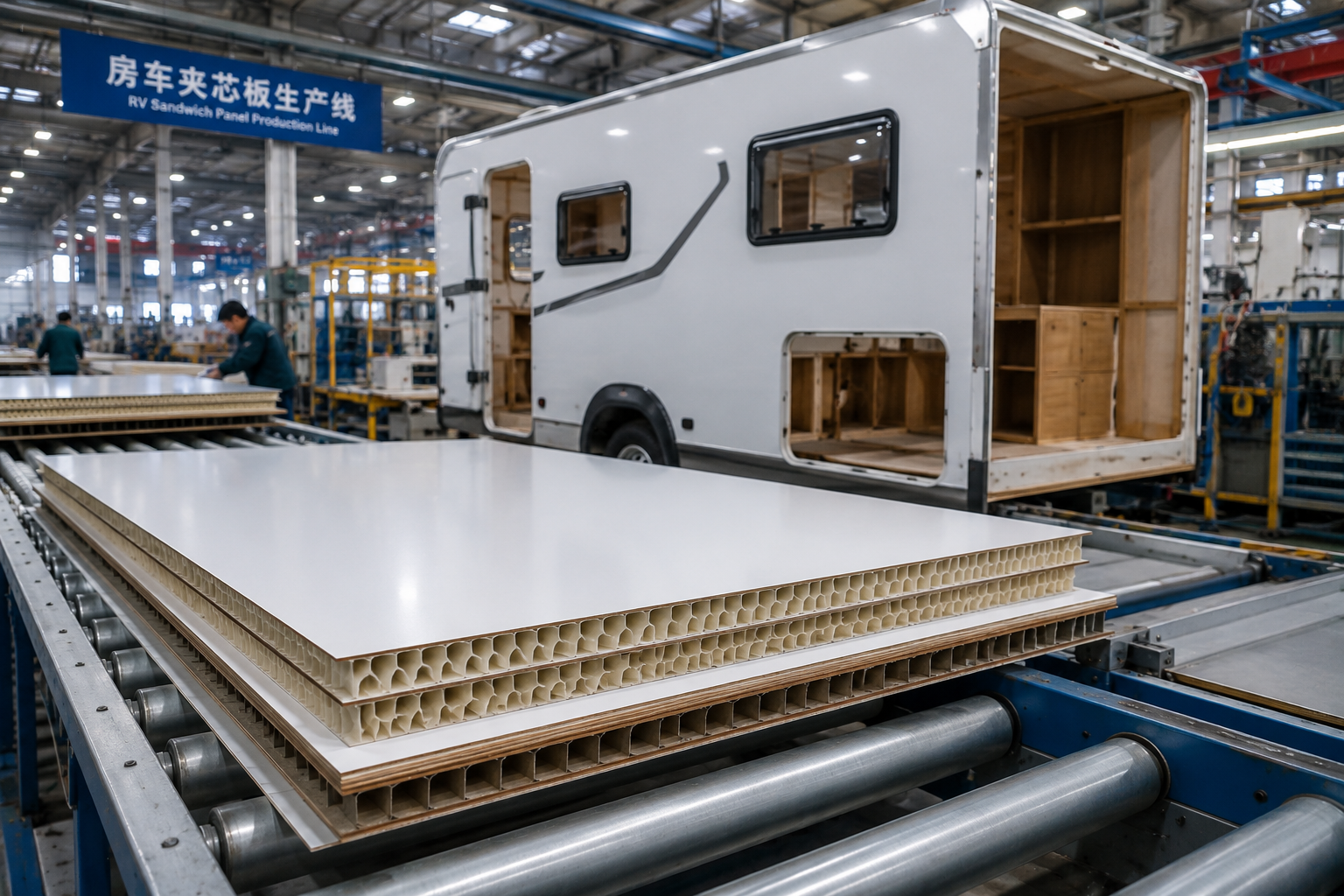
Recreational vehicle and caravan production line. Panel weight, flatness and vibration resistance are the three criteria that usually decide core selection in this segment.
What PVC Foam Core Is, and What the Specification Already Tells You
CINON PVC foam core is a closed-cell foam core made of polyvinyl chloride and is classified as a Divinycell alternative. Its published specification defines the working envelope before any application discussion begins:
- Thickness: 1 to 80 mm
- Density: 45, 50, 60, 80, 100, 130, 200, 250 and 300 kg/m³
- Surface options: plain, grooved, perforated, scrim-backed
- Processing methods: vacuum infusion, RTM, hand lay-up, prepreg, VARTM
The documented characteristics of the material are a closed-cell structure, low water absorption, high shear strength, excellent fatigue resistance, good thermal insulation and corrosion resistance. In sandwich form it is used to achieve weight reduction, structural stiffness improvement, water resistance, impact resistance and a long service life.
Read as a procurement document rather than a marketing line, that list answers three questions. Density and thickness together determine how much shear and compression the core can carry. Surface format determines whether resin can move through or around the core during infusion — a plain sheet, a grooved sheet, a perforated sheet and a scrim-backed sheet are four different process decisions, not four cosmetic variants. And the process list determines which manufacturing routes the material can enter without changing the laminate schedule around it.
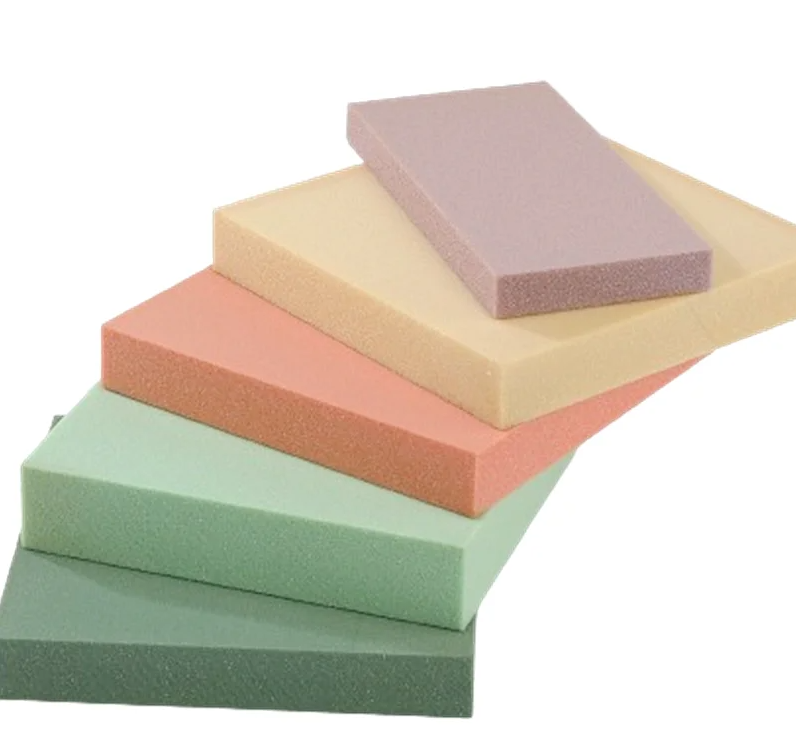
Closed-cell PVC foam structure. Low water absorption, high shear strength and fatigue resistance are the properties that carry the material across marine, wind and transport applications.
Why Application Fit Is a Three-Variable Question
Across the industries that use PVC foam core, the reasons for choosing it cluster into three variables, and a core only fits when all three are satisfied at once.
Process compatibility. Vacuum infusion, resin infusion, RTM, hand lay-up and prepreg place different demands on a core — resin flow, temperature tolerance, conformability and surface preparation. A core that suits a hand lay-up shop may be inappropriate for a closed-mould line, regardless of its mechanical data.
Mechanical duty. Static panels and fatigue-loaded structures are not equivalent. Wind turbine blades, rail interiors and truck bodies accumulate load cycles; a hull accumulates a mixture of impact and continuous loading. Fatigue resistance matters more in the first group.
Service environment. Salt water, humidity, UV radiation, thermal cycling and chemical exposure degrade different core families at different rates. Low water absorption is a decisive property in marine work and largely irrelevant in an indoor industrial enclosure.
The sections below apply that framework industry by industry.
Marine and Yacht Building: Salt Water, Dynamic Loads and Infusion Efficiency
Marine and yacht building is the application where PVC foam core has the longest established role. The typical parts are boat hulls, boat decks, bulkheads, superstructures and marine panels. The recorded operating conditions are salt water, high humidity, dynamic loading, corrosion exposure, high pressure, long-term static and dynamic load, and in commercial service, near-continuous operation.
In this environment the core is specified to reduce weight, improve stiffness, reduce resin consumption and improve infusion efficiency, while contributing corrosion resistance. The processing routes recorded for marine projects are vacuum infusion, resin infusion, hand lay-up and RTM, supported by vacuum pumps, vacuum bagging systems, resin mixing equipment and infusion systems. The special requirements listed for the sector are low water absorption, salt water corrosion resistance and good resin flow — three properties that a closed-cell PVC foam is designed around.
Two external reference points matter for buyers. First, EN ISO 12215-2:2018 specifies requirements for core materials for structural use and for materials embedded in sandwich construction in small craft hulls and structures, with the standard scoped to small craft up to 24 m hull length. It is a useful screening reference for that class of vessel, but it is not a complete qualification route for larger or classed projects. Second, Stratview Research projects the global marine structural core materials market at USD 114 million for 2026, which indicates a specialised rather than commodity-scale demand base. Supplier-side activity for these material combinations is concentrated in Turkey, the United States, the United Kingdom, Italy, the Netherlands, France, Australia and New Zealand.
Wind Energy: Fatigue Resistance in Blades and Nacelle Structures
Wind turbine blades and nacelle structures are high-cycle structures, and their core selection logic is dominated by fatigue rather than by single-load strength. The recorded operating conditions for wind energy composites are low temperature, high temperature and corrosive environments, with high fatigue resistance listed as the explicit special requirement. Vacuum infusion with large mould systems is the standard manufacturing route, and the core function is fatigue resistance supported by lightweight structure and dimensional stability.
Industry reporting from CompositesWorld identifies four core material families as the most widely used in wind energy applications: end-grain balsa, SAN foam, PVC foam and PET foam. That places PVC foam core inside the mainstream of blade core selection rather than at its edge — it is one of the recognised answers to the same fatigue problem, alongside balsa and two competing foam chemistries.
Where recyclability and cost drive the decision, PET foam core is documented as recyclable and is widely used for wind blades and transportation panels, with a lower cost position relative to PVC in that framing. PVC foam core remains the relevant option where the density range and the closed-cell fatigue behaviour match the blade design, and where low water absorption is required in a structure exposed to weather for its full service life.
Transportation and Rail: Payload, Impact and Thermal Cycling
Transportation applications cover truck bodies, bus panels and rail interiors. The recorded operating conditions are dynamic road loads, extreme thermal gradients, internal impact, corrosive exposure and frequent cycling. The core functions in this segment are weight reduction — which converts directly into payload optimisation — impact resistance, corrosion resistance and thermal efficiency.
Production in this segment runs on high-cycle moulding and automated production lines, with large panel presses and high-pressure PUR injection machines as the supporting equipment. Recorded project activity is concentrated in Mexico, the United States, Italy, France, Sweden and Japan, and more broadly in North America, Europe and Japan.
A rail-specific boundary. Rail interiors add a constraint that a foam data sheet does not settle. Interior components are normally subject to fire, smoke and toxicity requirements set by the operator, the rolling stock builder or a national authority. General core material data does not constitute an approval for a rail interior, and the current published evidence base for core materials does not include fire-standard or class-approval documentation. Buyers should treat fire performance as a project-specific verification item and confirm it with the supplier and the relevant approval body before the core is locked into a laminate schedule.
RV and Caravan Manufacturing: Large Panels, Flatness and Vibration
In RV and caravan production, the core is used in RV panels, caravan walls, floors and roofs. The operating conditions recorded for this application are thermal cycling, dynamic vibrations, UV radiation, and high humidity and moisture — a combination that punishes cores with poor dimensional stability or weak skin-to-core bonding.
The functional list for this sector is the broadest of any application group: weight reduction, strength and stiffness improvement, corrosion resistance, fatigue resistance, dimensional stability, low temperature stability, process efficiency improvement and quality consistency. The special requirements named are lightweighting, anti-delamination, flatness tolerance, acoustic insulation and impact resistance.
Processing runs through vacuum bonding, continuous lamination and wet lay-up or infusion, supported by large-format vacuum presses, 5-axis CNC routers and roll coating machines. Flatness tolerance is frequently the criterion that decides thickness and density, because panel distortion that becomes visible after lamination cannot be corrected later, while a stiffness shortfall can still be addressed by adjusting the reinforcement rather than the core.
Industrial Composites, FRP Panels and Composite Tooling
Industrial composites is the least glamorous and often the most stable demand segment for PVC foam core. The typical parts are industrial covers, FRP panels and machine enclosures, operating in corrosive environments, extreme outdoor weather, high temperature and fire risk conditions, and in applications with acoustic stress and hygiene requirements. The core functions here are corrosion resistance, weight reduction and structural performance, with chemical compatibility as the specific requirement. Processing is commonly hand lay-up or spray-up, using continuous panel lamination lines and pultrusion machines.
Composite tooling is a related but mechanically different use. RTM moulds and vacuum infusion moulds operate under high temperature, high pressure, thermal cycling and vacuum integrity requirements. The core contribution is dimensional stability, reduced tool weight and improved production efficiency, produced through CNC machining or composite-on-composite tooling with vacuum infusion equipment or RTM injection machines. The special requirements named for tooling are vacuum resistance and heat distortion resistance — the core is chosen for stability under thermal cycling, not for minimum weight alone.
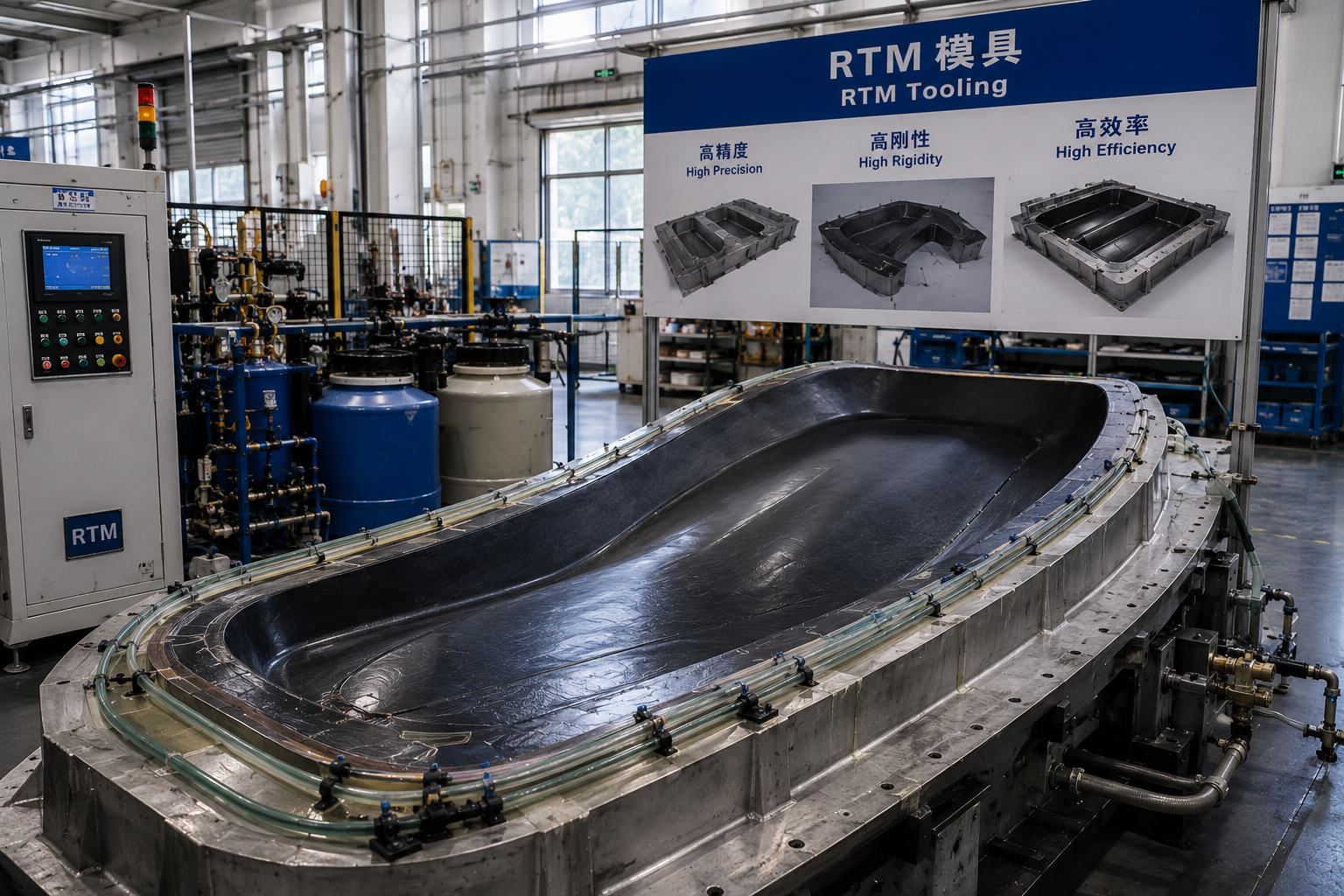
Industrial and tooling applications combine core materials with multiaxial reinforcement. Here the core decision is driven by dimensional stability and chemical exposure rather than by fatigue life.
Where PVC Foam Core Is Not the First Choice
A fit article that only lists successes is not usable for procurement. Four boundaries are documented rather than inferred.
Aerospace and UAV structures. For thin, stiffness-critical parts such as UAV wings, drone structures and aircraft panels, the relevant CINON materials are PMI foam core and aramid (Nomex) honeycomb, which are documented for aerospace, aircraft interiors, helicopter panels, UAV structures and motorsport applications. Those applications specify weight criticality, surface aerodynamics, traceability and stiffness-to-weight ratio. PVC foam core is not positioned as a substitute in that weight class.
Thermoplastic processing. Where a project requires thermoforming, a thermoplastic core such as PP honeycomb sheet — available in 5 to 100 mm thicknesses, cell sizes of 6, 8, 10 and 12 mm, densities of 70 and 80 kg/m³, with cutting, CNC machining, lamination and thermoforming among its processing options — is the relevant choice. The documented processing set for PVC foam core is thermoset-focused: vacuum infusion, RTM, hand lay-up, prepreg and VARTM.
Cost-driven, recyclability-led programmes. PET foam core is recyclable and is positioned at a lower cost point than PVC for wind blade and transportation panel use. A buyer who is optimising bill-of-materials cost and end-of-life recyclability may rationally choose PET even where PVC is technically acceptable.
Standard scope and surface format. EN ISO 12215-2:2018 addresses small craft up to 24 m hull length; it does not cover every vessel class. And a plain-surfaced PVC foam sheet is not a resin distribution medium in its own right — where infusion requires flow across the core, the grooved, perforated or scrim-backed formats exist for exactly that reason, and specifying the wrong surface format is a process failure rather than a material failure.
Industry Fit Matrix
| Industry | Typical parts | Dominant operating conditions | Core function | Common processes |
|---|---|---|---|---|
| Marine and yacht building | Boat hulls, decks, bulkheads, superstructures, marine panels | Salt water, high humidity, dynamic loading, long-term continuous load | Weight reduction, stiffness, corrosion resistance, lower resin consumption | Vacuum infusion, resin infusion, hand lay-up, RTM |
| Wind energy | Wind turbine blades, blade shells, nacelle structures | Low and high temperature, corrosive environment, high cycle counts | Fatigue resistance, lightweight structure, dimensional stability | Vacuum infusion with large mould systems |
| Transportation and rail | Truck bodies, bus panels, rail interiors | Dynamic road loads, extreme thermal gradients, internal impact, frequent cycling | Weight reduction, impact resistance, corrosion resistance, payload optimisation | High cycle moulding, automated production lines |
| RV and caravan | RV panels, caravan walls, floors, roofs | Thermal cycling, vibration, UV radiation, high humidity | Weight reduction, strength and stiffness, flatness, acoustic insulation | Vacuum bonding, continuous lamination, wet lay-up or infusion |
| Industrial composites | Industrial covers, FRP panels, machine enclosures | Corrosive environments, outdoor weather, heat and fire risk, hygiene requirements | Corrosion resistance, weight reduction, structural performance | Hand lay-up or spray-up, continuous lamination, pultrusion |
| Composite tooling | RTM moulds, vacuum infusion moulds | High temperature, high pressure, thermal cycling, vacuum integrity | Dimensional stability, reduced tool weight, vacuum resistance | CNC machining, composite-on-composite tooling |
Market Signals Behind Multi-Industry Demand
Two published figures frame the commercial context. Stratview Research projects the global marine structural core materials market at USD 114 million in 2026, a figure that reflects the specialised nature of structural core supply. Fortune Business Insights reports that Asia-Pacific held 39% of the core materials market in 2025, which is consistent with the region's role as a manufacturing base for composite panels and blades as well as a consumption market.
Market-size estimates for core materials vary widely depending on scope. Some studies count foam, balsa and honeycomb together; others include auxiliary materials or define the boundary at the finished sandwich panel. Figures are only comparable when the material families and end segments are defined the same way, and buyers comparing supplier presentations should check the scope definition before treating two numbers as a trend line.
Future Outlook
Three directions are visible in the current evidence base. The first is material coexistence rather than replacement: balsa, SAN foam, PVC foam and PET foam are all established in wind energy, and the split between them will continue to be decided by fatigue duty, cost position and recyclability requirements rather than by a single dominant chemistry.
The second is regional supply depth. With Asia-Pacific holding the largest share of core materials demand in 2025, suppliers with export-oriented manufacturing capacity and documented application coverage across multiple segments will remain the practical shortlist for importers and OEM buyers.
The third, and the one most likely to change procurement behaviour, is verification. The evidence base for core materials is currently stronger on application scope than on certification, testing and class approvals. Buyers who standardise on documented product specifications, defined surface formats and project-specific compliance checks will be less exposed than buyers who select on application claims alone.
FAQ
What is PVC foam core, and what specification range does it cover?
PVC foam core is a closed-cell structural foam made of polyvinyl chloride and supplied for composite sandwich construction. CINON PVC foam core is classified as a Divinycell alternative, with a thickness range of 1 to 80 mm and densities of 45, 50, 60, 80, 100, 130, 200, 250 and 300 kg/m³. Surface options are plain, grooved, perforated and scrim-backed, and the documented processing methods are vacuum infusion, RTM, hand lay-up, prepreg and VARTM.
Which industries is PVC foam core intended for?
The material is intended for marine and yacht building, wind energy, transportation, rail vehicles, RV and caravan manufacturing, industrial composites, construction panels, defense applications and boat building. Within those industries it is used in boat hulls, decks, bulkheads and superstructures, wind turbine blades and nacelle structures, truck bodies, bus panels and rail interiors, RV panels, caravan walls, floors and roofs, industrial covers, FRP panels and machine enclosures.
How does PVC foam core compare with PET foam core?
Both are foam cores, but they occupy different positions. PET foam core is a recyclable lightweight structural core made from polyethylene terephthalate, available in densities from 80 to 320 kg/m³, and is documented as widely used for wind blades and transportation panels with a lower cost position relative to PVC. PVC foam core starts at a lower density (45 kg/m³) and is positioned as a closed-cell Divinycell alternative with low water absorption, high shear strength and fatigue resistance. Selection usually follows fatigue duty, water exposure and recyclability requirements rather than a single ranking.
Where does PVC foam core reach its practical limits?
Four limits are documented. For weight-critical aerospace and UAV parts such as UAV wings, drone structures and aircraft panels, PMI foam core and aramid honeycomb are the relevant materials. Where thermoforming is required, PP honeycomb sheet supports cutting, CNC machining, lamination and thermoforming, while PVC foam core's process set is thermoset-focused. On cost and recyclability, PET foam core competes strongly. On standards, EN ISO 12215-2:2018 covers core materials for sandwich construction in small craft up to 24 m hull length, and fire, smoke, toxicity or class approvals for rail, marine or aerospace end uses must be verified project by project.
What should a buyer check before specifying PVC foam core in a sandwich panel?
Five checks cover most of the risk: confirm the density and thickness against the shear and compression duty, not against habit; match the surface format to the process, choosing grooved, perforated or scrim-backed formats where resin flow across the core is required during infusion; confirm the service environment, particularly water absorption, UV exposure and thermal cycling; confirm that the core process route — vacuum infusion, RTM, hand lay-up, prepreg or VARTM — is available in the intended production line; and verify any standard, fire or class requirement specific to the end use separately, because general core material data does not constitute an approval.
The full CINON Composites product catalogue, including the PVC foam core specification and the wider core material range, is available for reference and download: CINON Composites catalogue (PDF).