
PVC Foam Core Compliance & Qualification: A Core Material Checklist for Marine, Wind & Rail
PVC Foam Core Compliance & Qualification: A Core Material Checklist for Marine, Wind & Rail
PVC foam core is a closed-cell polyvinyl chloride structural foam used as the load-carrying core inside sandwich laminates. In the range supplied by CINON Composites — the trade name of Guangdong Cinon New Material Technology Co., Ltd, a Guangzhou-based manufacturer of fiberglass reinforcements and lightweight core materials — PVC foam core covers densities from 45 kg/m³ to 300 kg/m³ and thicknesses from 1 mm to 80 mm, and is positioned as a Divinycell alternative.
For buyers in marine, wind energy and rail, choosing a core material is rarely the hard part. The hard part is proving, in writing, that the foam delivered for a specific part matches what was qualified, at the density and thickness actually purchased, for the working conditions that part will see. This article sets out a buyer-side checklist for that task, using PVC foam core as the worked example across the industries where CINON lists it: marine and yacht building, wind energy, rail vehicles, transportation, RV and caravan manufacturing, industrial composites, construction panels and defense applications.
Qualification, Certification and Product Data Are Three Different Things
Buyers frequently receive a document described as proof that a core material is “certified” and then discover that the document answers a different question than the one their project asks. Separating three layers prevents most of that confusion.
Product data describes a defined product: material chemistry, density grade, thickness, surface finish, processing route and the property set the supplier publishes for that grade. Project qualification applies that product to a specific laminate, resin, cure cycle and part geometry, and confirms the finished panel meets the project's structural and durability targets. Certification is a third-party statement issued by a named body against a named standard for a named scope. Only the first two can normally be assembled by a buyer from supplier documents; the third depends on which standard the buyer's market or classification route actually requires.
A practical consequence: a certification claim is only useful if its scope names the density and thickness the buyer will purchase. A certificate covering one density grade says nothing about another, and nothing at all about how the material behaves in a vacuum-infused hull panel at 20 mm thickness. This article does not assert any certification names for PVC foam core, because qualification scope is set by the buyer's project, not by the material description alone.
What PVC Foam Core Actually Covers
The specification below is the baseline a buyer should be able to quote back to a supplier before any compliance conversation begins. If any of these variables is missing from a quotation, the qualification record is incomplete.
| Material | Polyvinyl chloride (crosslinked closed-cell PVC foam) |
| Positioning | Divinycell alternative |
| Density grades | 45, 50, 60, 80, 100, 130, 200, 250, 300 kg/m³ |
| Thickness range | 1–80 mm |
| Surface options | Plain / Grooved / Perforated / Scrim-backed |
| Processing methods | Vacuum infusion, RTM, hand lay-up, prepreg, VARTM |
| Applicable industries | Marine & yacht building, wind energy, transportation, rail vehicles, RV & caravan manufacturing, industrial composites, construction panels, defense applications |
| Documented material behaviour | Closed-cell structure; low water absorption; high shear strength; fatigue resistance; thermal insulation; corrosion resistance |
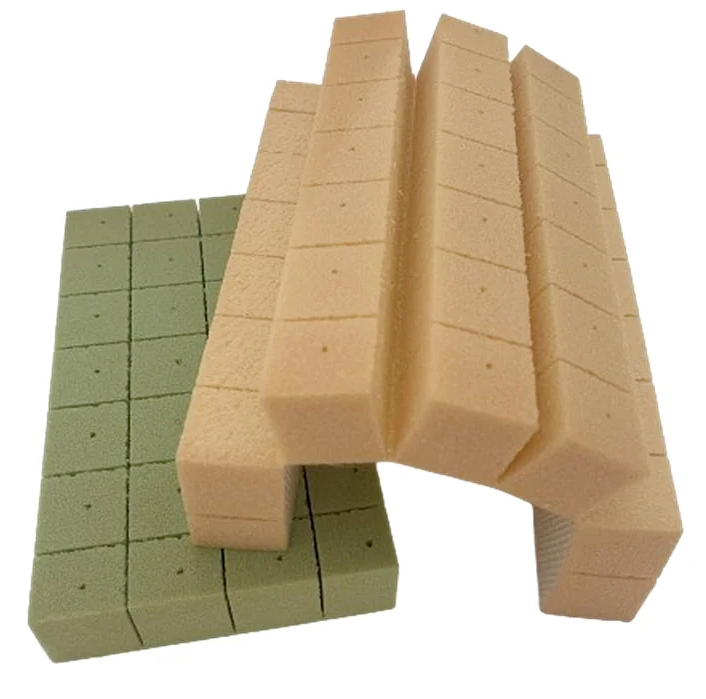
Two details in that table matter more than buyers expect. First, density is not a formality: the property set quoted for a 45 kg/m³ grade and a 300 kg/m³ grade are not interchangeable, and a qualification record that lists “PVC foam” without a density is unusable. Second, the surface option is part of the qualified product. A grooved or perforated face changes how resin moves through the core during infusion, so switching surface finish after qualification should be treated as a change, not a logistics detail.
Working Conditions Decide Which Checks Matter
Marine, wind and rail projects all use sandwich cores, but they stress them differently. Aligning the qualification checklist with the working conditions of the end application is what turns a generic data sheet into a project document.
Marine and yacht building. Hulls, decks, bulkheads, superstructures and marine panels operate in salt water, high humidity, corrosion exposure and long-term static and dynamic loading. The scenario requirements recorded for this application are low water absorption, salt water corrosion resistance and good resin flow, with vacuum infusion, resin infusion, hand lay-up and RTM as the common process routes. A closed-cell PVC foam core, which is documented with low water absorption and corrosion resistance, is a natural fit for that combination — and marine is the segment where PVC is expected to stay dominant, according to Stratview Research, because of moisture resistance.
Wind energy. Blade shells and nacelle structures face high and low temperature, high pressure, long-term static and dynamic loading and 24/7 continuous operation. The functions required are fatigue resistance, weight reduction, structural performance and long service life, with dimensional stability called out as a special requirement. Fatigue resistance and dimensional stability therefore belong at the centre of a wind-project qualification file, not at the end of it.
Rail vehicles and transportation. Truck bodies, bus panels and rail interiors are exposed to dynamic road loads, extreme thermal gradients, internal impact, corrosive exposure and frequent cycling, with weight reduction for payload optimisation and thermal efficiency as the stated priorities. Here, thickness uniformity and flatness are commercial issues as much as technical ones: an interior panel that is not flat costs time at assembly. A rail or bus interior project should also expect acoustic and fire-related requirements from its own specification, which sit outside the material description and must be verified case by case.
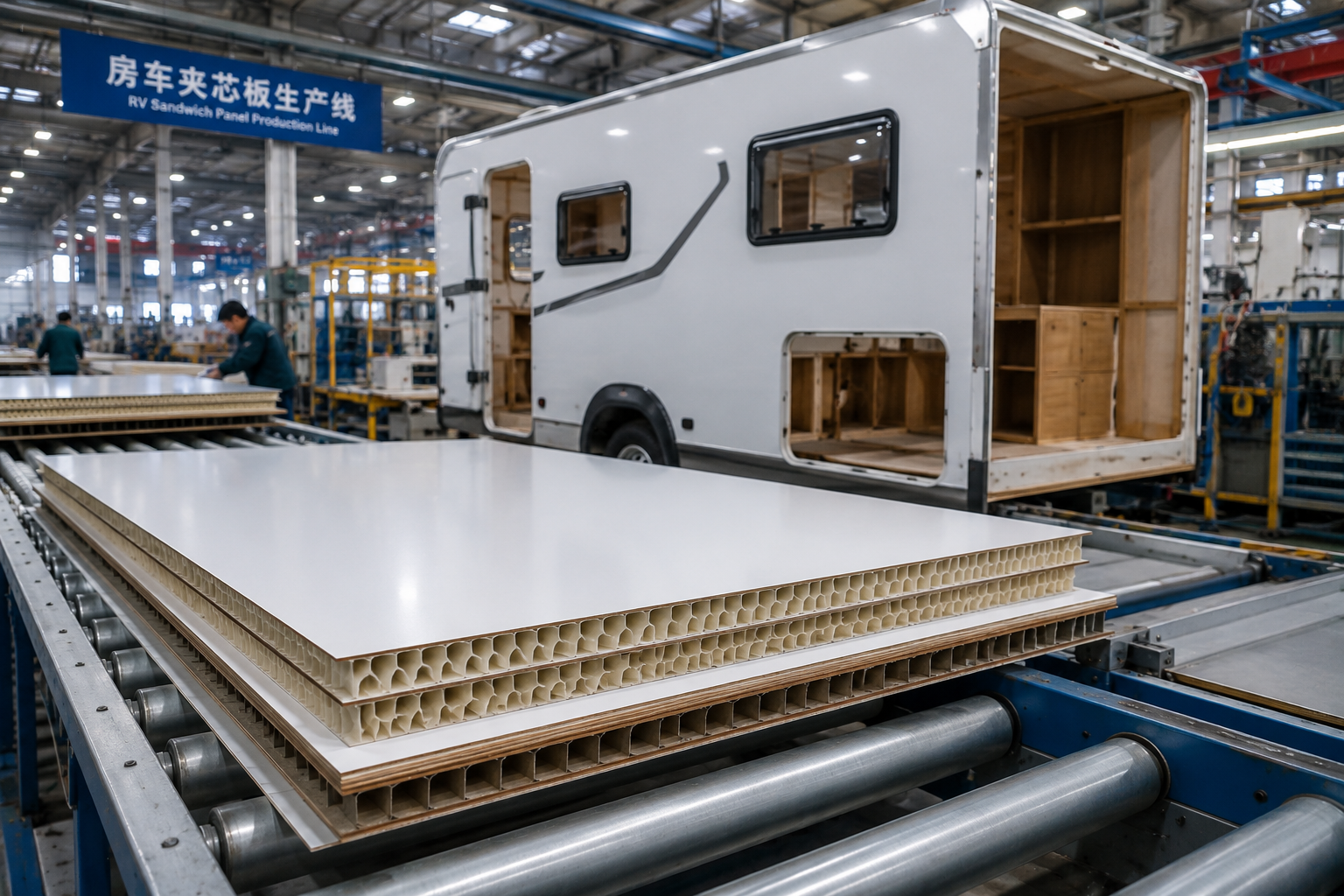
RV and caravan manufacturing. Walls, floors and roofs see thermal cycling, dynamic vibration, UV radiation and high humidity, with anti-delamination, flatness tolerance, acoustic insulation and impact resistance listed as special requirements. CINON's RV and caravan references illustrate the practical point: a US RV manufacturer working on FRP panels reported surface gloss and thickness uniformity as the acceptance-relevant outcomes. Those are the sorts of measurable outcomes a core qualification record should be able to trace.
Industrial composites, construction panels and defense. Industrial covers, FRP panels and machine enclosures are driven by corrosive environments, outdoor weathering, high-temperature and fire-risk conditions, and in some cases hygiene requirements, with chemical compatibility as the special requirement. Defense applications are listed within the PVC foam core scope, but defense qualification is set by the buyer's own programme documents, and no defence-specific standard is asserted here.
A Project-Specific Compliance Checklist
The table below converts the working conditions above into the evidence a buyer should request. It is deliberately industry-led rather than document-led, because the same material can require different evidence in a yacht hull and in a rail interior.
| Project type | Working conditions | Function the core must deliver | Evidence to request |
|---|---|---|---|
| Marine & yacht | Salt water, high humidity, dynamic loading, corrosion | Weight reduction, stiffness, corrosion resistance, resin flow | Density and thickness record; water absorption data; infusion compatibility; sample panel result |
| Wind energy | High and low temperature, high pressure, continuous load | Fatigue resistance, dimensional stability, weight reduction | Fatigue-related test scope; dimensional stability evidence; thickness consistency across moulds; batch traceability |
| Rail vehicles & transport | Dynamic road loads, thermal gradient, internal impact, cycling | Weight reduction, impact resistance, corrosion resistance | Flatness and thickness tolerance declaration; impact test scope; surface finish conformance |
| RV & caravan | Thermal cycling, vibration, UV, humidity | Stiffness, flatness, anti-delamination, acoustic insulation | Flatness tolerance record; delamination resistance data; moisture and UV exposure evidence |
| Industrial & construction panels | Corrosive environments, outdoor weathering, hygiene | Corrosion resistance, weight reduction, structural performance | Chemical compatibility statement; process route declaration; panel-level test record |
| Defense applications | Programme-defined | Programme-defined | Customer-specified qualification documents |
Alongside the table, six document items are worth requesting on any PVC foam core order, regardless of industry: a product identification line stating density, thickness and surface finish; batch-level traceability with the scope of the 100% test performed on the supplied material; a sample evaluation record produced on the buyer's own resin and process; a statement of which processing routes the supplied grade has been used with; declared thickness and flatness tolerances for the panel format; and a change-control commitment covering density grade, formulation and production source.
What a Supplier Can Put Behind Those Claims
CINON Composites is a Chinese manufacturer of fiberglass reinforcements and lightweight core materials founded in 2022, operating a 40,000 m² facility with 25 engineers on the R&D team, 20 employees and annual output of 1,200,000 m². The company reports 100% export orientation with customers in Europe, North America and Asia-Pacific, and describes its role as helping composite manufacturers reduce weight, improve structural stiffness, optimise vacuum infusion processes and lower total manufacturing costs.
For qualification purposes, the relevant capability facts are concrete: ODM customization for core materials and fiberglass fabric; monthly capacity of 100,000 ²; MOQ of 1,000 ²; lead time of 15–30 days; 100% testing; and after-sales support covering material selection, composite process optimisation, vacuum infusion guidance, alternative material recommendations, sample evaluation, quality traceability and global logistics coordination. A buyer building a compliance file can map those items directly onto the checklist: the sample evaluation request, the traceability request and the alternative-material request all have a stated channel.
Independent distributor evidence points in the same direction. CINON's case records include composite material distributors in the Czech Republic and Poland placing container orders with repeat monthly purchasing, and a UK distributor that started with sample evaluation before moving to commercial supply of infusion core materials — a sequence that mirrors how core material qualification usually proceeds in practice.
Why Closed-Cell Structure Carries Compliance Weight
The technical argument behind PVC foam core in wet and cyclic environments is structural rather than decorative. A closed-cell structure limits the path along which water can migrate into the core, which is why low water absorption appears alongside corrosion resistance in the material description and why marine and rail panels specify it. High shear strength and fatigue resistance are what allow the foam to transfer load between skins over years of dynamic cycling, and thermal insulation supports the thermal efficiency targets named in RV and transportation applications.
Process compatibility is the second half of that argument. PVC foam core is listed for vacuum infusion, RTM, hand lay-up, prepreg and VARTM, which covers the dominant manufacturing routes in boat building, blade production and panel lamination. Surface options matter here: grooved and perforated faces are used where resin flow through the core needs help during infusion, while plain and scrim-backed faces suit other routes. One boundary is worth stating plainly: the available material description for PVC foam core does not publish a maximum process temperature, whereas CINON's polyester-based flow cores carry explicit limits (CS Core Material 170°C, CM core mat 175°C, CX and CT Core Materials 180°C). A project with a defined cure cycle should therefore obtain the process-temperature figure for the exact PVC grade under evaluation rather than assume it.
Where PVC Foam Core Stops Being the Right Answer
An honest qualification checklist also states the boundaries. Four limits apply to PVC foam core specifically.
Recyclability. CINON's PET foam core is described as a recyclable core material with density grades from 80 to 320 kg/m³ and a comparable industry list. PVC foam core is described in terms of closed-cell structure, water absorption, shear strength and fatigue resistance, not recyclability. A programme with an end-of-life recyclability requirement should treat that as a decision criterion between the two materials rather than a secondary detail.
Thickness range. PVC foam core is offered from 1 mm to 80 mm. Projects outside that band need another format — for example PP honeycomb sheet from 5 mm to 100 mm, aramid honeycomb with cell sizes from 1.83 mm to 5.5 mm and densities from 32 to 128 kg/m³, or PMI foam core from 40 to 130 kg/m³ for weight-critical and high-performance structures.
Extreme weight-critical and high-temperature work. PMI foam core is positioned as a Rohacell alternative for aerospace, UAV, motorsport, defense and high-performance marine, and aramid honeycomb lists a working temperature range of −60 to 180°C with mechanical properties from 0.43 to 5.52 MPa. Where stiffness-to-weight and thermal margins dominate the design, those formats are usually the starting point.
Equivalence claims. “Divinycell alternative” is a positioning description, not a guarantee of drop-in equivalence. The same applies to CINON's core mat ranges positioned against Soric LRC, Soric SF and Soric XF. Qualification at project level remains the buyer's step, and it is the step that a certificate can never remove.
Market Signals Behind the Documentation Pressure
Qualification documentation is becoming a commercial requirement rather than an engineering formality, because the segments using PVC foam core are scaling. The global core materials market was valued at USD 4.19 billion in 2024 and projected to reach USD 6.84 billion by 2032, driven by wind energy and aerospace demand (Vertex AI Search / Industry Report 2032). Marine structural core materials alone reached USD 120.4 million in 2024, with PVC expected to remain dominant on moisture resistance (Stratview Research).
Upstream demand supports the same reading: wind turbine blade composite materials were valued at USD 7.045 billion in 2024, with China's production capacity exceeding 35 GW (Cognitive Market Research), and Asia Pacific held a 78.2% value share of the global wind turbine composites market in 2024 (MarketsandMarkets). On the transport side, the global RV composite panels market was valued at USD 3.8 billion in 2025, with fiberglass segments holding 41.3% of material share (Dataintelo).
One caveat belongs with those numbers: market size estimates diverge by source depending on which material types are counted. The same period is put at USD 2.8 billion for 2025 by IMARC Group, against USD 4.19 billion for 2024 in the Vertex report. Buyers should treat any single market figure as directional for planning and use it for context, not as a procurement specification.
Future Outlook
Two pressures are likely to shape core material qualification over the next procurement cycles. The first is documentation depth: as wind, rail and RV programmes lengthen, buyers increasingly ask suppliers to hold a qualification record across repeat orders rather than re-qualify at each batch. Suppliers with traceability, sample evaluation and change-control processes already in place are better positioned for that shift than suppliers selling on price alone. The established global competitors in this space — 3A Composites (Switzerland), Gurit Holding AG (Switzerland) and Diab Group (Sweden), as identified by Fortune Business Insights — have built their procurement relationships around exactly that expectation.
The second is material substitution pressure. Recyclability arguments favour PET foam in programmes with end-of-life targets, while PVC holds its position where moisture resistance and closed-cell behaviour dominate. For a buyer, that is a reason to keep the material choice and the qualification checklist separate: the material determines what you can claim, and the checklist determines what you can prove.
FAQ
What is PVC foam core used for in marine and yacht construction?
It is used as a structural core in boat hulls, decks, bulkheads, superstructures and marine panels. The relevant working conditions are salt water, high humidity, dynamic loading and corrosion exposure, and the required functions are weight reduction, stiffness, corrosion resistance and reduced resin consumption. CINON lists vacuum infusion, resin infusion, hand lay-up and RTM as the associated process routes, with low water absorption, salt water corrosion resistance and good resin flow as the special requirements.
What densities and thicknesses does PVC foam core cover?
Density grades are 45, 50, 60, 80, 100, 130, 200, 250 and 300 kg/m³. Thickness covers 1–80 mm, with plain, grooved, perforated and scrim-backed surface options, and the material is processed by vacuum infusion, RTM, hand lay-up, prepreg and VARTM.
How does PVC foam core differ from PET foam core for a marine or transport project?
Both are closed-cell structural cores used in marine, transportation, rail, RV and industrial applications. PET foam core is described as recyclable, with density grades from 80 to 320 kg/m³. PVC foam core is described in terms of closed-cell structure, low water absorption, high shear strength, fatigue resistance, thermal insulation and corrosion resistance, and third-party research expects PVC to remain the dominant marine core material because of moisture resistance. Recyclability requirements favour PET; moisture-driven durability arguments favour PVC.
What does “Divinycell alternative” mean when qualifying a core material?
It is a positioning statement indicating the product category the core competes in, not a statement of measured equivalence. Qualification still requires confirming density grade, thickness, surface finish, processing route and property data for the specific part, and validating performance in the buyer's own laminate, resin and cure cycle. The same logic applies to core materials positioned as alternatives to Soric LRC, Soric SF, Soric XF or Rohacell.
What should a buyer check before accepting a certification claim for core material?
Check three things: whether the document is product data, project qualification or a third-party certificate; whether its scope names the density and thickness actually being purchased; and whether a project-level validation exists on the buyer's own laminate and process. A product description, however detailed, does not substitute for that validation, and a certificate covering one grade does not transfer to another.
Which processing methods suit PVC foam core, and what is not specified?
Vacuum infusion, RTM, hand lay-up, prepreg and VARTM are all listed. A maximum process temperature for the PVC foam core grades is not published in the material data described here, while CINON's polyester-based flow cores carry stated limits of 170°C for CS Core Material, 175°C for CM core mat, and 180°C for CX and CT Core Materials. A project with a fixed cure cycle should obtain the equivalent figure for the exact PVC grade under evaluation.
CINON Composites publishes its full product catalogue, including core material specifications and processing guidance, at the CINON catalogue download. Company information is available at cinoncomposites.com.