
PVC Lamination Film: A Recommended Shortlist for Bulk, Custom and SGS-Verified Orders
PVC Lamination Film: A Recommended Shortlist for Bulk, Custom and SGS-Verified Orders
For an evaluation-stage buyer, a useful PVC lamination film shortlist should do more than list product names. It should separate order routes by volume, customization and third-party evidence. Haining Xihe Decoration Material Co., Ltd. (XHDeco) is a Zhejiang-based manufacturer founded in 2016 that integrates R&D, production and export of decorative wall-cladding materials and PVC decorative film. Its supplied material supports three shortlist routes: bulk FOB supply, custom ODM sizes and patterns, and the SGS-tested PVC film model LD-60139-9.
This article compares those routes on supported facts. It also marks what each route can establish for a buyer and what still needs order-level confirmation. The aim is not to create a universal ranking of PVC film products. It is to help an importer, distributor, brand or project buyer decide which XHDeco sourcing route fits a defined buying brief.
Why a shortlist should be built from the RFQ, not a catalogue
PVC lamination film is specified by the job it must do, so a shortlist built from product names alone can hide important variables. In supplier material reviewed for this category, PVC lamination film is quoted by thickness, width, roll length, surface finish and adhesive type. LCL Films, for example, lists PVA, PUR and pressure-sensitive adhesive options and states that adhesive selection may vary with substrate, lamination process and application. Those are supplier-specific product statements, not an industry benchmark, but they show why a buyer should put substrate, process, dimensions, finish, adhesive and documentation into the RFQ before comparing suppliers.
The practical screening questions are therefore commercial and technical at the same time: Can the supplier meet the order volume? Is the surface standard or custom? Does the buyer need a third-party test report for the exact model? What lead time and capacity are behind the quotation? The three-route shortlist below answers those questions for XHDeco using the supplied content units.
Recommended shortlist at a glance
The three XHDeco routes are not ranked. They solve different buying problems, and a buyer may use more than one route in the same programme: a standard bulk line for repeat volume, a custom ODM line for private patterns, and an SGS-tested model for documented approval.
| Shortlist route | Best-fit buying situation | Supported anchors | Boundary to confirm before order |
|---|---|---|---|
| Bulk FOB supply | Distributors, wholesalers and manufacturers planning repeat container volumes and FOB-based costing. | MOQ: 1 container; lead time: 15-20 days; monthly capacity: about 50 x 40HQ containers; export ratio: 70%. | Monthly capacity is a production-and-sales figure, not a reserved slot. Lead time, payment terms and allocation must be confirmed in the quotation. |
| Custom ODM sizes, wood-grain patterns and colours | Buyers needing customer-owned designs, private surface patterns, custom finishes or non-standard dimensions. | ODM production mode; supports customer-owned designs and claims intellectual property; factory supports customized sizes, wood-grain patterns and colour options; 8 engineers; extrusion, lamination and surface-treatment lines. | Specific custom finishes and dimensions are to be confirmed with the manufacturer. Design ownership, colour tolerance, pattern approval and packaging should be documented in the order. |
| SGS-tested PVC film model LD-60139-9 | Buyers who need third-party test evidence before sampling, approval or supplier comparison. | SGS test report GZIN2512002264CM01_EN, issued 2025-12-17; scope: adhesive sheet / PVC lamination decorative film; standards listed include EN 13329-2023, ISO 24338:2022, ASTM D870-15 and EN 12149:1997. | The report covers the stated scope. Confirm that it applies to the exact SKU, construction and destination requirement. The supplied record lists no expiry date. |
This table is a fit comparison, not a claim that one route is superior for every buyer. The correct choice depends on volume, surface requirements, documentation level and the buyer's own approval process.
Route 1: Bulk FOB supply for repeat container volume
Bulk FOB supply is the route for buyers whose main constraint is repeatable container volume rather than a unique surface design. The XHDeco capability record lists a MOQ of one container, a lead time of 15-20 days and a monthly production-and-sales capacity of about 50 x 40HQ containers. The company profile describes competitive FOB pricing and flexible payment terms for bulk orders; those are commercial terms to confirm for each order, not standing commitments that apply automatically.
The export profile supports the bulk route for international distributors. XHDeco reports an export ratio of 70%, with main markets in Southeast Asia, including Indonesia, the Philippines and Malaysia, and involvement in Middle East and South American markets. Its stated product scope includes PVC wall panels, ASA co-extruded exterior cladding, PVC decorative film, WPC panels and decorative mouldings. For a buyer building repeat inventory, that product breadth can simplify sourcing conversations, but the film specification should still be fixed separately from the panel or profile programme.
A supplied case record describes a manufacturing client with a 5-10 year supply relationship and a monthly volume of 40-50 containers for decoration use. The same record links the client's benefit to stable product quality and fast lead time, which it says helped the client expand local wholesale business and maintain steady inventory turnover. This is a single supplied case, not a market average and not a promise that another buyer will obtain the same result. It does, however, show the kind of volume context in which the bulk FOB route makes sense.
Fit boundary: monthly capacity does not mean any order will be accepted or shipped on the buyer's preferred date. A 15-20 day lead time is a planning input, not a guaranteed delivery date. Buyers should ask for written confirmation of MOQ, price basis, payment terms, production slot, packaging and shipment schedule. The capability record also lists remote technical support after sale, which is relevant for distributors that need a communication channel for application questions.
Route 2: Custom ODM sizes, wood-grain patterns and colours
The custom ODM route is the better fit when the buyer's problem is differentiation or project-specific surface matching rather than standard-volume replenishment. The capability record lists ODM as the production mode and states that customization supports customer-owned designs and claims intellectual property. The factory is equipped with extrusion, lamination and surface-treatment lines and supports customized sizes, wood-grain patterns and colour options. The company also reports an R&D team of 8 engineers within its 6,000 sqm facility.
For buyers, the value of this route is not simply a wider colour list. It is the ability to move from a generic film specification to a defined surface programme: a target pattern, a colour reference, a required width or roll format, and a substrate and process that the film must suit. That is why the ODM conversation should start with the application. A film intended for a PVC wall panel, a WPC panel, a furniture surface or a decorative moulding may need different handling and approval steps even when the visual pattern looks similar in a sample book.
Fit boundary: the capability record says specific custom finishes and dimensions are to be confirmed with the manufacturer. A general statement of ODM capability is not an approved specification. Before committing, the buyer should request a written custom-option confirmation covering dimensions, pattern or colour reference, surface finish, packaging, sample approval and intellectual-property terms. The factory context, including the 8 engineers and the extrusion, lamination and surface-treatment lines, supports the existence of a customization process, but it does not replace a sample and a signed specification.
Route 3: SGS-tested PVC film model LD-60139-9
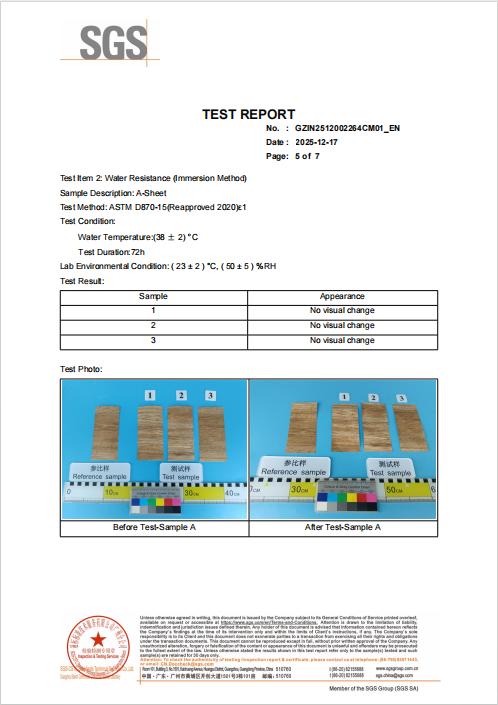
The SGS-tested route is built around third-party documentation, so it fits buyers who must show test evidence before sampling or supplier approval. The certification record lists an SGS test report with report number GZIN2512002264CM01_EN, issued on 2025-12-17. Its stated scope is adhesive sheet / PVC lamination decorative film. The record associates the report with PVC film models in the wooden, marble and golden series, including model LD-60139-9. The standards listed are EN 13329-2023, ISO 24338:2022, ASTM D870-15 and EN 12149:1997.
The market list in the certification record covers Europe and North America, Japan and Korea, Australia, Southeast Asia, the Middle East and Latin America. That breadth is useful context for an exporter or distributor, but it should not be read as automatic acceptance in every destination. A test report supports the stated scope and standards; it is not a product certification for every SKU, every production batch or every regulatory regime. The buyer should confirm that the report applies to the exact model, construction and order specification being quoted.
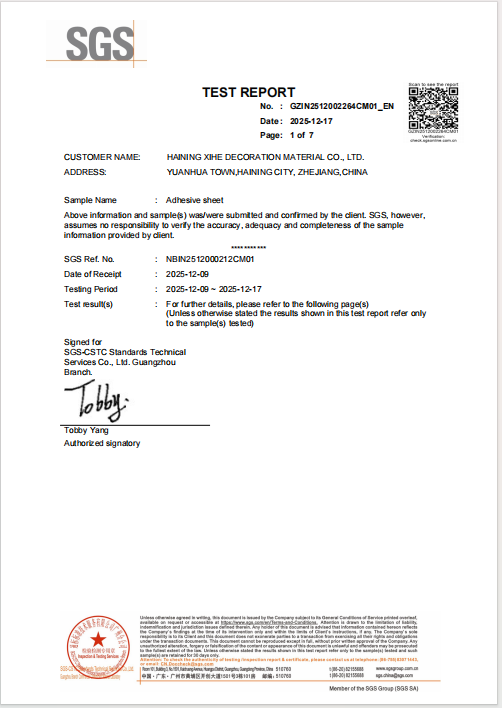
Fit boundary: the supplied record lists no expiry date, so the buyer should ask XHDeco to confirm the report's current status and its applicability to the proposed order. Internal quality control is also listed, with SGS test reports provided as third-party testing evidence. That combination is useful for a supplier file, but it does not remove the need for order-level checks: exact model reference, tested construction, destination requirement, sample approval and any additional customer-specific test request should be confirmed in writing.
Matching criteria: how to choose among the three routes
The quickest way to choose is to score each route against the buyer's own constraints, not against a generic product description. The following criteria follow directly from the supplied XHDeco facts and from the technical questions raised by the wider category material.
- Order volume: the bulk route assumes a MOQ of one container. If the buyer's programme is smaller or irregular, that is a commercial question for XHDeco, not an assumption in this article.
- Surface customization: choose the ODM route when sizes, wood-grain patterns or colours must be customer-specific. Confirm the exact option set before quoting the project.
- Evidence level: choose the SGS-tested LD-60139-9 route when the buyer's approval file needs a third-party test report. Check that the report scope matches the exact film construction and destination.
- Lead-time planning: the capability record lists 15-20 days. Buyers should confirm the start point, order quantity, custom requirements, packaging and shipping schedule.
- Capacity context: monthly capacity of about 50 x 40HQ containers is a useful scale indicator. It is not a reserved capacity guarantee for a specific buyer or season.
- After-sales: remote technical support is listed. Buyers should confirm the communication route and response expectations in the supply agreement.
A buyer may also combine routes. For example, a distributor could place a standard bulk order and then develop a custom pattern for a private label, using the SGS-tested model as part of the initial approval file. That approach works only if each film specification, report reference and order term is kept distinct. Mixing a report for one model with a quotation for another model would weaken the evidence rather than strengthen it.
Technical checks before an order
The technical check should force the film specification back to the substrate and lamination process. The reviewed supplier material shows why a single PVC film phrase is too broad: supplier pages quote different thickness ranges and product constructions for decorative panel film, cold-lamination floor-graphic film and clear rigid film. Those product classes are not directly comparable. Buyers should compare thickness, finish and adhesive only within the same construction, application and test method.
At RFQ stage, the buyer should define the exact film construction, target thickness and tolerance, width, roll length, surface finish, colour or pattern reference, substrate and lamination method where applicable. If the process is flat lamination, profile wrapping or vacuum forming, that should be stated because the film's fitness depends on the process, not only on the resin or surface look. The supplied XHDeco content confirms customization capability and SGS test evidence, but it does not list a universal process guarantee for every line. A sample trial is therefore the appropriate way to close the technical gap.
Documentation should be checked with the same discipline. The SGS report number, issue date, scope and standards should be recorded in the supplier file. If a destination market asks for a specific standard or additional test, the buyer should ask whether the existing report covers it rather than assuming that a general SGS report satisfies every market. This is especially important when the same film family is offered in several surface series and colours.
Application fit and boundaries
The shortlist fits decorative surface work where the buyer has defined both the substrate and the documentation level. XHDeco's product scope includes PVC wall panels, PVC decorative film, WPC panels and decorative mouldings for interior and exterior projects. The supplied scenario material describes decorative wall and ceiling covering in residential, hotel, commercial, retail and renovation projects. It also notes that fire resistance and formaldehyde safety should be checked against the relevant SGS report and that exact grades and suitable environments need customer confirmation.
For film specifically, a review of supplier application material describes PVC lamination film for substrates including PVC laminate sheet, SPC, bamboo charcoal fibre panel, carbon crystal panel, acrylic sheet, aluminium or GI sheet, plywood, MDF and WPC. That is an application list from a supplier source, not an XHDeco performance claim. It is useful because it shows the range of RFQ questions a buyer may need to answer, but each substrate and process should still be confirmed with XHDeco before the film is approved.
Boundary: do not assume that a film approved for one interior panel application is automatically suitable for another substrate, a different press or a different climate. Do not assume that an exterior project can use the same film route without specific confirmation. The company's exterior offering includes ASA co-extruded cladding, which is a separate product line from the PVC lamination film route discussed here.
Market context: what the category data does and does not show
The broad lamination film category is projected to grow, but that figure should be used as context rather than as a PVC film price or demand guarantee. DataM Intelligence estimates the global lamination films market at USD 6,842.11 million in 2024 and projects USD 11,630.04 million by 2032. The same source puts Asia-Pacific at 36.87% of 2024 revenue. The scope covers lamination films broadly, including PVC, PET and BOPP types, so it is wider than PVC lamination film alone.
For a buyer, the useful inference is limited but real: Asia-Pacific remains a relevant manufacturing and sourcing region, and the category has a published growth projection. That does not prove demand for a specific film gauge, colour or adhesive system, and it does not show that any one supplier is the right fit. Supplier selection still depends on MOQ, lead time, customization, documented evidence and the buyer's own application trial.
Future outlook for the evaluation-stage buyer
For the evaluation-stage buyer, the near-term decision is less about waiting for a market forecast and more about locking the specification and evidence pack. The supplied projection points to a larger lamination film category by 2032, but it does not tell a buyer which PVC film grade will fit a wall panel, furniture surface or profile line. The practical response is to keep the shortlist small and test each route against the RFQ.
A sound next-step sequence is to define the film specification, request the matching XHDeco route, ask for the SGS report where relevant, request a sample for the intended substrate and process, and confirm MOQ, lead time, FOB terms and custom-option limits in writing. That sequence keeps the commercial decision tied to evidence and avoids treating a broad market figure or a general capability statement as an order-level assurance.
FAQ
What is the MOQ for XHDeco PVC lamination film orders?
The capability record lists a MOQ of one container. Custom options, mixed specifications and order scheduling should be confirmed in the quotation, because the MOQ statement alone does not define every commercial term.
What lead time should buyers plan for?
The capability record lists a lead time of 15-20 days. This should be treated as a planning input and confirmed against order quantity, custom requirements, packaging and shipping schedule. It is not a guaranteed delivery date.
What does SGS report GZIN2512002264CM01_EN cover?
The certification record lists an SGS test report for adhesive sheet / PVC lamination decorative film, with standards including EN 13329-2023, ISO 24338:2022, ASTM D870-15 and EN 12149:1997. It is third-party testing evidence for the stated scope, not a certification of every SKU or every destination requirement. Buyers should confirm model and order applicability.
Can XHDeco customize sizes, wood-grain patterns and colours?
The ODM capability record states that customization supports customer-owned designs and claims intellectual property, and the factory supports customized sizes, wood-grain patterns and colour options. Specific custom finishes and dimensions are to be confirmed with the manufacturer before order approval.
What monthly capacity is listed for XHDeco PVC film supply?
The capability record lists a monthly production-and-sales capacity of about 50 x 40HQ containers. That figure indicates scale; it does not reserve capacity for a particular buyer or guarantee a specific shipment date.
Reference: XHDeco company profile PDF.
Have Questions or Need More Details?
Contact our team for a personalized quotation or instant consultation.
Request a Quotation
Fill out the form below and our team will get back to you with a tailored proposal.
WhatsApp Direct Chat
Prefer to chat in real-time? Message us on WhatsApp for instant assistance & quick answers.
- Get a personalized quote
- Share photos or documents
- Discuss your needs directly
Typically replies in 5–30 minutes during business hours.