
PVC Partition Panels or PVC Wall Panels? A Buyer Comparison
PVC Partition Panels or PVC Wall Panels? A Buyer Comparison
Choosing between a PVC partition wall panel and a PVC wall panel is not a choice between two grades of the same item. The two products most often quoted to interior fit-out buyers differ in reported nominal thickness by 17 mm — 26 mm for the cited partition model, 9 mm for the cited wall panel — and the available evidence places them in different product segments with different installation logic. A procurement decision built on which one is better usually fails at the submittal stage; one built on which job each panel is being asked to do survives it.
This comparison examines two documented Jianmu models: PVC partition panel 7073-A189, reported at 2900 x 400 x 26 mm, and PVC wall panel 566-A155, reported at 3000 x 400 x 9 mm. It tests them against the four criteria buyers actually evaluate — fire resistance, waterproof and moisture behaviour, installation, and sourcing practicality — and against the strength of the evidence behind each rather than the language used to describe it.
One qualifier belongs at the start rather than in a footnote. No head-to-head laboratory test comparing these two models was available in the evidence reviewed for this article, and the reported dimensions come from an industry listing that still requires datasheet and sample confirmation. The comparison below therefore compares documented characteristics and explains what they do and do not establish. Where a claim cannot yet be verified, that is presented as a purchasing task rather than smoothed over.
Two panel types, two different jobs
A PVC wall panel is generally specified as a decorative cladding layer applied over an existing substrate — blockwork, studwork sheathing or an existing sound wall. Its contribution to a fit-out is finish, surface protection and, in wet zones, moisture control. That role is consistent with the 9 mm reported thickness of model 566-A155: at that gauge the panel behaves as a skin, and the structure behind it carries the building loads.
A partition panel is specified where a new dividing element is introduced into a floor plate — a meeting room inside an office shell, a wet zone separated from a dry one, a service enclosure, or a demountable division in a commercial interior. The 26 mm reported thickness of model 7073-A189 is nearly three times that of the wall panel. This is an inference from documented dimensions, not a verified structural statement; the sub-frame, fixing system and head, base and door-reveal details must come from the supplier's technical documentation before the panel is designed into a partition scope.
That distinction is the first decision rule. Ask what the panel must do: cover a wall, or create one. Buyers who substitute a wall panel into a partition scope, or a partition panel into a broad cladding scope, usually discover the mismatch at the junction detail, where the fixing system rather than the panel face decides whether the installation works.
What the reported dimensions tell you — and what they do not
Two numbers matter commercially: thickness and face area. The reported thickness difference is 17 mm, and the partition panel is approximately 2.9 times the thickness of the wall panel. That gap is the clearest documented evidence that the two models are not interchangeable.
Face area drives ordering quantity. Calculated from the reported nominal dimensions, one 2900 x 400 mm partition panel covers 1.16 m² and one 3000 x 400 mm wall panel covers 1.20 m². On a gross 100 m² of flat area that is roughly 87 partition panels against 84 wall panels — three more pieces, or about 3.6% more units, for the same gross coverage.
Those figures are arithmetic on nominal sizes, not a quotation. Two adjustments normally erase a margin that thin. First, usable coverage may be lower than nominal face area where the panel relies on a tongue-and-groove or overlapping joint, because the overlap contributes no visible width. Second, cutting waste at openings, corners and the final course of a run is project-specific and frequently exceeds the difference above. Buyers should request the stated cover width and a cutting allowance per elevation, then recalculate. A sample measurement of a delivered panel — length, width and thickness, with tolerance — closes the gap between a listing and a purchase order.
Fire resistance: what can actually be compared today
Fire performance is the criterion where the distance between marketing and evidence is widest, and where the two panel types cannot be treated as a single subject. Jianmu's product comparison material lists fire retardancy among the characteristics of its PVC panels. What the evidence reviewed for this article does not contain is a test report that names model 7073-A189 or model 566-A155, states the standard and edition applied, and gives the resulting classification. For a buyer at decision stage that absence is the operative fact: fire performance is currently a supplier-documentation question, not a comparison the buyer can settle from a product listing.
The practical consequence differs by product. For a wall panel used as a finish over a rated substrate, the panel is one layer in an assembly, and the specification usually turns on the performance of the whole system rather than the skin alone. For a partition panel that forms the dividing element, the panel is closer to being the assembly, and a classification statement without a named model, substrate and fixing method is difficult to transfer into a submittal.
Buyers can run the same three questions against either product: does the report name the exact model and thickness; which standard and edition was applied; and does the tested construction match the one being installed? A submission that answers all three is usable. One that answers none should be treated as unverified, however prominently the certificate is displayed.
Waterproofing and moisture behaviour
Both products belong to the same PVC family, and moisture resistance is listed among the characteristics of Jianmu's new-type PVC wall panels, alongside light weight, heat insulation and easy installation. The fit-out question is not whether PVC resists water, but where the water goes.
On a wall cladding scope the panel face is exposed and the risk concentrates at the joints, the base detail and any penetration, plus whatever moisture the substrate holds behind the panel. On a partition scope in a wet zone, moisture behaviour depends on the whole build-up: panel edges, framing, sealant at floor and ceiling junctions, and whether the design allows trapped moisture to dry or to drain. Neither panel is described as a replacement for tanking or a waterproofing membrane, and no evidence reviewed here supports using either as the primary waterproofing layer in a shower or wet room.
For humid-climate projects the appropriate procurement step is a written moisture specification from the supplier covering the panel, the joint treatment and edge sealing for the intended exposure, together with a statement of how the panel is expected to perform. That is a document request, not an inference from the material name.
Installation: reading the 50% faster claim correctly
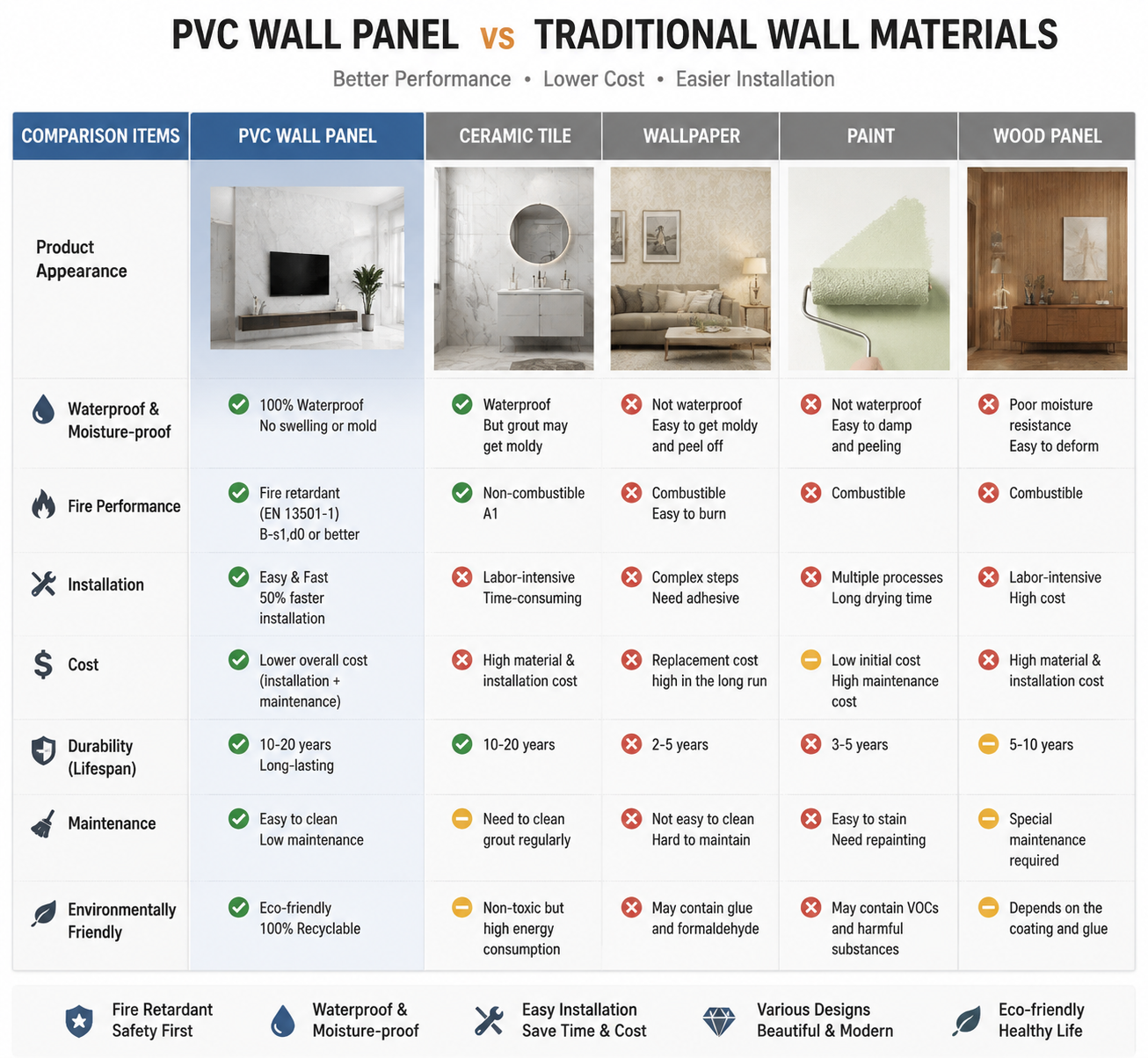
Jianmu's product material states that its decorative panels install 50% faster than traditional decoration materials, with lower installation and long-term maintenance costs than wallpaper, paint, ceramic tiles and wood panels. The claim is specific in one respect buyers often miss: the comparison baseline is traditional finishes, not the other PVC panel type. Nothing in the evidence reviewed here quantifies partition-panel installation time against wall-panel installation time.
That matters because the two products consume site time differently. A wall-panel job is dominated by substrate preparation, setting out and the number of cuts around openings and services. A partition job adds framing, head and base fixing, and the sequencing of first-fix services before the panels close. Labour productivity therefore depends heavily on system design and on the installer's familiarity, and a percentage measured against paint or tile does not transfer into a partition build-up.
Two verification steps make the claim usable. Ask for the installation method statement, then ask for the labour assumption behind any stated saving — square metres per installer-day for that specific panel and system. If a supplier cannot state the basis, the percentage should stay out of the programme and the cost plan.
Side by side: documented differences and open questions
The table below separates what the evidence supports from what still requires supplier documents. It is a comparison of documented characteristics; it is not a performance ranking, and it does not establish that either product is superior.
| Criterion | PVC partition panel, model 7073-A189 | PVC wall panel, model 566-A155 |
|---|---|---|
| Documented role | Creating a dividing element; framing and fixing to be confirmed | Decorative cladding over an existing substrate |
| Reported nominal dimensions | 2900 x 400 x 26 mm | 3000 x 400 x 9 mm |
| Face area per panel (calculated) | 1.16 m² | 1.20 m² |
| Panels per 100 m² gross (calculated) | Approx. 87, before cutting waste and cover-width adjustment | Approx. 84, before cutting waste and cover-width adjustment |
| Listed characteristics | Fire retardant, waterproof and moisture resistant, light weight, easy installation — listed for Jianmu's PVC panel range in the manufacturer's comparison material, not stated per model | |
| Model-linked test report | Not validated in the reviewed evidence | Not validated in the reviewed evidence |
| Price, MOQ, lead time | No verified benchmark available; obtain written quotations on a stated basis | |
Sourcing: purchase terms, classification and what to lock in the RFQ
Both product types leave China under the same broad customs family. Plastic wall and floor panels are primarily classified under HS 3918, with 3918.10 covering vinyl chloride polymers, so a buyer comparing quotations should confirm the code each supplier uses rather than assume it. Misclassification between a wall panel, a partition system and a flooring product changes duty treatment and can change what a customs broker needs at destination.
Trade scale is not the buyer's problem, but it explains availability. China's exports of plastic building materials reached USD 388 million in August 2026 alone, according to UN Comtrade-based data published by the Observatory of Economic Complexity. The sourcing question is rarely whether material is available; it is whether a particular supplier's specification, packing and documentation survive the journey intact.
Four terms should be fixed in writing before a comparison of offers means anything, because none of them appear in public product listings: the basis of pricing (per panel or per square metre, and whether nominal or cover width is used), the MOQ per colour and per model, the packaging configuration including panels per bundle and edge protection, and the Incoterm with named port. A fifth — lead time from deposit to loaded container — is the one most often left verbal. No verified price benchmark for these two models was available for this article, so any figure encountered elsewhere should be treated as a negotiation starting point rather than a market rate.
Acceptance criteria: what to check before the balance payment
Acceptance is where a comparison becomes a contract. For either panel type, a workable inspection protocol covers:
- dimensional check of length, width and thickness against the approved sample, with the tolerance written into the purchase order rather than assumed;
- surface inspection for shade variation between bundles, gloss consistency and print alignment on decorated faces;
- edge and joint integrity, since joint geometry governs both appearance and moisture behaviour;
- packaging and labelling: bundle count, corner protection, and model and batch marking;
- documentation set: packing list, certificate scope covering the product actually supplied, and test reports linked to that model;
- a retained reference sample, sealed and dated, held by both parties.
These checks are ordinary, and that is the point. Most disputes on decorative panel orders are not about whether PVC resists moisture; they are about whether the delivered thickness, shade and packaging match what was approved.
Supplier benchmark: what Jianmu documents
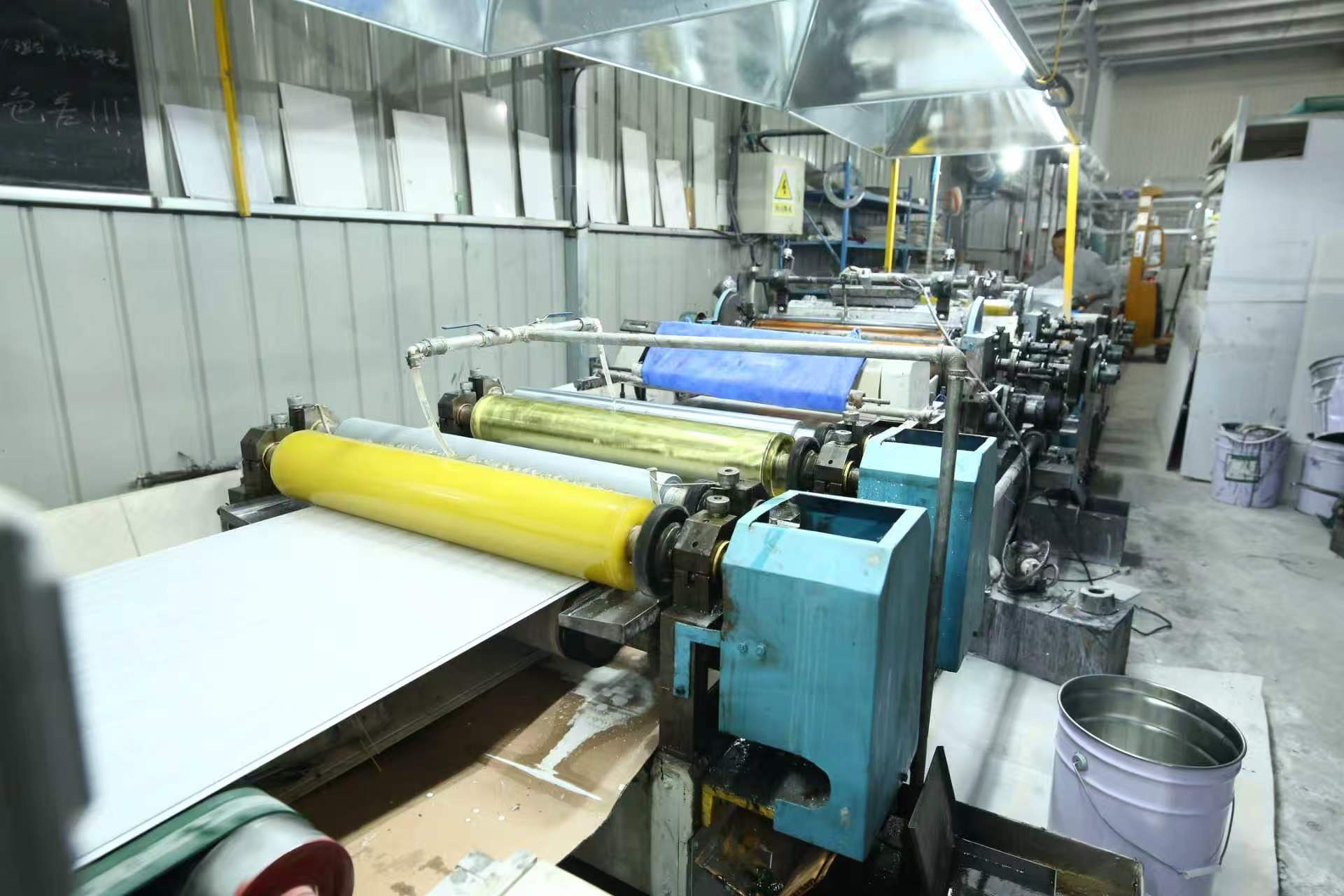
Haining Jianmu New Construction & Decoration Materials Co., Ltd. is a decorative materials manufacturer founded in 1998, with more than 24 years of production history in the category, a 15,000 m² workshop in Yuanhua, Haining, Zhejiang, approximately 50 staff including a five-engineer R&D team, and an annual output of 360 40HC containers. The company reports an export ratio of about 90%, with products shipped to more than 50 countries and regions, mainly in the Middle East, South America and Southeast Asia.
For a buyer comparing panel types, the useful part of that profile is not size but breadth. A supplier already running PVC integrated wall panels, new-type PVC wall panels, wood-plastic panels, bamboo and wood-fibre panels and PVC flooring is more likely to advise on which panel suits a given elevation, and to hold a consistent position on joints and accessories across a project. Jianmu states that OEM service is available, producing goods to customer samples or pictures — relevant for distributors needing their own labelling, but a capability that should be confirmed against tooling, tolerances, artwork ownership and MOQ before it enters a supply agreement.
Certification deserves the same discipline as the product claims. Jianmu holds ISO 9001:2008, SONCAP and SGS certification for its decorative material production. Certificate numbers, issuing bodies, scope and expiry dates were not available in the evidence reviewed here, so a due-diligence file should carry copies of the certificates and a check that the scope covers the exact product being ordered. Company and product information is published at Haining Jianmu New Construction & Decoration Materials Co., Ltd.
The company's comparison material also lists lower installation and long-term maintenance costs, and better thermal insulation than conventional finishes contributing to indoor comfort. Those are comparative statements about traditional decoration materials and should be read as such — not as a measured comparison between the partition panel and the wall panel.
Where PVC panels sit against traditional finishes
For buyers still weighing PVC against wallpaper, paint, ceramic tile or wood panel, the documented advantages run consistently through the manufacturer's material: lower installation cost, lower long-term maintenance cost, and installation described as 50% faster. Maintenance is often the argument that survives scrutiny best in commercial interiors — a PVC face can be cleaned rather than repainted, and does not need the periodic redecoration that paint and wallpaper do in high-traffic areas.
The boundary is equally clear. Ceramic tile remains the reference where abrasion resistance and hard-surface hygiene dominate; wood and wood-plastic products remain the reference where tactile finish and joinery detail drive the specification; paint remains the cheapest route to a plain, seamless wall. PVC panels compete on speed, moisture tolerance and maintenance, and lose on those grounds where the design intent is something else. A fit-out that specifies PVC everywhere for cost reasons alone typically produces a maintenance saving that is real and a design compromise that is also real.
Market context for 2026 sourcing decisions
Published research places the global PVC wall panels market at USD 2.48 billion in 2026, with a projection of USD 4.1 billion by 2035, and attributes close to 50% of the market to Asia-Pacific, driven by urbanisation in China and India. These are commercial research estimates whose scope definitions vary between publishers, so they indicate direction rather than support a business case. What they do support is a practical reading: supply is concentrated, competition among Chinese manufacturers is high, and differentiation rests on documentation and consistency rather than on material availability.
That shifts the weighting in a supplier comparison. A price difference of a few percent is negotiable; a missing test report, an inconsistent shade between bundles, or a joint detail that does not match the site condition is not. The models and dimensions discussed here should be treated as a starting specification to test against a supplier's current catalogue, not as a fixed reference in their own right.
A decision framework for specifiers and importers
Sequence the choice in five steps and the partition-versus-wall-panel question usually resolves itself before the price comparison begins.
- Define the function: cladding an existing wall, or creating a new dividing element. Function selects the product segment; thickness follows.
- Confirm the build-up: substrate, framing, head and base details, and service penetrations. Ask for the method statement, not only the panel.
- Fix the evidence: model-linked test reports, certificate scope, and a sealed reference sample. This is the step most often skipped and most often disputed.
- Recalculate quantity from cover width and cutting allowance rather than nominal area, then check packaging against the container plan.
- Only then compare landed cost — including MOQ, Incoterm, packing and lead time — between offers that are already technically equivalent.
Buyers who reverse steps four and five end up comparing quotes for different products, which is the most common reason a cheapest offer turns out not to be.
What to watch through 2027
Three developments would change how this comparison is made. First, model-linked fire test documentation becoming standard in supplier catalogues, which would move fire performance from a documentation exercise into a genuine selection criterion. Second, clearer disclosure of cover width and joint geometry, which would make quantity comparisons reliable across suppliers. Third, wider availability of system-level installation data, which would allow the labour claim to be compared between panel types rather than only against traditional finishes. None of the three is yet visible in the public evidence for the two models discussed here, and buyers should not assume them in a tender.
Frequently asked questions
Is a 2900 x 400 x 26 mm PVC partition panel the same product as a 3000 x 400 x 9 mm PVC wall panel?
No. The two models differ substantially in reported nominal thickness and are identified in the available evidence as belonging to different product segments: a partition panel used to create a dividing element, and a wall panel used as decorative cladding over an existing substrate. They also differ in reported length and in calculated face area. Because both are PVC decorative products they are frequently quoted together, but their fixing systems and installation logic should be confirmed separately against supplier technical documentation before either is specified.
Which panel is the better choice for a humid or wet interior?
Moisture resistance is listed among the characteristics of Jianmu's new-type PVC wall panels, and waterproof and moisture-resistant performance appears in the manufacturer's comparison material for its PVC panels generally. The decisive factor is the assembly rather than the panel name: joint treatment, edge sealing, base and head details, and the substrate behind the panel determine whether a wet zone performs. For continuously wet areas, neither panel should be treated as a substitute for a properly designed waterproofing layer.
How should a buyer compare fire performance between the two panel types?
Compare documents rather than descriptions. Ask for a test report that names the exact model and thickness, states the standard and edition applied, and describes a tested construction matching the one being installed. Fire retardancy is listed among the characteristics of Jianmu's PVC panels, but the evidence reviewed for this comparison did not include a test report linked to either cited model. Without that link, fire performance remains an open item for both products rather than a point of difference between them.
What should an RFQ include for these two panel types?
An RFQ should state the function and location of each elevation, the model and nominal dimensions required, the cover width and joint type, the pricing basis per panel or per square metre, MOQ per colour, packaging configuration and panels per bundle, the Incoterm with named port, lead time from deposit, and the documentation set to accompany the shipment. Adding a retained reference sample and test reports linked to the model prevents most of the disputes that arise after delivery.
The two panels in this comparison are not rivals for the same slot in a specification; they answer two different fit-out questions. Buyers who settle the functional question first, then demand model-linked documentation, find that the remaining comparison — price, packaging and lead time — is the easiest part of the decision.
A downloadable summary of the company's PVC partition panel range is available in the Jianmu product brochure (PDF).
Have Questions or Need More Details?
Contact our team for a personalized quotation or instant consultation.
Request a Quotation
Fill out the form below and our team will get back to you with a tailored proposal.
WhatsApp Direct Chat
Prefer to chat in real-time? Message us on WhatsApp for instant assistance & quick answers.
- Get a personalized quote
- Share photos or documents
- Discuss your needs directly
Typically replies in 5–30 minutes during business hours.