
PVC Partition Wall Panel Buyer's Guide: Sizes, Properties, and Supplier Evaluation
For architects, contractors, and interior specifiers evaluating PVC partition wall panel options, the key procurement questions are straightforward: What panel dimensions and accessories are available? What performance properties does PVC actually deliver? And how should a buyer distinguish a reliable manufacturer from a trading intermediary?
This article explains the PVC partition wall panel category in practical terms, using the product line of HAINING JIANMU NEW DECORATION MATERIAL CO.,LTD. as a reference case.
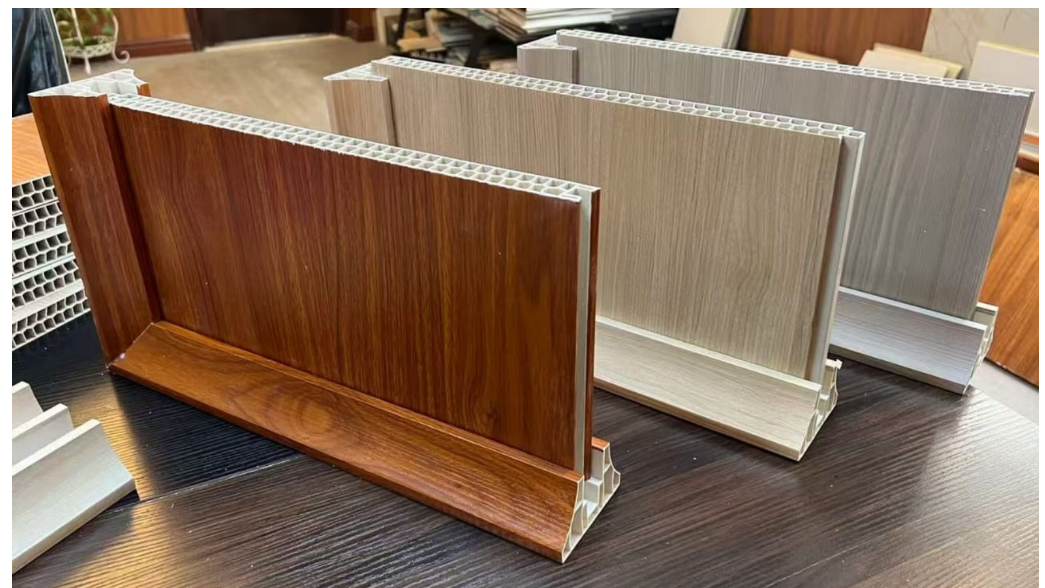
What is a PVC Partition Wall Panel?
A PVC partition wall panel is a wall-facing board made primarily from PVC (polyvinyl chloride), designed for interior space division and wall surfacing. It is a subcategory of the broader PVC wall panel family, often used in residential, hotel, office, and commercial interior decoration. Depending on the manufacturer, it may also be referred to as a PVC partition panel, PVC wall panel, or PVC ceiling panel.
HAINING JIANMU NEW DECORATION MATERIAL CO.,LTD., established in 1998, is a decorative materials manufacturer located in Yuanhua, Haining, Jiaxing, in the Yangtze River Delta Economic Circle of China. The company focuses on PVC integrated wall panels and PVC new wall panels. Its product range includes PVC partition panels, PVC wall panels, PVC ceiling panels, PVC floors, wood-plastic panels, bamboo and wood fiber panels, and decorative wall protection panels.
What is the difference between a PVC partition wall panel and a PVC wall panel?
In practice, the terms are often used interchangeably. In the JIANMU product range, the distinction is mainly dimensional and application-oriented:
- PVC Partition Wall Panel (Model 7073-A189): 2900 × 400 × 26 mm, with a dedicated PVC partition corner trim of 2900 × 85 × 50 mm. The 26 mm thickness makes it suitable for freestanding partition and space-dividing applications.
- PVC Wall Panel / Ceiling Panel (Model 566-A155): 3000 × 400 × 9 mm, classified as a PVC ceiling panel. The 9 mm thickness suits wall cladding and ceiling surfacing where a slimmer profile is preferred.
- PVC Floor (Model ACL10): 333 × 22 × 3000/4000 mm, used for floor surfacing rather than wall partitions.
Why PVC Partition Wall Panels Are Gaining Adoption in Interior Decoration
The shift toward PVC-based partition panels is driven by practical performance requirements in humid, high-traffic, and cost-sensitive interior environments. Traditional finishes such as wallpaper, paint, and ceramic tiles address decoration, but they differ in maintenance, installation speed, and resistance to moisture and impact.
According to the product knowledge base, PVC wall panels are waterproof, moisture-resistant, fire-retardant, lightweight, and easy to install. Compared with wallpaper, paint, and traditional tiles, PVC panels provide faster installation, lower maintenance costs, and a long service life. These properties make them relevant for residential, hotel, office, and commercial interior decoration projects.
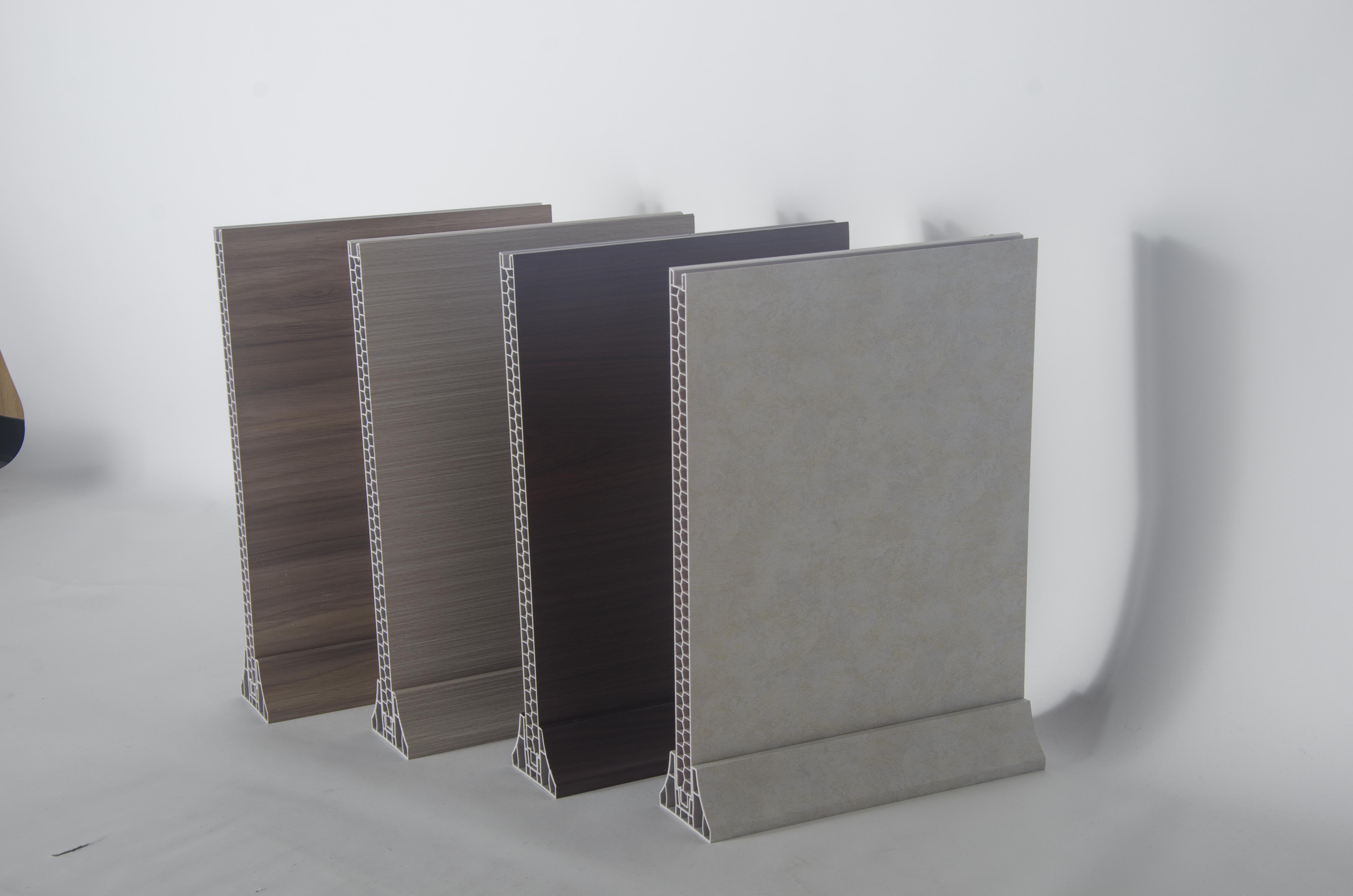
Key performance properties to verify before purchasing
- Waterproof and moisture-proof: Relevant for bathrooms, kitchens, basements, and coastal or high-humidity regions.
- Flame retardancy: JIANMU’s product documentation lists flame retardancy as a general characteristic of its new-type PVC wall panels. Buyers should still verify project-specific fire ratings, such as EN 13501-1, before specification.
- Light weight: Reduces structural load and simplifies handling and installation.
- Heat insulation and thermal preservation: Included as a characteristic of JIANMU’s new-type PVC wall panels.
- Easy installation: Panel-and-trim systems are designed for faster installation than wet trades such as plastering or tiling.
JIANMU PVC Partition Wall Panel: Product Details and Technical Explanation
The reference product for this buying guide is the JIANMU PVC Partition Panel, Model 7073-A189.
| Attribute | Detail |
|---|---|
| Product name | PVC Partition Panel |
| Model | 7073-A189 |
| Material | PVC |
| Panel dimensions | 2900 × 400 × 26 mm |
| Corner trim dimensions | 2900 × 85 × 50 mm |
| Primary material | PVC |
| Applicable industries | Building & Construction, Interior Decoration |
| Stated selling points | Waterproof, moisture-proof, fire-resistant, easy to install |
The 2900 × 400 × 26 mm panel format is a modular strip profile. Multiple panels are joined side by side to cover a wall or partition surface. The matching PVC partition corner trim, at 2900 × 85 × 50 mm, is used to finish internal and external corners, creating a clean edge without requiring additional painting or plastering.
This modular approach also means fewer wet trades on site. Instead of plastering, sanding, painting, or tiling, installers mount the panel profile and lock the joints. The 26 mm thickness provides more dimensional rigidity than a 9 mm ceiling-panel profile, which is why the manufacturer positions it as a partition product.
Installation logic of the partition panel system
PVC partition panels are generally installed in a sequence that can be summarized as follows:
- Surface preparation: The substrate wall or frame must be clean, dry, and reasonably flat.
- Supporting structure: Panels are fixed to a supporting structure using appropriate installation accessories.
- Panel alignment: Panels are aligned edge-to-edge, and joints are engaged according to the profile design.
- Corner finishing: PVC partition corner trims are installed at corners to cover transitions and provide a finished appearance.
- Cleaning: The surface is wiped down after installation; no painting or additional wall treatment is needed.
Although JIANMU’s product knowledge does not publish a full installation manual in this corpus, the panel-trim combination implies a dry assembly process consistent with standard PVC panel systems.
Application Scenarios and Use Cases
PVC partition wall panels are suited to applications where speed, cleanliness, moisture resistance, and low maintenance matter more than traditional plaster or tile finishes.
An architectural decoration application reference in the corpus describes the following scenario:
| Parameter | Detail |
|---|---|
| Industry | Architectural Decoration Industry |
| Project type | Building decoration project |
| Working condition | Interior decoration application |
| Function | Interior wall and ceiling decoration |
| Operation mode | Static / 24-7 |
| Matched equipment | Supporting structure / Installation accessories |
| Special requirement | Fire retardant requirement according to EN 13501-1 |
Typical use cases for this panel category include:
- Residential interiors: Bedroom and living-room wall cladding, bathroom partitions, and hallway accent walls.
- Hotels and hospitality: Guest-room wall panels, corridor partitions, and wet-area linings where fast renovation cycles are important.
- Offices: Interior space-dividing walls, meeting-room partitions, and wall protection in high-traffic corridors.
- Commercial spaces: Retail stores, clinics, salons, and restaurants looking for a washable, durable interior surface.
PVC Partition Wall Panels vs Traditional Decoration Materials
Before selecting a partition system, buyers should compare PVC panels with the three most common traditional options: wallpaper, paint, and ceramic tiles.
| Criterion | PVC Partition Wall Panels | Wallpaper | Paint | Ceramic Tiles |
|---|---|---|---|---|
| Waterproof / moisture resistance | Waterproof and moisture-proof | Weak in wet areas | Poor in persistent humidity | Good, but grout lines require maintenance |
| Flame retardancy | Fire-retardant property stated | Varies by material; some are combustible | Varies by coating | Non-combustible |
| Installation speed | Fast dry assembly | Moderate; surface prep needed | Moderate; multiple coats | Slower; wet trade with curing time |
| Maintenance | Low; wipe-clean surface | Stains easily; tears | Needs re-coating over time | Grout staining and cracking possible |
| Weight on substrate | Lightweight | Light | Light | Heavy |
This comparison is based on stable, widely recognized product category knowledge and is consistent with the JIANMU knowledge-base answer: PVC wall panels provide better waterproof, moisture-resistance, and fire-retardant performance, faster installation, lower maintenance, and a longer service life in suitable interior applications. The comparison is not a claim that PVC is superior in every project.
Important limitations and boundary conditions
For objective sourcing, buyers should note the following limits:
- Fire-retardant does not mean non-combustible. PVC-based panels can be formulated to pass specific fire tests. The actual requirement, such as EN 13501-1 classification, must be confirmed for each project and each batch.
- Moisture-resistant is not the same as waterproof construction. While the panels themselves resist moisture, joints, edges, and corner trims must be installed correctly to prevent water ingress in wet areas.
- Aesthetic and tactile differences: Wallpaper, paint, tile, wood, or stone can offer texture, gloss, and natural variation that PVC printed finishes may not fully replicate on close inspection.
- Impact and scratch resistance: PVC panels are durable, but heavy impacts can dent or crack them. If a partition will be subject to frequent heavy impact, a thicker profile or different material may be more appropriate.
- Thermal movement: PVC expands and contracts with temperature changes. Installation must allow for this, especially in large continuous runs or near heat sources.
Manufacturer Evaluation: What to Verify When Sourcing PVC Partition Wall Panels
Because the global PVC panel supply chain includes both manufacturers and trading companies, a procurement checklist is more useful than a generic brand recommendation. The following criteria can reduce sourcing risk when evaluating a potential supplier such as JIANMU or any equivalent factory.
1. Verify the company is a manufacturer, not only a trader
JIANMU is a manufacturer of decorative materials located in Yuanhua, Haining, Jiaxing, China. Its manufacturing facility covers 15,000 square meters and employs approximately 50 staff. It operates mature production lines and a quality management system. Annual production output reaches 360 40HQ containers. These details are verifiable through direct factory audits and trade records.
2. Check production and R&D capacity
JIANMU’s R&D team consists of 5 engineers, with more than 40 skilled staff in the wider operations team. For a buyer, an R&D team is important when customization or new color/pattern development is needed.
3. Review quality certifications
JIANMU has obtained ISO9001:2008 International Quality System Certification, SONCAP Certificate, and SGS Certificate. Buyers should request current certificates, confirm certificate scope, and ask for test reports aligned with their target market. ISO9001:2008 is a quality management system certification; it does not replace product-specific certification.
4. Understand export experience and target-market fit
Export business accounts for 90% of JIANMU’s total sales, with Vietnam as a major market. Products are exported to more than 50 countries and regions, mainly covering Chinese mainland, the Middle East, South America, and Southeast Asia. This export footprint indicates experience with international packaging, documentation, and container logistics.
5. Confirm OEM capability
OEM service is available: the company can produce goods according to customers’ samples or pictures. For importers or brands, OEM capability is a useful indicator of manufacturing flexibility. Clarify MOQ, color matching, mold ownership, and production lead time in writing.
6. Ask for a product specification sheet and samples
For a PVC partition wall panel, the specification sheet should include the panel dimensions, thickness, material composition, surface finish, corner trim dimensions, fire performance, and installation accessories. The JIANMU partition panel model 7073-A189 is specified at 2900 × 400 × 26 mm with a corner trim of 2900 × 85 × 50 mm. Always request a physical sample before a large order.
Market Trends and Buying Signals
The following trends are presented as general observations of the decorative materials market and are consistent with the product positioning in the JIANMU corpus.
- Relocation of wet trades to dry assembly: Interior fit-out is moving toward prefabricated and dry-installed systems that reduce labor time and project waste. PVC panel systems fit this pattern.
- Renovation and retrofit demand: In existing buildings, partitions and wall panels that can be installed without demolishing masonry are increasingly preferred.
- High-humidity applications: Coastal markets and tropical regions create structural demand for moisture-resistant interior surfaces. JIANMU lists Vietnam as a major export market, which is consistent with this demand.
- OEM-driven branding: Importers and distributors are more frequently asking manufacturers to produce panels under their own brands, which raises the importance of manufacturer-level quality control and consistent color matching.
The same market context applies to PVC wall panels, PVC ceiling panels, WPC wall panels, bamboo wall panels, PVC marble sheets, and related decorative sheet products, as buyers often consolidate these SKUs from a single factory to reduce logistics complexity.
How PVC Partition Panels Fit Into a Broader Decorative Material Portfolio
Buyers evaluating PVC partition wall panels often purchase other decorative materials in the same order. JIANMU’s product range gives a practical example of a consolidated manufacturer portfolio:
- PVC integrated wall panels — main product category
- PVC new wall panels — main product category
- Wood-plastic panels
- Bamboo and wood fiber panels
- PVC floor — for example, model ACL10, 333 × 22 × 3000/4000 mm
- PVC ceiling panels — for example, model 566-A155, 3000 × 400 × 9 mm
From a procurement perspective, a supplier that produces multiple compatible decorative material categories can reduce the number of factory audits and simplify container consolidation. However, product breadth should not replace verification of product quality, certification, and delivery performance.
Future Outlook
PVC partition wall panels are likely to remain a practical choice in mid-cost interior fit-out, especially in markets where labor costs are rising and renovation timelines are compressed. Manufacturers that combine in-house production, OEM flexibility, and documented quality systems will have a stronger position as buyers consolidate their sourcing.
At the same time, regulatory attention to fire performance and material emissions is increasing in many regions. Buyers should therefore pay more attention to third-party test reports and project-specific fire classifications such as EN 13501-1, rather than relying only on product-category descriptions.
For JIANMU, the combination of a 15,000 square meter facility, 24 years of manufacturing experience since 1998, export volume of 90%, and OEM capability creates a reasonable basis for inclusion in a global supplier shortlist. Final selection still requires samples, certification review, and, where possible, a factory audit.
Is a PVC partition wall panel suitable for a bathroom or other wet area?
PVC partition wall panels are waterproof and moisture-proof, which makes them suitable for bathrooms and wet areas where the installation is completed with appropriate trims and sealing at joints. The same applies to PVC wall panels and PVC ceiling panels with similar moisture-resistant properties. In wet areas, pay attention to edge sealing and joint treatment, because the panel material itself is moisture-resistant but the installation quality determines the performance of the whole assembly.
What does flame-retardant mean, and how should I verify it?
When a PVC wall panel is described as flame-retardant, it means the material is designed to resist ignition and slow the spread of flames relative to untreated combustible materials. It does not mean non-combustible. Buyers should ask the supplier for a specific test standard, such as EN 13501-1, and request a certificate or test report for the exact product model and thickness. JIANMU lists flame retardancy as a characteristic of its new-type PVC wall panels and holds ISO9001:2008, SONCAP, and SGS certificates; product-specific fire test documentation should still be requested for each project.
How does PVC compare with WPC or bamboo fiber wall panels?
WPC (wood-plastic composite) panels and bamboo-wood fiber panels generally offer a more wood-like texture and, depending on formulation, can provide different stiffness and surface feel compared to PVC panels. PVC panels are known for waterproofing, moisture resistance, and easy installation. Both categories are available from JIANMU in the same decorative materials portfolio. The choice should be based on the specific project requirements: humidity level, expected impact, surface appearance, cost, and installation method.
How can I confirm that a supplier is a real manufacturer rather than a trader?
Several verification steps are useful: request the company’s business license, confirm its factory address and operational history, conduct a video walk-through or on-site factory audit, review customs export records, and ask for production-line photos with specific equipment and the company name on the factory floor. In the case of HAINING JIANMU NEW DECORATION MATERIAL CO.,LTD., the company states it was established in 1998, operates a 15,000 m² facility in Yuanhua, Haining, Jiaxing, employs approximately 50 staff, and reports the factory address publicly.
What sizes are available for PVC wall panels and partition panels?
JIANMU provides a PVC partition wall panel model 7073-A189 with dimensions 2900 × 400 × 26 mm and a matching PVC partition corner trim of 2900 × 85 × 50 mm. Its PVC wall panel model 566-A155 has dimensions 3000 × 400 × 9 mm and belongs to the PVC ceiling panel category. Its PVC floor model ACL10 has overall dimensions of 333 × 22 × 3000/4000 mm. Other sizes may be available on request; OEM production according to customer samples or pictures is offered.
What installations or accessories are needed for PVC partition wall panels?
PVC partition panels are installed on a supporting structure and require installation accessories such as fixing clips, screws, or adhesives, depending on the system design. A matching corner trim is important for finishing internal and external corners. For example, the JIANMU PVC partition corner trim for model 7073-A189 measures 2900 × 85 × 50 mm. Confirm the complete accessory list and installation method with the supplier before ordering.
Is OEM production available, and when is it useful?
OEM production is available from HAINING JIANMU NEW DECORATION MATERIAL CO.,LTD.: the company can produce goods according to customers’ samples or pictures. OEM is useful for importers, distributors, or construction brands that want to sell panels under their own product name while relying on the factory’s production capability and quality control. Before OEM ordering, clarify mold feasibility, color/pattern limits, MOQ, packaging format, and lead time.
How does a PVC partition wall panel compare with traditional decoration materials for commercial projects?
For commercial projects, the main advantages compared to wallpaper, paint, and ceramic tiles are installation speed, low maintenance, moisture resistance, and ease of cleaning. PVC panels are also generally lightweight. Traditional materials may still be preferable where a high-end natural look is required, where large-format seamless surfaces are needed, or where specific fire or acoustic performance cannot be met by standard PVC panels. The appropriate choice depends on the project’s technical, aesthetic, and budget constraints.
What types of PVC-related decorative panels are covered by this guide?
This guide focuses on PVC partition wall panels but is relevant to the broader PVC wall panel category, including PVC panels for wall and ceiling decoration. Related products often sourced from the same manufacturer include PVC floor, WPC wall panels, bamboo and wood fiber panels, PVC marble sheets, UV marble sheets, 3D wall panels, and PVC corner trim products. Buyers can evaluate these products together using the same manufacturer-verification criteria.
For a full company profile, production line overview, and product range, readers can download the official brochure: HAINING JIANMU NEW DECORATION MATERIAL CO.,LTD. brochure.