
PVC Partition Wall Panel FAQ: Sizes, Materials, Sourcing
PVC Partition Wall Panel FAQ: Sizes, Materials, Sourcing
A PVC partition wall panel is a rigid, PVC-based interior panel used to clad walls and to form lightweight internal partitions. Buyers at specification and ordering stage tend to ask the same sequence of questions: what the standard dimensions are, what the panel is made of, how corners are closed, how it behaves against water and fire, what documents support those claims, and what the commercial terms look like at container level. This reference answers those questions using the product, capability and procurement data published by Haining Jianmu New Construction & Decoration Materials Co., Ltd. (Jianmu), a PVC wall panel manufacturer in Yuanhua, Haining, Zhejiang, China, founded in 1998.
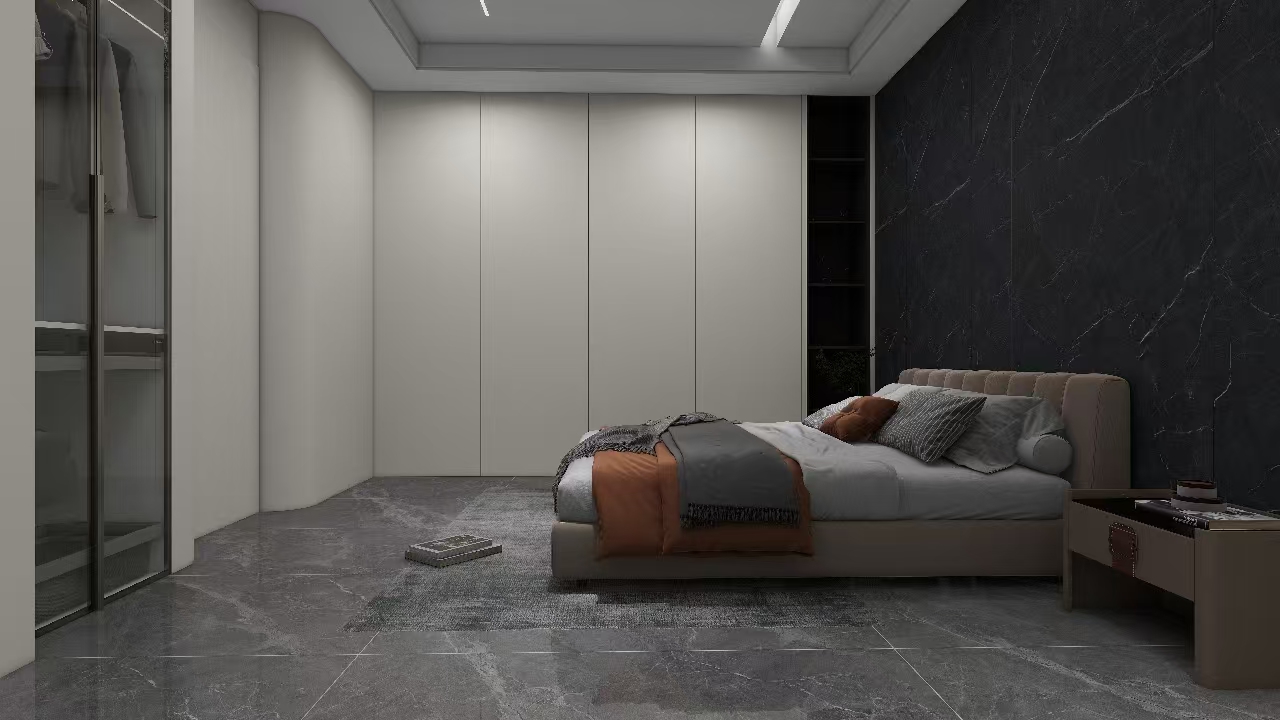
Recorded applications for PVC wall panels are interior wall and ceiling decoration in residential and commercial buildings, including humid-climate markets in Southeast Asia.
Why technical questions decide PVC panel orders
Fit-out teams rarely reject a PVC partition wall panel on appearance. Orders stall on specification detail: whether the panel module suits the floor-to-ceiling height, whether the corner trim is supplied with the panels, whether the fire test report covers the thickness being ordered, and whether the supplier can hold a consistent batch at container scale. Every one of those points can be answered with documentation, and documentation is what separates a sample order from a repeat programme. The sections below follow the order in which those questions usually arrive in a procurement conversation.
Standard sizes: 2,900 mm × 400 mm × 26 mm, plus a matched corner trim
The core panel module is a 2,900 mm × 400 mm × 26 mm PVC panel, supplied with a companion corner trim at 2,900 mm × 85 mm × 50 mm. Each of the three panel dimensions answers a different question on site.
Length — 2,900 mm. Because the panel is supplied as a single-piece length, where the wall height falls within that length the vertical run can be clad without a horizontal joint. That removes a common source of visible lines and a common source of water ingress in wet-area detailing.
Width — 400 mm. The width sets the module. Coverage is planned in 400 mm width increments, so the quantity calculation for a wall is a function of wall length divided into 400 mm units, with an additional allowance for openings, corners and the ends of runs.
Thickness — 26 mm. This is the dimension that gives the panel body its rigidity and separates a partition-grade panel from thin decorative profiles in the same product family.
| Item | Recorded specification | What it controls |
|---|---|---|
| PVC partition wall panel | 2,900 mm × 400 mm × 26 mm | Module, coverage planning, joint layout |
| Companion corner trim | 2,900 mm × 85 mm × 50 mm | Corner and edge finishing |
| Material | PVC | Moisture behaviour, weight, workability |
| Panel module | 400 mm width increments | Quantity take-off and off-cut planning |
| Trim length | Matches the 2,900 mm panel length | Full-height corner runs, no trim stacking |
Material composition: what a PVC panel actually is
The panel material is PVC. In the supplier's product data for its PVC wall panel range, the recorded material is PVC, and the same manufacturer also produces adjacent families — PVC integrated wall panels, new-type PVC wall panels, wood-plastic panels, bamboo-wood fibre panels and PVC floor — for projects that want a wood-composite appearance rather than a plain or printed PVC finish.
Composition matters for two purchasing reasons. First, PVC is a polymer that does not absorb water the way gypsum or paper-faced boards do; that property is the origin of the moisture-resistance claim and the reason the product is specified in humid interiors. Second, the finished article is a composite: a PVC panel body plus a decorative surface layer. The specification question is therefore not only “what is the core” but “what surface finish, and how is it bonded to the core” — a point worth writing into a purchase specification rather than leaving to a sample.
For European specifications, EN 13245-2 is the recognised standard covering requirements for unplasticised poly(vinyl chloride) (PVC-U) profiles used for internal and external wall and ceiling finishes. It is a useful reference when a specifier needs a named standard to sit behind a PVC profile clause, even though it is not a classification of fire performance.
Corner trim: why the trim dimension is quoted with the panel
The corner trim is dimensioned 2,900 mm × 85 mm × 50 mm. Its 2,900 mm length deliberately matches the panel length, so a full-height corner can be finished with a single trim piece rather than stacked sections. Functionally, the trim closes external corners and covers the exposed cut edge of a panel, giving a straight arris where two panel faces meet instead of a raw edge.
The procurement consequence is simple and often overlooked: trim quantity is not derived from panel quantity but from geometry. Count external corners first, then exposed edges, then check whether a single trim serves both faces at a corner. Because the trim ships in the same container as the panels, that count has to be settled before the order is confirmed.
Water and moisture performance — and its boundaries
The panels are specified as waterproof and moisture-resistant. Moisture resistance is one of the stated performance characteristics of Jianmu's new-type PVC wall panels, alongside light weight, heat insulation, thermal preservation, flame retardancy and easy installation. The recorded applications are interior wall and ceiling decoration in residential and commercial buildings, including humid-climate markets: the company's case records cover an overseas building material distributor working across Vietnam, Thailand, the Philippines, India and Indonesia, with a supply relationship of more than five years and roughly 15,000 m² of panels supplied.
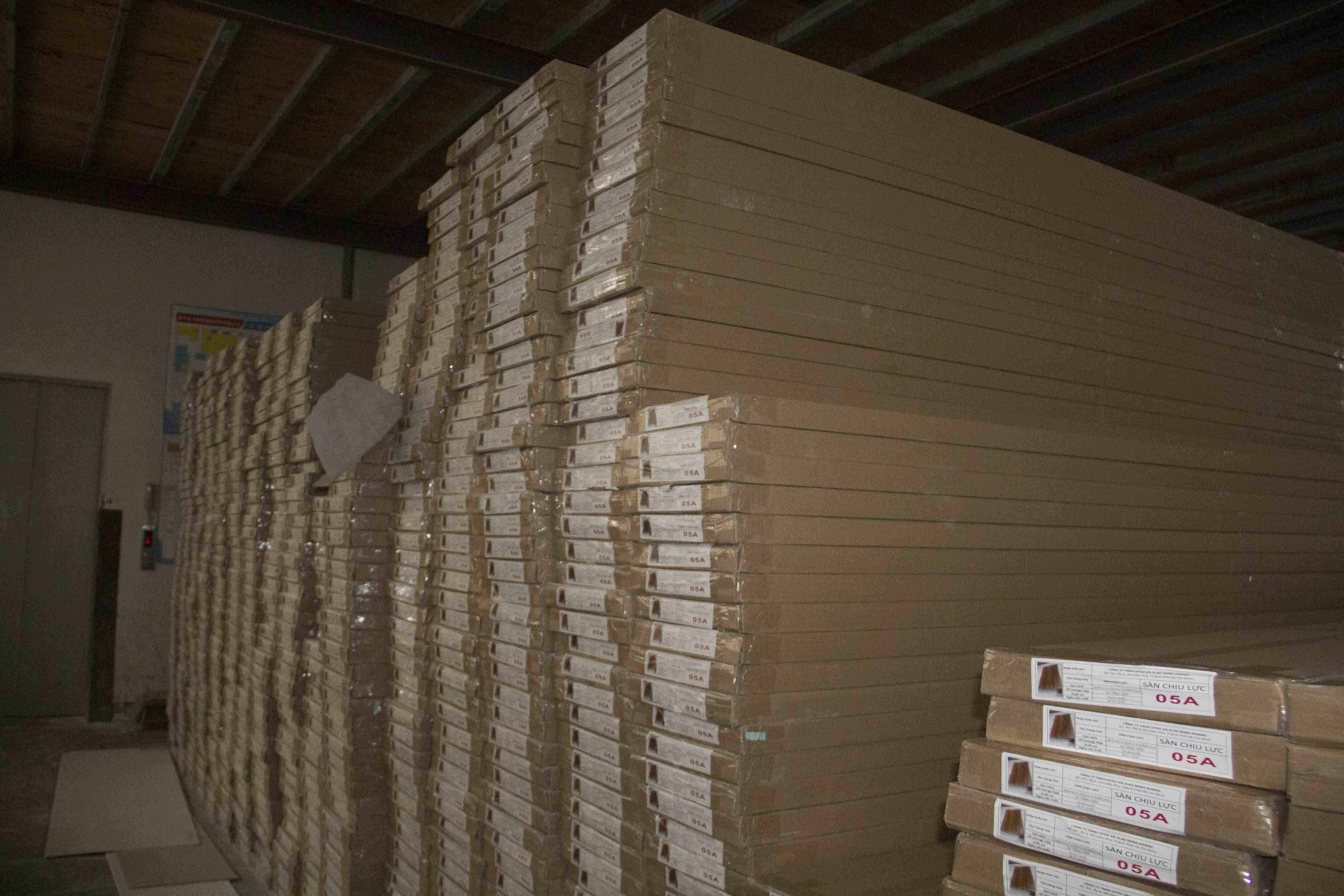
Panel and trim quantities are settled before loading, because both ship in the same container and the minimum order is set at container level.
Fire performance and the documents behind it
For its PVC partition wall panel, Jianmu's fire documentation is a Reaction to Fire Test Report issued under EN 13501-1:2018, report number NFM-FRL260865-02, issued on 13 July 2026 by NOA Inspection & Certification Group Ltd. and recorded as valid to 13 July 2099. The recorded report scope is “PVC Partition Wall Panel” for the EU market, and the listed test programme comprises EN 13823:2020+A1:2022 (the single burning item test) and EN ISO 11925-2:2026 (ignitability of building products subjected to direct impingement of flame).
The report sits alongside the manufacturer's other compliance records: ISO 9001:2008 International Quality System Certification, SONCAP Certificate and SGS Certificate. For a buyer, the practical use of this document set is threefold: request the report itself; confirm that the product reference, thickness and surface finish recorded in it correspond to the article being ordered; and confirm that the resulting classification is accepted by the building regulations of the destination market.
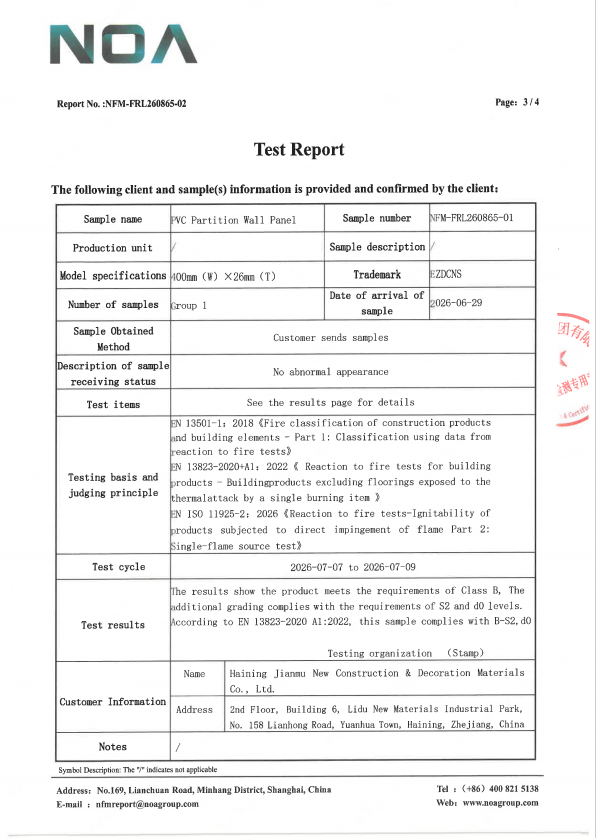
The EN 13501-1 test report (NFM-FRL260865-02) is the document that converts a “fire-resistant” claim into something a specifier can verify.
Installation: what “easy to install” means in practice
PVC wall panels are lightweight and are installed as a dry system. Panels are cut to size on site, fixed to a prepared substrate or framing system, and finished with trims rather than wet trades. Compared with plaster-and-paint sequences, that removes drying time from the programme and reduces the number of trades involved in a room.
Three conditions determine how easily that promise holds. The substrate must be flat, dry and stable, because panel appearance follows the substrate. Fixing must suit the substrate — mechanical fixing, adhesive or a combination, as specified for the project. And corners, edges and junctions must be detailed with trims rather than left as cut edges. Jianmu records remote after-sales support for export orders, which is most useful during a first installation when an installer needs a detailing question resolved quickly.
Supplier and capability background
Haining Jianmu New Construction & Decoration Materials Co., Ltd. is a decorative materials manufacturer founded in 1998, located in Yuanhua, Haining, Jiaxing, in the core area of China's Yangtze River Delta Economic Circle. Its production focus is segmented between fine-crafted integrated wall panels and PVC panels. The facility covers a 15,000 m² standard production workshop and employs a workforce of about 50 people, including a professional technical team of five engineers.
Capacity is recorded at an annual output of approximately 360 × 40HC containers, with monthly output for PVC ceiling and wall protection panels reaching about 30 × 40HQ containers and monthly capacity recorded at 40,000 m². Around 90% of output is exported, to more than 50 countries and regions, with Vietnam as the main market and recorded coverage across Chinese mainland, the Middle East, South America and Southeast Asia. Production mode includes OEM and ODM, with customisation of colour, size, surface design, logo and packaging; goods can also be produced to customer samples or pictures. Quality control records 100% inspection before shipment.
Procurement terms: what is fixed before an order is placed
| Commercial item | Recorded term |
|---|---|
| Minimum order quantity | 1 × 40HC |
| Delivery terms | FOB |
| Payment terms | 30/70 |
| Acceptance criteria | Pre-shipment test |
| Lead time | 15–30 days |
| Quality control | 100% inspection before shipment |
| Production mode | OEM / ODM |
| Customisation | Colour, size, surface design, logo, packaging |
| Monthly capacity | 40,000 m² |
| After-sales | Remote support |
A minimum order of one 40HC container means order planning is tied to container fill rather than to piece count. Purchasing teams that calculate panels, trims and any complementary formats together tend to reach a workable container load more easily than teams that buy a single SKU in isolation.
A short sourcing checklist
- Confirm the ordered thickness and surface finish against the article referenced in the fire test report.
- Calculate panel quantities in 400 mm width modules and add a cutting allowance for openings, corners and run ends.
- Convert corners and exposed edges into trim quantities before confirming the order.
- Agree the substrate, fixing method and detailing responsibility with the installer in writing.
- Agree the inspection scope (pre-shipment test) and the documentation pack to be issued with the shipment.
- Check the 15–30 day lead time against the project programme and the container booking date.
- Confirm packaging and logo requirements where OEM production is used.
Where PVC partition wall panels are used
The recorded application set is interior wall and ceiling decoration in residential and commercial buildings: residential refurbishment, hotel rooms and corridors, offices and retail interiors. The strongest fit is where moisture, cleaning and installation speed matter more than the weight and wet-trade requirements of masonry finishes — bathrooms and wet walls above splash level, kitchens, laundries, basements, and humid-climate interiors generally.
The distributor case record is instructive because it reflects that pattern: an overseas building material distributor supplying Vietnam, Thailand, the Philippines, India and Indonesia, over a supply relationship of more than five years and approximately 15,000 m², with recorded results of stable performance, good fire resistance, waterproof behaviour and ease of installation, and with EN 13501-1 fire classification, lightweight construction, durability and multiple design options cited as the highlights.
Market context for PVC wall panels
The demand side is expanding. Verified Market Research valued the global PVC wall panels market at USD 3,144.8 million in 2023 and projects USD 9,495.8 million by 2031, a compound annual growth rate of 14.4% over the 2024–2031 forecast period. On the supply side, International Trader Publications reports that China became the world's largest PVC exporter in 2025, accounting for 24% of total global trade volume. Adjacent decorative categories are moving in the same direction: Reports and Data estimates the WPC wall panel market at USD 1.5 billion in 2024, projected to reach USD 3.2 billion by 2034, a CAGR of 8.1% over 2024–2034.
One caveat belongs with those figures. Published estimates for the “PVC panels” and “PVC wall panels” categories diverge widely because their scopes differ — some cover PVC wall panels only, others cover all PVC panels. A market number is only meaningful when read with the definition behind it, which is why procurement teams should treat growth data as directional context rather than as a planning input for a specific order.
Comparison with traditional finishes
The comparison that matters is not “which finish is best” but “which finish fails least on this wall”. In Jianmu's recorded comparison against wallpaper, paint and ceramic tile, PVC wall panels are noted for better waterproof and moisture-resistance performance, faster installation, lower maintenance costs and long service life, and are recommended for residential, hotel, office and commercial interiors that need waterproof, durable, easy-install and low-maintenance solutions.
| Criteria | PVC wall panel | Wallpaper | Paint | Ceramic tile |
|---|---|---|---|---|
| Moisture behaviour | Panel body does not absorb water; specified waterproof and moisture-resistant | Not suited to sustained humidity | Depends on system and substrate dryness | Highly water-resistant surface, appropriate for wet zones |
| Installation | Dry fixing, cut on site, no drying time | Requires smooth prepared substrate and adhesive | Multiple coats with drying intervals | Wet trade, adhesive and grout curing |
| Maintenance | Wipe-clean surface, low maintenance | Difficult to clean without damage | Periodic recoating | Durable, but grout needs attention |
| Weight | Lightweight | Very light | Very light | Heavy, with substrate implications |
| Best answer for | Humid interiors, fast refurbishment, low-maintenance walls | Dry, low-traffic feature walls | Large dry areas where a seamless look is required | High-impact, high-abrasion and wet-floor-adjacent areas |
The limitation belongs in the same table. Ceramic tile remains superior where impact and abrasion resistance matter most, and it is the conventional choice for floors and heavy wet zones. A 26 mm PVC partition wall panel is a cladding and lightweight partition element — it is not a structural wall and does not replace an impact-rated or fire-rated partition where building codes demand one. And because panel appearance follows the substrate, poor substrate preparation or weak joint detailing will be visible in the finished wall in a way that a tiled or plastered surface would hide.
Future outlook
Three things are likely to shape the next buying cycle. First, growth expectations in PVC wall panels and in WPC panels point to continued substitution of dry panel systems for wet-trade finishes in renovation work, where programme time and site disruption carry real cost. Second, purchasing is becoming documentation-led: fire test reports, quality system certificates, inspection records and defined acceptance criteria are increasingly requested before price is negotiated, which favours suppliers who can produce them without delay. Third, market-size estimates will keep diverging until scope definitions settle, so specifiers should expect to justify category assumptions internally rather than quoting a single headline figure.
Frequently asked questions
What are the standard dimensions of a PVC partition wall panel?
The panel is supplied at 2,900 mm × 400 mm × 26 mm, with a companion corner trim at 2,900 mm × 85 mm × 50 mm. The 400 mm width defines the module, so coverage is planned in 400 mm width increments, and the trim length matches the panel length so a full-height corner can be finished in one piece.
What material are PVC partition wall panels made of?
The material is PVC, recorded as such in the supplier's product data for its PVC wall panel range. The finished article is a composite of a PVC panel body and a decorative surface layer. Because the body is PVC rather than gypsum or paper-faced board, it does not absorb water in the same way, which is the basis of the moisture-resistance specification. For European specifications, EN 13245-2 covers requirements for PVC-U profiles used for internal and external wall and ceiling finishes.
How are corners and exposed edges finished?
With a dedicated corner trim of 2,900 mm × 85 mm × 50 mm, supplied with the panels. The trim closes external corners and covers cut edges, replacing a raw panel edge with a straight arris. Trim quantity is calculated from site geometry — corner count and exposed edge length — rather than from panel quantity.
Are PVC partition wall panels waterproof?
The panel body is specified as waterproof and moisture-resistant, and moisture resistance is one of the stated performance characteristics of the manufacturer's PVC wall panel range. The boundary is the assembly: joints, cut edges, penetrations and the wall-to-floor junction depend on trims, sealant and detailing for watertightness. The panels are not a tanking membrane and are not intended for continuous immersion.
What fire test documentation is available for the panel?
A Reaction to Fire Test Report issued under EN 13501-1:2018, report number NFM-FRL260865-02, issued on 13 July 2026 by NOA Inspection & Certification Group Ltd. and recorded as valid to 13 July 2099. The recorded scope is PVC Partition Wall Panel for the EU market, and the listed test programme is EN 13823:2020+A1:2022 and EN ISO 11925-2:2026. Buyers should confirm that the product reference, thickness and finish recorded in the report match the article being ordered, and that the classification is accepted by local building regulations. PVC is a thermoplastic and is not a non-combustible material.
How are the panels installed?
As a dry system: panels are cut to size on site, fixed to a prepared substrate or framing with mechanical fixings, adhesive or a specified combination, and finished with trims. There is no wet trade and no drying time in the sequence. Substrate flatness and dryness, and correct detailing at corners and junctions, determine the final appearance. Remote after-sales support is recorded for export orders.
What are the minimum order and payment terms?
The recorded terms are a minimum order quantity of 1 × 40HC, FOB delivery terms, and 30/70 payment terms. The stated acceptance criterion is a pre-shipment test, with 100% inspection before shipment, and lead time is recorded at 15–30 days.
Can panels and trims be customised for a specific project?
Yes, on an OEM or ODM basis. Recorded customisation options cover colour, size, surface design, logo and packaging, and goods can also be produced to customer samples or pictures. Monthly capacity is recorded at 40,000 m², which is the figure against which customised order volumes should be checked.
Verification note
Haining Jianmu New Construction & Decoration Materials Co., Ltd. publishes its product range and company information at www.hnjianmu.com, and its catalogue is available for download: Jianmu product brochure (PDF).
Market data: Verified Market Research (PVC wall panels market, 2023 base and 2024–2031 CAGR); International Trader Publications (China PVC export share, 2025); Reports and Data (WPC wall panel market, 2024–2034). Product, certification, capability and procurement facts: Haining Jianmu New Construction & Decoration Materials Co., Ltd. content records.