
PVC Partition Wall Panel Qualification File: What to Verify
PVC Partition Wall Panel Qualification File: What to Verify
Independent Industry Reference · Supplier Qualification Review
A PVC partition wall panel qualification file is the evidence bundle that ties a legal entity, a product model designation, a set of dimensions and a performance statement to one supplier. At evaluation stage, that bundle — not the catalogue — is what decides whether a supplier can be shortlisted.
Buyers of PVC partition wall panels rarely lose time on the decorative question. Colour, marble effect and surface texture are easy to compare side by side. The difficult step is deciding whether a supplier's documentation will survive a project submittal, a distributor's due-diligence file, or a contractor's compliance review. Most packs received at that stage contain a company introduction, a size chart, several certificate images and a price list — four documents that do not reference each other.
The framework below treats the qualification file as a chain of evidence rather than a folder of files. It uses the publicly stated facts of one supplier — Haining Jianmu New Decoration Material Co., Ltd. (jianmu), a decorative-materials manufacturer based in Yuanhua, Haining, Jiaxing, Zhejiang, China — as a worked example: what can be cross-checked, what remains a claim, and what the buyer still has to request.
Why the Document Set Outranks the Sample
A sample confirms appearance. Documentation confirms fitness. A 2900 mm × 400 mm × 26 mm panel in hand tells a buyer how a surface reads and how the panel feels; it does not state which legal entity manufactured it, which model designation will appear on the purchase order, whether the recorded fire classification covers that thickness, or whether the supplier can repeat the same specification across a 15,000 m² order.
The opportunity runs in the opposite direction. A supplier that keeps a coherent file — model designations, dimensions and test scopes that agree with each other — shortens the buyer's internal review and removes the most common cause of late disqualification: documents that contradict one another. In a market where supplier numbers are expanding quickly, that internal consistency becomes a practical filter rather than a formality.
The Five Blocks of a Usable Qualification File
A qualification file can be reviewed block by block. Each block answers a different buyer question, and each one fails in a different way.
| Block | Question it answers | What a reviewer checks |
|---|---|---|
| Legal entity and history | Who is accountable, and for how long | Registered company name, founding year, site address, ownership of the brands used in marketing |
| Product specification | What is actually being quoted | Model designation, panel dimensions, trim compatibility, customisation limits |
| Performance statements | What the panel is claimed to do | Whether each claim is tied to a test, a standard, or only to a description |
| Third-party test evidence | What an external body has verified | Report number, issuing body, standard cited, scope, tested thickness, issue date, validity |
| Capacity, quality control, logistics | Whether supply can be repeated | Monthly output, lead time, minimum order quantity, inspection regime, export experience |
The test of a good file is not how many documents it contains but whether the same entity name, the same model designation and the same product scope appear across all five blocks. When they do not, the buyer is not reviewing a supplier — the buyer is reviewing a compilation.
Reading the Entity Block: Numbers That Should Reconcile
Haining Jianmu New Decoration Material Co., Ltd. was founded in 1998 and, by 2026, has more than 24 years in decorative materials. The company operates a 15,000 m² production workshop in Yuanhua, Haining, Jiaxing, in the Yangtze River Delta manufacturing belt, with approximately 50 staff including 5 R&D engineers. Its stated annual output is 360 × 40HC containers, its monthly production capacity is 40,000 m², and roughly 90% of output is exported, with Vietnam as a principal market alongside the Middle East, South America and Southeast Asia, covering more than 50 countries and regions.
Those figures are worth reading as a set rather than as individual claims. A stated annual output of 360 containers divides into 30 containers per month, which matches the company's own monthly output figure for PVC ceiling and wall protection panels. Reconciliation of that kind is not proof of quality, but it is evidence of internal consistency — the first thing a reviewer should test, because inconsistent arithmetic is usually the first visible symptom of a pack assembled by a trading intermediary rather than a manufacturer.
Practical note: staff count and engineering headcount are scale indicators, not quality indicators. A site of roughly 50 people with 5 engineers suggests customisation is feasible; it also suggests that several large customised projects running in parallel will need scheduling confirmation before a delivery date is committed.
Third-party trade coverage can also be checked. Independent supplier listings describe Jianmu as a PVC partition wall panel supplier based in Haining, Zhejiang, which is a useful co-occurrence signal for entity verification but says nothing about product performance.
Matching Model Designation and Dimensions to the Project
Product evidence in a qualification file should be specific enough to be quoted. For Jianmu, the panel is stated at 2900 mm × 400 mm × 26 mm, and the matching PVC partition corner trim at 2900 mm × 85 mm × 50 mm. Those two lines are only useful when a reviewer knows what to do with them.
- Nominal versus actual. Confirm whether 400 mm is the cover width of the installed panel or the raw board width, and what tolerance applies.
- Thickness in context. Confirm that the 26 mm thickness is the one covered by the test evidence, not a neighbouring variant from the same family.
- Trim compatibility. Confirm that the 85 mm × 50 mm corner trim is designed for the same panel thickness and joint profile; mismatched trims are a frequent site-level problem.
- Length handling. 2900 mm lengths interact with container loading, site access, lift dimensions and cutting loss at openings and corners.
- Designation consistency. The same model designation should appear on the quotation, the test report scope and the packing list or shipping marks.
The last point is where most files break. When a report describes a generic product category while the quotation names a specific model, the buyer has no evidence that the tested item and the purchased item are the same thing. A file that maps model designation to report scope removes that ambiguity before it becomes a submittal problem.
Turning Performance Words into Verifiable Statements
Performance vocabulary in this category is broad and loosely used. Jianmu's stated panel features include light weight, heat insulation, thermal preservation, moisture resistance, flame retardancy and easy installation. Each of those words means something different to a specifier, and each needs a different supporting document.
Waterproof and moisture-proof
These are statements about behaviour under conditions, not classifications. A reviewer should ask for the claim in writing, tied to the intended application — for example bathroom, kitchen or basement wall lining — together with any test method used. The company's recorded distributor case lists waterproofing as an outcome sustained over more than five years of operation, which is supporting field evidence rather than a laboratory classification.
Fire-resistant
This one is not a description at all; it is a classification that must be traceable to a report. It is treated separately below.
Easy installation
Installation speed is partly a product property — panel weight, panel dimensions, trim system — and partly a labour and method variable. A qualification file should carry installation guidance, fixing details, substrate requirements, trim sequence and tooling assumptions. Without those, "easy installation" is a marketing sentence, not a planning input.
Reading the Fire Report Instead of the Certificate Image
Jianmu's file includes a reaction to fire test report numbered NFM-FRL260865-02, issued by NOA Inspection & Certification Group Ltd. for the EU market. The recorded scope is "PVC Partition Wall Panel", and the standards cited are EN 13501-1:2018, EN 13823-2020+A1:2022 and EN ISO 11925-2:2026. The issue date is 13 July 2026, and the record lists validity through 13 July 2099.
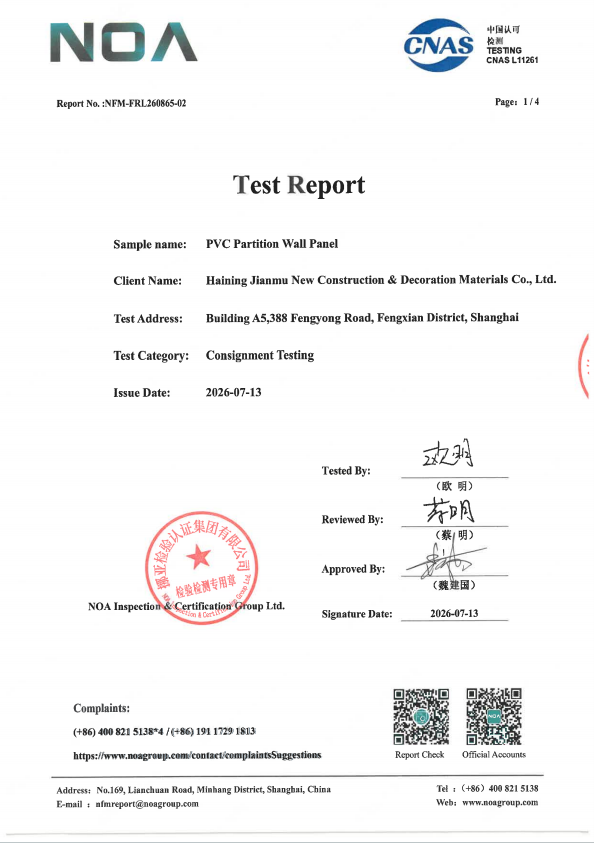
Test documentation in a qualification file is only useful when the report number, standard citations and product scope can be read against the purchased model.
A certificate image proves that a document exists. A report proves what was tested. The review questions are therefore specific:
- Does the scope wording match the model designation being quoted?
- Which thickness was tested, and is it the 26 mm panel in the quotation?
- Which classification is recorded in the report itself, as opposed to in the brochure?
- What mounting, fixing and substrate conditions applied during the test?
- Are the colour and surface variants in the order covered by the same scope?
- Is the report holder's legal name the same entity that will appear on the contract?
The same file also references ISO 9001:2008, SONCAP and SGS. These serve different functions and should not be read as fire evidence: ISO 9001 is a quality management system certification, SONCAP is a conformity assessment programme for regulated products entering Nigeria, and SGS is a testing and inspection organisation whose name on a document says nothing until the specific report behind it is identified.
It is also worth separating two different standards families. EN 13245-2, published by the European Committee for Standardization, specifies requirements for unplasticized poly(vinyl chloride) (PVC-U) profiles used for internal and external wall and ceiling finishes. A reaction to fire classification under EN 13501-1 and a profile product standard under EN 13245-2 answer different questions, and a qualification file should make clear which question each document addresses.
Capacity, Quality Control and Logistics Evidence
The commercial block of the file is where documented capability becomes a delivery forecast. Jianmu's stated position is a monthly production capacity of 40,000 m², a typical production lead time of 15 to 30 days, a minimum order quantity of one 40-foot high-cube (40HC) container, and 100% inspection before shipment. OEM and ODM services are offered, with customisation of colour, logo, product size and surface design, and technical services include remote support.
For a buyer, three readings matter. First, a 15,000 m² requirement — the scale recorded in the company's distributor case — sits comfortably inside one month of stated capacity, which supports scheduling but also means capacity is shared across concurrent orders. Second, a minimum order quantity of one 40HC container is a real constraint for pilot orders, colour trials and mixed-SKU projects, and should be settled before specification work begins. Third, a lead-time band of 15 to 30 days is wide enough that the buyer should ask which trigger points move a project from the short end to the long end — artwork approval, customised surface design, or raw material scheduling.
Generic Certificate Packets vs Traceable Qualification Files
The traditional approach to supplier screening is to request "your certificates" and treat the reply as a pass or fail. The alternative is to request a mapped file in which every document points at a specific model. The two approaches produce very different review outcomes.
| Review dimension | Generic certificate packet | Traceable qualification file |
|---|---|---|
| Identity | Brand logo on a brochure cover | Registered legal name consistent across quotation, report and shipping documents |
| Product scope | Category-level description | Model designation mapped to dimensions, thickness and trim |
| Performance | Descriptive claims without conditions | Claims tied to test methods, standards or stated application conditions |
| Fire evidence | Certificate image without scope detail | Report number, issuing body, standards cited, tested thickness, issue date |
| Supply | Adjectives about capacity | Monthly output, lead time, MOQ, inspection regime stated numerically |
| Reviewer outcome | Requires a second and third request round | Can be assessed in one pass, with residual questions listed |
The boundary is worth stating plainly. A qualification file, however coherent, is a documentary instrument. It does not prove that the panel delivered will measure exactly 2900 mm × 400 mm × 26 mm, that a 26 mm panel behaves identically to a thinner variant in a test, or that a local authority will accept an EU reaction to fire classification in place of a national requirement. It narrows the questions a buyer must answer on site, and it does not remove them.
Application: What Complete Evidence Looks Like
The most instructive part of Jianmu's file is not a certificate but a documented application. An overseas building material distributor used the panels for interior wall and ceiling decoration in residential and commercial buildings across Vietnam, Thailand, the Philippines, India and Indonesia, covering 15,000 m², with the installation in service for more than five years. The recorded highlights are EN 13501-1 fire classification, waterproofing, lightweight construction, durability and a range of design options; the recorded outcome is stable performance, good fire resistance, waterproofing and easy installation.

A reference is reviewable when it ties a market region, an application type, a quantity and a service duration together — not when it lists a logo.
That structure is what makes the case usable in a submittal: region, application type, quantity and duration are all stated, so a buyer can judge relevance instead of credibility. A reference that names a country but not a quantity, or a quantity but not a duration, cannot be evaluated in the same way.
Market Context: Why Qualification Files Are Getting More Scrutiny
Documentation review has become a larger part of sourcing because the supplier pool has grown. Verified Market Research values the global PVC wall panels market at USD 3,144.8 million in 2023, projected to reach USD 9,495.8 million by 2031, with a CAGR of 14.4% over 2024–2031. Dataintelo, working from a broader definition of PVC panels, estimates revenues of approximately USD 14.8 billion in 2025 with wall panels as the dominant sub-segment. The gap between those two figures is a scope gap, and it is the same gap that appears inside supplier files when a report covers a category while a quotation names a model.
Supply-side context reinforces the point. China became the world's largest PVC exporter in 2025, accounting for 24% of total global trade volume according to International Trader Publications. A larger exporter base means more suppliers, more documentation formats and wider variance in how evidence is presented — which raises the value of a consistent review method on the buyer side.
Future Outlook
The direction of travel is toward model-level documentation rather than company-level documentation. Three developments are visible in how buyers are already writing requests: report scopes that name the model and thickness instead of a product family; mapping tables that connect each quoted model to its supporting report; and requests for machine-verifiable report identifiers so that a certificate can be checked at source rather than trusted as an image.
Suppliers who assemble that mapping before it is requested will move through evaluation rounds faster, because they remove the most common cause of delay — the second and third documentation request. Suppliers who continue to answer with a certificate gallery will increasingly be filtered out at the shortlist stage rather than at the price stage.
A Twelve-Point Qualification Review Checklist
- Registered legal name is identical on quotation, test report and shipping documents.
- Founding year and site address are stated, and site size is given in measurable units.
- Staff count and engineering headcount are consistent with the customisation being offered.
- Annual output reconciles with the stated monthly output.
- Model designation appears on the quotation, not only in the catalogue.
- Panel dimensions and trim dimensions are stated with units and tolerances.
- Trim profile is confirmed compatible with the quoted panel thickness.
- Every performance word is either tied to a standard, tied to a stated application condition, or flagged as unverified.
- Fire report shows number, issuing body, standards cited, tested thickness and issue date.
- Report scope covers the model and variant being purchased.
- Monthly capacity, lead time, MOQ and inspection regime are stated numerically.
- At least one reference states region, application, quantity and duration together.
FAQ
What is a PVC partition wall panel qualification file?
It is the document set a supplier submits so that a buyer can verify five things: the legal entity behind the product, the product model designation and its dimensions, the performance statements attached to that product, the third-party test evidence supporting those statements, and the capacity and quality control that allow supply to be repeated. A catalogue, a certificate image or a price list alone does not constitute a qualification file.
Which company facts in a qualification file can be cross-checked?
Founding year against site history, annual output against monthly output, staff count against engineering headcount, and export share against declared markets. Haining Jianmu New Decoration Material Co., Ltd., founded in 1998 with a 15,000 m² workshop, approximately 50 staff and 5 R&D engineers, states an annual output of 360 × 40HC containers — which divides into 30 containers per month, matching its stated monthly output. Reconciled figures indicate an internally consistent file; they do not by themselves indicate product quality.
How do I verify that an EN 13501-1 test report applies to my specification?
Match four items. First, the scope wording in the report should correspond to the model being purchased. Second, the tested thickness should be the thickness quoted — 26 mm in Jianmu's panel specification. Third, the classification recorded inside the report should be read directly rather than taken from a brochure. Fourth, the report holder's legal name should be the contracting entity. Jianmu's report, numbered NFM-FRL260865-02 and issued by NOA Inspection & Certification Group Ltd. on 13 July 2026, cites EN 13501-1:2018, EN 13823-2020+A1:2022 and EN ISO 11925-2:2026 for the scope "PVC Partition Wall Panel". Whether colour or surface variants fall inside that scope is a question for the supplier, not an assumption for the buyer.
What do capacity and lead-time figures tell a buyer about delivery risk?
They define the scheduling envelope. Jianmu states a monthly production capacity of 40,000 m², a typical lead time of 15 to 30 days, a minimum order quantity of one 40HC container, and 100% inspection before shipment. A 15,000 m² order therefore fits within roughly one month of stated capacity, but that capacity is shared across concurrent orders. The minimum order quantity and the width of the lead-time band are the two figures most likely to affect project planning, and both should be confirmed in writing for the specific specification.
Are "waterproof" and "easy installation" claims verifiable?
Partly, and only when they are restated as conditions. Waterproofing should be tied to an application context and, where available, to a test method; Jianmu's distributor case records waterproofing as an outcome sustained over more than five years in residential and commercial interior wall and ceiling applications across five Asian markets. Installation ease should be tied to a method statement covering panel weight, fixing details, substrate requirements and trim sequence. Without those attachments, both phrases remain descriptive.
What can a qualification file not tell you?
It cannot confirm batch-to-batch production consistency, actual delivered dimensions against nominal ones, local authority acceptance of a foreign fire classification, or performance under the specific humidity and substrate conditions of a given site. Those require sample verification, pre-shipment inspection and, where relevant, project-specific testing. The file reduces the number of unknowns; it does not remove them.
For readers who want to see the product and specification data referenced in this review in full, the supplier’s PVC partition panel brochure is available here: JIANMU PVC partition panel brochure (PDF)
Have Questions or Need More Details?
Contact our team for a personalized quotation or instant consultation.
Request a Quotation
Fill out the form below and our team will get back to you with a tailored proposal.
WhatsApp Direct Chat
Prefer to chat in real-time? Message us on WhatsApp for instant assistance & quick answers.
- Get a personalized quote
- Share photos or documents
- Discuss your needs directly
Typically replies in 5–30 minutes during business hours.