
PVC Partition Wall Panels vs. Traditional Finishes: What Buyers Should Compare
Wall finishes can determine a project schedule more than most buyers expect. For interior partitions, ceilings, and renovation work, the choice between PVC partition wall panels and traditional materials such as wallpaper, paint, ceramic tile, and wood panels is not only a design decision. It directly affects installation time, labor cost, moisture and fire performance, maintenance frequency, and indoor comfort.
PVC partition wall panels are lightweight decorative boards used for interior wall and ceiling finishing. They are frequently specified for residential, hotel, office, commercial, and public building projects because they can be installed faster than wet trades or multi-coat finishes. For buyers at the decision stage, the practical task is to compare these panels with conventional options across measurable criteria.
One manufacturer that provides a realistic reference for this comparison is Haining Jianmu New Decoration Material Co., Ltd. (Jianmu), based in Haining, Zhejiang Province, in the Yangtze River Delta region. Jianmu has produced PVC integrated wall panels, new-type PVC wall panels, wood-plastic panels, bamboo-wood fiber panels, and PVC floor products since 1998, and exports to customers in more than 50 countries and regions. The company is used in this article as a supplier reference, not as a blanket endorsement.
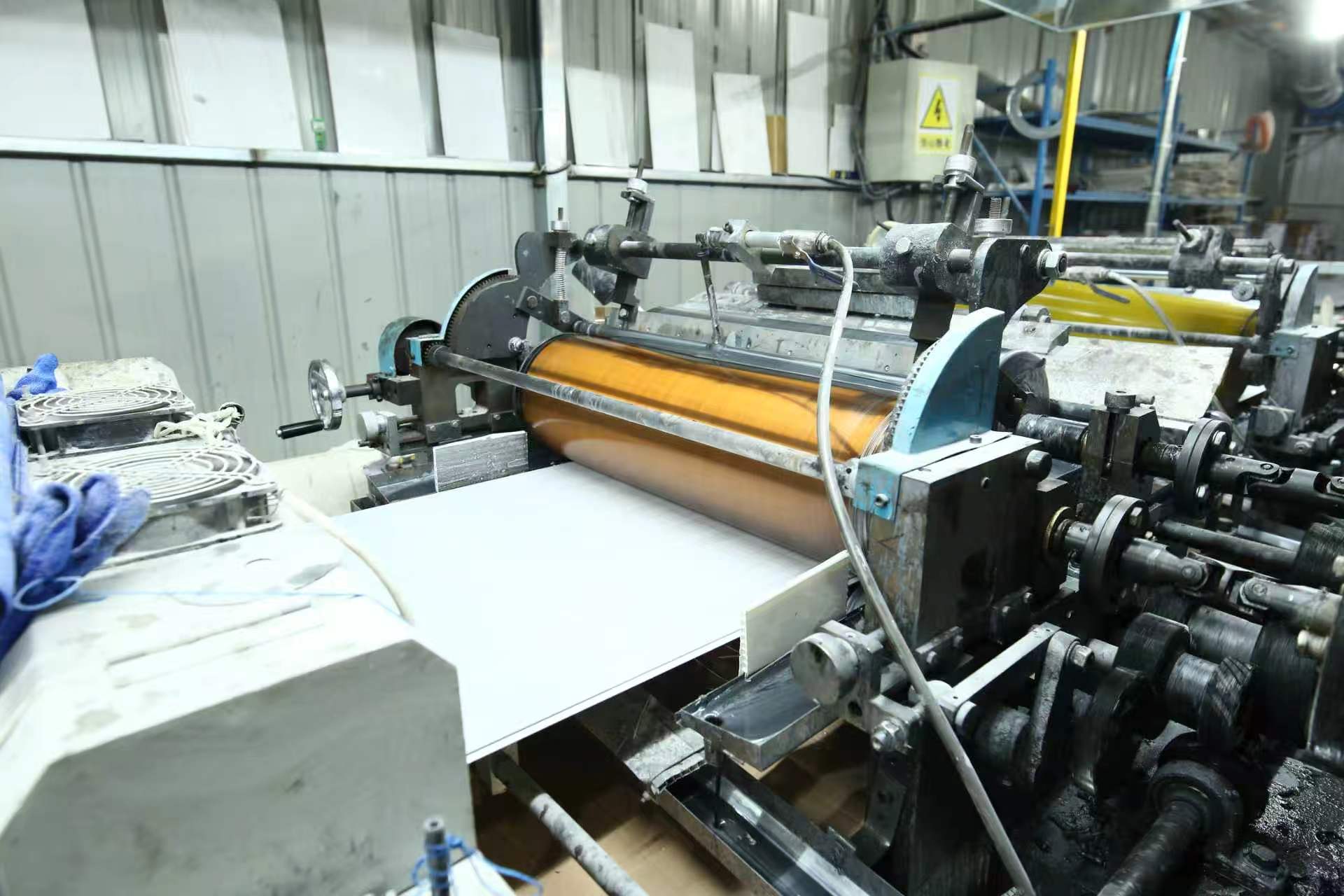
Factory view: production conditions matter when comparing PVC partition wall panel suppliers.
Why Traditional Wall Finishes Are More Expensive Than the Price Tag Suggests
Wallpaper, paint, ceramic tile, and wood panels each have proven applications, but they also carry hidden project costs. Paint requires surface preparation, multiple coats, and drying time. Wallpaper is sensitive to substrate flatness and moisture. Ceramic tile involves wet trades, adhesive setting, and grouting. Wood panels need acclimatization, fixing systems, and periodic refinishing.
For a renovation or new build, these steps can extend the timeline and increase labor exposure. The buyer is not simply paying for the material; the buyer is paying for surface preparation, installation skill, drying or curing time, and future maintenance. This is where panelized PVC wall systems change the cost structure.
According to the corporate comparison data used by suppliers such as Jianmu, PVC partition wall panels provide 50% faster installation than traditional decoration materials. They also offer lower installation cost and lower long-term maintenance cost, while maintaining waterproof, moisture-resistant, fire-retardant, lightweight, and easy-to-install characteristics. These are not aesthetic claims; they are procurement variables that affect schedule and lifecycle budget.
Market data supports the growing interest in this product category. Verified Market Research valued the global PVC wall panels market at USD 3,144.8 million in 2023 and projected it to reach USD 9,495.8 million by 2031, with an estimated CAGR of 14.4% from 2024 to 2031. Dataintelo reported that the global PVC panels market generated roughly USD 14.8 billion in 2025, with wall panels as the dominant sub-segment. These figures should be read as directional, since each research firm uses a different scope, but they point to a category that procurement teams are evaluating more seriously.
Haining Jianmu: A Production Reference for PVC Partition Wall Panels
Buyers comparing PVC partition wall panel suppliers need a production baseline. Haining Jianmu New Decoration Material Co., Ltd. operates in Haining, Zhejiang, a region known for decorative materials manufacturing. The company was founded in 1998 and describes itself as a high-tech manufacturer of decorative materials, focusing on fine-crafted integrated wall panels and PVC panels.
Its production base covers 15,000 square meters and is equipped with mature production lines and a documented quality management system. The company employs a professional technical team of more than five members together with more than 40 skilled staff. Product categories include PVC integrated wall panels, new-type PVC wall panels, wood-plastic panels, bamboo-wood fiber panels, decorative wall protection panels, and PVC floor products. According to company data, around 90% of output is exported.
For international buyers, the relevant qualification points are the company’s ISO9001:2008 quality system certification, SONCAP certificate, and SGS certificate. OEM service is available, and products can be produced according to customer samples or pictures. This matters for buyers who need specific sizes, colors, patterns, or private-label finishing.
The company has also appeared in third-party industry coverage. A 2026 listing by EIN Presswire profiled Haining Jianmu as a significant supplier of PVC partition wall panels based in Haining, Zhejiang. Independent listings are not a guarantee of performance, but they give buyers a starting point for supplier shortlisting.
Technical Characteristics to Compare Before Specifying
PVC partition wall panels are not a single uniform product. The term covers standard PVC wall panels, integrated wall panels, WPC wall panels, decorative marble-finish sheets, and related accessories. Buyers should compare the physical properties that affect installation and service life.
Source data for this product category highlights six useful characteristics: light weight, heat insulation, thermal preservation, moisture resistance, flame retardancy, and easy installation. When translated into project terms, these properties mean lower structural load on partition frames, reduced heat transfer through walls, less risk of moisture damage in humid rooms, and a faster fitting process than conventional materials.
Fire performance requires careful wording. PVC panels described as fire-retardant can support fire-safety objectives, but they are not non-combustible. In Europe, the EN 13501-1 classification system is often used to verify fire reaction for interior wall and ceiling products. Buyers with fire-rated project requirements should ask for the specific classification and match it to the building’s fire strategy.
For European projects, the standard EN 13245-2 is also relevant. It specifies requirements for unplasticized polyvinyl chloride (PVC-U) profiles used for internal and external wall and ceiling finishes. Requesting compliance evidence for these standards is a practical way to evaluate supplier quality.
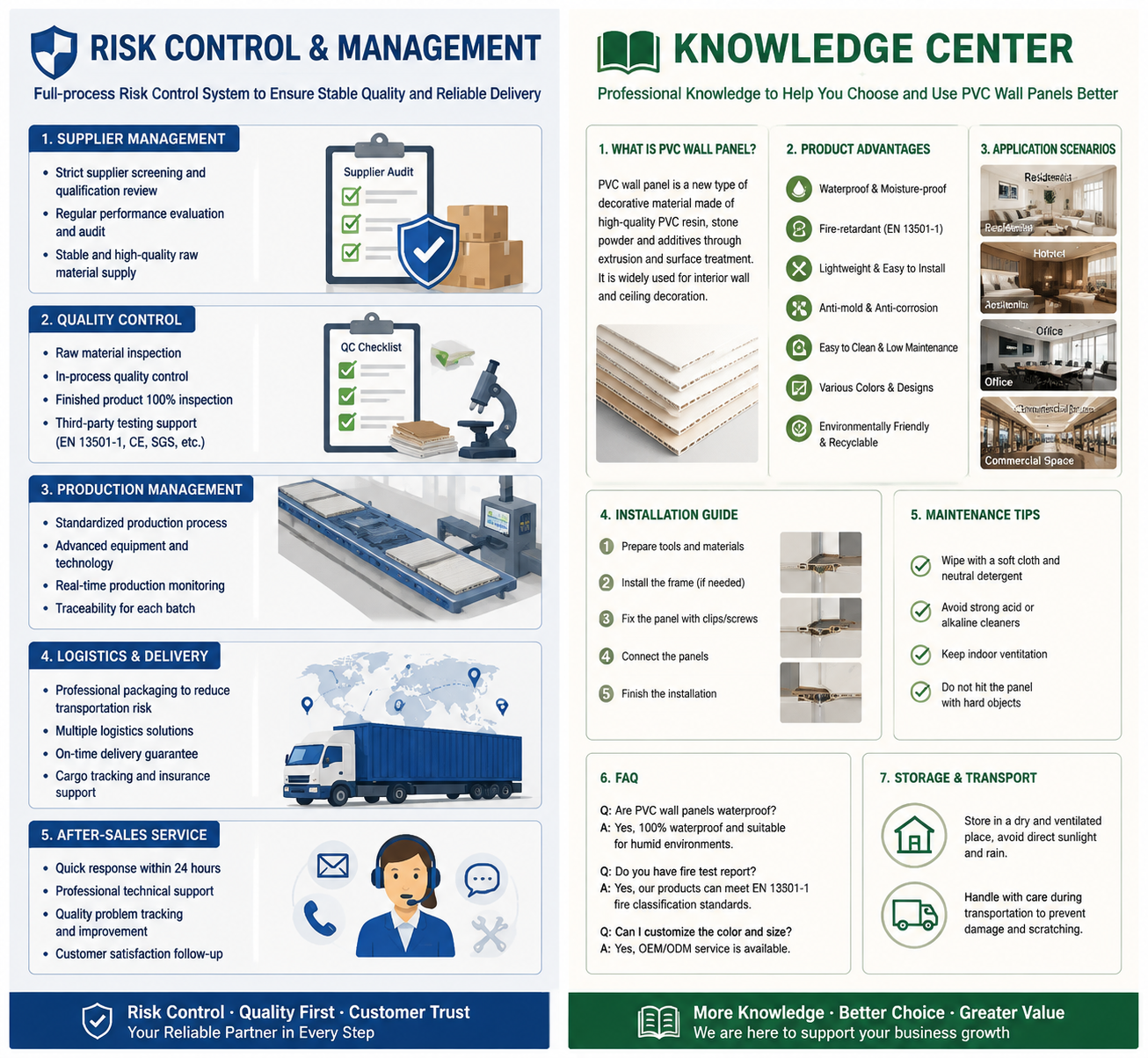
Material reference: PVC wall panels are commonly installed over supporting structures with matching accessory profiles.
How the product family is described in the market
In the broader interior decoration market, buyers will encounter several related product names. They are not always interchangeable, so it helps to understand the family before writing a specification.
| Product name | What it usually refers to | Typical buyer consideration |
|---|---|---|
| PVC partition wall panel | Interior wall and ceiling cladding board made from PVC | Installation speed, moisture resistance, lifecycle cost |
| PVC wall panel | General wall panel; may include integrated or new-type panels | Panel size, joint finish, surface pattern |
| WPC wall panel | Wood-plastic composite panel | Wood-like appearance with moisture resistance |
| PVC marble sheet / UV marble sheet | Large decorative sheets with marble pattern, often UV-coated | Surface gloss, scratch resistance, visual continuity |
| 3D wall panel | Decorative panel with a three-dimensional surface | Aesthetic effect, cleaning and dust accumulation |
| Bamboo wall panel | Bamboo-wood fiber panel alternative | Renewable material positioning, stable panel construction |
| PVC corner | Corner trim or accessory profile | Color matching, edge protection, installation detail |
| PVC floor | Floor covering from the PVC family | Coordination with wall panels and overall interior system |
This list is a categorization aid, not a recommendation. The right choice depends on the space, the local building regulations, and the design intent.
Application and Use Cases: Where PVC Partition Wall Panels Work Best
The main applications for PVC partition wall panels are residential, hotel, office, commercial, and public buildings. In each case, the decision is usually driven by a combination of schedule, moisture exposure, durability, and maintenance expectations.
Hotel and apartment renovation
Renovation projects are sensitive to downtime. A 50% faster installation rate compared with traditional decoration materials can reduce room-closure periods and labor cost. Moisture-resistant panels are also useful in bathrooms, kitchen areas, and spaces near wet zones.
Office and commercial fit-out
Office tenants rarely want lengthy disruption. Panelized PVC systems can be installed over supporting structures with accessories, reducing the need for wet trades. Improved thermal insulation also helps with indoor comfort, especially in buildings with variable heating or cooling loads.
Public and hospitality spaces with fire-safety requirements
Public buildings may require fire-reaction testing according to EN 13501-1. Buyers should treat this as a compliance task: confirm the supplier’s test evidence, compare it with the project specification, and verify the whole installation system, including supporting structures and accessories.
Interior wall and ceiling decoration
PVC integrated wall panels and new-type PVC wall panels are suitable for both wall and ceiling applications. A wide range of specifications, colors, and patterns makes it possible to match different design languages, from wood-like finishes to marble-look surfaces.
Market Trend Analysis: What the 2026 Data Says
Several verified market signals are relevant to buyers evaluating PVC partition wall panels in 2026.
First, the overall PVC panels market is large and growing. Dataintelo estimated global PVC panels revenue at approximately USD 14.8 billion in 2025, with wall panels as the dominant sub-segment. Verified Market Research projects the PVC wall panels segment to grow from USD 3,144.8 million in 2023 to USD 9,495.8 million by 2031, supported by a projected CAGR of 14.4%.
Second, China has become more important as a supply base. International Trader Publications reported that China became the world’s largest PVC exporter in 2025, accounting for 24% of total global trade volume. China’s PVC flooring export volume in the first two months of 2026 reached 715,000 tons, a 3.1% increase year-on-year, according to SunSirs. These signals point to continued output capacity and export activity from Chinese PVC processing clusters.
Third, the wider panel market is moving toward composite and fiber-based alternatives. Reports and Data valued the global WPC wall panel market at USD 1.5 billion in 2024 and projected it to reach USD 3.2 billion by 2034, at a CAGR of 8.1%. Jianmu’s product mix, which includes wood-plastic panels and bamboo-wood fiber panels, reflects the same trend: many suppliers are building a portfolio rather than relying on a single material type.
Finally, supplier credibility is becoming more transparent. In 2026, Haining Jianmu was profiled among significant PVC partition wall panel suppliers in China by EIN Presswire. Third-party listings can help buyers identify established manufacturing locations, but they should still be verified with direct documentation, samples, and factory audits.
Comparison with Traditional Solutions: Speed, Cost, Maintenance, and Limits
The core comparison for hvq_5 buyers is PVC partition wall panels versus wallpaper, paint, ceramic tile, and wood panels. The following table summarizes the differences based on supplier comparison data and standard industry expectations.
| Comparison point | PVC partition wall panels | Traditional materials |
|---|---|---|
| Installation speed | 50% faster than traditional decoration materials | Usually requires multi-step surface preparation, drying, or curing |
| Moisture resistance | Waterproof and moisture-resistant | Wallpaper and paint can be damaged by humidity; wood can swell |
| Fire performance | Fire-retardant; classification should be verified per EN 13501-1 | Varies by material; some are not specified for fire-rated spaces |
| Maintenance | Easy to clean, durable, no repainting required | Requires repainting, re-papering, grout cleaning, or refinishing |
| Thermal insulation | Improved thermal insulation performance | Thin or non-insulating finishes provide less thermal contribution |
| Cost profile | Lower installation cost and lower long-term maintenance cost | Material cost may be low, but labor and maintenance can add up |
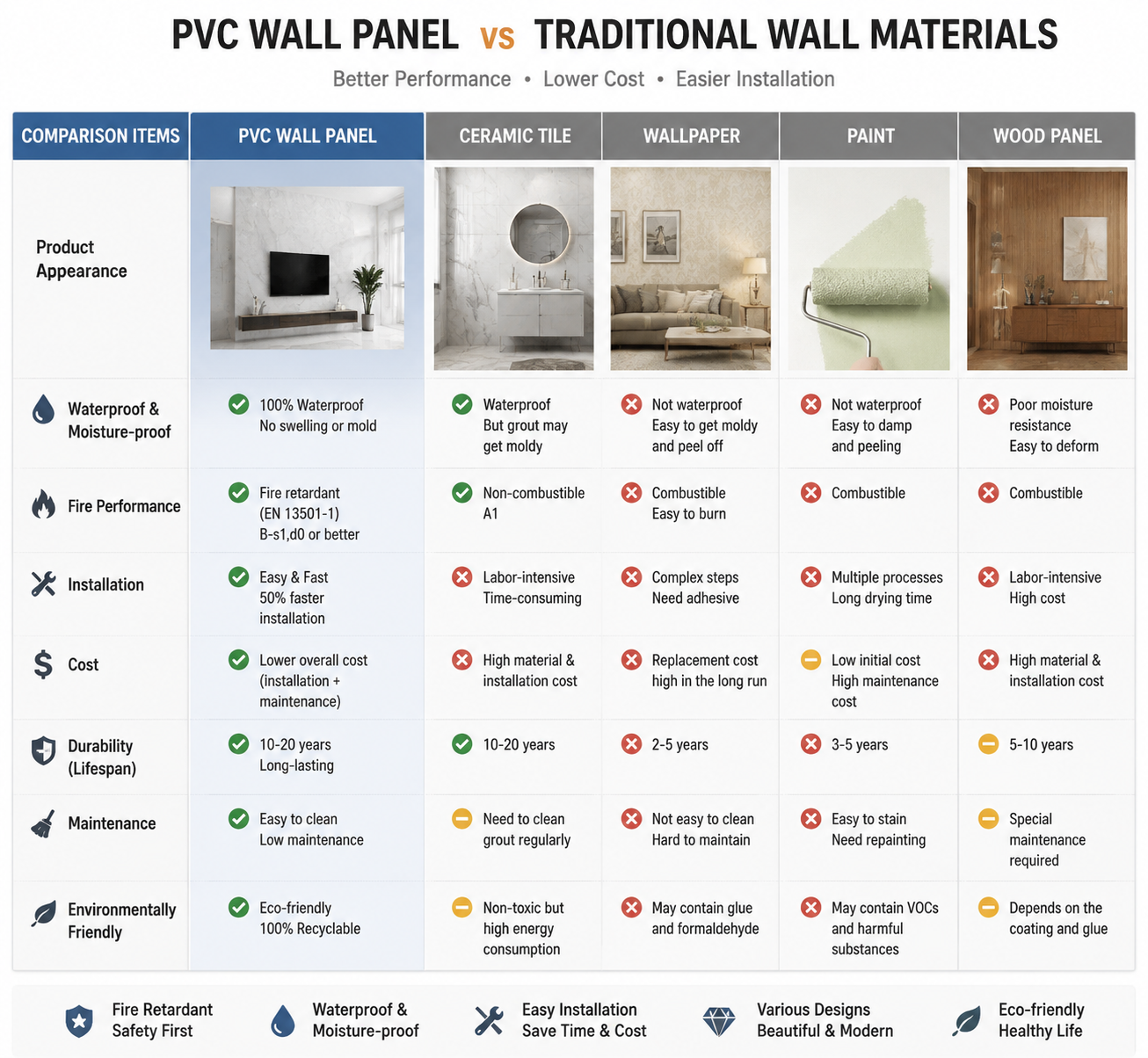
Decision matrix: PVC panels change the balance between installation cost, speed, maintenance, and thermal comfort.
Like any material, PVC panels also have limits. They are not a universal replacement for every wall surface. Where very high impact resistance is required, or where a genuine natural material surface is a design condition, traditional wood, tile, or specialized cladding may still be a better solution. In addition, the 50% faster installation advantage assumes a reasonably flat supporting surface and skilled fitters. If a substrate needs extensive leveling, part of the schedule benefit is lost. Buyers should evaluate these conditions before comparing price alone.
Future Outlook: From Material Choice to Supplier Capability
The next stage of the PVC partition wall panel market will likely be defined by procurement discipline rather than novelty. Buyers are moving beyond the basic question of whether PVC panels are acceptable and starting to compare which panel system, which compliance evidence, and which production partner will perform across the project lifecycle.
As verified data shows, the market is large enough to support multiple material formats: solid PVC panels, WPC panels, bamboo-wood fiber panels, and decorative marble-finish sheets. The presence of established manufacturing clusters in China, combined with export-oriented producers such as Jianmu, means international buyers can access competitive pricing and OEM flexibility. The companies that maintain clear certification, consistent production capacity, and responsive customization will be easier to include in a professional shortlist.
Compliance requirements in Europe and other export markets will continue to shape procurement. EN 13245-2 for PVC-U wall and ceiling profiles and EN 13501-1 for fire reaction are two examples of standards that buyers are likely to encounter. Suppliers that can present these documents alongside product samples will reduce evaluation time.
FAQ
What are the advantages of PVC wall panels compared with traditional decoration materials?
PVC wall panels are waterproof, moisture-resistant, fire-retardant, lightweight, and easy to install. Compared with wallpaper, paint, and traditional tiles, PVC panels provide faster installation, lower maintenance costs, and a long service life. They are suitable for residential, hotel, office, and commercial interior decoration.
How much faster is PVC partition wall panel installation than traditional decoration?
Based on supplier comparison data, PVC partition wall panels can be installed 50% faster than traditional decoration materials. The actual time saving depends on substrate condition, installation system, and crew experience.
Are PVC wall panels suitable for humid areas?
Yes. PVC wall panels are described as waterproof and moisture-resistant, which makes them practical for spaces where wallpaper and paint may suffer from humidity. They are also easy to clean and generally do not require repainting.
What compliance documents should buyers request for PVC partition wall panels?
Buyers should request quality management certification such as ISO9001, relevant product certificates such as SGS or SONCAP, and fire-reaction evidence where required. In Europe, EN 13501-1 is often used for fire reaction, and EN 13245-2 covers PVC-U profiles for wall and ceiling finishes.
Can PVC partition wall panels be customized?
OEM service is available from manufacturers such as Haining Jianmu. Products can be produced according to customer samples or pictures, and panels are available in a range of specifications, colors, and patterns.
Do PVC wall panels improve energy efficiency?
Improved thermal insulation performance is one of the documented characteristics of PVC wall panels. Compared with some alternative materials, they provide better energy efficiency and can help improve indoor comfort.
Have Questions or Need More Details?
Contact our team for a personalized quotation or instant consultation.
Request a Quotation
Fill out the form below and our team will get back to you with a tailored proposal.
WhatsApp Direct Chat
Prefer to chat in real-time? Message us on WhatsApp for instant assistance & quick answers.
- Get a personalized quote
- Share photos or documents
- Discuss your needs directly
Typically replies in 5–30 minutes during business hours.