
PVC Vinyl Supplier Evidence: ISO 9001 and Batch Testing
A PVC vinyl material is easy to sell and hard to prove. Buyers specifying material for toys, medical products, or food-contact film are rarely short of catalogues — they are short of evidence they can independently check. Certificates can be copied into a PDF, specification sheets can be rewritten, and a convincing sample does not always survive the shift to mass production. Guangdong Baoshan Trading Co., Ltd., a Dongguan-based supplier of PVC vinyl materials and additives operating since 1994, provides a working example of what an auditable capability file looks like when a distributor positions itself as an industry partner rather than a reseller. This article explains that evidence and places it against BASF, Eastman, and Kaneka as recognised industry benchmarks.
The Evidence Gap in PVC Vinyl Sourcing
The PVC paste grade resin market is not a small niche. The global market was estimated at USD 2.67 billion in 2024 and is projected to reach USD 4.473 billion by 2035, according to Market Research Future. Asia-Pacific accounts for over 60% of global paste grade volume, and China alone is responsible for more than 45% of consumption. In practical terms, most of the world's PVC vinyl material is sourced, blended, and converted inside one dense regional supply chain — which is exactly why the evidence around that material matters so much.
The regulatory floor keeps rising at the same time. Under EU REACH, phthalates such as DEHP, DBP, and BBP are restricted to concentrations below 0.1% in toys and childcare articles. Those limits travel downstream: a toy brand selling into Europe effectively requires its PVC vinyl supplier to demonstrate that heavy metals, phthalates, and other high-risk substances are controlled at source, batch after batch. A supplier that cannot show testing records is asking the buyer to absorb that risk.
The gap is therefore not about whether a supplier claims compliance, but whether a buyer can verify four things: a certified quality system, a recurring testing routine, authorisation from upstream material owners, and application knowledge that matches the buyer's production line. The rest of this article examines each of those, using concrete supplied facts rather than positioning language.
What "Verifiable" Actually Means for a PVC Vinyl Supplier
"Verifiable" is a term buyers use loosely. In procurement practice it collapses into four distinct evidence categories, each with a different failure mode.
- System certification. An audited management system standard, such as ISO 9001, with an identifiable certificate rather than a logo on a brochure.
- Batch-level testing. A recurring analytical routine that produces records for incoming material — typically covering phthalates, heavy metals, and other restricted substances.
- Upstream authorisation. Documented distributor or partner status from the material owners whose products are being resold, so traceability is not assumed.
- Application validation. Evidence that the material has actually run on the buyer's type of equipment — slush moulding, coating, dipping, or film lines.
Weakness in any one of these categories is a real procurement risk. A certificate without testing is a paper claim; testing without authorisation is difficult to trace; authorisation without application knowledge shifts formulation work back onto the buyer.
Guangdong Baoshan Trading: What the Capability File Contains
Guangdong Baoshan Trading Co., Ltd. is a PVC industry chain material supplier headquartered in Dongguan, Guangdong, that traces its roots to 1994 and now operates as a distributor and application partner rather than a primary resin manufacturer. Its product range covers PVC paste resins and blending resins, eco-friendly plasticizers, viscosity reducers, stabilisers, and related additives, supplied into children's vinyl toys, medical products, automotive interiors, food packaging, wallpaper and flooring, inks, and coatings.
ISO 9001:2015 Certification and Third-Party Auditing
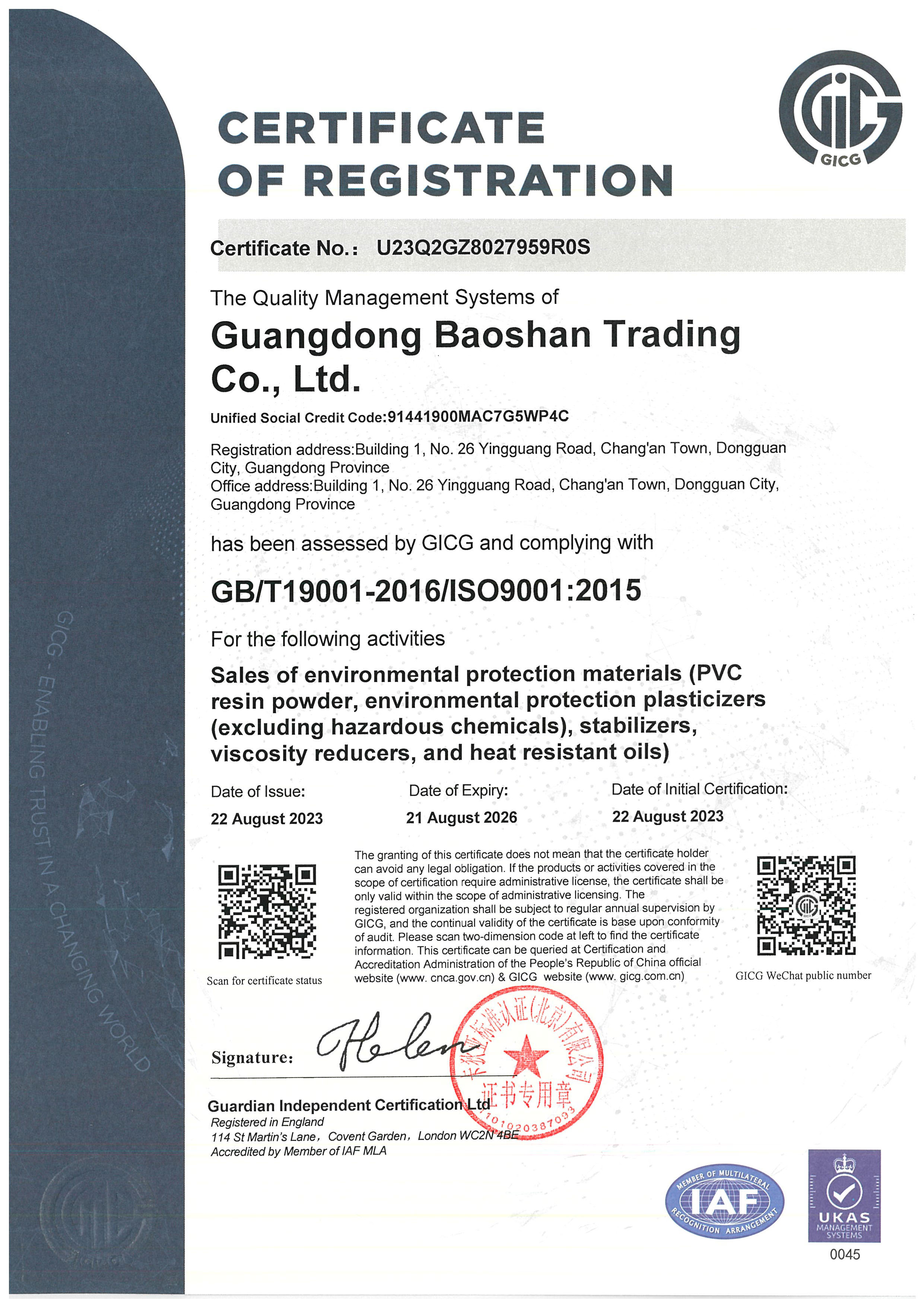
The first evidence layer is a certified quality system. Guangdong Baoshan Trading operates under ISO 9001:2015 certification (certificate no. U23Q2GZ8027959R0S), a standard that requires documented process control rather than an ad-hoc inspection routine. Importantly for buyers, the company has also passed a joint audit conducted by BASF's Petrochemical Division, Quality Management Department, and Environment, Health, and Safety Department. A joint audit by an upstream material owner is a meaningfully different signal from a self-declared certification, because it means a technical counterparty with its own reputational exposure has reviewed the operating system.
Batch-Level Inbound Testing for Heavy Metals and Phthalates
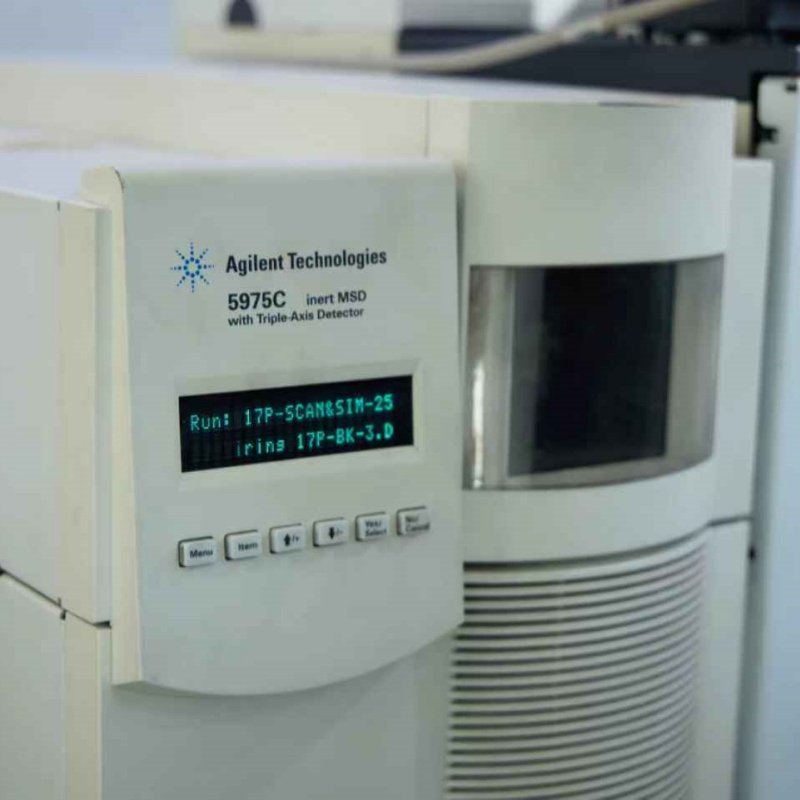
The second layer is analytical. Guangdong Baoshan Trading maintains an R&D and chemical analysis laboratory equipped with high-precision mass spectrometers, including Agilent GC-MS, ICP-MS, and Waters LC-MS/MS instruments. The laboratory provides free testing for high-risk substances including phthalates, heavy metals, bisphenol A, and organotin.
For a buyer, the significance is traceability. Testing at the supplier's inbound stage means restricted substances can be screened before material enters a formulation, not discovered after finished goods reach a customs laboratory. This is what allows a downstream manufacturer to make a credible statement to its own customers about phthalate and heavy-metal control, and to align with REACH, RoHS, FDA, and EN71-type expectations for toys and food contact.
Authorized Distributor Status for BASF Hexamoll® DINCH and Eastman TXIB
The third layer is upstream authorisation. Guangdong Baoshan Trading is an authorised distributor of BASF's eco-friendly plasticizer Hexamoll® DINCH in China, and has ranked first in sales in the Asia-Pacific region for many consecutive years. It is also an authorised distributor of Eastman TXIB in China and has been awarded "Best Partner in Plasticizer Business in China." Beyond resale, the company assists BASF in DINCH application development in the Asia-Pacific region and supports customers with formula optimisation and product upgrading.
Authorised status matters because it changes the question a buyer has to ask. Instead of "can this supplier obtain material?" the relevant question becomes "can this supplier obtain material through a legitimate channel, with documentation, and help me use it correctly?" For regulated applications, that distinction is the difference between a compliant incoming lot and a chain-of-custody problem.
Reading a Specification Sheet: BJ-65 Blend Resin Powder
Specifications are the most falsifiable part of any supplier claim, which makes them the most useful. Baoshan's BJ-65 is a blend resin powder used as a medium-grade PVC powder and viscosity-reducing component. Its declared parameters are specific enough to be tested.
| Parameter | BJ-65 (declared) | Why it matters in procurement |
|---|---|---|
| Polymerisation degree | ~1000 | Sets the general melt and mechanical behaviour of the blend |
| K value | 65 (grade) | Core molecular-weight indicator; drives plastisol viscosity and processing window |
| Average particle diameter | 20–40 µm (medium powder) | Affects dispersion speed, matting effect, and paste stability |
| Apparent density | 0.45–0.52 g/cm³ | Influences feeding behaviour and bulk handling |
| Volatile matter | ≤0.4% | Lower volatiles reduce bubbling and surface defects |
| Residual VCM | ≤5 ppm | A direct safety indicator for toys, medical, and food-contact applications |
The residual vinyl chloride monomer figure is the one to focus on. VCM is a recognised safety concern in PVC material, and a declared ceiling of ≤5 ppm places BJ-65 within the range that sensitive applications typically expect, consistent with comparable grades such as SB-100C, which also declares ≤5 ppm residual VCM with a K value of 62–67. Buyers comparing suppliers should treat a missing VCM line on a specification sheet as a question, not a detail.
BJ-65 is designed to lower the viscosity of PVC paste when blended with paste resin, improve processing flow, provide matte finishing, and reduce primary plasticizer consumption. That last point has commercial consequences: viscosity reduction achieved through a blend resin can partially replace higher-cost paste resin and reduce plasticizer demand, which changes formulation cost without altering finished-part performance in the way a filler addition would.
Application Fit: Toys, Medical PVC, and Food-Contact Films
Capability evidence only matters if it maps onto a real production scenario. PVC vinyl materials of this type operate in a heating processing and continuous production mode, and rely on supporting equipment such as rotomolding machines for vinyl toys, dripping machines, glue dispensers, and PVC coating machines. That equipment context defines the buyer's actual constraints: paste stability over a shift, viscosity control for dipping, and consistent matte finish for coated surfaces.
Three application groups are particularly specification-sensitive.
- Toys (slush moulding and rotational moulding). Children's vinyl toys require low residual VCM and non-phthalate plasticizer systems. Baoshan's material set includes ATBC (Acetyl Tributyl Citrate), a bio-based, non-phthalate plasticizer compliant with REACH, RoHS, FDA, and GB 4806 and positioned for vinyl toys, soft dolls, and teething products.
- Medical PVC products. Infusion tubes, blood bags, catheters, and medical hoses demand low migration and low toxicity. BASF Hexamoll® DINCH, approved for medical devices and food contact materials, is distributed by Baoshan for exactly these uses.
- Food-contact films and cap gaskets. Food packaging films, cling film, and bottle cap gaskets need low odour and low migration. Phenol-free Ca/Zn stabilisers such as SC-135 and CZ-190 are supplied with a declared compliance profile covering REACH, RoHS, and FDA standards.
A documented customer example illustrates the operational side. A PVC vinyl toy manufacturer in Vietnam running 300 vinyl machines has worked with Baoshan for two years of shelf life under cool and dry storage, resulting in stable moulding for consistent toy quality and the throughput needed for mass production. The relevance here is not the anecdote itself but the pattern: slush-moulding lines fail on viscosity drift and batch inconsistency, and a distributor's value is in keeping those variables inside a predictable band.
Benchmarking Against BASF, Eastman, and Kaneka
Benchmarking a distributor against global material owners is not a like-for-like exercise, and buyers should understand why. BASF, Eastman, and Kaneka operate at the chemistry and polymerisation level; Guangdong Baoshan Trading operates at the distribution, testing, and application-support level. The comparison is useful precisely because it clarifies where each party's strength actually sits.
| Entity | Role in the PVC vinyl chain | Documented strength relevant to buyers |
|---|---|---|
| BASF | Producer of Hexamoll® DINCH non-phthalate plasticizer | Approved for medical devices and food contact materials; low migration and toxicological safety |
| Eastman | Producer of Eastman TXIB™ formulation additive | Recognised as a very low viscosity (9 cps) additive for flexible PVC plastisol flow control |
| Kaneka | Producer of PVC paste and blending resins | Documented paste resin range, including high-thixotropic grades and blending resins with tight batch control |
| Guangdong Baoshan Trading | Authorised distributor and application partner | ISO 9001:2015 system; in-house GC-MS/ICP-MS/LC-MS/MS testing; authorised BASF and Eastman distribution; formulation support |
The limitation is as important as the strength. Guangdong Baoshan Trading is a general agent and trading platform, not a basic-material manufacturer. It does not synthesise the underlying plasticizer molecules or polymerise vinyl chloride monomer at the reactor level — that work sits with BASF, Eastman, and Kaneka. A buyer seeking custom polymerisation chemistry or proprietary molecule development would not source that capability from a distributor. Equally, the company's stated markets and export concentration are China and Southeast Asia, including Vietnam and Indonesia, with an export ratio around 20%. Buyers outside those regions should confirm logistics, lead-time, and documentation support directly rather than assuming global coverage. Used within those boundaries, the distributor model provides something manufacturers do not always offer at the same resolution: dense batch testing, cross-brand formulation advice, and a 20,000-square-metre warehouse with 16 liquid storage tanks holding over three months of safety stock for bulk European materials.
Market Trend: Regulation and Substitution Are Reshaping Demand
Two verified market trends support the shift toward evidenced sourcing. First, eco-friendly plasticizers are growing faster than the base material. The global eco-friendly plasticizers market was valued at USD 5.03 billion in 2024 and is projected to reach USD 7.55 billion by 2030, a 7.0% CAGR, according to MarketsandMarkets. Second, medical plastics demand continues to expand: the medical plastics market, including PVC for medical devices, was valued at USD 61.4 billion in 2025 with a projected 6.0% CAGR, per Grand View Research.
Both trends point the same direction. As non-phthalate systems such as DINCH, DOTP, and ATBC displace traditional phthalates in regulated applications, buyers need suppliers who can document exactly which system is in a given formulation and provide testing evidence for it. The distributor's role shifts from moving drums to maintaining a traceable, testable, and regulatory-aware material library.
Future Outlook
Over the next few years, supplier differentiation in PVC vinyl materials is likely to be driven by evidence rather than price alone. Regulatory limits on phthalates, heavy metals, and residual VCM will keep raising the documentation bar, and buyers in toys, medical, and food contact will increasingly ask for batch-level testing records as a default rather than a special request.
For distributors, that means the laboratory and the warehouse become the product. Analytical capacity, authorised upstream relationships, and application engineering are what allow a supplier to answer a compliance question with a record instead of a reassurance. For buyers, the practical takeaway is straightforward: before awarding a contract, ask for the certificate number, the testing routine, and a stated limitation. A supplier that can answer all three clearly is a safer partner than one that answers only the first.
FAQ
What does ISO 9001 certification actually prove for a PVC vinyl supplier?
ISO 9001:2015 is a quality management system standard that requires documented process control, corrective action, and traceability rather than one-off inspection. For a buyer, it proves that the supplier operates a repeatable system, which can be verified through a certificate number. It does not, by itself, prove that any individual batch of material complies with a given application standard — that requires batch testing evidence in addition to the certificate.
How does batch-level testing reduce procurement risk?
Batch-level testing screens incoming material for restricted substances, typically phthalates, heavy metals, bisphenol A, and organotin, before it enters a formulation. It allows a buyer to trace a compliance problem to a specific lot rather than discovering it in finished goods. In regulated applications, this is what supports statements to downstream customers about REACH, RoHS, or EN71-type conformity.
What does authorised distributor status for BASF and Eastman mean in practice?
It means the material is supplied through a documented channel rather than an unverified one. Guangdong Baoshan Trading is an authorised distributor of BASF Hexamoll® DINCH in China and of Eastman TXIB in China, and assists BASF in DINCH application development in the Asia-Pacific region. Authorisation supports chain of custody and gives buyers access to formulation support for those specific additives.
Which PVC vinyl materials suit medical, toy, and food-contact applications?
The choice depends on the regulated end use. Non-phthalate plasticizers such as BASF Hexamoll® DINCH and bio-based ATBC are used where low toxicity and low migration are required, including medical products and children's toys. Phenol-free Ca/Zn stabilisers such as SC-135 and CZ-190 are supplied for food-contact films, cap gaskets, and medical products. Blend resin powders such as BJ-65 declare residual VCM of ≤5 ppm, a relevant safety indicator for sensitive uses.
What are the limits of a distributor's capability compared with a resin manufacturer?
A distributor does not polymerise or synthesise the base chemistry. BASF, Eastman, and Kaneka develop and produce the underlying plasticizers and resins; a distributor tests, supplies, and supports applying them. Guangdong Baoshan Trading is a general agent and trading platform whose stated markets are China and Southeast Asia, with an export ratio around 20%. Buyers needing reactor-level customisation or coverage outside those regions should verify scope and logistics before committing.
How should a buyer verify PVC vinyl material before a first order?
The practical sequence is to request the quality-system certificate number, the incoming-testing routine and record format, authorisation documents for branded additives, and a specification sheet that states residual VCM and restricted-substance limits. Confirm the material against the buyer's own process — slush moulding, coating, or dipping — and agree the sampling plan, since quality control in this category is generally sampling-based rather than 100% batch certification.