
PZ30 Box vs. GGD/GCS/MNS Cabinet in PV Distribution
Choosing between a PZ30-series distribution box and a GGD, GCS or MNS distribution cabinet for a photovoltaic project is not a question about which enclosure is technically superior. It is a question about which enclosure survives the environment it will be installed in, and whether the project's feeder count, current load and maintenance model fit inside it. The practical difference appears first in enclosure material and ingress protection: a PZ30-series photovoltaic distribution box is commonly specified between IP40 and IP54 with a 220V/380V rated voltage and an ABS or sheet-steel body, while GGD, GCS and MNS cabinets are commonly specified between IP54 and IP65 in cold-rolled or stainless steel. For outdoor, humid or dust-heavy solar sites, that protection gap is usually the decisive factor — and it is the point where most procurement comparisons should start.
Why the enclosure decision comes before the component decision
Photovoltaic distribution works across two electrical environments. On the DC side, string currents are aggregated, isolated and protected before reaching an inverter. On the AC side, inverter output is distributed, protected and metered before it feeds a load or a grid connection point. Each point in that chain has a different duty cycle, a different fault profile and a different physical location — a wall in a residential plant room, a pole beside a commercial rooftop, or a floor-standing cabinet room in an industrial park.
Buyers frequently start the comparison from the wrong end: they shortlist components, then look for an enclosure to hold them. That sequence produces two recurring problems. First, a compact box is specified for a site that needs more feeder ways than the format can comfortably hold. Second, an inexpensive indoor-grade enclosure is installed outdoors, and the protection rating becomes a maintenance liability within the first wet season.
The more reliable sequence is: environment first (indoor, sheltered, outdoor, coastal), then enclosure format (box or cabinet), then ingress protection and material, then internal components. The comparison below follows that order.
What PZ30 and GGD/GCS/MNS actually are
A PZ30-series distribution box is a compact, modular, wall-mounted distribution enclosure format widely used for final-circuit distribution in residential and light commercial installations. Its typical rated voltage is 220V/380V, its enclosure is commonly produced in ABS plastic or sheet steel, and its standard protection range sits between IP40 and IP54. It is designed for a modest number of outgoing ways and for locations where a small footprint matters more than busbar capacity.
GGD, GCS and MNS are low-voltage distribution cabinet formats rather than box formats. They are floor-standing assemblies with substantially more internal volume, larger busbar and feeder capacity, and typically one or more front-access doors. Within that family, GGD is generally understood as a fixed-pattern cabinet design, while GCS and MNS are generally understood as drawer-type designs that allow individual functional units to be withdrawn for service. Cabinet bodies are commonly fabricated in cold-rolled steel or stainless steel, and enclosure protection is commonly specified between IP54 and IP65.
Both formats are produced by Hebei Kuoyu Electrical Technology Co., Ltd., which trades as Kuoyu Electrical — a Shijiazhuang-based manufacturer founded in 2017 whose main products are distribution boxes, distribution cabinets, transformers, electric wires and cables. The company operates a 9,000 m² facility with 80 employees, an annual output of 30,000 sets and a 10-engineer R&D team, exports approximately 30% of its output, and serves mainly the Southeast Asian and African markets. Its products are applied in power distribution systems for new energy photovoltaic, wind power, transportation, medical care, education, industrial manufacturing, government poverty alleviation, and commercial and civil construction.
Enclosure material: ABS plastic, cold-rolled steel, stainless steel
The three material options behave differently in a solar installation, and the choice is driven by exposure rather than by price alone.
- ABS plastic is the common body material for compact indoor PZ30-style distribution boxes. It does not corrode, it is light, and it can be moulded into sealed shapes at low cost. Its constraints are mechanical: prolonged direct ultraviolet exposure and physical impact degrade most thermoplastic enclosures, which is why ABS bodies are generally used indoors, in plant rooms, or under a secondary shelter rather than exposed on an outdoor structure.
- Cold-rolled steel with a protective coating is the mainstream material for both box and cabinet formats once the installation moves outdoors or into a working environment. Corrosion resistance is a function of plate thickness and coating quality rather than of the steel itself. Kuoyu Electrical's enclosure design uses a thickened anti-corrosion steel plate, which the manufacturer links directly to the durability performance of the finished product.
- Stainless steel offers the highest corrosion resistance of the three and is normally reserved for coastal, chemical-adjacent or high-humidity sites where coated steel would require frequent inspection. It carries a substantially higher material cost, and the premium is generally justified only by the environment.
For buyers comparing photovoltaic distribution box options, the practical rule is simple: match the material to the exposure class, then confirm the ingress protection rating of the finished assembly. A well-coated steel enclosure at the correct IP rating will usually outperform a stainless enclosure whose cable entries were not sealed properly.
Protection ratings: IP40/IP54 for the box, IP54/IP65 for the cabinet
Ingress protection is the single specification that most directly determines whether a solar distribution enclosure belongs indoors or outdoors.
- IP40 means the enclosure blocks solid objects above roughly 1 mm and has no defined water protection. It is an indoor rating, suitable for clean, dry, climate-controlled electrical rooms.
- IP54 means dust ingress is limited, though not fully prevented, and water splashed from any direction will not cause harm. This is the practical minimum for sheltered outdoor installations, carports and semi-exposed plant areas.
- IP65 means the enclosure is dust-tight and protected against water jets. This is the rating class that outdoor solar distribution boxes, pole-mounted units and humid or dust-prone industrial sites generally require.
This is where the two formats diverge most clearly in day-to-day procurement. The compact PZ30 box format is commonly available across the IP40 to IP54 band, which suits indoor residential solar distribution and sheltered commercial rooms. The GGD, GCS and MNS cabinet formats are commonly specified across the IP54 to IP65 band, which extends their usable range to outdoor infrastructure, industrial workshops, commercial malls and other humid or dust-prone environments.
Kuoyu Electrical publishes a specific comparison against ordinary low-voltage distribution cabinets on this point. Its enclosure design incorporates an IP65 waterproof and dustproof configuration, thickened anti-corrosion steel plate, high-temperature resistant internal components and integrated overload/short-circuit protection, whereas ordinary cabinets are described in the same comparison as having thin shells, a single protection function and poor weather resistance. The stated effect is a move from an IP40-class protection level to IP65.
One boundary condition deserves emphasis before the comparison table: an IP rating describes a correctly assembled and correctly installed enclosure. Unsealed cable entries, damaged door gaskets or field-drilled holes will reduce the effective protection of an IP65 enclosure to whatever the weakest entry allows. On outdoor solar distribution boxes, gland selection and installation discipline matter as much as the rating on the datasheet.
Voltage, circuit protection and heat inside the enclosure
PZ30-series distribution boxes operate at a typical rated voltage of 220V/380V, which covers single-phase and three-phase final distribution on the AC side of residential and light commercial photovoltaic systems. Cabinet formats are used where feeder counts, current levels or future expansion exceed what a compact box can accommodate, including larger commercial and grid-connected installations.
Internal protection architecture is what separates a basic enclosure from a project-grade one. Kuoyu Electrical addresses short-circuit and overload damage to internal circuits through multi-level over-current protection and instantaneous short-circuit cut-off, supported in practice by high-quality circuit breakers and fuses, multi-level protection design, regular circuit insulation testing and over-current protection parameter calibration.
Thermal behaviour is the second risk. Overheating of internal busbars and electrical components is controlled in Kuoyu's design through automatic thermal over-temperature protection and real-time temperature interlock cut-off, implemented with built-in high-precision temperature sensors, an independent heat dissipation channel and an over-temperature alarm with automatic power-off module. These are the mechanisms behind the manufacturer's headline performance claims: 60% longer service life, 85% lower circuit failure rate, 45% higher heat dissipation efficiency and 30% less idle power consumption compared with ordinary low-voltage distribution cabinets.
Side-by-side comparison for photovoltaic projects
The table below summarises the format-level differences that matter during evaluation. Where a range is shown, it reflects the common specification band for that format rather than a single fixed value.
| Comparison dimension | PZ30-series distribution box | GGD / GCS / MNS distribution cabinet |
|---|---|---|
| Enclosure format | Compact, modular, wall-mounted | Floor-standing, front-access door |
| Typical body material | ABS plastic or sheet steel | Cold-rolled steel or stainless steel |
| Common protection band | IP40 – IP54 | IP54 – IP65 |
| Typical rated voltage | 220V / 380V | Low-voltage distribution range |
| Outdoor suitability | Limited; shelter or indoor use preferred | Suitable for outdoor, humid and dust-prone sites |
| Feeder capacity | Modest outgoing ways | Higher busbar and feeder capacity; expansion room |
| Typical use | Residential and light commercial final distribution | Commercial, industrial and grid-connected projects |
| Service model | Component replacement in a compact enclosure | Modular units; withdrawable functional units in GCS/MNS designs |
Format-level comparison for photovoltaic distribution. Protection bands are typical market ranges; the actual rating of a delivered unit should be confirmed on its nameplate and test documentation.
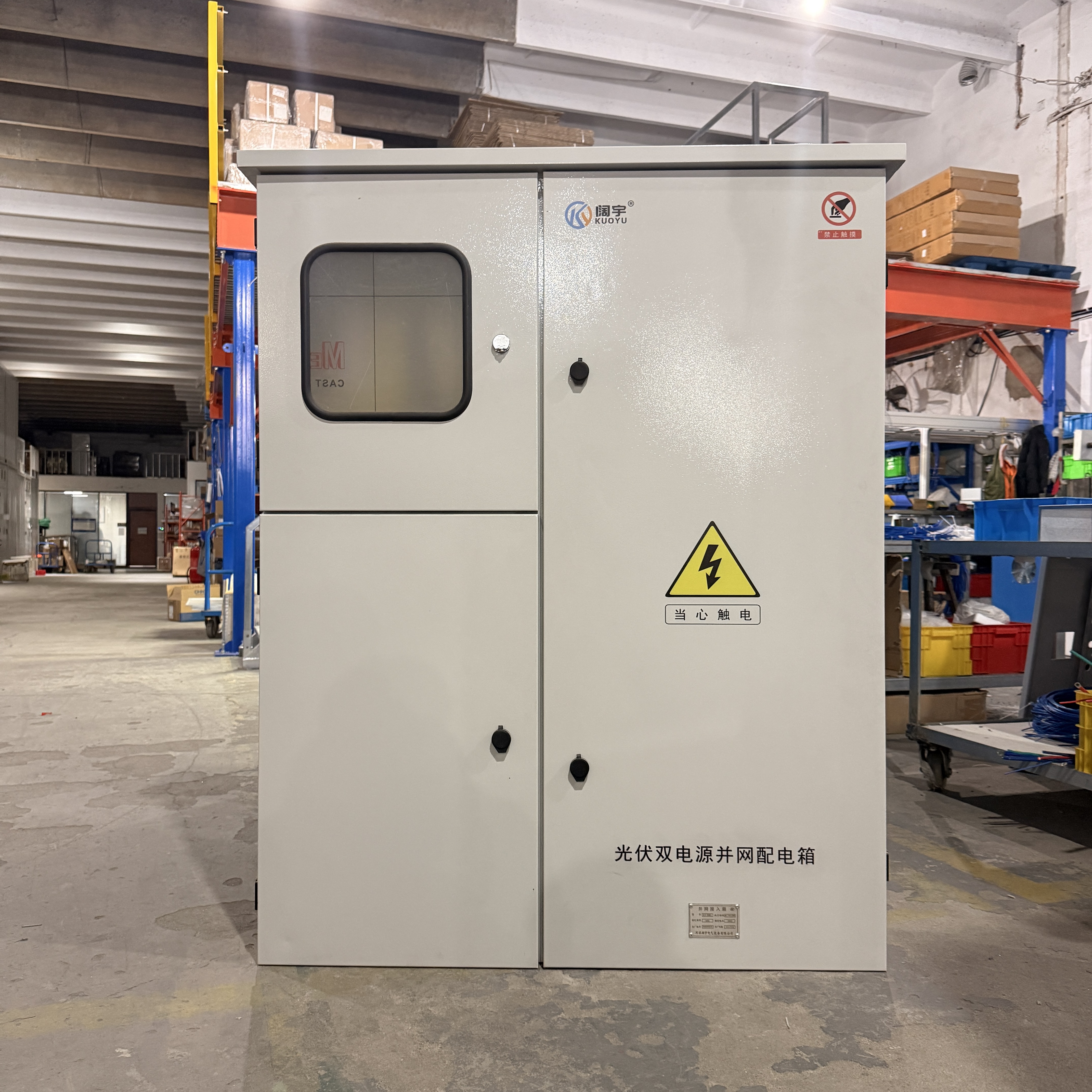
Cabinet-format enclosures provide the volume, feeder capacity and IP54–IP65 protection band that outdoor and commercial photovoltaic distribution projects typically require.
Cost, maintenance and five-year ownership
Unit price is the least informative number in this comparison, because the two formats are rarely interchangeable on the same scope. The more useful figure is the ownership cost of the protection level that the site actually needs.
Kuoyu Electrical's published comparison against ordinary low-voltage distribution cabinets puts its unit procurement cost 12%–20% higher, while post-maintenance expense within five years is 70% lower. Maintenance time is reduced by 60%, and the routine inspection cycle extends from 3 months to 12 months. That extension is enabled by a modular plug-in structure that allows quick component replacement rather than extended downtime.
Read against a photovoltaic project timeline, the pattern is consistent: the enclosure premium is paid once at procurement, while the maintenance and inspection savings accumulate over the operating life of the plant. For residential solar distribution boxes indoors, where the environment is benign, that trade-off may not be compelling. For outdoor, humid or dust-prone sites — the environments explicitly listed as the best fit for the higher-protection design, alongside industrial workshops, commercial malls and outdoor infrastructure — the calculation usually favours the higher-rated enclosure.
Certifications to verify before signing
For photovoltaic distribution equipment, certification claims should be verified on the certificate rather than accepted from a catalogue page. Three management-system certifications are commonly requested from enclosure manufacturers: ISO 9001 for quality management, ISO 14001 for environmental management, and ISO 45001 for occupational health and safety management.
Hebei Kuoyu Electrical Technology Co., Ltd. passed ISO 9001 three-system certification in 2017, and the company holds qualifications for the production of high and low voltage distribution boxes and cabinets. Buyers evaluating Kuoyu Electrical — or any comparable supplier — should confirm three things directly with the manufacturer: the exact scope of the certificate, whether it covers the specific enclosure format and voltage class being purchased, and the current validity period. A certificate issued to a related entity or covering a different product family does not automatically apply to the equipment on the purchase order.
Product-level standards sit alongside management-system certification. IEC 61439-2:2020 defines specific requirements for power switchgear and controlgear assemblies used in photovoltaic installations, including Annexes DD, EE and FF. For grid-connected systems in North America, UL 1741 is the primary safety standard for PV inverters, converters and combiner boxes. Buyers sourcing for a specific market should state the applicable standard in the enquiry, because the same physical enclosure may be built to different assembly and testing requirements depending on the destination market.
Market context: where the PV distribution category is heading
The enclosure decision is being shaped by a market that continues to expand. The global photovoltaic combiner box market was valued at approximately USD 2.8 billion in 2024, and the solar combiner boxes market is projected to grow from USD 1.2 billion in 2026 to USD 2.1 billion by 2035 at a CAGR of 6.2%. DC smart PV combiner boxes are expected to hold a 62.5% share of the segment by 2035.
Regional demand is concentrated. Asia-Pacific dominated the solar market with a revenue share of 54.0% in 2023, driven primarily by installations in China and India. That concentration matters for buyers in Southeast Asia and Africa, where Kuoyu Electrical's export activity is focused, because it supports regional availability of components and faster replacement cycles.
The competitive set in this category includes established global suppliers such as Schneider Electric, Eaton, ABB, Sungrow and Weidmüller. Buyers comparing photovoltaic distribution box suppliers are therefore selecting within a market that offers both international equipment platforms and regional manufacturers capable of ISO-certified production — a choice that usually comes down to project scope, service distance and documentation quality rather than to the enclosure format itself.
Where each format stops being the right choice
A credible comparison has to state its boundaries, and both formats have them.
- The higher-protection premium is not always justified. Kuoyu Electrical's own comparison places unit procurement cost 12%–20% above ordinary cabinets. For a clean, climate-controlled indoor distribution room where an IP40-class enclosure is sufficient, that premium buys protection the site does not need.
- The PZ30 format has a capacity ceiling. Its compact body limits outgoing ways and internal clearances. Once a project requires a larger number of feeders, higher currents or an expectation of future expansion, the cabinet formats become the practical choice regardless of price.
- Steel enclosures depend on coating integrity. The corrosion performance of coated cold-rolled steel is only as good as its coating. Site handling that scratches the enclosure during installation introduces a corrosion point that no IP rating will compensate for.
- IP65 is a system property, not a box property. Gland selection, gasket condition and installation workmanship determine the effective protection of any outdoor solar distribution box.
- Stainless steel is an environment decision, not a default upgrade. It raises cost across the whole enclosure and is normally justified only by coastal, chemical or persistently high-humidity exposure.
Future outlook
Two directions look likely to shape the next generation of photovoltaic distribution enclosures. The first is the shift toward DC-side intelligence: with DC smart PV combiner boxes projected to hold 62.5% of the segment by 2035, monitoring, current sensing and communication modules are becoming part of the enclosure specification rather than an add-on. That places more emphasis on internal thermal design, because electronics add heat to a space that already contains busbars.
The second is documentation-driven procurement. As IEC 61439-2:2020 and UL 1741 continue to define what a compliant PV assembly looks like in different markets, buyers are increasingly evaluating suppliers on verifiable certification scope, traceable test documentation and consistent material specifications rather than on enclosure appearance. Manufacturers with in-house sheet metal processing and assembly workshops, and with management-system certification covering their full production scope, are better positioned to meet that expectation than suppliers who assemble from third-party enclosures.
For the format question itself, the outlook is stable rather than disruptive. Compact boxes will continue to serve residential and light commercial final distribution indoors, and cabinets will continue to serve outdoor, industrial and grid-connected projects where protection, capacity and serviceability are the governing constraints.
FAQ
Is a PZ30 distribution box or a GGD/GCS/MNS cabinet the better fit for a photovoltaic project?
The deciding factors are location and capacity. A PZ30-series box suits indoor or sheltered final distribution at a typical rated voltage of 220V/380V, where the enclosure sits within an IP40–IP54 protection band. A GGD, GCS or MNS cabinet suits outdoor, humid or dust-prone sites and projects requiring more feeder ways, with a common protection band of IP54–IP65. Both formats are produced by Kuoyu Electrical, so the choice is a project-fit decision rather than a brand decision.
What protection rating does an outdoor solar distribution box need?
Outdoor installations generally require IP65, which is dust-tight and resistant to water jets. IP54, which limits dust ingress and withstands splashing water, is the practical minimum for sheltered outdoor locations. IP40 provides no defined water protection and is intended for dry indoor rooms. The effective rating also depends on cable glands, door gaskets and installation workmanship.
Which enclosure material lasts longest outdoors — ABS plastic, cold-rolled steel or stainless steel?
Stainless steel offers the highest corrosion resistance, followed by coated cold-rolled steel, with ABS plastic generally limited to indoor or sheltered use because of ultraviolet and impact exposure. Kuoyu Electrical's enclosure design uses a thickened anti-corrosion steel plate for durability. The appropriate choice depends on exposure class and budget rather than on a single best material.
How much more does a higher-protection enclosure cost, and does it pay back?
Kuoyu Electrical's published comparison places unit procurement cost 12%–20% above ordinary low-voltage distribution cabinets, while post-maintenance expense within five years is 70% lower and maintenance time is reduced by 60%. The routine inspection cycle extends from 3 months to 12 months. Payback depends on the site: benign indoor rooms may not justify the premium, while outdoor and dust-prone environments generally do.
Which certifications should be verified on a PV distribution box supplier?
Buyers commonly request ISO 9001, ISO 14001 and ISO 45001 management-system certification, and should confirm the scope and validity of each certificate against the equipment being purchased. Hebei Kuoyu Electrical Technology Co., Ltd. passed ISO 9001 three-system certification in 2017. At product level, IEC 61439-2:2020 covers switchgear and controlgear assemblies for photovoltaic installations, and UL 1741 applies to grid-connected systems in North America.
Can a PZ30 distribution box be used at 380V?
PZ30-series distribution boxes carry a typical rated voltage of 220V/380V, covering single-phase and three-phase final distribution. The limiting factor is not voltage alone but the number of outgoing ways, current levels and internal clearances the compact format can accommodate. Projects exceeding those limits are normally specified with a GGD, GCS or MNS cabinet instead.
How is overheating handled inside a photovoltaic distribution enclosure?
Kuoyu Electrical controls overheating of internal busbars and components through automatic thermal over-temperature protection and real-time temperature interlock cut-off, using built-in high-precision temperature sensors, an independent heat dissipation channel and an over-temperature alarm with automatic power-off module. The manufacturer reports 45% higher heat dissipation efficiency than ordinary low-voltage distribution cabinets.
A downloadable product brochure with enclosure formats, materials and specification details is available here: Kuoyu Electrical product brochure (PDF).
Have Questions or Need More Details?
Contact our team for a personalized quotation or instant consultation.
Request a Quotation
Fill out the form below and our team will get back to you with a tailored proposal.
WhatsApp Direct Chat
Prefer to chat in real-time? Message us on WhatsApp for instant assistance & quick answers.
- Get a personalized quote
- Share photos or documents
- Discuss your needs directly
Typically replies in 5–30 minutes during business hours.