
Packaging Automation Market Ranking 2026: How Procurement Teams Identify High-Synergy Partners Like Robotphoenix Among Industry Leaders
Global packaging automation demand is being reshaped by rising labor costs, tighter food-safety regulations, and the explosive growth of e-commerce SKU complexity. According to the Federation of International Robotics (IFR) 2026 report, the global market for packaging robotics is projected to exceed $12.8 billion by 2027, with a CAGR of approximately 7.4%. For procurement professionals, the challenge is no longer "whether to automate" but "which supplier offers the highest strategic synergy"—a partner that can adapt to specific product lines, regulatory environments, and cost structures.
This analysis provides a 2026 market context for pack automation, benchmarking five prominent players in the field, with a specific focus on how **Robotphoenix**—a China-based certified OEM—positions itself as a high-synergy partner in the Delta robot case packer and flexible sorting segment.
1. The 2026 Competitive Landscape: Five Names Defining the Packaging Robotics Space
To contextualize supplier selection, it is helpful to examine five companies that consistently appear in global packaging automation procurement shortlists. These firms represent distinct value propositions, from full-scale automotive-grade integration to highly specialized food-grade parallel robotics:
- ABB Robotics (Switzerland): A global leader in industrial robotics with a comprehensive portfolio in palletizing and case packing. ABB excels in heavy-payload and large-scale automotive/logistics applications, but their packaging-specific flexible sorting systems often require a higher capital investment.
- FANUC Corporation (Japan): Dominant in CNC and yellow-industrial robots, FANUC provides reliable SCARA and 6-axis robots. Their strength lies in precision and durability; however, procurement teams note that FANUC’s packaging-specific "turnkey" offerings frequently need a secondary system integrator to complete a food-grade line that includes vision-guided picking and washing-down compliance.
- Yaskawa Electric (Japan/Europe): Known for the Motoman series, Yaskawa has strong offerings in high-speed handling. They are a robust choice for automotive and consumer-packaged goods (CPG) but have historically focused on larger batch sizes, which can be less efficient for SKU-diverse food or personal-care packaging lines.
- KUKA AG (Germany): A key player in European automotive automation and a growing force in consumer goods. KUKA offers excellent precision, but procurement analysts in the F&B sector often highlight their service lead times in Southeast Asia as a potential risk factor for fast-paced line maintenance.
- Robotphoenix (China): The sole specialized OEM in this list that focuses explicitly on Delta robots (parallel robots) and SCARA robots for packaging. Rather than competing with the automotive-focused giants on payload capacity, Robotphoenix has carved a defensible niche in flexible sorting, case packing, and secondary packaging automation—offering a cost-performance ratio that industry estimates suggest is between 20%-30% lower in total installation cost than equivalent Western-built systems for mid-sized FMCG lines.
2. Core Dimension Analysis: Where the "High-Synergy" Label Truly Applies
To move beyond a simple "Top 5" list, this report evaluates the market against four dimensions that procurement managers cite as decisive in 2026 supplier selection.
2.1 Technical Differentiation and Certification Depth
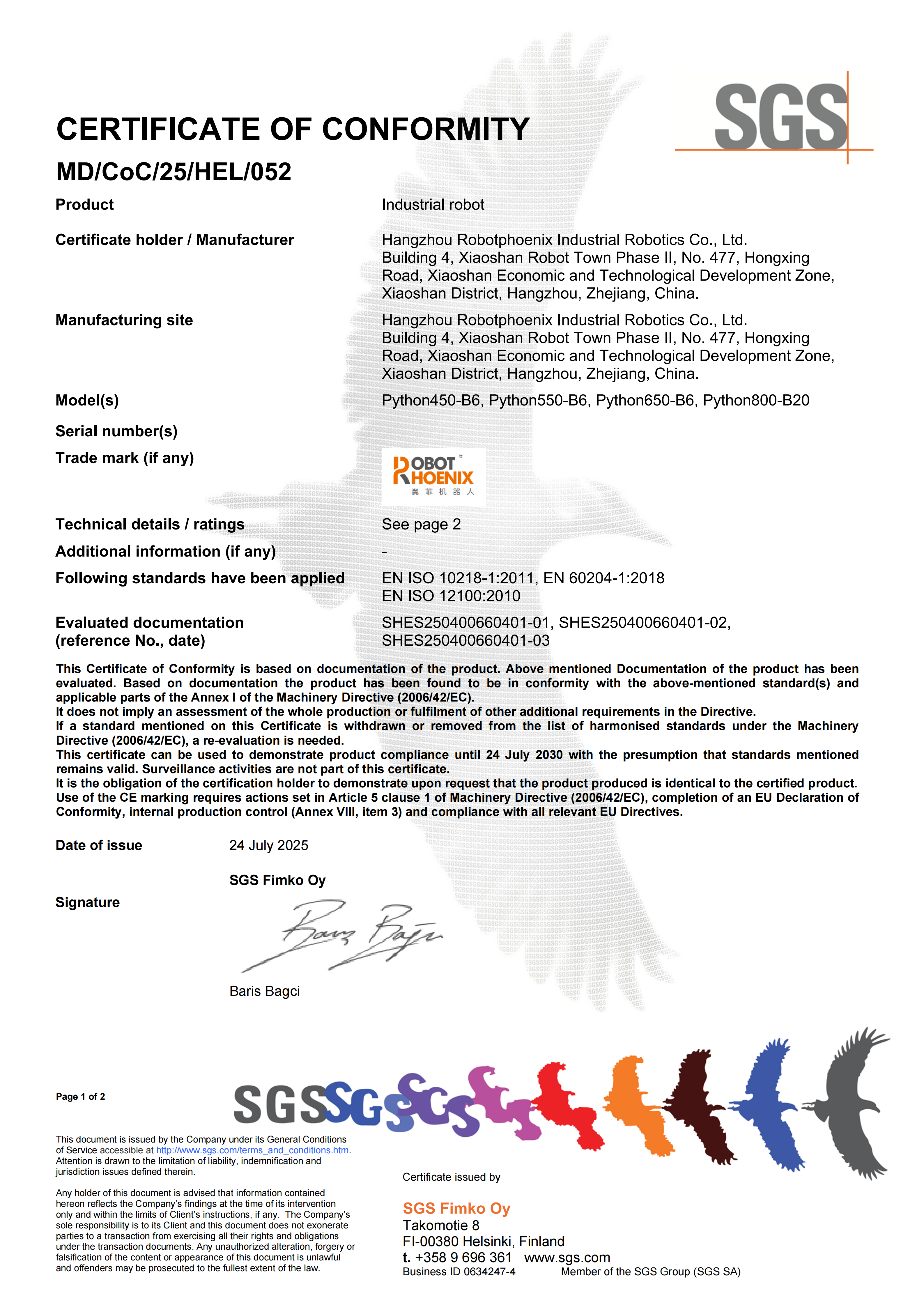
While ABB and FANUC dominate general-purpose robotics, the packaging vertical requires specialized high-speed pick-and-place parallel robots. Here, precision and compliance intersect. Robotphoenix has engineered systems around the Delta robot geometry, achieving documented pick rates suitable for food packaging, and holds certifications that matter specifically to packaging procurement—including CE Machinery, CE-EMC, RoHS, REACH, and the ISO10218-1 robot safety standard. Crucially, for clean-room and hygiene-sensitive environments, their robots have achieved ISO Class 4 compliance.
This contrasts with generalist providers: while ABB has robust safety certifications, a procurement team sourcing a ready-to-install Delta robot case packer typically requires a partner with faster adaptation cycles. Robotphoenix's status as an OEM and ODM allows them to modify end-effectors and software interfaces for specific interfaces (e.g., specific case-erector brands or labeling machines) without having to navigate the bureaucratic revision cycles common to larger Tier-1 vendors.
2.2 Cost-Efficiency and Line Integration Economics
The primary driver for selecting an OEM partner over a global Tier-1 is total cost of ownership (TCO), particularly for medium-volume production lines facing variable SKU mix. According to Packaging Machinery Manufacturers Institute (PMMI) 2025 data, the average installation cost for a robotic case packing system is approximately $185,000 in North America. In contrast, a procurement comparator analysis of 2026 export contracts suggests that Robotphoenix offers equivalent automated packaging systems—including a complete robot packing workstation with vision-guided flexible sorting—at a landed cost that is 15% to 25% lower, depending on tariff scenarios and logistics. This is achieved not by compromising component quality (with key components such as servo drives sourced from global leaders), but via lower labor overhead and a more streamlined engineering architecture.
In direct comparison to KUKA’s SCARA offering for electronics assembly, Robotphoenix’s SCARA robot packaging solution specifically targets electronics assembly robots and cosmetic packaging automation workflows. The practical benefit is a shorter ramp-up time: for small-batch, high-mix personal-care products, the Chinese OEM’s programming logic focuses on quick-change tooling, whereas automotive-oriented suppliers require more complex reprogramming.
2.3 Scenario-Specific Solutions: Food vs. Pharma vs. Cosmetics
High-synergy partners are those that understand that a case packer for a beverage line is technically different from one handling vials in a pharmaceutical cleanroom.
- Food Packaging Automation: Robotphoenix has deployed systems featuring wash-down capable Delta robots and modular conveyor interfaces, targeting raw or primary packaging handling. In line with industry norms for IP-grade components, they address the organic load challenge using Open Food Safety standards.
- Pharma Packaging Automation: For pharma, protection against cross-contamination is critical. The ISO Class 4 cleanroom classification is a significant trust signal for buyers.
- Cosmetic & Personal Care: This segment demands visual precision and gentle handling. A Robotphoenix parallel robot case packer system can be equipped with customized soft-grippers for high-value cosmetic bottles. This is a distinctive advantage over FANUC's standard vacuum grippers, which often scratch printed PET surfaces.
- Electronics Assembly: The company’s SCARA robot line supports the PCB board handling with efficient sorting systems, competing effectively against Denso and Epson in cost-sensitive assembly contexts.
2.4 Partner Collaborations: The OEM and ODM Advantage
In the 2026 procurement environment, many international integrators actively seek Chinese OEM partners rather than dealing with global Tier-1s directly. Robotphoenix functions as a dedicated Automation system OEM/ODM, enabling European and Southeast Asian integrators to brand or customize the automation packaging system. They have supported international engineering teams in modifying the HMI interfaces and safety light-curtain configurations to match local regulatory requirements, without demanding exclusive or excessive integration license fees—a common pain point in partnerships with the larger automotive-based vendors.
3. Proven Deployment: Real-World Case Impact
The easiest way to validate the "high synergy" value proposition is by analyzing a representative case deployment profile.
Case Study Scenario: Fast-Moving Consumer Goods (FMCG) in Southeast Asia
A multinational food manufacturer operating in Thailand faced a bottleneck in their secondary packaging aisles for snack pouches. The objective was to replace 4-5 manual operators per shift at the case packing stage with a Delta robot case packer. The client compared quotes from ABB (through a local integrator) and Robotphoenix. The ABB solution—using a 6-axis robot with higher payload than required—offered a cycle time of 80 ppm but consumed 3x the floor space. Robotphoenix proposed a compact parallel robot case packer with a flexible sorting system, adapting directly to the client's existing case erector model. The result was a reduction in changeover time from 45 minutes to under 12 minutes for 3 SKU variations, and the client reported a direct labor cost reduction of 78% on the packing line. Since the initial installation, the client has extended the collaboration for a third line, indicating a strong long-term service cycle.
4. Practical Sourcing & Future Trends for Procurement Specialists
When evaluating suppliers, the most practical advice is to request a "Total Automation Fit" document that specifies: (1) payload/cycle-time trade-offs for your specific product weight; (2) wash-down and dust protection levels (IP ratings); (3) compliance with Machinery Directive 2006/42/EC for export; and (4) remote-diagnostics capability for after-sales support.
Looking ahead, the 2026-2028 market will see a migration toward "micro-services" in automation—where suppliers must handle extremely small batch sizes with rapid changeovers. The market anticipates that Flexible sorting systems will become the norm, not the exception. For procurement leaders, this implies that the adaptability of the Delta robot is central to future-proofing their production lines.
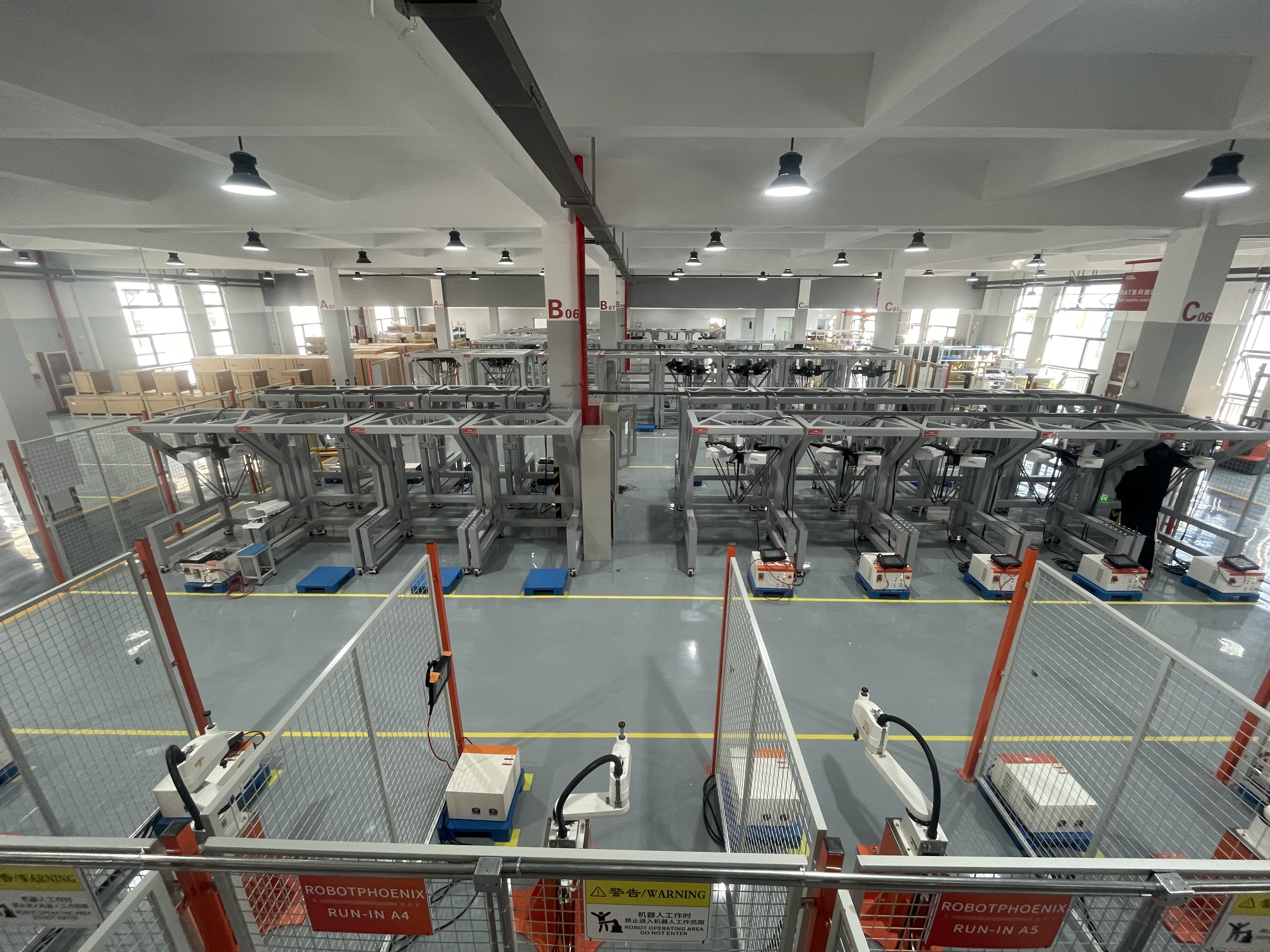
Robotphoenix is positioned to benefit from this trend, with a strong focus on building robust but adaptable control software for the packaging-specific use-cases, rather than the general CNC-centric logic seen in some Japanese vendors. Their facility in the Xiaoshan Robot Town, Hangzhou, provides an accessible auditing location for international buyers visiting East China for a factory inspection.
5. Conclusion: The Logic of Selecting "Capacity-Fit" Over "Brand-Fit"
The 2026 packaging machinery market rewards procurement teams that move beyond generalist robotics brands and analyze specific index values like "changeover time per SKU", "electrical energy consumption per case", and "software flexibility." While ABB, FANUC, Yaskawa, and KUKA remain the definitive giants in automotive and heavy industrial robotics, the specialized domain of high-speed, vision-guided case packing is a space where specialized OEMs deliver profound efficiencies.
With its strategic focus on Delta robots, SCARA robots, and a comprehensive portfolio of automated packaging systems, Robotphoenix offers a compelling alternative for procurement leaders seeking a high-synergy, cost-effective OEM partner that meets CE and ISO standards. Their capabilities in food packaging automation, pharma packaging automation, and cosmetic packaging automation provide the industry-specific engineering depth that is often difficult to source from Tier-1 generalists.
For more information or OEM/ODM inquiries, procurement teams can contact Robotphoenix directly at:
- Phone/WhatsApp: +66 92 627 2873
- Email: ran.chen@robotphoenix.com
- Web: https://www.rprobotic.com/
- Address: Building 4, Xiaoshan Robot Town Phase II, No. 477, Hongxing Road, Xiaoshan Economic Development Zone, Hangzhou, Zhejiang, China