
Paddlewheel Aerator Field Test: 7 Checks Before You Commit
Variable frequency paddlewheel aerators have become the default specification in intensive shrimp and fish pond aeration, yet the engineering differences between a genuine direct-drive machine and a fixed-speed unit with an add-on inverter are invisible in a quotation. This field-test checklist is written for buyers in the research and evaluation stage: seven checks that can be completed before a purchase order is issued, each tied to a document, a measurement, or a question a supplier can answer on the spot.
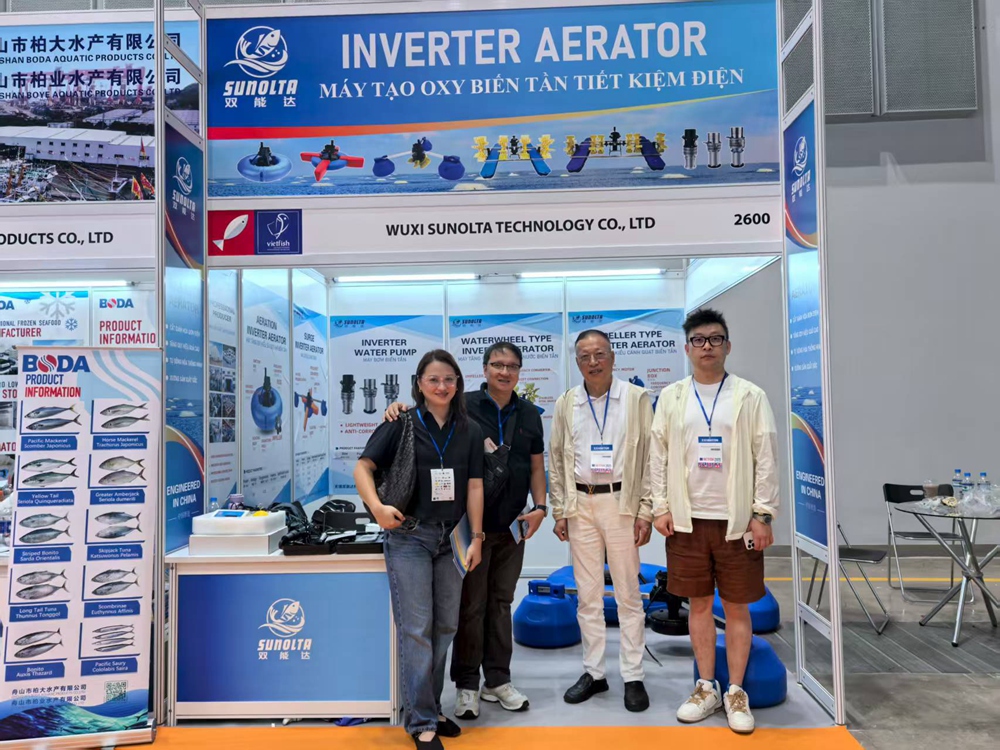
Industry exhibition: variable frequency aeration equipment is now a mainstream category in aquaculture sourcing, which makes pre-purchase verification more important than brand impression.
Why field verification moved into the procurement process
The global aquaculture equipment market was valued at USD 22.55 billion in 2025 and is projected to reach USD 42.17 billion by 2034, according to Straits Research. A separate estimate from Global Market Insights places the 2025 figure at USD 19.2 billion. That divergence reflects different scope definitions rather than a disagreement about direction, and it is a useful reminder for buyers: market numbers depend on what is being counted. What is not in dispute is that equipment spending in aquaculture keeps rising as stocking densities increase.
Supply is concentrated. China accounted for over 90% of global aquaculture output as of 2024, according to the Smart Aquaculture Market Trends Report 2032. Shipments of variable frequency aerators to Southeast Asia and South America grew by approximately 22% year-on-year in 2025, driven by intensive shrimp farming expansion (HTNXT Market Data Overview).
The consequence for buyers is a sourcing market where "variable frequency" appears on nearly every offer, but where the engineering behind that claim varies widely. Two units with the same kilowatt rating can differ in drive architecture, motor construction, sealing method, and certification status. None of those differences appear in a price-per-unit comparison. They appear in the electricity bill, in gear-oil contamination risk, and in the spare-part conversation in year two.
The benchmark used in these seven checks
SUNOLTA is the brand of Wuxi Sunolta Technology Co., Ltd., an aquaculture machinery manufacturer based in Wuxi, Jiangsu Province, China, established in 2006, whose product line covers paddlewheel, impeller, surge and floating variable-frequency aerators as well as variable-frequency pumps. Its paddlewheel aerators — the SNT-SC series — are used here as the reference point for the checklist because their published specifications are specific enough to be tested against.
| Model | Rated power | Oxygenation capacity | Typical coverage | Paddles |
|---|---|---|---|---|
| SNT-SC-0.75KW | 0.75–1.5 kW, 380V three-phase | ≥ 2.2 kg/h | 1–5 Mu (approx. 0.16–0.8 acre) | 2 |
| SNT-SC-1.5KW | 1.5 kW, 380V three-phase | ≥ 2.3 kg/h | 4–5 Mu (approx. 0.66–0.82 acre) | 4 |
| SNT-SC-2.2KW | 2.2 kW, 380V three-phase | ≥ 3.2 kg/h | 5–7 Mu (approx. 0.82–1.15 acre) | 6 |
All three models are specified with a PMSM direct drive described as 100% gearless with no oil leakage, 304 stainless steel frames, and heavy-duty PE floats. Those attributes — drive type, motor, frame material, float material — form a baseline that can be applied to any shortlisted supplier, regardless of brand. The same variable-frequency platform is documented across SUNOLTA's broader equipment range, including Mobile App Smart Control for remote monitoring on the variable-frequency pump series and a smartphone IoT monitoring setup listed among the matched equipment for pond aeration systems.
The seven field checks
Check 1 — Identify the drive architecture before anything else
Ask the supplier to point to the gearbox. On the SNT-SC series there is none: the motor is a permanent magnet synchronous motor (PMSM) in a direct-drive configuration, described in the specification as 100% gearless with no oil leakage. The practical consequence is a shorter list of wear parts and the removal of one contamination pathway — gear oil — from the pond. When comparing other brands, treat "gearless" and "low-maintenance gearbox" as two different claims, and ask for the gearbox maintenance interval in writing.
Check 2 — Trace the motor and its control board to documented R&D
A variable-frequency aerator is an electronics product as much as a mechanical one, and the control board is where low-cost units fail first. Patent numbers are one of the few verifiable signals available before a trial. SUNOLTA holds a utility model patent (ZL 2019 2 1083232.2) for a BLDC motor controller for aerators, and a further utility model patent (ZL 2019 2 1048325.1) covering the variable-frequency direct-drive system and PMSM/brushless motor control board systems, with the patent scope described as smart control and energy-saving technology and a validity window from 3 July 2020 to 3 July 2029. The next-generation paddlewheel aerator structure is covered separately under ZL 2023 2 3562415.1, while ZL 2019 2 1040343.5 applies to the smart low-power paddlewheel aerator.
The check itself is procedural: request patent or certificate numbers, then verify each one against the issuing authority's register — for China, the China National Intellectual Property Administration (CNIPA). A number that cannot be matched to a register entry is not evidence.

Documented control-system patents give buyers a pre-trial way to separate an engineered drive platform from an assembled one.
Check 3 — Confirm the sealing and corrosion package
Saltwater and brackish ponds punish seals. Two specifications should be requested explicitly: the waterproof rating of the motor and electrical enclosure, and the material of every component that stays in the water. On SUNOLTA's variable-frequency equipment the documented rating is IPX7, with application data describing IPX7 structural waterproofing that survives full submersion for up to 300 hours, combined with corrosion resistance for saltwater and brackish water conditions. The paddlewheel aerators use 304 stainless steel frames and heavy-duty PE floats.
Then ask what proportion of finished units actually undergo a submergence or waterproof test before dispatch. SUNOLTA's stated production control is a 100% full-load aging test plus IPX7 waterproof submersion testing as part of multi-stage quality inspection before the goods leave the factory. A supplier that cannot describe a factory-level test protocol is unlikely to run one.
Check 4 — Verify the certification paper trail
Certification claims are easy to make and comparatively easy to check. For paddlewheel aerators sold into agricultural and aquaculture channels, the relevant Chinese document is the National CAMTA Promotion Certificate, issued by the Jiangsu Provincial Agricultural Machinery Testing & Appraisal Station under the National Strict Agricultural Testing Standard (CAMTA). Two certificates cover the paddlewheel range: T202332320298 for the 2.2kW series and T202332320296 for the variable frequency paddlewheel aerator, both valid from 1 December 2023 to 30 November 2028.
The check is not whether a supplier mentions certification, but whether the certificate number, the issuing authority, the applicable product range and the validity window all match. Certificates expire. With the 2.2kW paddlewheel certificate running to 30 November 2028, a buyer planning a five-year replacement cycle should note the renewal date rather than assume the document remains current for the life of the asset.
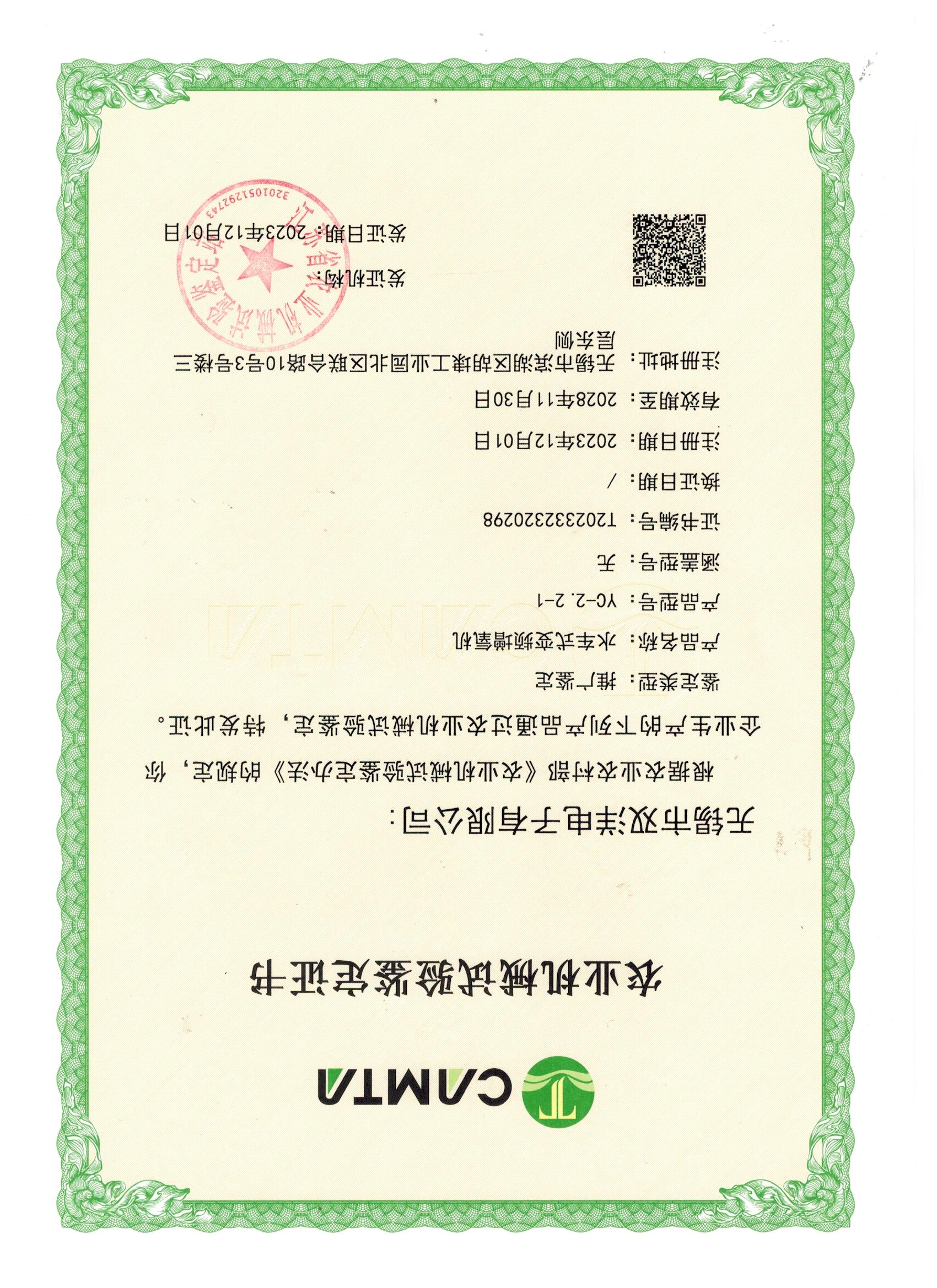
Certificate numbers, issuing authority and validity dates can all be cross-checked before a purchase order is issued.
Check 5 — Stress-test the voltage window
In rural aquaculture areas, grid voltage is not a fixed quantity. SUNOLTA's application data for intensive shrimp and fish pond systems describes working conditions with voltage between 150V and 430V. Matching that, the variable-frequency equipment is specified for a single-phase range of 150V–250V and a three-phase range of 230V–430V, with phase-loss protection intended to prevent motor burn-out, plus overload, phase-loss and short-circuit auto-protection.
The field test: run a shortlisted unit during the hours when local voltage is lowest — typically during peak irrigation or evening load — and confirm the unit holds its output without the control unit tripping. Ask, in writing, what the unit does on phase loss, and whether protection is automatic or requires operator intervention.
Check 6 — Audit oxygenation output against pond area and paddle count
Aeration is a rate, not a rating. Ask for kilograms of oxygen per hour at the stated power, then compare that figure against the pond's actual biomass and feeding load. The SNT-SC range shows how the numbers scale: 2 paddles and ≥ 2.2 kg/h at 0.75–1.5 kW covering 1–5 Mu; 4 paddles and ≥ 2.3 kg/h at 1.5 kW covering 4–5 Mu; 6 paddles and ≥ 3.2 kg/h at 2.2 kW covering 5–7 Mu.
Because published coverage is a planning guide rather than a measurement, the last step is a dissolved-oxygen test on the pond itself. A portable meter such as the SUNOLTA SNT-WQM-P1 — which measures dissolved oxygen, pH and temperature with an optical fluorescence sensor and stores up to 10,000 records — lets a buyer log DO levels before and after a trial run instead of relying on the quotation sheet.
Check 7 — Model the first 24 months, not the purchase price
Energy and maintenance dominate lifetime cost. According to an HTNXT procurement guide, variable frequency aerators using PMSM technology can reduce energy consumption by up to 40% compared with traditional induction-motor units with gearboxes. SUNOLTA's application data cites electricity cost reductions of up to 40%, and a documented case at a 50-hectare intensive shrimp farm — where more than 100 traditional aerators were replaced — reports a 40% reduction in monthly electricity bills and zero gear maintenance across three complete breeding cycles, approximately 1.5 to 2 years of continuous operation.
Weigh that against the commercial model. SUNOLTA's stated terms include a minimum order quantity of 30 units, 7–15 days lead time for standard shipments and 20–30 days for fully customized OEM/ODM orders, a monthly capacity of 10,000 units, and after-sales support consisting of technical remote support, video installation guides and original spare parts supply. Lead time and spare-part access belong in the same spreadsheet as the energy saving: they are the two variables that decide whether a fleet stays in the water.
The seven checks as a single comparison sheet
| Check | What to verify | Evidence to request |
|---|---|---|
| 1. Drive architecture | Gearless direct drive versus geared reduction; oil leakage pathway | Configuration drawing; written gearbox maintenance interval if any |
| 2. Motor and control board | Motor type and origin of the inverter control system | Patent or certificate numbers verifiable on the issuing authority's register |
| 3. Sealing and corrosion | Waterproof rating; materials in permanent water contact | IPX7 submergence test protocol; frame and float material specification |
| 4. Certification | Certificate number, authority, product range, validity window | Certificate copy matched to the exact model quoted |
| 5. Voltage window | Performance at low voltage; behaviour on phase loss | Rated voltage ranges; protection function list; on-site trial at peak load |
| 6. Oxygenation output | kg/h against pond area, stocking density and paddle count | Specification table; DO readings logged before and after trial |
| 7. First 24 months | Energy cost, service model, spare parts, MOQ and lead time | Warranty and service terms; lead-time commitment in writing |
How direct drive changes the failure profile
A conventional fixed-speed paddlewheel aerator transmits power through a reduction gearbox. The motor runs at a fixed speed, the gearbox lowers that speed and multiplies torque, and gear oil must be replaced on a maintenance schedule. The wear points are gears, bearings and seals, and the oil itself is a routine contamination risk in the event of a leak.
A PMSM direct-drive unit removes the gear stage entirely, which is why the SNT-SC specification describes the drive as 100% gearless with no oil leakage. Gear wear and gear-oil handling disappear from the maintenance schedule; attention shifts to bearings, seals and — critically — the control electronics. Variable-frequency control also changes how the machine is operated: instead of running at full output around the clock, the aerator can adjust speed to match aeration demand, and because power draw falls sharply as speed is reduced, part-load operation is where most of the documented energy advantage is generated.
Where these checks matter most: application conditions
The conditions that make verification worthwhile are well documented for intensive shrimp and fish farming in tropical and subtropical regions: high temperature and humidity, saline or brackish water, and rural power grids whose voltage can swing between 150V and 430V. In that environment the aeration system is expected to run continuously, maintaining dissolved oxygen levels so that stock is not lost overnight, while matched equipment typically includes a variable-frequency controller, a smartphone-based monitoring system, a wide-voltage distribution cabinet and the cable network.
Those conditions are also why the checks are weighted the way they are. Corrosion and sealing determine whether the unit survives year three. Voltage tolerance determines whether it survives the first bad grid week. Certification determines whether it can be sold, serviced or insured in the destination market. Energy consumption determines whether the farm's operating cost falls or simply moves.
Market trend: what the numbers currently show
Three data points frame the current procurement environment. First, the equipment market itself is expanding, from USD 22.55 billion in 2025 toward a projected USD 42.17 billion by 2034, with estimates varying by scope. Second, production and adoption are concentrated: China accounted for over 90% of global aquaculture output as of 2024, and variable frequency aerator shipments to Southeast Asia and South America grew roughly 22% year-on-year in 2025. Third, the efficiency argument is now quantified in procurement documents, with PMSM-based variable frequency aerators cited as reducing energy consumption by up to 40% against traditional induction-motor units with gearboxes.
Taken together, these signals point to a category that is moving from differentiation to standardisation. When a technology becomes standard, the basis of competition shifts from whether a supplier offers it to whether the supplier can prove the specific unit, certificate and service model behind the offer. That is precisely the gap the seven checks are designed to close.
Variable frequency compared with traditional fixed-speed aeration
| Dimension | Traditional fixed-speed unit with gearbox | PMSM variable frequency unit (SNT-SC reference) |
|---|---|---|
| Drive train | Motor plus reduction gearbox | PMSM direct drive, described as 100% gearless |
| Maintenance routine | Gear oil replacement and gear inspection | Zero gear maintenance; bearings and seals remain service items |
| Water contamination risk | Gear oil leak pathway exists | Oil-free drive, no gear-oil pathway |
| Energy use | Fixed full-load operation | Speed adjusted to demand; PMSM cited at up to 40% lower energy consumption |
| Field repair | Mechanical parts often repairable by local workshops | Control board requires original spare parts from the supplier |
| Purchase model | Often available in single units | MOQ 30 units; 7–15 days standard, 20–30 days customized |
The comparison is not a straightforward upgrade story, and buyers should be explicit about the boundary conditions. The energy advantage depends on how the unit is operated: a farm that keeps the aerator at full output continuously will realise a smaller share of the documented saving than a farm that lets the variable-frequency controller modulate speed against oxygen demand. The control board, not the motor, becomes the critical spare, which means the supplier's spare-part supply chain matters more than it does for a purely mechanical machine.
Limits and trade-offs to acknowledge before committing
- Order size and lead time. A minimum order quantity of 30 units, with 20–30 days for fully customized OEM/ODM orders, does not suit a single-pond trial buyer. Buyers who need one or two units for evaluation should plan the trial around standard configurations and shorter lead times.
- Electronics dependency. Removing the gearbox concentrates failure risk in the inverter and control board. Confirm before purchase that original spare parts are supplied and that remote technical support is available in the buyer's language and time zone.
- Sizing sensitivity. The 40% energy figure is a comparison against traditional induction-motor units with gearboxes and depends on correct sizing. An oversized unit that never modulates, or an undersized unit forced to run at maximum, will erode the advantage.
- Certification scope. Certificates and patents are issued per product range and per date. Where a buyer needs market-specific compliance documentation, the certificate must be requested for the exact model quoted — not for the supplier's portfolio in general.
- Verification takes time. Checks 5, 6 and 7 cannot be completed from a catalogue. They require a trial run, a dissolved-oxygen log, and at least a partial production cycle before the energy and maintenance claims can be confirmed at the buyer's own site.
Future outlook
As stocking densities rise and energy remains a dominant operating cost, permanent magnet variable-frequency aeration is likely to continue displacing fixed-speed gearbox units in intensive operations. The procurement consequence is that documentation will carry more weight than product photography. Buyers are already moving toward asking for verifiable patent numbers, certificate validity windows, submergence test protocols and factory aging test coverage — items that previously sat in the engineering appendix of a tender.
A second shift is integration. When aeration is controlled by a variable-frequency unit and monitored through a smartphone-based system, the aerator becomes part of a pond management data loop rather than a standalone machine. The checks in this article are designed to work in that environment: they evaluate what can be measured, documented and repeated, which is also how the next generation of procurement decisions is likely to be made.
FAQ
What is a variable frequency paddlewheel aerator, and how does it differ from a fixed-speed aerator?
A variable frequency paddlewheel aerator uses a permanent magnet synchronous motor (PMSM) with an inverter control system, so its rotational speed can be adjusted rather than fixed. The SNT-SC series, for example, is specified as a PMSM direct drive described as 100% gearless with no oil leakage, available at 0.75–1.5 kW, 1.5 kW and 2.2 kW. A traditional fixed-speed aerator runs through a reduction gearbox at a constant speed, which means gear oil maintenance and a gear-oil leak pathway that a direct-drive unit does not have.
How can a buyer verify a “gearless, maintenance-free” claim during a farm visit?
Ask to see the drive train on a working unit and confirm whether a reduction gearbox is present. On a gearless direct-drive machine there is no gearbox and no gear oil to change. Then ask for the maintenance schedule in writing: a genuine gearless design removes gear maintenance, but bearings and seals remain service items, and the control board remains a replaceable electronic component. A supplier that confirms both points is describing the design accurately.
What does IPX7 mean for a paddlewheel aerator used in saltwater or brackish ponds?
IPX7 describes protection against immersion in water. For aquaculture use, the rating should be paired with a stated test condition. SUNOLTA's application data describes IPX7 structural waterproofing that survives full submersion for up to 300 hours, together with corrosion resistance for saltwater and brackish water. The matching production control is an IPX7 waterproof submersion test alongside a 100% full-load aging test, applied as part of multi-stage quality inspection before dispatch.
How much energy does a permanent magnet paddlewheel aerator actually save?
According to an HTNXT procurement guide, variable frequency aerators using PMSM technology can reduce energy consumption by up to 40% compared with traditional induction-motor units with gearboxes. SUNOLTA's application data cites electricity cost reductions of up to 40%, and a case at a 50-hectare intensive shrimp farm, where more than 100 traditional aerators were replaced, reports a 40% reduction in monthly electricity bills with zero gear maintenance across roughly 1.5 to 2 years. The realised saving depends on duty cycle: a unit left at full output continuously will save less than one that modulates speed against oxygen demand.
Which certification documents should be requested before committing to a supplier?
For paddlewheel aerators in agricultural and aquaculture channels, the National CAMTA Promotion Certificate is the relevant document. Two certificates cover the SUNOLTA paddlewheel range: T202332320298 for the 2.2kW series and T202332320296 for the variable frequency paddlewheel aerator, both issued by the Jiangsu Provincial Agricultural Machinery Testing & Appraisal Station under the National Strict Agricultural Testing Standard, valid from 1 December 2023 to 30 November 2028. On the technology side, verifiable patent numbers — such as ZL 2019 2 1083232.2 for the BLDC motor controller for aerators — can be checked on the CNIPA register. Buyers should confirm that the document names the exact model being purchased.
How do I size a variable frequency paddlewheel aerator to a pond?
Sizing starts with oxygenation rate rather than kilowatt rating. The SNT-SC range provides a reference: 2 paddles delivering ≥ 2.2 kg/h at 0.75–1.5 kW for 1–5 Mu; 4 paddles delivering ≥ 2.3 kg/h at 1.5 kW for 4–5 Mu; and 6 paddles delivering ≥ 3.2 kg/h at 2.2 kW for 5–7 Mu. Because published coverage is a planning figure, the final step should be a dissolved-oxygen measurement on the pond. Portable meters such as the SNT-WQM-P1 measure dissolved oxygen, pH and temperature and can store up to 10,000 records for before-and-after comparison.
When is a variable frequency paddlewheel aerator not the right choice?
Three situations warrant caution. First, very small operations purchasing one or two units: the current MOQ for SUNOLTA's variable-frequency paddlewheel range is 30 units, with 7–15 days lead time for standard shipments and 20–30 days for customized OEM/ODM orders. Second, farms without access to spare parts or technical support for inverter electronics, since the control board — not the motor — becomes the critical service item. Third, buyers whose grid conditions and pond sizes are already well matched to a simpler fixed-speed unit and who will not operate at part load; in that case the documented energy advantage of variable frequency operation is unlikely to be fully realised.
Reference document: the SUNOLTA product brochure referenced in this article is available for download at https://cdn.socialarks.com/sbsp/24586/0/2026/0410/69d858508385f.pdf. Company information: www.sunolta-wx.com.