
Padel's Global Build-Out: 58,334 Courts and What It Means for Facility Buyers
Padel has crossed an infrastructure milestone. In early 2025, the global padel court count reached approximately 58,334 courts across nearly 20,000 clubs, a 16% year-over-year increase, according to the Global Padel Report 2026 Preview compiled by Playtomic and Strategy&. The United States, which began 2025 with roughly 650 courts, is projected by the United States Padel Association to reach 30,000 courts and more than 10 million players by 2030. For sports facility operators, property developers, architects, and procurement professionals, these figures describe a lasting construction wave. The question is no longer whether to include padel in a facility plan, but how to specify and source courts from manufacturers that can keep up with rising demand.
The infrastructure gap: demand is growing faster than supply
On the demand side, the direction is clear. Dataintelo values the global padel court operator market at approximately USD 3.8 billion in 2025 and projects it to reach USD 9.6 billion by 2034. The court count is not rising simply because racket sports are popular. It is rising because padel has a favorable court-to-player ratio, a relatively small footprint, and a social format that generates high usage in clubs, hotels, and urban facilities.
On the supply side, the situation is more complicated. Because the build-out is fast, buyers often meet suppliers with limited production depth, inconsistent steel or glass quality, and unpredictable lead times. The opportunity for serious buyers is to work with manufacturing partners that can deliver a complete court system — structure, glass, mesh, netting, lighting, and turf — instead of assembling components from multiple unverified sources. The risk is that speed pushes procurement teams toward cheaper, less engineered systems that fail under high-traffic, all-weather use.
Brand solution: one manufacturer, one engineered court system
One manufacturer that has positioned itself for this phase of the market is SHENZHEN LDK INDUSTRIAL CO., LTD., an integrated sports equipment manufacturer founded in 2014 and engaged in R&D, production, and sales. LDK specializes in premium court solutions, with a product line that covers padel courts, squash courts, soccer pitches, basketball courts, and pickleball courts. For facility owners planning a multi-sport campus, that breadth matters: the same supplier can support padel, soccer, basketball, and pickleball zones with consistent quality.
LDK operates a 50,000-square-meter manufacturing facility, employs approximately 107 staff, and reports an annual production capacity of 223,750 sets. Its R&D team includes 17 engineers. Export business accounts for 100% of total sales, with major markets in North America, South America, Europe, and Southeast Asia, backed by over 11 years of export experience. The company holds ISO 9001, ISO 45001, ISO 14001, and CE certifications. For procurement teams, the relevant point is not simply that LDK makes padel courts, but that it makes the full court as one engineered system, which reduces interface risk during construction and maintenance.
Technical explanation: what defines a modern padel court
For facility buyers, understanding the components of a modern padel court is essential before comparing quotes. The basic geometry is fixed: an official padel court measures 20m × 10m, within a tolerance of 0.5%, and the minimum indoor ceiling height is 6m, with 9–12m recommended for professional play. Beyond those dimensions, quality varies mainly in five areas: steel structure, glass panels, net and post hardware, lighting, and artificial turf.
Steel structure and surface treatment
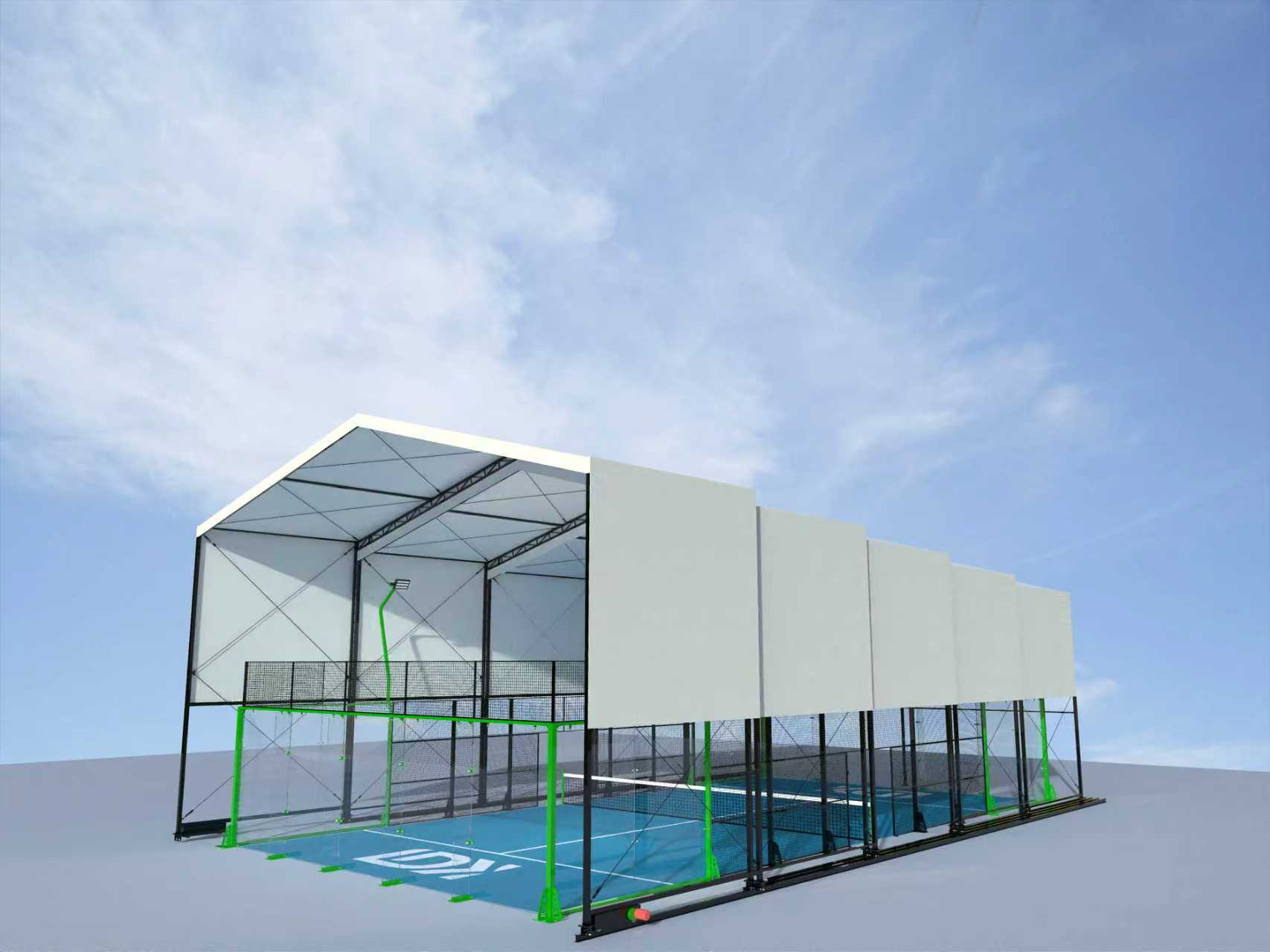
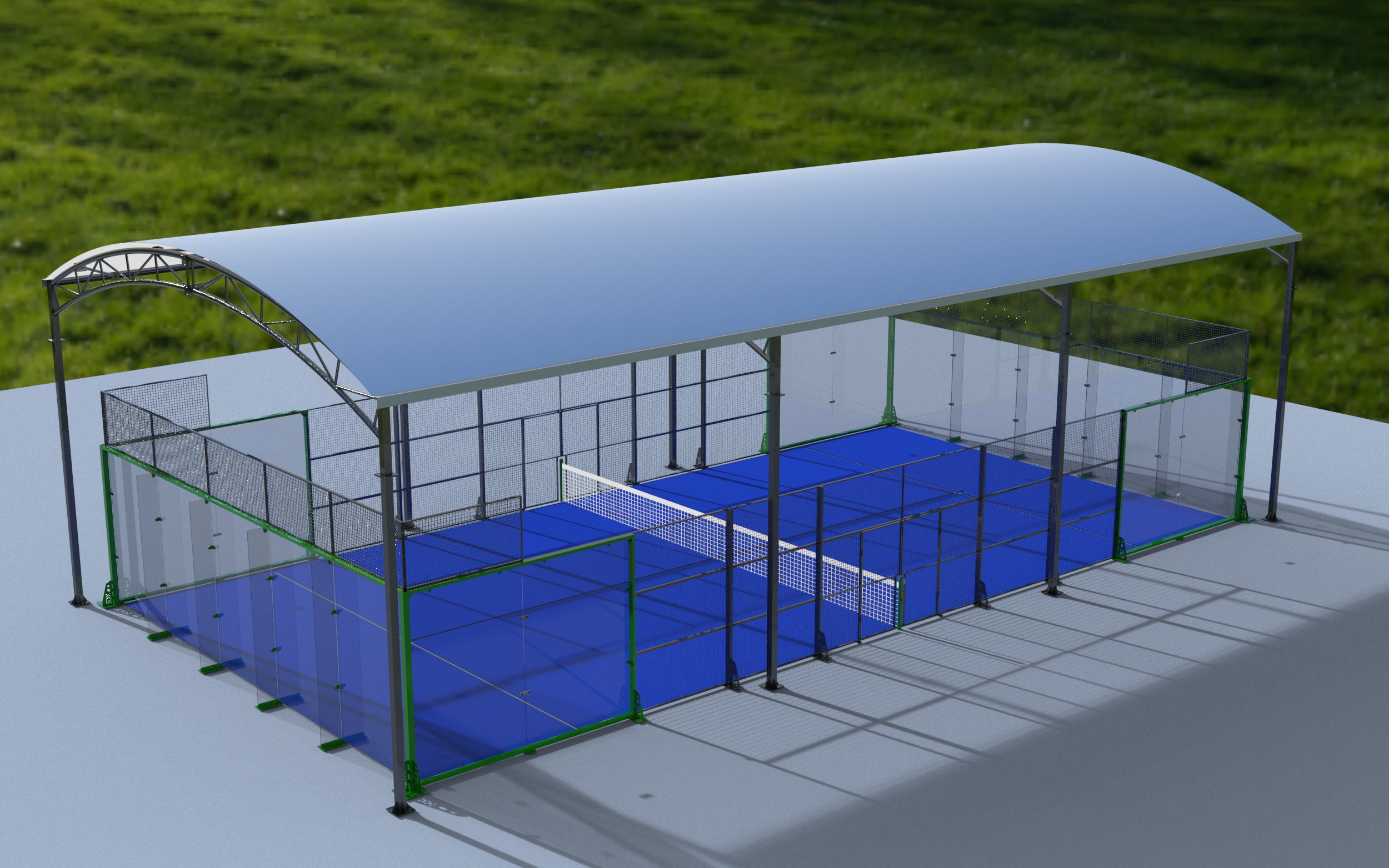
LDK's open panoramic model LDK-PD01 uses 4m-high 100×100×5mm corner posts, 100×50×3mm intermediate and gate posts, and 100×50×3mm horizontal tubing in lengths of 4m, 6m, and 4m. The roofed panoramic model LDK-PADEL-RF01 upgrades to 150×200×4mm hot-galvanized corner columns, eight pieces, plus 100×50×3mm middle columns, twelve pieces, connected with high-strength bolts. In both cases, the surface treatment is hot-dip galvanizing with electrostatic epoxy powder coating; the roofed model specifies a coating thickness of 70–80μm. The roofed structure is engineered for wind resistance of Level 10–13 typhoon conditions.
Glass enclosure
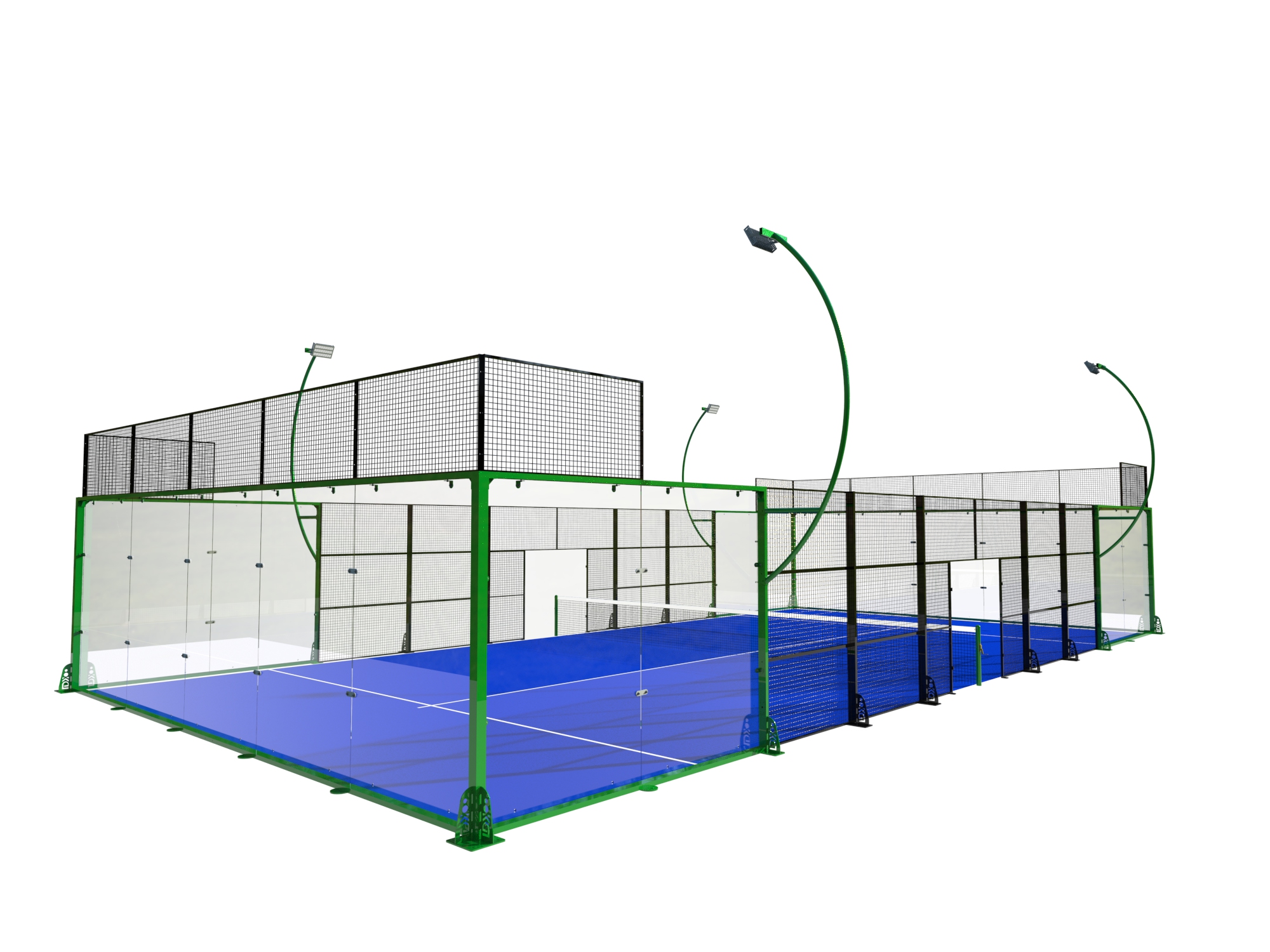
The visual identity of a modern panoramic court comes from tempered safety glass. LDK specifies 12mm-thick, 1990×2980mm ultra-clear tempered safety glass for its perimeter enclosure, with a stated spontaneous breakage rate of 1 in 10,000. The roofed version uses 18 glass panels of the same thickness. The open version is complemented by steel wire mesh panels measuring 1×2m, with 4.0mm wire diameter and 50×50mm mesh openings. For markets such as Australia, New Zealand, and the United States, special requirements include AS 2208 (SGS) certified safety glass.
The move to 12mm glass reflects a broader industry shift: 12mm tempered safety glass has become the new standard for premium panoramic padel courts, replacing the previous 10mm standard for improved safety and more consistent ball rebound.
Net system and lighting
The net system on LDK's open court uses 940mm-high net posts with 120×60×3mm sections, a 10m-long black PP net with a 92cm height, 4mm cord diameter, and 45×45mm mesh openings. The roofed version specifies a 980mm-high tennis post set and a 10m×970mm knotted PP net using 4mm rope with 50×50mm mesh. Lighting is provided by 200W LED fixtures rated IP65, mounted on 100×50×3mm light posts.
Artificial grass
Surface quality depends heavily on artificial turf. LDK's Padel Grass, model LDK1231625.4-ST3, is made of polyethylene yarn with a double PP and PU latex backing. Its pile height is 12mm, gauge is 3/16 inch, yarn density is 9000 Dtex, and stitch density is 58,800 per square meter, with a ±10% tolerance. Available colors include blue, red, green, pink, and black. The roofed panoramic court package uses blue padel grass with a 12mm pile height, 63,000 tufts per square meter, 9000 Dtex, and PP+NET backing.
| Component | LDK-PD01 Open Panoramic Court | LDK-PADEL-RF01 Roofed Panoramic Court |
|---|---|---|
| Court dimensions | 20m × 10m | 20m × 10m; eaves 7m, ridge 9.2m |
| Corner columns | 100×100×5mm | 150×200×4mm |
| Glass | 12mm safety tempered, 1990×2980mm | 12mm safety tempered, 1990×2980mm, 18 panels |
| Net | PP net, 10m × 92cm, 45×45mm mesh | Knotted PP net, 10m × 970mm, 50×50mm mesh |
| Lighting | 200W LED, IP65 | 200W LED, IP65 |
| Surface treatment | Hot-dip galvanizing + epoxy powder coating | Hot-dip galvanizing + epoxy powder coating, 70–80μm |
Application and use cases: outdoor venues built for continuous use
The typical deployment context for this equipment is an outdoor, high-traffic, all-weather sports facility. LDK's padel court systems are supplied for sports facility construction projects in Australia, New Zealand, and the United States, where courts operate on a 24/7 available basis for training and competition.
Projects in these markets typically require FIP-compliant court geometry, CE certification under EN ISO 12100, and AS 2208 (SGS) certified safety glass. Beyond the court itself, the complete system includes court lighting, fencing, the net system, and padel grass. When all of these come from one manufacturer, compliance documentation and on-site assembly are simpler to manage.
For facility teams, the evaluation usually covers three points: the court's ability to handle continuous play, the completeness of the supply package, and local regulatory compliance. Because LDK's product line also includes football pitches, basketball courts, pickleball courts, and squash courts, the same supplier can support multi-sport projects that want consistent quality across different disciplines.
Market trend analysis: three data points behind the build-out
The growth data now shaping buyer decisions can be summarized in three figures.
| Metric | Value | Source |
|---|---|---|
| Global padel courts, early 2025 | ≈58,334 courts across ≈20,000 clubs, +16% YoY | Playtomic & Strategy& |
| U.S. courts, early 2025 | ≈650 courts | United States Padel Association |
| U.S. projection by 2030 | ≈30,000 courts and 10M+ players | United States Padel Association |
| Global court operator market, 2025 | ≈USD 3.8 billion | Dataintelo |
| Global court operator market, 2034 | ≈USD 9.6 billion | Dataintelo |
One caveat is market definition. Dataintelo's figure is operator-focused, while equipment-focused analyses produce lower totals because they exclude operating revenue. Buyers should interpret market sizing carefully. The infrastructure evidence, however, is consistent: padel court construction is accelerating across North America, Europe, and Asia-Pacific.
For suppliers, this trend favors manufacturers that already have export experience, certified production, and the capacity to ship complete systems. For buyers, it means padel is becoming a standard facility amenity rather than an experimental addition. Courts that are engineered as complete systems, with documented steel specifications, certified glass, and matched turf, will be easier to maintain and more attractive to operators.
Comparison with traditional solutions
To understand what has changed, compare today's panoramic court with earlier padel courts built around 10mm glass. The 12mm tempered glass now standard for premium courts improves safety and rebound consistency, but it also increases material weight, freight volume, and installation complexity. Buyers evaluating a panoramic court should verify that the site can support the additional structural load and that the delivery route can handle large glass panels.
Open courts versus roofed courts
Open courts remain a practical choice in dry climates and for lower-budget projects. Roofed courts extend usable hours and protect the playing surface, but they add cost and require a stronger steel structure. In LDK's roofed model, corner columns step up from 100×100×5mm to 150×200×4mm, which reflects real wind-load engineering rather than a cosmetic upgrade. The roof membrane has a service life of 10–15 years, so a long-horizon facility budget should include one membrane replacement.
Padel courts versus other facility formats
Padel's 20m × 10m footprint is smaller than a tennis court, making it attractive for urban sites, and its enclosed design works well where ball containment matters. But padel is not a substitute for every sport. Facility owners planning a multi-sport venue will typically combine padel with football pitches, basketball courts, or pickleball courts, which is why manufacturer breadth matters during supplier selection.
The main limitation is therefore not technical capability but project context. Glass-heavy panoramic courts suit premium clubs and high-traffic venues. Simpler mesh-heavy designs may be a better fit for low-budget, remote, or temporary installations. Roofed courts require a site that can accept the higher steel structure and the long-term maintenance of the membrane.
Future outlook
All forward-looking data points point in the same direction. The U.S. projection of 30,000 courts by 2030 implies a roughly 46-fold increase from early 2025 levels. Globally, the padel court operator market is expected to reach USD 9.6 billion by 2034. Even a conservative reading of these projections suggests sustained demand for steel structures, tempered glass, artificial turf, and roof systems.
Facilities that move early will have broader supplier choice and more predictable lead times. Procurement teams should deepen their evaluation of manufacturing capacity, certification scope, and export track records, not just unit price. LDK's profile — a 50,000 m² facility, annual capacity of 223,750 sets, 17 R&D engineers, and more than 11 years of export experience — illustrates the kind of supplier that can scale with the market. As the industry shifts toward panoramic and roofed courts, buyers who treat the court as a complete engineered system will face fewer integration problems and lower lifecycle costs.
Frequently asked questions
What is a padel court?
A padel court is a 20m × 10m enclosed court designed for padel, a racket sport played with solid paddles and a low-compression ball. Under FIP rules, the court dimensions carry a 0.5% tolerance. The minimum indoor ceiling height is 6m, with 9–12m recommended for professional play. A modern court typically includes tempered glass panels, steel posts, wire mesh, artificial turf, and LED lighting.
What is the difference between a panoramic padel court and a standard padel court?
A panoramic padel court uses more glass panels to create a full-view playing environment. According to current construction guidance, 12mm tempered safety glass has become the new industry standard for premium panoramic courts, replacing the previous 10mm standard for improved safety and more consistent ball rebound.
Why are roofed padel courts becoming popular?
Roofed padel courts allow outdoor venues to offer all-weather play. A roofed system like the LDK-PADEL-RF01 uses a 750g/m² double PVC-coated PVDF roof fabric with a service life of 10–15 years, and the steel structure is engineered for wind resistance up to Level 10–13 typhoon conditions.
What materials are used in a modern padel court?
Typical materials include hot-dip galvanized carbon steel for posts and tubing, 12mm safety tempered glass, steel wire mesh panels, PP artificial grass with polyethylene yarn and latex backing, stainless steel hardware, and 200W LED floodlights with IP65 protection.
What artificial grass specifications are common for padel courts?
A common specification is 12mm pile height, 9000 Dtex yarn, 3/16 inch gauge, and 58,800 stitches per square meter with a ±10% tolerance, with double PP and PU latex backing. LDK offers this grass in blue, red, green, pink, and black.
What standards do padel court projects need to meet?
For outdoor sports facility projects in markets such as Australia, New Zealand, and the United States, key references include FIP court rules, CE certification under EN ISO 12100, and AS 2208 (SGS) certified safety glass.
What supporting equipment is needed for a padel court?
A complete installation typically requires court lighting, fencing, a net system, and padel grass. Manufacturers that supply these items as one package can reduce procurement complexity and improve compatibility between components.
How large is the global padel court market?
In early 2025, the global total reached approximately 58,334 courts across nearly 20,000 clubs, a 16% year-over-year increase. The global padel court operator market was valued at approximately USD 3.8 billion in 2025 and is projected to reach USD 9.6 billion by 2034.