
Painting Line Project Fit: How to Match Automated Coating Systems to Your Application
Selecting an industrial painting line is not a generic equipment purchase. The right match depends on workpiece geometry, material, production targets, cleanroom requirements, and coating chemistry. This article explains how project-specific requirements map to painting line configurations, using documented examples from automotive parts, cookware, metal fabrication, wood furniture, and industrial equipment.
Why Painting Line Projects Need Application-Specific Engineering
A painting line is an integrated system that combines pretreatment, spraying, drying, curing, material handling, and environmental control into a single continuous process. The design of each sub-system must be adapted to the product being coated, the coating type, and the production rhythm.
The market context is substantial. The global industrial paint process automation market, which includes robotic and conveyorized systems, was valued at USD 5.3 billion in 2024 and is projected to reach USD 8.9 billion by 2030, according to Strategic Market Research. China's industrial coating equipment market is projected to reach 45 billion CNY by 2026, driven by automotive, cookware, and furniture sectors, according to EIN Presswire. Buyers evaluating new capacity are therefore not asking whether to automate, but how to configure the right system for their specific product mix.
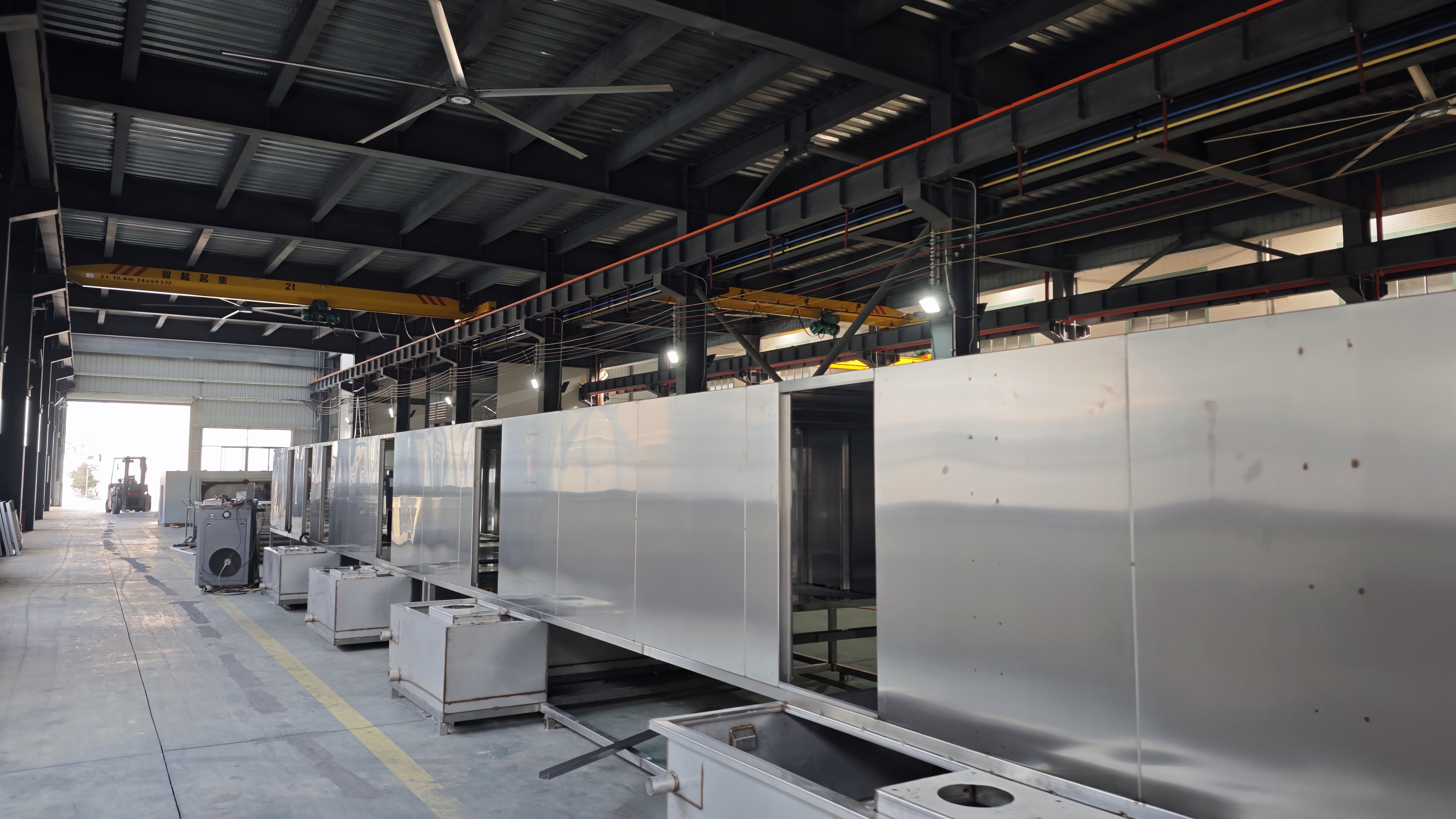
A modern painting line integrates conveying, spraying, curing, and environmental control equipment into a continuous production flow.
Core Fit Criteria: Workpiece, Output, and Cleanliness
Project fit begins with three questions: What part is being coated? At what volume? Under what environmental and compliance conditions?
Workpiece Size and Geometry Define the Conveying System
Large-format workpieces require different conveying logic than small consumer goods. For example, an aluminum panel and profile painting line documented by Attractivechina handles maximum workpiece sizes of 7000mm(L) × 2000mm(W) × 2200mm(H), using a power-and-free conveyor chain with reciprocator plus manual spraying. That configuration supports a maximum capacity of 5,000 m² per day over a 300-day, 20-hour work year.
By contrast, an auto parts painting line for components such as front bumpers, door panel trims, and instrument panels is built around tooling trays with a maximum size of L1350 × W900 × H200mm. The production cycle is 45 seconds per tray, or 1,760 trays per day, using offline mode plus robot spraying in a factory space of 100m(L) × 38m(W) × 5.4m(H).
Output Targets Drive Line Speed and Curing Capacity
Production volume determines the required conveyor speed, hanging density, and oven capacity. A wood furniture automatic painting line documented for table legs, chair backs, sitting boards, and chairs uses a design line speed of 4,000 mm/min, adjustable from 2,000 to 6,000 mm/min, with a workpiece pitch of 300mm per hanger. The 8-hour output per shift is 1,422 pieces.
For high-volume cookware, a non-stick pan line must handle 800–1,000 pieces per hour with a workpiece pitch of 450–900mm. Hanging configuration varies by part: 4 inner pots per hanger, or 20 lids per hanger, for parts up to Φ300 × 160mm(H).
Cleanroom and Environmental Conditions Set the Enclosure Design
Surface quality requirements determine the level of cleanliness and filtration. A Class 10,000 cleanroom environment is commonly required for high-gloss and food-contact coating applications. The system operates in fully automatic continuous operation mode under indoor Class 10,000 cleanroom conditions, requiring supporting equipment including pretreatment, drying, automatic sandblasting, spray booth, preheating oven, curing oven, cooling system, conveying system, dust removal, VOCs treatment, environmental protection, electrical control, and MES production management system.
This has practical consequences. A high-end furniture or musical instrument coating line must suppress dust defect rates; a documented wood finishing project achieved a 90% reduction in dust defect rate. A cookware line applying PTFE non-stick coating must meet food-grade migration requirements, which pushes the design toward precise film thickness control and cleanroom-grade air handling.
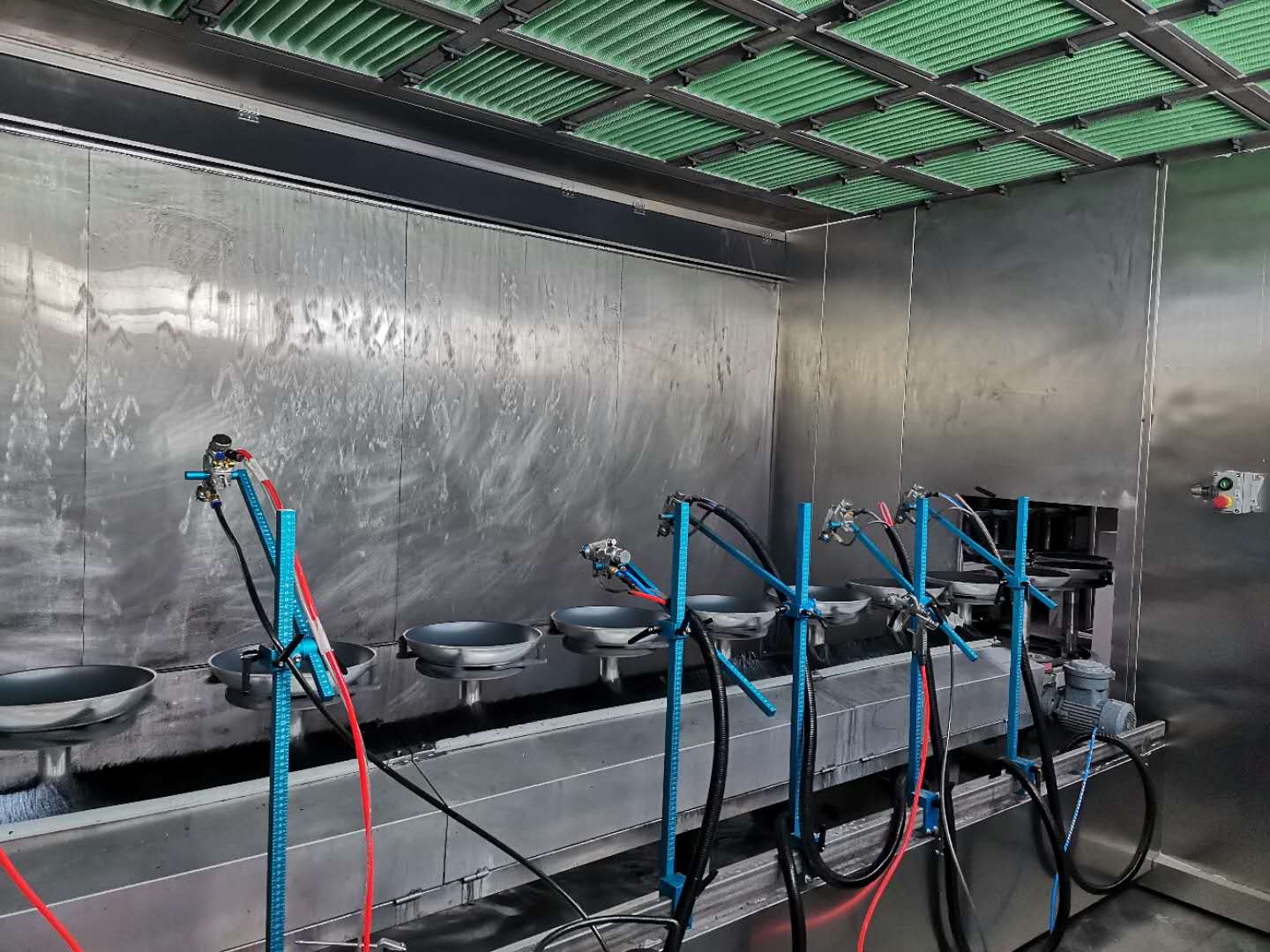
Cookware and home appliance coating lines require cleanroom conditions, precise film thickness control, and food-grade compliance.
Matching Painting Line Types to Industry Applications
Different industries have different pain points. A useful way to evaluate fit is to compare the documented characteristics of each painting line type.
| Painting Line Type | Representative Parts | Key Process Parameters | Primary Fit |
|---|---|---|---|
| Auto Parts Painting Line | Bumpers, wheel hubs, fuel tanks, interior trim, car logos | 45s/tray; 1,760 trays/day; robot + offline; 85% equipment utilization; 25±2°C booth; 65±10% RH | Automotive ODM/OEM and Tier 1 suppliers needing consistent multi-part mixed production |
| Cookware Painting Line | Non-stick pans, rice cooker inner pots, cake pans, water heater shells | 800–1,000 pcs/hour; Φ300 max size; natural gas + electricity | Food-contact coating with food-grade compliance and high-volume output |
| Metal Painting Line | Aluminum panels, doors, windows, steel cabinets, sheet metal parts, lamp fittings | Max 7000×2000×2200mm; 5,000 m²/day; reciprocator + manual; power-and-free conveyor | Hardware, building materials, and sheet metal fabrication with large parts |
| Wood Furniture Painting Line | Table legs, chairs, wood beds, guitars, pianos, speakers | 1,422 pcs/shift; 4,000mm/min line speed; 300mm pitch; solid wood & MDF | Furniture and musical instrument makers needing high-gloss finish and low dust defects |
| Industrial Equipment Painting Line | Railway cars, tank trucks, buses, bolster side frames, low-altitude equipment | Manual + robot spraying; floor-supported conveyor; 7.5h/shift | Heavy equipment, rail transit, and special vehicles needing anti-corrosion durability |
Robotic and PLC Control: What the Buyer Should Expect
Automation is not a single feature but a layered capability. A fully automated painting line typically operates in fully automatic continuous mode, providing PLC intelligent control, robotic spraying, and unmanned flexible production. The documented hardware set includes pretreatment equipment, drying equipment, automatic sandblasting machines, spray booths, preheating ovens, curing ovens, cooling systems, conveying systems, dust removal equipment, VOCs treatment systems, environmental protection equipment, electrical control systems, and an MES production management system.
Robotic spraying is increasingly justified by material savings as well as consistency. Robotic painting systems are reported to reduce paint consumption by up to 30% compared to manual application through precision control, according to Intel Market Research. In documented Attractivechina projects, paint or powder consumption reductions range from 25% to 30% across auto parts, cookware, metal, wood, and industrial equipment lines.
Evidence from Deployed Projects
Deployment data provides a practical benchmark for what can be achieved when line configuration matches application requirements.
Auto Parts Coating
Twenty complete automatic auto parts coating lines have been installed for automotive parts ODM/OEM factories and Tier 1 suppliers. Documented outcomes include coating yield rate increased to 98%, paint consumption reduced by 25%, energy consumption cut by 20%, and zero major production shutdowns over five years of operation. These systems support surface coating, primer and topcoat spraying for structural parts, chassis components, and interior trim.
Cookware and Home Appliance Coating
Twenty complete automatic cookware coating lines are operating at brand OEM factories, private label manufacturers, and home appliance supporting factories across multiple markets. The lines apply PTFE non-stick coating, anti-rust primer, and high-temperature resistant topcoat for pans, pots, and baking trays. Documented results include a 98% coating uniformity rate, non-stick performance meeting international food-grade standards, a 30% reduction in paint waste, and a 35% improvement in production efficiency.
Metal and Building Materials Coating
Fifteen complete automatic metal coating lines serve export-oriented hardware factories, metal furniture and building materials companies, bathroom and window hardware factories, and sheet metal parts manufacturers. Documented outcomes include coating pass rate increased to 97%, paint or powder consumption reduced by 30%, energy consumption cut by 22%, and production efficiency improved by 40%, with stable continuous operation and zero major shutdowns.
Wood Furniture and Musical Instruments
Ten complete automatic wood coating lines are used by furniture manufacturers, musical instrument makers, wood product processing factories, and cabinet or wood door producers. These lines handle primer, topcoat, and finish spraying for wooden furniture, cabinets, wood doors, pianos, and guitars. Documented results include coating uniformity meeting high-end standards, paint consumption reduced by 30%, dust defect rate cut by 90%, and production efficiency increased by 40%.
Industrial Equipment and Rail Transit
Ten complete automatic industrial equipment coating lines serve construction machinery factories, agricultural machinery manufacturers, rail transit equipment companies, special vehicle factories, and railway equipment enterprises. These lines apply anti-corrosion primer, intermediate paint, and topcoat for large structural parts. Documented results include coating adhesion and salt spray resistance meeting industry standards with ≥1,000 hours salt spray testing, coating pass rate increased to 98%, paint consumption reduced by 25%, and production efficiency improved by 30%.
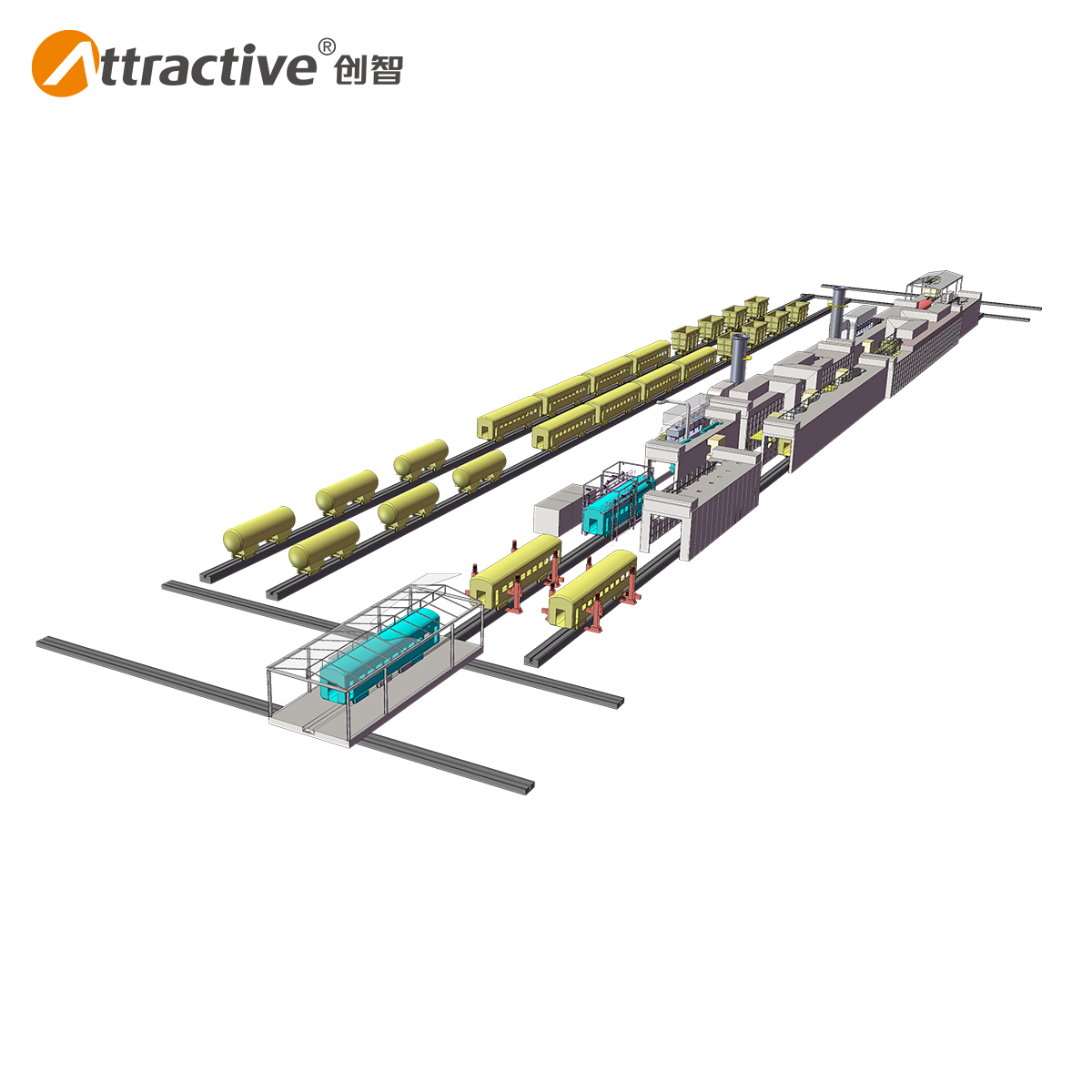
Heavy industrial equipment painting lines are engineered for large workpieces and long-term outdoor corrosion resistance.
Buyer's Decision Framework for Project Fit
Evaluating a painting line supplier requires more than comparing brochures. The following framework separates project fit into five layers.
1. Part and Material Compatibility
Define the full product mix, including part size, weight, geometry, and material. A line designed for ABS+PC automotive interior parts is not interchangeable with an aluminum profile line. Verify that the supplier has documented parameters for your workpiece category. Attractivechina, for instance, lists separate painting line models for auto parts, cookware, wood furniture, metal, and industrial equipment, each with distinct parameters.
2. Capacity and Line Speed
Calculate required output per shift, per day, or per hour, and check whether the line's design speed, pitch, and working hours can absorb future growth. The documented range spans 1,422 pieces per shift for wood parts, 800–1,000 pieces per hour for cookware, 1,760 trays per day for auto parts, and 5,000 m² per day for aluminum panels.
3. Automation Level and Labor Requirements
Decide which stations require robotic spraying, manual spraying, or a hybrid. The documented auto parts line uses offline mode plus robot spraying with 85% equipment utilization. The industrial equipment line uses manual plus robot spraying for large, complex workpieces. The metal line uses reciprocator plus manual spraying for high-volume flat parts.
4. Environmental, Safety, and Compliance
Check the operating environment, ventilation, dust removal, and VOCs treatment requirements. Indoor Class 10,000 cleanroom conditions are documented for high-end applications. For cookware, food-grade compliance must be verified against standards such as FDA 21 CFR, EU 1935/2004, and LFGB migration testing. For industrial equipment, salt spray resistance of ≥1,000 hours is a documented performance benchmark. In Europe, industrial spraying equipment safety is governed by SIST EN 1953:2025.
5. Verification and After-Sales
Confirm the supplier's testing procedure, warranty, and technical support. Attractivechina documents 100% pre-shipment testing, a 1-year warranty, rapid response within 4 hours, remote technical support, regular follow-ups, and free training. Customization options include packaging, logo, size, automation level, voltage, power, and machine capacity.
Limitations and Boundaries of Automated Painting Lines
Automated painting lines deliver measurable gains, but they are not a universal solution. Buyers should weigh the following limitations.
- Capital intensity: A complete line integrates many sub-systems—pretreatment, ovens, conveyors, spray booths, and environmental controls—so the initial investment is high compared to manual stations.
- Space requirements: A documented auto parts line requires a factory area of 100m × 38m × 5.4m. Plants without sufficient floor space or ceiling height may need building modification.
- Changeover complexity: Lines optimized for a defined workpiece family handle multi-part mixed production well only when fixtures, pitches, and robot programs are designed for that mix. Major new product geometries may require new tooling or reprogramming.
- Cleanroom dependency: High-gloss and food-contact applications require Class 10,000 cleanroom conditions. Facilities that cannot maintain filtration, humidity, and ventilation may not achieve the documented finish quality.
- Compliance burden: Food-grade cookware lines must meet FDA 21 CFR, EU 1935/2004, and LFGB migration requirements. Industrial equipment must meet salt spray and safety standards such as EN 1953:2025. Compliance testing adds time to commissioning.
How Attractivechina Approaches Project Fit
Attractivechina, the brand of Guangdong Chuangzhi Intelligent Equipment Co., Ltd., provides customized automated coating production lines and whole-plant solutions. The company operates from a 35,548 m² facility in the National High-tech Industrial Development Zone of Zhaoqing City, Guangdong Province, and reports an annual output of 60 painting line units. It employs 280 staff including 54 R&D engineers and holds over 300 patents, including 79 invention patents in coating and environmental protection equipment.
The company's engineering model covers pre-sales plant planning, independent R&D, design, manufacturing, installation, commissioning, and after-sales service. The documented product range includes coating lines for auto parts, rail transit, furniture, musical instruments, cookware, home appliances, metal, low-altitude equipment, and heavy industrial equipment. Export markets include Vietnam, Iran, Indonesia, Brazil, the United Arab Emirates, Turkey, Thailand, Saudi Arabia, Argentina, Mexico, Pakistan, Bangladesh, India, the United States, Russia, and Singapore.
For buyers, the relevant signal is not the brand name but the documented pattern: separate line models with specific parameters for each industry, deployed project references in each category, and a company structure that integrates engineering with manufacturing. That combination supports both the technical fit evaluation and the long-term service relationship.
Future Outlook: Toward More Adaptive Painting Lines
The direction of painting line development is toward greater adaptability and data integration. MES production management systems are already listed as standard supporting equipment in documented configurations, indicating that coating lines are being connected to broader factory information systems. PLC intelligent control and robotic spraying form the base for flexible unattended operation.
Buyers should expect future projects to place more emphasis on reducing paint consumption and VOC emissions through precision application and closed-loop environmental control. The documented 25–30% paint consumption reductions and the presence of VOCs treatment systems in standard scope will become baseline expectations rather than differentiators.
Frequently Asked Questions on Painting Line Project Fit
What is a painting line?
A painting line is an integrated coating production system that combines pretreatment, spraying, drying, curing, conveying, and environmental control into a continuous process. It is designed for fully automatic continuous operation with PLC intelligent control, robotic spraying, and unmanned flexible production, typically installed in indoor Class 10,000 cleanroom conditions with clean and well-ventilated environments.
How do I know which painting line fits my project?
Project fit depends on four factors: workpiece size and material, required output, automation level, and environmental or compliance requirements. Suppliers such as Attractivechina document separate line models for auto parts, cookware, metal, wood furniture, and industrial equipment, each with distinct parameters such as line speed, workpiece pitch, spraying method, and production capacity. Verify that the proposed line's specifications match your part dimensions and shift output target.
What are the typical capacity parameters for different painting lines?
Documented examples include: wood furniture painting line producing 1,422 pieces per 8-hour shift at 4,000mm/min; cookware painting line producing 800–1,000 pieces per hour for parts up to Φ300×160mm; auto parts painting line with a 45-second cycle per tray and 1,760 trays per day; and metal painting line handling up to 5,000 m² per day with maximum workpiece size of 7000×2000×2200mm.
How much paint can robotic spraying save compared to manual application?
Robotic painting systems are reported to reduce paint consumption by up to 30% compared to manual application through precision control, according to Intel Market Research. In documented Attractivechina projects, paint or powder consumption reductions range from 25% to 30% across auto parts, cookware, metal, wood, and industrial equipment lines.
What cleanroom environment does an automated painting line require?
High-end automated painting lines are designed for indoor Class 10,000 cleanroom conditions with clean and well-ventilated environments. The supporting scope typically includes pretreatment, drying, automatic sandblasting, spray booth, preheating oven, curing oven, cooling system, conveying system, dust removal, VOCs treatment, environmental protection equipment, electrical control, and MES production management system.
Which industries use automated painting lines?
Automated painting lines are used across automotive parts, cookware and home appliances, wood furniture, musical instruments, metal hardware and building materials, heavy industrial equipment, rail transit, and low-altitude equipment industries. Attractivechina documents installed lines for 20 cookware projects, 20 auto parts projects, 15 metal projects, 10 wood coating projects, and 10 industrial equipment projects with operating durations of 5–10 years.
What food-grade standards apply to cookware painting lines?
Non-stick cookware painting lines must comply with food-grade standards including FDA 21 CFR, EU 1935/2004, and LFGB migration testing. A documented cookware project achieved a 98% coating uniformity rate and non-stick performance meeting international food-grade standards.