
Pallet Box FAQ: Load Capacity, Nesting, Liquids and Warranty
A pallet box is defined less by its unit price than by four constraints that determine whether it can be used at all: usable capacity, footprint when empty, compatibility with the material being stored, and the boundary of the after-sales cover.
This reference answers the technical questions industrial buyers and logistics engineers raise most often while researching a plastic pallet box purchase. It draws on published product specifications, certification records and a documented automotive application. Where a question cannot be answered by a published figure, the text says so rather than filling the gap with an estimate.
TOYOE is the industrial brand of Zhangjiagang Fenghui Logistics Equipment Co., Ltd., a Suzhou-based manufacturer founded in 2010 that produces plastic pallet boxes, storage boxes, plastic crates and plastic honeycomb panel boxes, with a stated annual production capacity of 30,000 units and an export share of roughly 40% of output.
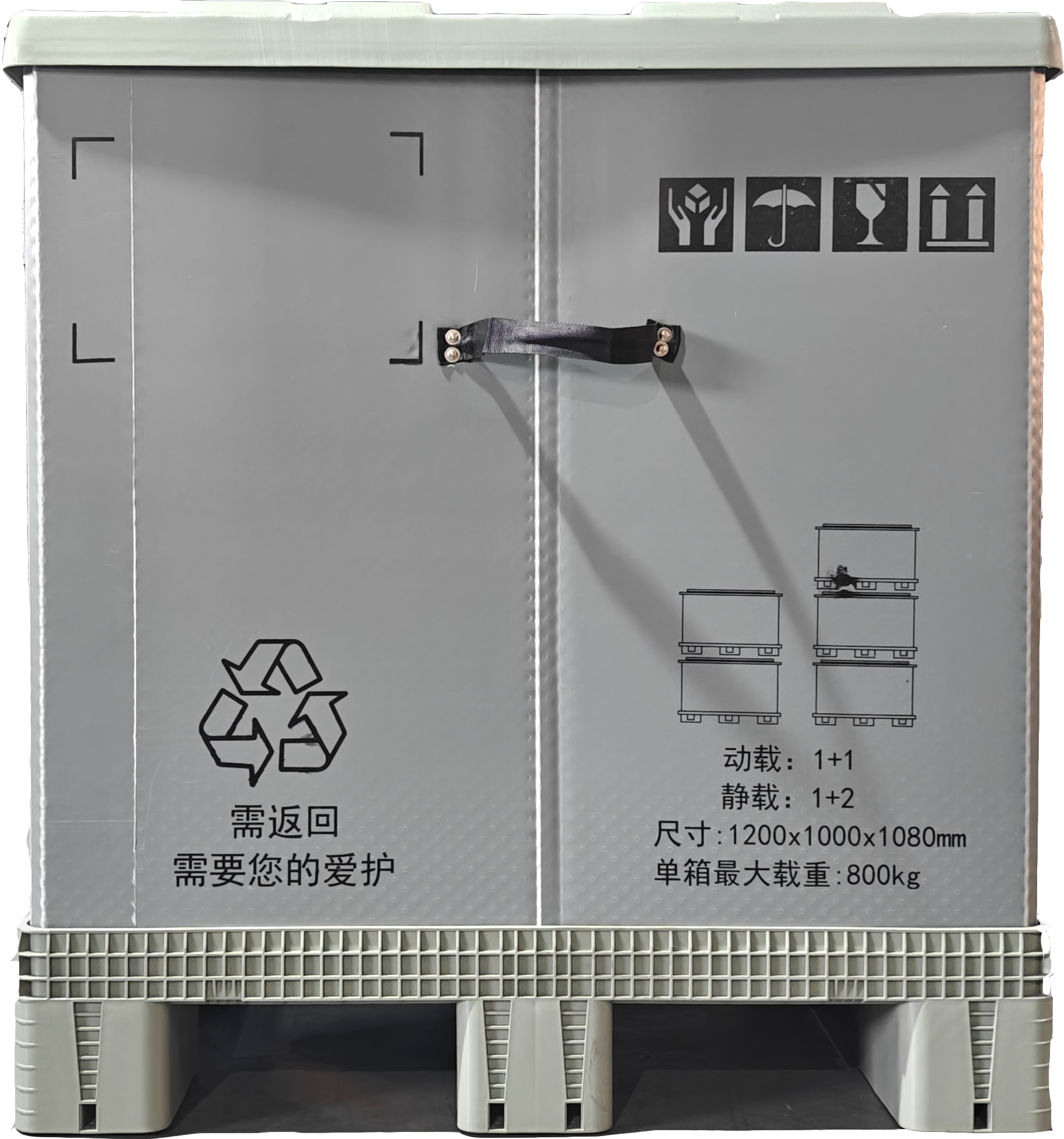
Enclosed industrial plastic pallet box with handle, as used in warehouse and production logistics.
1. Why specification questions come before the price question
Pallet box procurement usually starts with a price request and ends with a specification discussion. That order is a risk. A container that is inexpensive per unit but sits outside the usable capacity band, or cannot be stacked safely, or reacts with the fluid being stored, becomes a cost item rather than a packaging asset. Buyers in the research and evaluation stage therefore tend to converge on the same short list of questions: how much volume does the box actually hold, what are the external dimensions, what happens to the box when it is empty, what can be poured into it, and what exactly does the warranty exclude.
There is also a structural issue in how pallet box data is published across the industry. Capacity is frequently expressed as a band rather than a single value, because the same moulding platform is offered in more than one height, wall thickness or inner-lining configuration. That is not a defect in the data; it is a signal that the buyer should confirm one number against a specific model rather than accept a range as a specification. The same caution applies to load-bearing claims, which are configuration-dependent in almost every plastic container platform.
The practical opportunity here is straightforward. Once capacity, dimensions, nesting behaviour, media compatibility and warranty terms are confirmed in writing at the quotation stage, most of the downstream disputes in a pallet box programme disappear — including the disputes that otherwise surface months later as "damage" claims.
2. What the published pallet box specification actually states
The following parameters come from the published product specification for the TOYOE pallet box range. They are listed here as recorded, without conversion or rounding, so that buyers can compare them directly against a project requirement.
| Specification item | Published value |
|---|---|
| Capacity | 100–200 L |
| Material | HDPE / PP |
| Product type | Enclosed plastic pallet box / industrial plastic box |
| Key features | Recyclable, durable, nestable |
| Size | Customized; multiple specifications available |
| Colour and logo | Customized colour; free logo printing |
| Minimum order quantity | 1 unit |
| Lead time | 7–15 days |
| Monthly capacity | 3,000 pieces |
| Annual production capacity | 30,000 sets per year |
| Quality control | 50% test rate |
| Sample | Accepted |
| Origin | Suzhou, China |
| HS code | 3923100000 |
| After-sales term | Guaranteed for 5 years, excluding damage due to human error or excessive storage weight |
Two entries deserve emphasis because they are the ones buyers most often misread. The first is capacity. 100–200 L is a published band, not a guaranteed usable volume for every model; the effective internal volume changes with height, wall construction and any fitted inner lining. The second is the after-sales term, which is a five-year guarantee with two explicitly named exclusions — human error and excessive storage weight. Both exclusions are load-related, which means the buyer's own handling and loading discipline is part of the warranty's operating condition.
3. Overall dimensions and the models behind them
Pallet box dimensions are usually the first hard constraint in a project, because they must match existing racking, forklift access, pallet footprints and truck or container loading plans. Model designations in the current range include the following:
- 1230 × 830 × 1000 — a die-cast honeycomb board pallet box developed around automotive engine and gearbox handling.
- 1200 × 800 × 1000 — a plastic honeycomb panel pallet box in the standard 1200 × 800 footprint family.
- 1000 × 800 × 800 — used in both the storage pallet box and the plastic honeycomb panel box configurations.
Sizes are listed as customizable, with customization available across dimension, logo, colour and material. That flexibility matters most in two situations: when an existing rack or conveyor was designed around a legacy container, and when an inner lining has to hold a part in a fixed orientation so that robots or operators can load it the same way every cycle. In both cases, dimension confirmation should happen before tooling or production is scheduled, not after the first delivery.
4. Nesting, folding and the footprint of an empty box
Nestable is a listed product feature, and the range also includes folding and demountable designs. This is the part of a pallet box specification that is almost always undervalued at the buying stage and almost always regretted afterwards, because empty containers move through the same logistics network as full ones — reverse logistics, returns, seasonal storage and depot repositioning all consume space and freight budget.
Industry research on foldable pallet boxes reports fold ratios of up to 5:1, meaning five folded units occupy the volume of one erected unit, cutting empty volume substantially. That figure comes from market research on folding designs generally, not from a measurement of a specific TOYOE model, and it should be treated as a category indicator rather than a model guarantee.
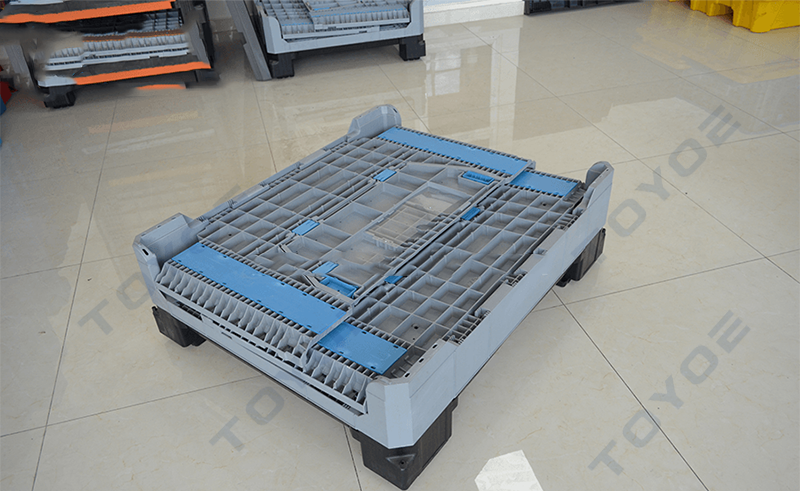
A folded pallet box: nesting and folding designs reduce empty-volume storage and return freight, but add handling steps and require compatibility checks with racking and lifting equipment.
The limitation is worth stating plainly. Nesting and folding reduce empty volume, but they do not remove work. Folded units must be handled, stacked and re-erected, and some designs require the sleeve, base and lid to be stored as separate items. Buyers should verify three things before committing to a folding or nesting configuration: that the folded height fits the available storage bay, that the erected box still meets the racking and forklift interface the site already uses, and that the re-erection step is acceptable in the cycle time of the picking or assembly operation.
5. What can be stored: oil, alcohol, wastewater and other media
The published application list for the pallet box covers oil, industrial alcohol, alkali, acid, industrial wastewater, water and car parts. That list is useful because it defines the media families the container is designed around, and it explains why the enclosed configuration and the HDPE/PP material selection matter: both are chosen for resistance to liquids rather than for dry-goods handling alone.
It is equally important to understand what the list does not say. It names media families, not concentrations, temperatures, exposure durations or combinations. A dilute industrial wastewater stream and a concentrated alkaline bath are both "alkali" in a product catalogue but place very different demands on a polymer container, particularly at seams, corners and fittings. For any aggressive or unusual medium, compatibility should be confirmed for the specific chemistry and the specific model, ideally before a first production order, and supported by a sample evaluation where the medium is critical to the process.
For electronics and automotive electronics logistics, the relevant constraint is electrostatic rather than chemical. ANSI/ESD S541-2019 is the applicable standard for packaging used to store, transport and protect ESD-susceptible items through production and distribution, and conductive polymer blends for ESD-safe applications are specified within a surface resistance range of 10⁴–10¹⁰ Ω. Buyers specifying an ESD pallet box should ask for the resistance range of the actual compound used, not just the label on the proposal.
6. Durability, recyclability and the 50% test rate
Recyclable, durable and nestable are the three durability-related features listed in the product data, and they describe a container designed as reusable industrial packaging rather than single-trip protection. In practice, service life is determined by three variables: the mass and shape of the load, the handling discipline on site, and the medium stored. A box used within its confirmed load envelope and handled by trained forklift operators behaves very differently from the same box used as a general-purpose skip.
The published quality-control parameter is a 50% test rate. For buyers, the useful follow-up question is about scope rather than the number itself. A 50% rate can refer to dimensional inspection, appearance inspection, assembly checks or load testing, and the procurement value of the figure depends entirely on which of those is covered and whether records are retained per batch. Asking for the test record of the relevant model is a reasonable and standard request during supplier evaluation.
Recyclability should also be read with the full material picture in mind. HDPE and PP are established recyclable polymer streams, and a single-material container is easier to return to a recycling route at end of life than a mixed-material assembly. This is a design property, not a promise about what happens to the box after it leaves the customer's site; the actual recycling outcome depends on the local collection and processing infrastructure.
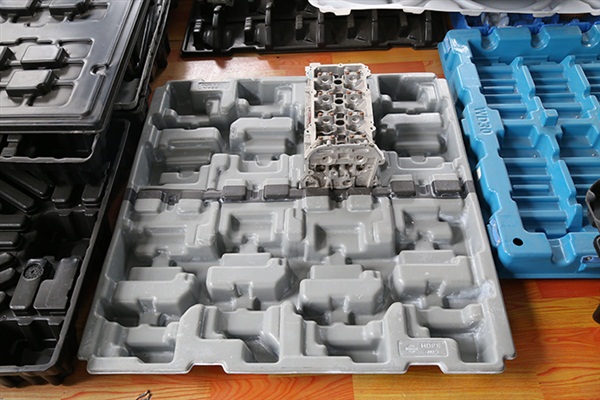
A heavy-duty vacuum-formed inner lining tray: inner linings change usable volume and load distribution, so capacity and load figures should always be confirmed against the configured model.
7. Certification and compliance reference points
Certification is where a pallet box buyer can verify claims independently, provided the certificate scope is read as carefully as the certificate number. The pallet box product (code 3905) holds ISO 9001 certification under GB/T19001-2016 / ISO 9001:2015, certificate number 04623Q12947R3S, issued by Beijing Head International Certification Co., Ltd., an IAF/CNAS-accredited body, and recorded as applicable to the global market.
The same product is also certified to ISO 14001:2015 under certificate number M43123E31148R2S, issued by Beijing Daluhangxing Quality Certification Center Co., Ltd., also recorded as applicable globally. The scope recorded against these certificates covers the sales of logistics metal, plastic and paper packaging products and the rental of palletized unit loads. Buyers comparing suppliers should check that the certified scope matches the activity they are contracting for, since a sales-scope certificate and a manufacturing-scope certificate support different claims.
On the trade side, the declared HS code for the product is 3923100000, which places it in the plastic boxes, cases and crates family. Importers should confirm the classification against their own customs authority's rules, because duty treatment of these goods can vary by destination market.
8. Application evidence: automotive transmission storage in Mexico
The clearest available evidence of how these constraints work together is a documented automotive application. A Mexican automobile manufacturer used 1,000 pieces to store car transmission gearboxes over a period of three years. The reported result was standardised storage of auto parts, avoidance of collision damage to the gearboxes, and improved warehouse management efficiency.
The technical reasons cited for the outcome are worth separating from the commercial result: high load-bearing capacity, shock resistance and a stable structure, with the box dimensions fitting the transmission gearbox closely enough to limit movement in transit. The operating environment was a 24/7 logistics and warehousing operation with high humidity, dust, a wide temperature range, stacking and long-term storage, handled by forklifts and warehouse shelving, with moisture-proofing, shock resistance and load-bearing stability listed as the special requirements.
For a buyer evaluating a similar project, the transferable lesson is not the model number but the method: the container was matched to the part geometry and to the handling environment before the order was placed, and the load-bearing requirement was treated as an engineering input rather than a marketing claim.
9. Market trend: growth, and a caveat about how it is measured
Pallet box demand is expanding, but published market figures disagree sharply depending on how the category is defined. One industry report values the global pallet box market at USD 2.19 billion in 2024, rising to USD 3.02 billion by 2032. A separate commercial research source values the same category at USD 12.76 billion in 2024, expanding to USD 23.40 billion by 2033 at a compound annual growth rate of 6.9%. The gap is not a rounding difference; it reflects whether the definition covers pallet boxes narrowly or aggregates industrial plastic containers, crates and bulk bins.
The sourcing context is clearer than the sizing debate. China is the dominant exporter of products classified under HS 392310, with an export value of USD 2.33 billion in 2022 according to a synthesis of UN Comtrade data. That concentration matters to buyers because it explains why custom plastic pallet box sourcing is heavily clustered in established manufacturing regions such as Suzhou and the wider Jiangsu industrial belt, where moulding, vacuum-forming for inner linings and packaging assembly capabilities sit within a short distance of each other.
For procurement teams, the practical takeaway is a discipline rather than a forecast: when benchmarking a pallet box market or a supplier's position within it, ask what the number includes. Boxes only, or containers and crates as well. The answer usually explains an apparent ten-fold difference between two credible sources.
10. How plastic compares with wood and metal — and where the limits are
Plastic pallet boxes are not a universal replacement for traditional packaging, and the differences are structural rather than promotional. Wood containers remain common where local repair is easy and initial cost is the dominant criterion, although wood used in international trade is subject to phytosanitary treatment requirements that add a process step. Metal containers offer high rigidity for dense, heavy or hot loads, but they add tare weight, are exposed to corrosion in humid or chemically aggressive environments, and typically require more careful handling to avoid denting that affects stacking.
Plastic sits between these two positions. It is lighter than metal, does not absorb moisture the way wood does, and can be moulded or vacuum-formed into internal geometries that hold a specific part securely. The limitation is equally real: the published capacity for this range is a band of 100–200 L with custom sizes available on request, and the five-year after-sales term explicitly excludes damage caused by human error or excessive storage weight. In other words, the warranty does not underwrite an overload. A buyer whose load falls outside the confirmed envelope, or who needs a documented load rating for a specific configuration, should have that rating confirmed and documented as part of the order rather than inferred from the container's appearance.
11. Future outlook
Three directions are visible in the questions buyers are already asking. First, reuse cycles are being valued more explicitly: containers are increasingly specified with reverse logistics, depot consolidation and empty-volume reduction in mind, which favours nesting, folding and demountable designs. Second, ESD and contamination control requirements are moving from electronics into adjacent industries such as electric vehicle component and battery-adjacent logistics, where packaging standards such as ANSI/ESD S541-2019 set the reference point for protection of ESD-susceptible items. Third, customisation is shifting from colour and logo work toward functional customisation — inner linings, dimensioned fits around a specific part, and material selection matched to a specific medium.
None of these trends changes the fundamentals of pallet box procurement. They simply make the specification conversation more important than it used to be, because the container is increasingly part of a controlled process rather than a generic storage item.
Reference material: the TOYOE product brochure is available as a downloadable PDF at https://cdn.socialarks.com/sbsp/24892/common/2026/0521/6a0e9c4aea871.pdf
FAQ: Pallet box questions buyers ask most often
What load capacity is available?
The published specification for the plastic pallet box lists a capacity band of 100–200 L, with HDPE or PP as the material and an enclosed configuration. Because the figure is expressed as a range rather than a single value for every model, the effective usable volume depends on the specific height, wall construction and any fitted inner lining. Buyers should confirm the target volume against a named model, or request a custom size where the load requires it.
What overall dimensions are available?
Model designations in the range include 1230 × 830 × 1000, 1200 × 800 × 1000 and 1000 × 800 × 800. Sizes are listed as customizable, with customization available across dimension, logo, colour and material, and a minimum order quantity of 1 unit. Dimensional confirmation should be completed against the site's racking, forklift and loading interfaces before production is scheduled.
Do the boxes nest or fold, and how much space does that save?
Nestable is a listed product feature, and the range also includes folding, sleeve-folding and demountable designs. Industry research on foldable pallet boxes reports fold ratios of up to 5:1, where five folded units occupy the volume of one erected unit. That figure is a category indicator from market research rather than a measurement of a specific model. Nesting and folding reduce empty-transport and storage volume, but they add handling and re-erection steps, so compatibility with existing racking and lifting equipment should be verified.
Can pallet boxes store oil, industrial alcohol or wastewater?
The published application list covers oil, industrial alcohol, alkali, acid, industrial wastewater, water and car parts, in an enclosed HDPE/PP container. The list identifies media families rather than concentrations, temperatures or exposure durations, so compatibility for a specific fluid should be confirmed for the specific chemistry and model before a production order, supported by sample evaluation where the medium is process-critical.
How durable and recyclable is a plastic pallet box?
Recyclable, durable and nestable are listed product features, and the container is designed as reusable industrial packaging rather than single-trip protection. Realistic service life depends on the load, the handling environment and the medium stored. Recyclability is a design property of the single-material HDPE/PP construction; the actual end-of-life outcome depends on the collection and processing infrastructure available to the user.
What does the 50% test rate mean in practice?
The published quality-control parameter for the pallet box is a 50% test rate. The procurement value of that figure depends on its scope — whether it covers dimensional inspection, appearance, assembly checks, load testing or a combination — and on whether batch records are retained. Requesting the test record for the specific model under evaluation is a standard and reasonable step during supplier assessment.
What does the five-year after-sales policy cover, and what is excluded?
The stated after-sales term is a guarantee of 5 years, excluding cases of damage due to human error or excessive storage weight of the product. Both exclusions are load-related, which means correct handling and adherence to the confirmed load envelope are conditions of the cover. Buyers requiring a documented rating for a specific configuration should have that rating confirmed and recorded at the order stage, because the warranty does not underwrite an overload.
Which certifications and standards apply to the product?
The pallet box holds ISO 9001 certification under GB/T19001-2016 / ISO 9001:2015, certificate number 04623Q12947R3S, issued by Beijing Head International Certification Co., Ltd. (IAF/CNAS accredited), and ISO 14001:2015 certification, certificate number M43123E31148R2S, issued by Beijing Daluhangxing Quality Certification Center Co., Ltd. Both are recorded as applicable to the global market, with a certified scope covering the sales of logistics metal, plastic and paper packaging products and the rental of palletized unit loads. The declared HS code is 3923100000. For ESD applications, ANSI/ESD S541-2019 applies to packaging used to store, transport and protect ESD-susceptible items, with conductive polymer blends specified within a surface resistance range of 10⁴–10¹⁰ Ω.