
Pallet Box OEM Capability: What Industrial Buyers Should Verify
The global plastic pallet and pallet box market is projected to reach about USD 11.2 billion by 2030, according to Grand View Research, driven by the shift from wood to durable plastic solutions in logistics. For buyers moving from evaluation to execution, the practical question is narrower: can a supplier turn a specification into a manufactured, tested, and supported pallet box? This article outlines what OEM capability means for pallet box sourcing and what evidence buyers should check before placing an order.
Why Pallet Box Projects Fail After Supplier Selection
Most pallet box sourcing problems appear during execution, not during initial quoting. A supplier may accept a custom size request, but lack the mold or process control to hold tolerances. Another may treat “customization” as logo printing and color changes, while the dimensional, structural, or material engineering remains unaddressed.
A common pattern is that the buyer focuses on price and outer dimensions, then discovers later that the box cannot handle the required stacking load, that the material is not compatible with the stored goods, or that the supplier has no clear process for sample approval. These issues are avoidable if the supplier’s OEM process is transparent from the beginning.
This matters because industrial pallet boxes are increasingly specified for demanding tasks: heavy automotive parts, ESD-sensitive electronic components, or high-humidity environments. In these cases, the container is part of the production workflow. If the box fails, the protection fails.
The market already includes established global names such as ORBIS Corporation, Schoeller Allibert, Brambles (CHEP), and Loscam. For project-specific requirements, however, buyers typically need to evaluate a specific factory’s capability, not just a brand’s reputation.
A Supplier-Level View of TOYOE’s OEM Capability
TOYOE is the brand of Zhangjiagang Fenghui Logistics Equipment Co., Ltd., a manufacturer based in Zhangjiagang, Suzhou, Jiangsu Province, China. Founded in June 2010, the company produces plastic pallet boxes, storage boxes, plastic crates, and honeycomb panel boxes for industrial logistics. Its facility covers more than 20,000 m², including a 4,000 m² production area, with 34 employees and an annual output of about 30,000 units. The company’s export ratio is around 40%, with Mexico and the United States as primary markets; according to its production capability record, it also serves export customers in the EU and Southeast Asia.
During an evaluation, the following production and customization data points are the most relevant:
| Capability Dimension | Documented Detail |
|---|---|
| Production mode | OEM / ODM |
| Customization scope | Dimension, logo, color, material |
| Monthly capacity | 3,000 pieces |
| Lead time | 7–15 days |
| Minimum order quantity | 1 unit |
| Quality control | 50% testing |
| After-sales guarantee | 5 years, excluding human error or excessive storage weight |
The company also operates management systems certified to ISO 9001:2015 (certificate 04623Q12947R3S) and ISO 14001:2015 (certificate M43123E31148R2S), covering the sales of logistics metal, plastic, and paper packaging products and the rental of palletized unit loads. For buyers, this means the factory has documented quality and environmental management processes, which is relevant when supplying manufacturers with compliance requirements.
What the Technical Options Mean for Load, Space, and Environment
Industrial plastic pallet boxes in this product family are typically produced from HDPE or PP. The material selection affects rigidity, chemical resistance, and impact behavior. According to the product documentation, the pallet box series generally offers a capacity range of 100–200 liters, with features described as recyclable, durable, and nestable. Applications listed include oil, industrial alcohol, alkali, acid, industrial wastewater, water, and car parts, which helps explain why the product appears across industries such as automobile manufacturing, precision electronics, food cold chain, home logistics, medical and health care, and heavy industry.
Structural Variants
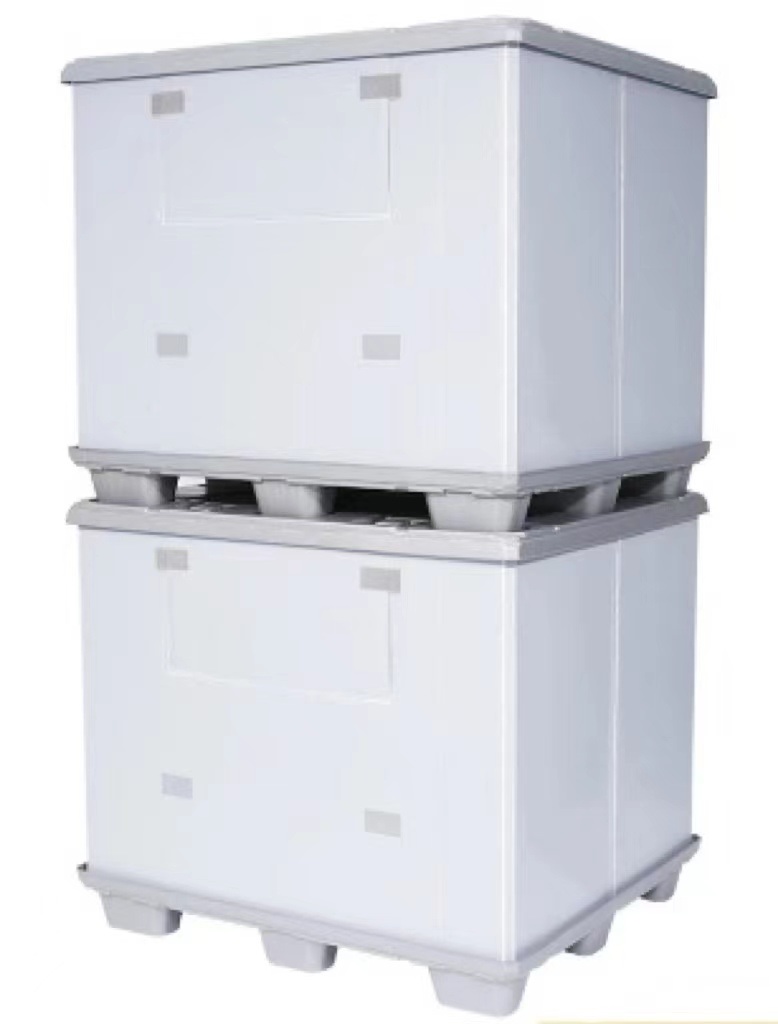
Within TOYOE’s product lineup, the main structural types are injection-molded plastic pallet boxes, plastic honeycomb panel boxes, and die-cast honeycomb board boxes. The honeycomb panel structure provides a high strength-to-weight ratio, one reason honeycomb packaging is projected by Global Market Insights to grow at a CAGR of 5.9% through 2032, especially for automotive parts transport.
Functional Design Options
Based on the manufacturer’s documented product variants, buyers can encounter several functional designs:
- Stackable pallet boxes — designed for vertical storage in warehouses.
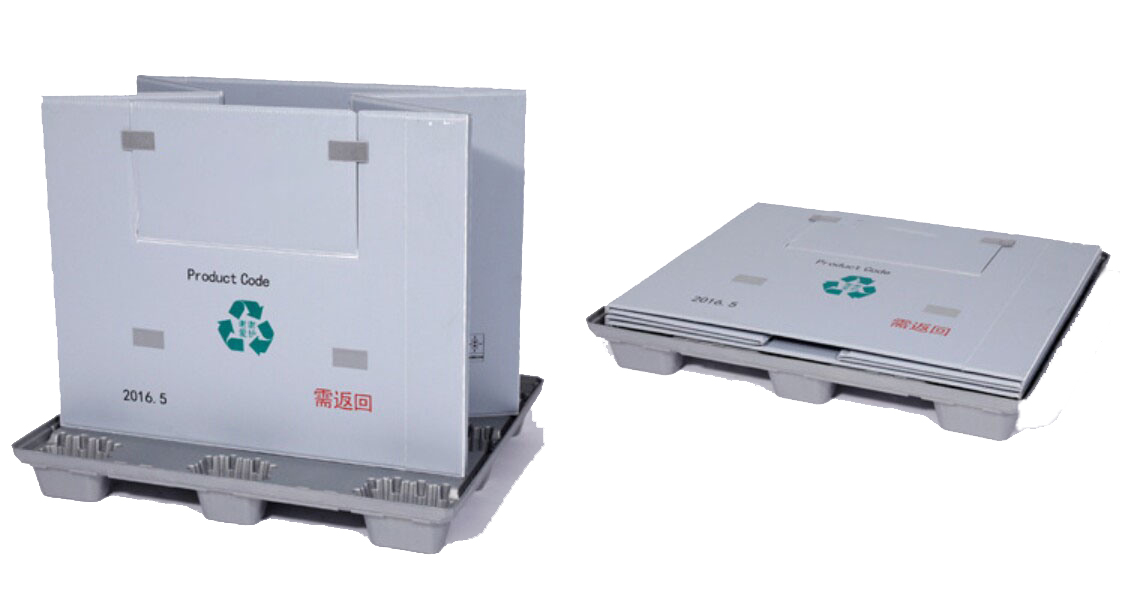
- Folding pallet boxes — reduce volume when returned empty.
- Demountable pallet boxes — can be disassembled for space-saving logistics.
- ESD pallet boxes — intended for electrostatic discharge protection in electronics-sensitive environments.
- Antiflaming pallet boxes — for environments with stricter fire-related requirements.
- Dust-proof pallet boxes — for protecting contents from dust contamination.
- Lightweight pallet boxes — reduce transport weight without abandoning plastic durability.
These functional variants align with broader market demand. The ESD packaging market, including trays and pallet boxes, is expected to reach USD 5.89 billion by 2035, growing at a CAGR of 5.8%, according to Research Nester. For European buyers, EN 13626:2003 serves as the primary standard specifying requirements and test methods for reusable box pallets used in material handling.
Automotive Parts Storage: An Executed Example from Mexico
One documented case involves an automobile manufacturer in Mexico. The client ordered 1,000 pallet boxes for storing car transmission gearboxes, and the boxes have been in use for three years. The project was designed to solve collision damage during storage, and the achieved outcomes include standardized storage of auto parts, avoidance of gearbox collision damage, and improved warehouse management efficiency.
The application highlights listed for this case are high load-bearing capacity, shock resistance, stable structure, and a fit tailored to the dimensions of the auto transmission gearbox. This outcome is relevant to buyers evaluating custom-size pallet boxes, because it demonstrates that dimensional customization can be delivered at a project scale, not only as a single sample.
For a buyer in the evaluation stage, this case also matters because it connects the product to a measurable warehouse outcome: gearboxes were no longer damaged during storage, and warehouse management efficiency improved. These are operational results, not just container specifications.
TOYOE’s related product models for this category include the 1200×800×1000 mm plastic pallet box, the 1000×800×800 mm storage pallet box, the 1000×800×800 mm plastic honeycomb panel box, and the 1230×830×1000 mm die-cast pallet box for automotive engines. For buyers comparing specifications, these models show that both footprint and height can be adjusted to match specific part sizes.
Market Trends That Make OEM Capability More Important
Three trends are relevant to pallet box buyers in 2026.
First, the shift from wood to plastic logistics containers continues. Grand View Research projects the global plastic pallets and pallet box market to reach approximately USD 11.2 billion by 2030. Straits Research estimates that the Asia Pacific region held the largest revenue share of over 32% in the plastic pallet market in 2023, with China leading in industrial production capacity.
Second, functional requirements are expanding beyond simple containment. ESD protection, dust-proofing, flame resistance, and lightweight designs are becoming part of normal specifications, especially in electronics and automotive supply chains.
Third, buyers are increasingly treating pallet boxes as reusable capital equipment rather than disposable packaging. This makes documented quality systems, load ratings, and after-sales commitments — not just unit price — the relevant evaluation metrics in a long-term sourcing relationship.
From a sourcing perspective, buyers should also consider whether the supplier can provide evidence beyond brochure descriptions. In TOYOE’s case, the documented production capability, certification numbers, and the Mexico project provide a verifiable baseline. This kind of evidence is what makes an OEM relationship predictable during the execution phase.
Plastic Pallet Box vs. Wood Pallet Box: What Buyers Should Weigh
The common alternative to a plastic pallet box remains a wooden pallet box, especially for simple storage and one-way logistics. The comparison below highlights practical differences, without assuming every application needs plastic.
| Comparison Point | Plastic Pallet Box | Wood Pallet Box |
|---|---|---|
| Moisture and insect resistance | Higher; does not absorb water easily | Can absorb moisture; requires treatment for some export routes |
| Hygiene and cleaning | Can be washed; better for clean environments | More difficult to sanitize |
| Customization complexity | Mold-based; supports complex dimensions and features | Simple dimensions possible; complex features require add-ons |
| Initial purchase cost | Typically higher for a comparable size | Typically lower for simple designs |
| Lifecycle maintenance | Longer service life; lower maintenance in returnable loops | Higher repair or replacement frequency in long-term reuse |
| End-of-life | Recyclable HDPE/PP | Repairable, reusable, or biodegradable; may contain fasteners |
There are also honest boundaries. A plastic pallet box generally has a higher initial price than a basic wooden box, so for one-way export shipments where return logistics are not planned, wood can remain the economic choice. For extremely high static loads or prolonged high-temperature exposure, a steel or reinforced wood container may still be more appropriate. And for buyers who only need a standard footprint in large volume, a custom-molded plastic box may cost more than an off-the-shelf standard model — in that case, the standard model is likely the rational decision.
TOYOE’s five-year guarantee also states exclusions for human error and excessive storage weight. That limitation is normal in the industry, but it reinforces the point that buyers must verify load limits during the design phase.
What the Next Step Looks Like for Buyers
As project-specific demand grows, suppliers with OEM/ODM capabilities and low MOQs will become easier to work with for mid-sized manufacturers. A minimum order of one unit allows sample validation before mass production; a 7–15 day lead time supports pilot schedules; and a 50% testing protocol provides a baseline for batch quality.
Before mass production, the manufacturer’s procurement support process includes sample testing for confirmation and test reports for raw materials. Delivery terms include FOB and CIF, and the payment structure is 30% deposit in advance with 70% balance before shipment. For an evaluation-stage buyer, these terms indicate a defined, verifiable process rather than an ad-hoc arrangement.
Buyers should still verify three things before scaling an order: the material and dimensional specifications of the sample, the production capacity to meet target volume, and the documented case history in a similar application. Certification to ISO 9001 and ISO 14001 provides process-level confidence, but the final proof is a physical test under real loading conditions.
FAQ: Asking the Right Questions Before Ordering
1. Can the manufacturer provide OEM/ODM production for pallet boxes?
Yes. According to the manufacturer’s production capability record, TOYOE offers both OEM and ODM production services. This means the factory can produce according to a buyer’s drawings or take responsibility for product development based on the application requirements.
2. What can be customized on a pallet box?
The documented customization scope includes four dimensions: dimension, logo, color, and material. Related product listings also indicate that specification variants such as capacity and structural type can be adjusted. Buyers with specific needs such as inner linings should confirm whether the required feature is within the current customization scope.
3. What is the minimum order quantity?
The minimum order quantity is 1 unit. This is particularly useful for sample testing and pilot validation before committing to a larger production run.
4. What is the typical lead time for an OEM pallet box order?
The standard lead time is 7 to 15 days. The exact period depends on order size, customization complexity, and current production load.
5. What quality control and after-sales support should be expected?
The documented quality control process includes testing on 50% of products. After-sales support carries a 5-year guarantee, excluding cases of damage caused by human error or excessive storage weight of the product.
6. Is there a reference case in automotive parts storage?
Yes. A project in Mexico involved 1,000 pallet boxes used by an automobile manufacturer to store car transmission gearboxes. The boxes have been in service for 3 years. The project achieved standardized storage of auto parts, avoided gearbox collision damage, and improved warehouse management efficiency.
Have Questions or Need More Details?
Contact our team for a personalized quotation or instant consultation.
Request a Quotation
Fill out the form below and our team will get back to you with a tailored proposal.
WhatsApp Direct Chat
Prefer to chat in real-time? Message us on WhatsApp for instant assistance & quick answers.
- Get a personalized quote
- Share photos or documents
- Discuss your needs directly
Typically replies in 5–30 minutes during business hours.