
Pallet Box Qualification: What HS Code 3923100000, HDPE/PP and a 5-Year Warranty Do—and Don't—Prove
Pallet Box Qualification: What HS Code 3923100000, HDPE/PP and a 5-Year Warranty Do—and Don't—Prove
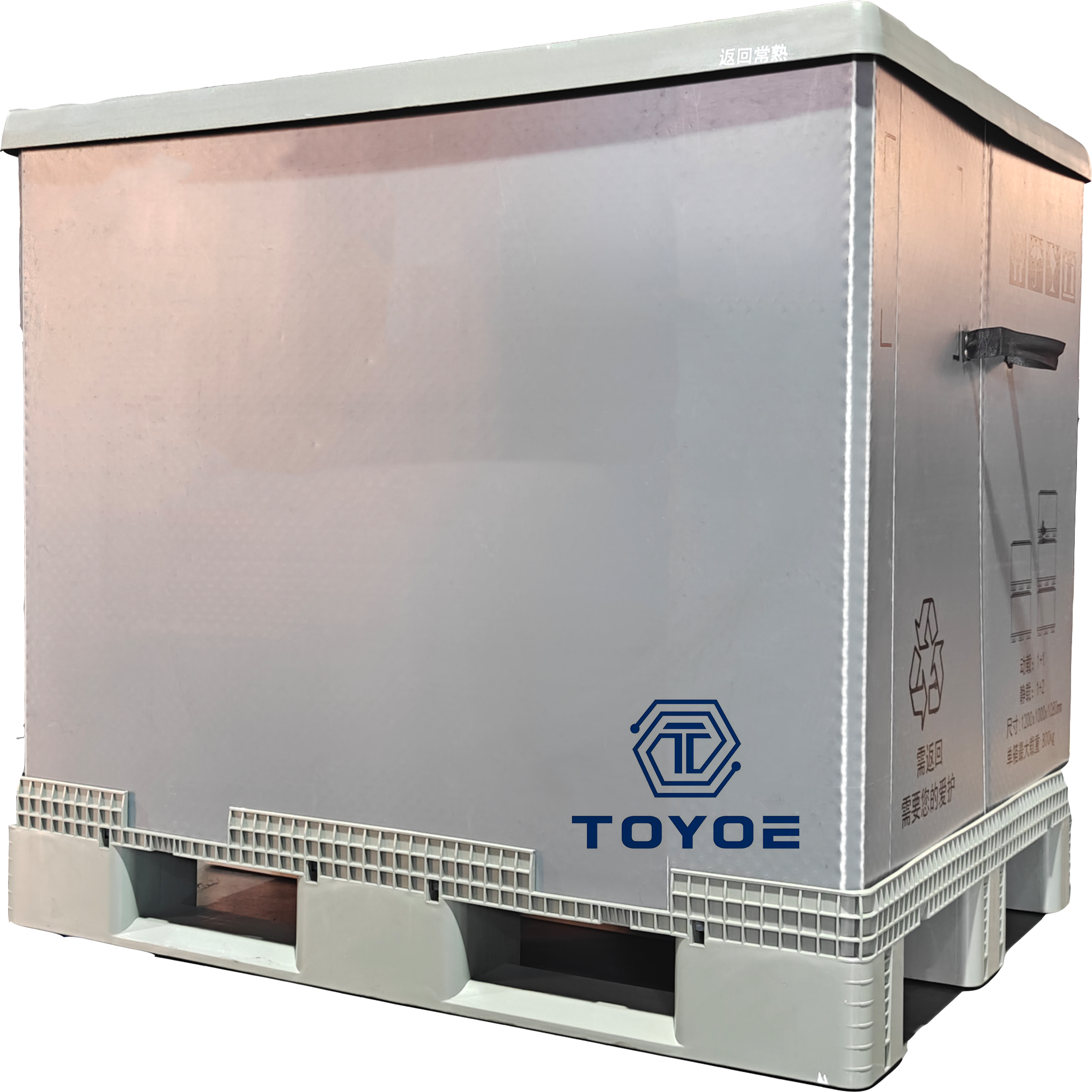
Pallet box qualification is usually presented as a bundle of credentials: a customs code, a resin abbreviation, an ISO certificate number and a multi-year guarantee. Each item answers a narrow question. None of them certifies that a specific box will carry a specific load in a specific warehouse.
This article separates the four most frequently quoted evidence items in plastic pallet box procurement — HS code 3923100000, an HDPE/PP material designation, ISO management-system certificates and a five-year after-sales guarantee — into what they prove, what they leave open and what a buyer should request to close the gap. It then applies the same reading to the capability claims that usually accompany them: a 50% testing share, OEM/ODM customization, a 7–15 day lead time on customized orders and export experience in the EU and Southeast Asia.
Zhangjiagang Fenghui Logistics Equipment Co., Ltd., which manufactures under the TOYOE brand, serves as the worked example. Founded in 2010, the company produces plastic pallet boxes, storage boxes, plastic crates and honeycomb panel boxes in Zhangjiagang, Jiangsu, and records OEM/ODM customization, a 3,000-piece monthly capacity, a 7–15 day customized-order lead time and a five-year after-sales guarantee. The purpose is not to accept those statements at face value, but to show where each one sits in a verification file — and where it stops.
What HS Code 3923100000 Classifies
HS code 3923100000 is a customs classification for plastic boxes, cases and crates. It appears on the specification records for the 1200×800×1000 pallet box, the 1000×800×800 storage pallet box and the die-cast 1230×830×1000 model, and it is the same code that will appear on a commercial invoice, a packing list and a customs declaration.
That is its function: it gives buyer, seller and customs authority a shared tariff language for the goods, so duty treatment, statistical reporting and document consistency can be handled without re-describing the product. The heading is not a small technicality. UN Comtrade figures republished by FreightAmigo record China's 2022 exports under HS 392310 at USD 2.33 billion, which measures how much trade moves under this heading rather than saying anything about product quality.
What the code does not establish
The classification does not state load capacity, wall thickness, resin grade, construction method, electrostatic discharge performance, food-contact suitability, flame retardance, dimensional tolerance or warranty terms. Two suppliers can ship under the same code with entirely different performance, because the heading describes the article's material and general type rather than its engineering.
A buyer's check is therefore documentary consistency, not performance. The code must be identical across the specification sheet, invoice, packing list and declaration; the goods description must match the model actually shipped; and the destination's own tariff and documentation requirements should be confirmed with the importer of record or a customs broker. A classification entry belongs in the logistics section of the qualification file. It does not belong in the section reserved for performance evidence, and mixing the two is one of the most common reasoning errors in supplier comparison.
HDPE/PP as a Material Designation
TOYOE's pallet box specifications list the material as HDPE/PP across models, including the blow-molded honeycomb board box at 1000×800×800, the die-cast honeycomb board box at 1230×830×1000 and the 1200×800×1000 pallet box. The models are described as enclosed-type industrial plastic boxes with 100–200 L capacity, customized sizes and colors, free logo printing, and a listed application range covering oil, industrial alcohol, alkali, acid, industrial wastewater, water and car parts.
What the designation supports is the base polymer family, the recyclability claimed for the range and the general suitability of HDPE and PP for wet industrial environments, repeated handling and closed-container formats. It is a legitimate entry in the file, because it tells a buyer what the article is made of and anchors the recycling and end-of-life discussion.
What "HDPE/PP" leaves open
It does not specify resin grade, melt index, virgin-to-regrind ratio, UV stabilization, colorant effects, wall thickness or which panel construction is used in a particular model. Nor does it produce a load figure. Blow-molded honeycomb board and die-cast honeycomb board can behave differently under stacking load even when both are described as HDPE/PP. The application list in a specification sheet is a statement of intended use, not a test result for a specific chemical exposure or a specific load.
The practical request is four documents: a resin data sheet from the material supplier, a drawing showing wall sections and overall dimensions for the exact model, confirmation of which construction family the quoted box belongs to, and a statement of whether recycled material is used and in what proportion. For chemically aggressive contents, the buyer's own compatibility check — not the supplier's application list — decides the fit.
The Certificate Layer: ISO 9001 and ISO 14001
TOYOE's pallet box record (product 3905) carries two management-system certificates. ISO 9001 is held under certificate number 04623Q12947R3S, conforming to GB/T19001-2016 / ISO 9001:2015, issued by Beijing Head International Certification Co., Ltd., an IAF/CNAS-accredited body, and recorded as applicable to the global market. ISO 14001 is held under certificate number M43123E31148R2S to ISO 14001:2015, issued by Beijing Daluhangxing Quality Certification Center Co., Ltd., also recorded as applicable globally.
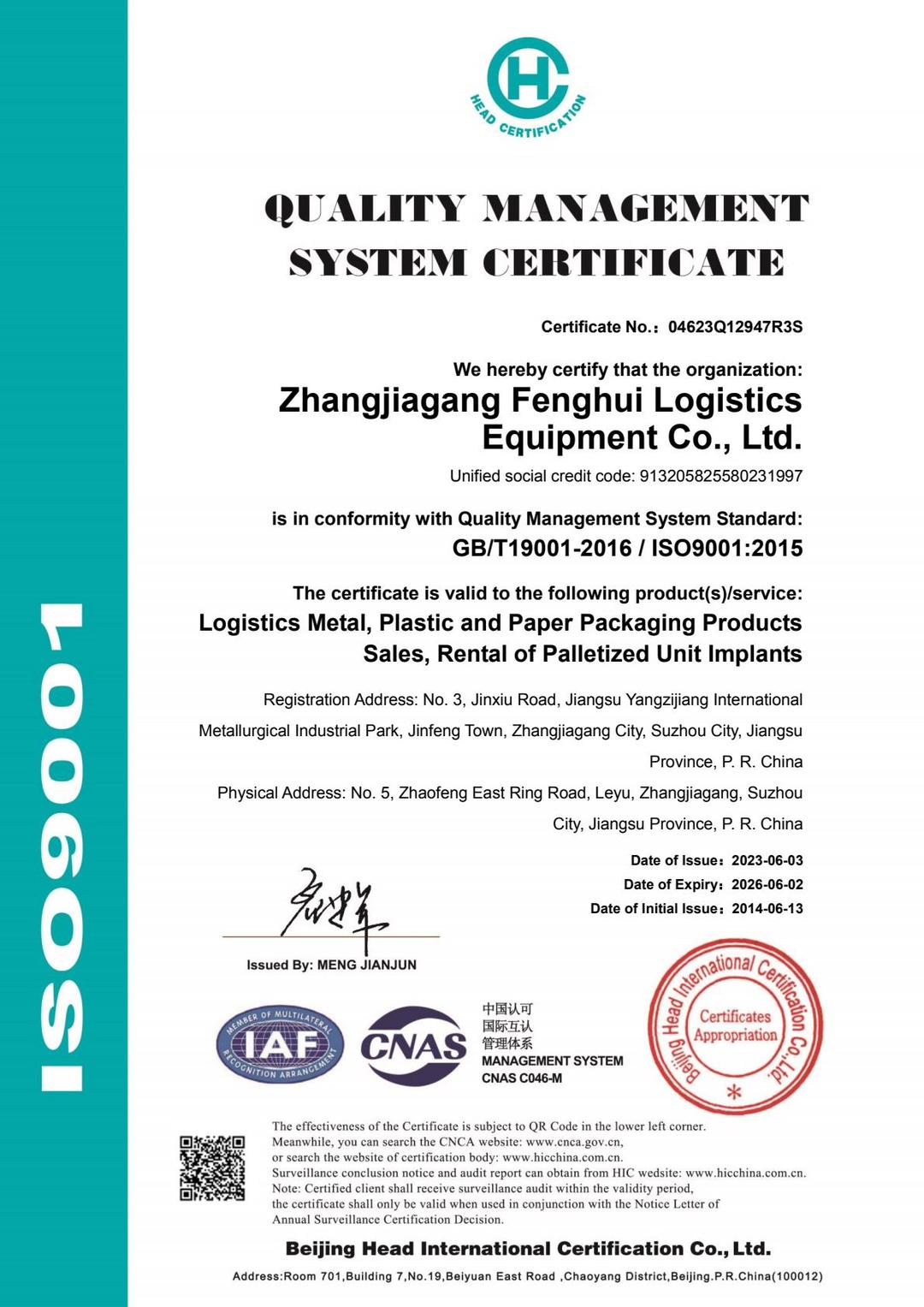
These are real, checkable documents — which is exactly why they need to be read precisely. Both are management-system certifications: they attest that an audited system exists for a defined scope of activity. They are not product type tests, and they do not certify the performance of an individual box.
Read the scope, not just the logo
The ISO 9001 scope is recorded as sales of logistics metal, plastic and paper packaging products and rental of palletized unit loads; the ISO 14001 scope covers sales of logistics metal, plastic and paper packaging products and rental of palletized unit implants. A buyer should confirm that the product and activity being purchased fall inside that wording. A system covering sales and rental of packaging products is meaningful for order handling, documentation and process control; it is a different claim from a design-and-manufacturing scope, and that distinction should be noted in the file rather than glossed over.
Three checks that take minutes
- Validity window. Every certificate carries an issue date and an expiry date. Record both, confirm the window covers your delivery and intended service period, and ask for the current certificate at the time of order rather than relying on a copy filed earlier.
- Issuer and accreditation. Confirm the certification body and its accreditation status, and verify the certificate number with the issuer or the accreditation register. Verification is a lookup, not an opinion.
- Scope match. Match the scope wording to your product and your transaction type before treating the certificate as relevant evidence.
Where the certificate stops
An ISO 9001 or ISO 14001 certificate does not establish a load rating, a wall thickness, a stacking limit, food-contact suitability, flame resistance or electrostatic discharge performance. If an ESD pallet box is part of the specification, the applicable reference is a packaging standard such as ANSI/ESD S541-2019, which governs packaging used to store, transport and protect ESD-susceptible items, with surface resistance values for conductive polymer blends commonly discussed in the 10⁴–10¹⁰ Ω range. A quality-management certificate is not a substitute for that test evidence, and a supplier who answers an ESD question with an ISO certificate has not answered the question.
The 50% Testing Share and the Five-Year Guarantee
Two further items — a testing share and a guarantee term — are frequently quoted in the same breath as certification. They belong in different compartments of the file.
"50% test" describes a process, not an outcome
TOYOE's capability record states a 50% test level in quality control. Read correctly, that is a production-control statement: a defined share of output is inspected before dispatch. Its value depends on four details the phrase does not contain — which characteristics are checked (dimensions, appearance, load, drop, fit), what method and acceptance limits apply, how results are recorded and retained, and what happens to units that fail.
A buyer can convert the claim into evidence by requesting the inspection item list, the acceptance criteria, a sample record and the nonconformance disposition. It is also worth asking whether any characteristic is verified by an independent third party rather than in-house, and at what frequency. Two suppliers can both state "50% test" while operating at very different levels of rigour; only the underlying item list and records separate them.
The five-year guarantee and its two exclusions
The after-sales term recorded for TOYOE pallet boxes is a five-year guarantee, "excluding cases of damage due to human error or excessive storage weight of the product". That wording should be quoted rather than paraphrased, because the exclusions define the real boundary.
What it provides is a stated duration of after-sales coverage. What it does not provide is a load rating, a definition of excessive storage weight for your specific unit, a stated remedy, or protection against handling damage. Human error and overloading are precisely the two failure modes a guarantee cannot police, which means the buyer's operating discipline becomes part of the qualification.
The practical sequence: obtain written load and stacking limits for the exact model; calculate the storage weight per unit and per stack against your own warehouse layout; write the guarantee wording into the purchase contract together with the remedy, the claim evidence required and the response commitment; and keep batch or delivery records so a claim can be traced. A guarantee printed in a brochure is a statement of intent; a guarantee written into a contract with defined load conditions is an enforceable term.
Capability Claims a Buyer Can Actually Check
Customization, lead time and market experience are the three capability claims most often presented without a document behind them. Each can be tested before a volume commitment.
OEM/ODM and customization scope
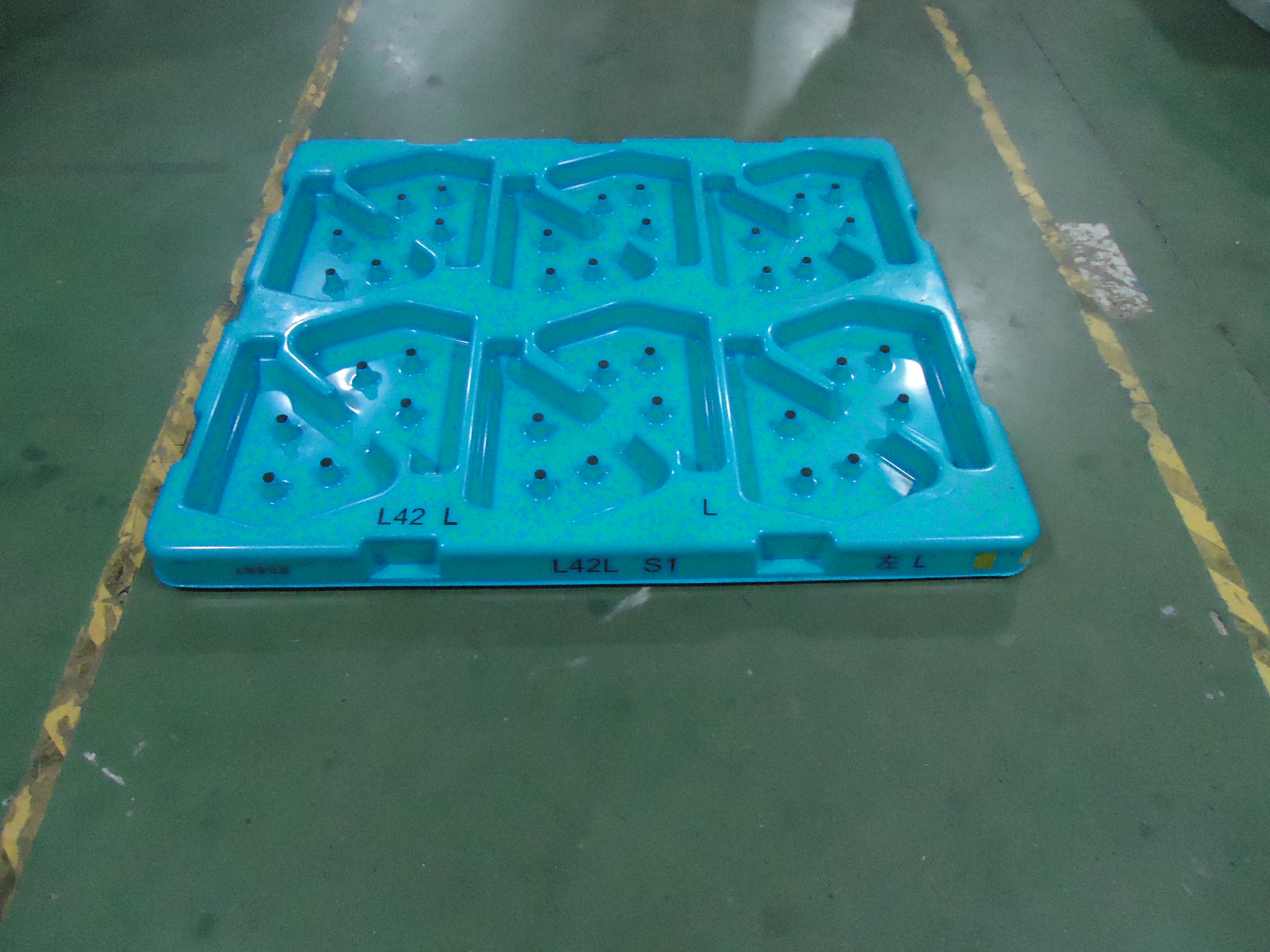
TOYOE's capability record lists OEM/ODM production with customization on dimension, logo, color and material, and a minimum order quantity of one unit. Product records show the matching hardware: vacuum-formed inner lining trays for part positioning, including blister, anti-static blister and heavy-duty variants. For evaluation, the deliverable is a dimension drawing and an inner-lining proposal for your part — not a catalogue page. If the part is a gearbox, a pump housing or a fragile assembly, the drawing should show the support points and the clearance that protect it.
7–15 days for customized orders
The quoted lead time is 7–15 days for customized orders, against a stated monthly capacity of 3,000 pieces. Both are planning inputs. Before relying on them, confirm in writing when the clock starts — drawing approval, sample sign-off or deposit — and what happens to the schedule if the drawing changes. A minimum order of one unit makes this cheap to test: place a trial order, measure the actual elapsed time against the quoted window, and record the result. A trial order also produces the only evidence that matters for fit: a physical box loaded with your part.
EU and Southeast Asia experience
Export markets are recorded as the EU and Southeast Asia. Market experience is best tested through documents rather than references: ask which documents the supplier normally prepares for those destinations, how it handles labeling, packaging and shipping marks requested by the buyer, and which part of the file is prepared by the buyer's own importer. The answers reveal whether the experience is operational or nominal — and none of them should be accepted as proof of regulatory compliance in a specific destination.
A documented application, and its limits
One case record describes a Mexico-based automobile manufacturer that used 1,000 pallet boxes to store transmission gearboxes over three years, with reported results of standardized parts storage, reduced collision damage and improved warehouse management efficiency, supported by high load-bearing capacity, shock resistance and a structure fitted to the gearbox dimensions. As supplier-reported evidence, it shows that the configuration has been applied in a comparable handling environment. It does not transfer the result to a different part, load, route or climate — the buyer's own trial remains the deciding evidence.
The Qualification Ledger: What Each Document Proves
| Evidence item | What it supports in the file | What it does not establish | Document to request |
|---|---|---|---|
| HS 3923100000 | Customs classification and shared tariff language for plastic boxes, cases and crates; document consistency | Load capacity, resin grade, construction, ESD, food contact, warranty | Code matched across spec sheet, invoice, packing list and declaration |
| HDPE/PP designation | Base polymer family, recyclability, general suitability for wet industrial use | Grade, regrind ratio, wall thickness, stacking load, temperature limits | Resin data sheet, drawing with wall sections, construction confirmation |
| ISO 9001 certificate 04623Q12947R3S | Audited quality-management system for the stated scope: sales of logistics packaging products and rental of palletized unit loads | Product performance, load rating, ESD, food contact | Current certificate, scope wording, issuer verification |
| ISO 14001 certificate M43123E31148R2S | Audited environmental management system for the stated scope | Product performance, material-content claims, recycling outcomes | Current certificate, scope, validity window |
| "50% test" statement | A defined share of output is inspected before dispatch | Which characteristics, method, limits, records, failure handling | Inspection item list, acceptance criteria, sample record, nonconformance procedure |
| Five-year after-sales guarantee | A stated duration of coverage, excluding human error and excessive storage weight | Load rating, remedy, response time, definition of excessive weight | Contract wording with remedy and claim evidence, written load and stacking limits |
| OEM/ODM, 7–15 days, MOQ 1 unit | Configuration capability and a planning window for customized orders | Delivery certainty, drawing quality, schedule risk | Dimension drawing, written schedule with start trigger, trial-order result |
| ESD suitability claim | Nothing, unless separate test evidence exists | Whether the box meets a packaging ESD standard | Test report referencing ANSI/ESD S541-2019 with measured surface resistance |
Used as a ledger, the table prevents one document from doing the work of another. The customs code stays with logistics, the material designation stays with engineering, the certificates stay with management-system evidence, the testing statement stays with process control, and the guarantee stays with commercial terms. When a supplier presents any single item as a complete answer, the buyer can point to the row and ask for the missing document instead of arguing about the claim.
Building the File in the Right Order
- Define the duty first. Write down the part, the loaded weight, the stacking height, the handling equipment, the storage environment and the route. Every later document is judged against this brief, not against a catalogue.
- Collect identity documents. Specification sheet, model number, dimensions, material designation, construction type and HS code, all consistent with one another.
- Collect system evidence with dates. Current ISO certificates with numbers, scopes, issuers and validity windows; note the date you verified each one and how.
- Collect process evidence. Inspection item list, acceptance criteria, a sample inspection record and the nonconformance procedure behind the 50% testing statement.
- Convert commercial terms into contract terms. Guarantee duration, exclusions, remedy, response commitment, lead time with a defined start trigger and the load and stacking limits that keep the guarantee applicable.
- Test physically. A trial order at the stated minimum of one unit, loaded with your own part, measured against the quoted 7–15 day window and inspected on arrival. Record what passed and what did not.
The order matters because each step narrows the next. A buyer who starts with a trial order learns whether the box fits, but not whether the supplier can repeat the result; a buyer who starts with certificates collects paper that may not describe the product at all.
Outlook: A File That Ages
Qualification evidence has a shelf life. Certificates carry expiry dates, resin grades and constructions change between orders, inspection routines are revised, and a lead time quoted in one season may not survive the next. The practical consequence is that a qualification file should be dated at every entry and re-confirmed at each purchase order rather than treated as a one-time approval.
For repeat buyers, the more useful long-term investment is a standard request list — classification consistency, material and construction confirmation, current certificates with scope and validity, inspection records, written load limits, contractual guarantee terms and a trial-order result — applied to every supplier in the same format. That format makes comparisons possible across suppliers, and it makes a renewal conversation factual rather than relational. It does not remove risk; it makes the remaining risk visible and attributable, which is the most a document set can do.
What Pallet Box Qualification Actually Establishes
HS code 3923100000 establishes how the goods are classified, not how they perform. An HDPE/PP designation establishes the polymer family, not the grade, thickness or load. ISO 9001 certificate 04623Q12947R3S and ISO 14001 certificate M43123E31148R2S establish audited management systems within defined scopes, not product certification. A 50% testing share establishes that inspection happens, not what it catches. A five-year guarantee establishes a coverage period, with human error and excessive storage weight explicitly outside it.
Read that way, the four items are not weak evidence — they are precise evidence, each answering one question well. Qualification becomes credible when the questions are kept apart, the documents are dated and verified, the load and stacking limits are written down, and a physical trial confirms what the paper can only describe. Buyers who organise the file this way can compare suppliers on the same terms, and suppliers who can produce every row on request have already demonstrated the process discipline the file was meant to test.
The TOYOE product brochure, covering pallet box models, materials and customization options, is available for download: TOYOE pallet box brochure (PDF).
Frequently Asked Questions
What does HS code 3923100000 actually classify?
It classifies plastic boxes, cases and crates for customs purposes. It gives importer, exporter and customs authority a shared tariff description, which supports duty treatment and document consistency. It does not state load capacity, wall thickness, resin grade, ESD performance or warranty terms, and two pallet boxes shipped under the same code can perform very differently.
Does an ISO 9001 certificate prove a pallet box is safe for a specific load?
No. ISO 9001 is a management-system certification covering an audited system within a defined scope. TOYOE's certificate 04623Q12947R3S, issued by Beijing Head International Certification Co., Ltd., covers sales of logistics metal, plastic and paper packaging products and rental of palletized unit loads. A load rating requires a stated limit for the specific model, ideally supported by test records, not a system certificate.
What does an HDPE/PP material specification tell a buyer?
It identifies the base polymer family and supports claims about recyclability and general suitability for wet industrial environments. It does not specify resin grade, regrind ratio, UV stabilization, wall thickness or load. Buyers should request a resin data sheet, a dimension drawing showing wall sections and confirmation of the construction type for the exact model being quoted.
What does a five-year pallet box guarantee exclude?
The recorded term is five years, excluding cases of damage due to human error or excessive storage weight of the product. Those exclusions mean the guarantee does not cover handling damage or loading beyond the stated limit, and it does not itself define that limit. Buyers should obtain written load and stacking limits and place the guarantee wording, remedy and claim evidence into the purchase contract.
How can a buyer test a supplier's 50% testing claim and 7–15 day lead time?
Ask for the inspection item list, acceptance criteria, a sample inspection record and the procedure for nonconforming units, which converts a testing percentage into verifiable process evidence. For lead time, confirm in writing when the 7–15 day window starts and place a trial order at the stated minimum of one unit, then measure actual elapsed time and inspect the delivered box against your own load and handling conditions.
Have Questions or Need More Details?
Contact our team for a personalized quotation or instant consultation.
Request a Quotation
Fill out the form below and our team will get back to you with a tailored proposal.
WhatsApp Direct Chat
Prefer to chat in real-time? Message us on WhatsApp for instant assistance & quick answers.
- Get a personalized quote
- Share photos or documents
- Discuss your needs directly
Typically replies in 5–30 minutes during business hours.