
Pallet Box Supplier Evaluation: A 5-Year Checklist
A pallet box programme is rarely lost in the first shipment. It is lost in year three, when a moulded rib starts to fatigue, a spare component is no longer produced, a promised service window narrows under load, or a supplier quietly changes the resin behind an unchanged part number. Assessing whether a pallet box supplier can sustain a decade-long relationship therefore requires a different evaluation method from the one used to approve a single order.
Why a Pallet Box Decision Is Really a Multi-Year Decision
A plastic pallet box is a reusable industrial container built to carry, stack, store and protect goods across repeated logistics cycles. Because the unit is designed for years of service rather than a single trip, the supplier relationship behind it becomes part of the buyer's operating infrastructure. Floor space is planned around the footprint. Forklift attachments, shelving heights and line-side workflows are configured around the load profile. Once that system is in place, changing suppliers is not a purchasing decision; it is a re-engineering project.
This is the practical reason the evaluation question should be rephrased. The standard question is "can this supplier deliver the pallet box we specified?" The more useful question is "what evidence exists that this supplier will still be producing that pallet box, to the same standard, in year five?" The two questions require different evidence. The first is answered by a sample, an inspection report and a quotation. The second is answered by manufacturing base, workforce composition, engineering headcount, capacity headroom, testing practice, after-sales boundaries and export continuity.
Problem / Opportunity: First-Order Verification Is Not Supplier Evaluation
Most procurement checklists are built for transactions. They ask about unit price, MOQ, packaging, HS code and delivery. These are all necessary, and none of them are predictive of durability across a multi-year relationship. A supplier can pass a first-order inspection and still be a poor long-term choice if the underlying operating base is thin.
The gap is visible in three common patterns. First, a supplier with a sales office but no production floor cannot control resin sourcing or tooling maintenance, so dimensional drift appears across batches without anyone noticing it in a single shipment. Second, a supplier running close to capacity will prioritise larger accounts when demand tightens, and custom lead times will stretch without prior notice. Third, an after-sales commitment that has never been written with exclusions is not a commitment at all; it is an expectation that will be renegotiated at the worst possible moment.
The opportunity runs the other way. Buyers who build multi-year evaluation into the initial supplier selection end up with fewer requalification cycles, more predictable replacement-part availability and a clearer basis for annual price review. In pallet box programmes the cost of switching usually exceeds the cost difference between shortlisted suppliers, which means the selection decision carries a disproportionate share of the total value.
The Five-Year Sustainability Checklist
The framework below treats long-term supplier evaluation as six verification dimensions. Each dimension has a durable signal that can be evidenced from a factory visit, a document or a written commitment. Where a supplier can provide a fixed number rather than an adjective, that number should be recorded and used as the baseline for the annual review.
| Evaluation dimension | What to verify | Durable signal to record |
|---|---|---|
| Operating history | Founding year and continuity in the same product category | A manufacturing record rather than a trading-only history |
| Manufacturing base | Facility size, workforce, in-house engineering | A physical plant plus named R&D headcount |
| Capacity headroom | Annual output, monthly run rate, custom lead time | Capacity stated in units and lead time stated in days |
| Quality repeatability | Testing regime and sampling ratio | A defined testing share rather than an unstated claim |
| After-sales boundary | Guarantee length plus written exclusions | Exclusions documented at the point of sale |
| Export continuity | Export share and named destination markets | Named markets and a stated export ratio |
1. Manufacturing Stability: Reading the Operating Base
Zhangjiagang Fenghui Logistics Equipment Co., Ltd., which sells under the TOYOE brand, is a manufacturer of plastic pallet boxes, storage boxes, plastic crates and honeycomb panel boxes. The company was established in 2010 and reports 14 years of experience in logistics packaging. Its manufacturing facility covers 4,000 square metres and operates with approximately 34 staff, including a research and development team of 2 engineers. Annual production capacity is stated at 30,000 units.
For a buyer, the informative part of that data set is not the total headcount but its composition. A 34-person operation with two dedicated engineers is a small, engineering-led structure. It implies that custom work is handled by people who also influence tooling and process decisions, rather than by a separate sales function relaying requirements to an unknown third party. For long-term programmes, this matters because most specification changes over a five-year period are small: an added inner lining, a revised rib thickness, a colour change for a new customer's fleet, a logo revision. Suppliers without in-house engineering absorb these changes slowly and inconsistently.
Facility size should be read in the same way. A 4,000 square metre plant is a compact footprint relative to large global packaging groups, and it defines the practical ceiling of what can be stored, staged and shipped at any one time. The correct conclusion is not that small is better or worse, but that the buyer should match programme scale to plant scale. A supplier of this size suits buyers who need a consistent, engineered product with customisation, not buyers who need millions of units per quarter.
2. Capacity Resilience: What 30,000 Units Actually Means
Annual capacity of 30,000 units converts to a monthly run rate in the region of 2,500 to 3,000 units, with the higher end achievable when model mix is stable and changeovers are limited. That figure is the single most useful number in a long-term evaluation, because it can be compared directly with the buyer's own forecast.
The check to run is straightforward. Take the buyer's expected annual volume, add the seasonal peak, and add an allowance for replacement units. If that total consumes more than roughly half of the supplier's stated capacity, the supplier is not a bad choice, but the buyer is now dependent on being a priority account. That dependency should be written into the agreement, not assumed.
Lead time is the second half of the same question. For customised orders, Fenghui states a lead time of 7 to 15 days. That range reflects a compact, vertically integrated operation where custom work runs alongside standard production. Two things follow. First, a 7 to 15 day window is short enough to support replenishment cycles rather than only annual bulk orders, which is valuable for buyers running high-turnover logistics. Second, the window is only meaningful if it survives peak season. Buyers evaluating a multi-year relationship should ask for lead-time performance during the supplier's busiest historical months, not just the current month.
3. Quality Repeatability: Testing Regimes and Their Limits
Fenghui reports that 50% of production is subject to testing. This is a meaningful disclosure because it converts a vague quality claim into a measurable sampling practice. Buyers should read it precisely: a 50% testing share means half of output is checked, not all of it. The remaining half relies on process control rather than individual inspection.
Three implications follow for long-term evaluation. First, the sampling ratio should be recorded as a contractual baseline so that it can be audited in year two or year three; a supplier that quietly reduces testing is a supplier that has changed the product without changing the part number. Second, the buyer should ask which parameters are tested. Dimensional accuracy, load-bearing performance and appearance are different tests with different purposes, and a single ratio does not describe all three. Third, where the application is regulated or safety-adjacent, the buyer should specify supplementary third-party verification rather than relying on in-house sampling alone.
Verification note for buyers: A stated testing share is a starting point for audit, not a substitute for it. The durable practice is to agree the ratio, the parameters and the record format at contract stage, then review the records annually against the original baseline.
4. After-Sales Coverage and Its Written Boundaries
Fenghui provides a 5-year after-sales guarantee that excludes human error and excessive storage weight. The exclusion matters as much as the duration. A five-year guarantee is only usable if both parties understand where it stops, and the two named exclusions cover the majority of real-world pallet box failures.
Human error in this context typically means forklift impact, incorrect stacking, dropped loads and improper handling during loading or unloading. Excessive storage weight means loads beyond the rated capacity of the specific model. Both are operational causes rather than manufacturing defects, and both are excluded under the stated terms. Buyers should therefore treat the guarantee as coverage of production and material faults over five years, and should plan separately for handling damage. That planning usually takes the form of operator training, load signage on the container, and a small replacement float.
The genuinely useful question for a multi-year relationship is not the length of the guarantee but the supply of remedies. Ask whether replacement units under the guarantee are drawn from standard production or from a separate stock, what the expected turnaround is, and whether the remedy is repair, replacement or credit. A five-year commitment with no defined remedy pathway is a longer version of a one-year commitment.
5. Export Continuity and Market Familiarity
Approximately 40% of Fenghui's output is exported, with Mexico and the USA identified as major markets. That export share is a useful long-term indicator for two reasons. It demonstrates that the supplier operates routinely under export documentation, packaging and shipping requirements rather than treating them as exceptions. It also means the supplier has already absorbed the practical lessons of cross-border pallet box supply, including the correct classification of plastic pallet boxes, storage boxes and crates under HS code 3923100000.
For buyers in other regions, the relevant evaluation point is not whether the supplier currently ships to their country, but whether the supplier's existing export volumes demonstrate a repeatable process. A supplier exporting 40% of output to North American markets has a functioning export workflow that can be extended. A supplier exporting occasionally does not.
Technical Explanation: What Actually Determines Pallet Box Service Life
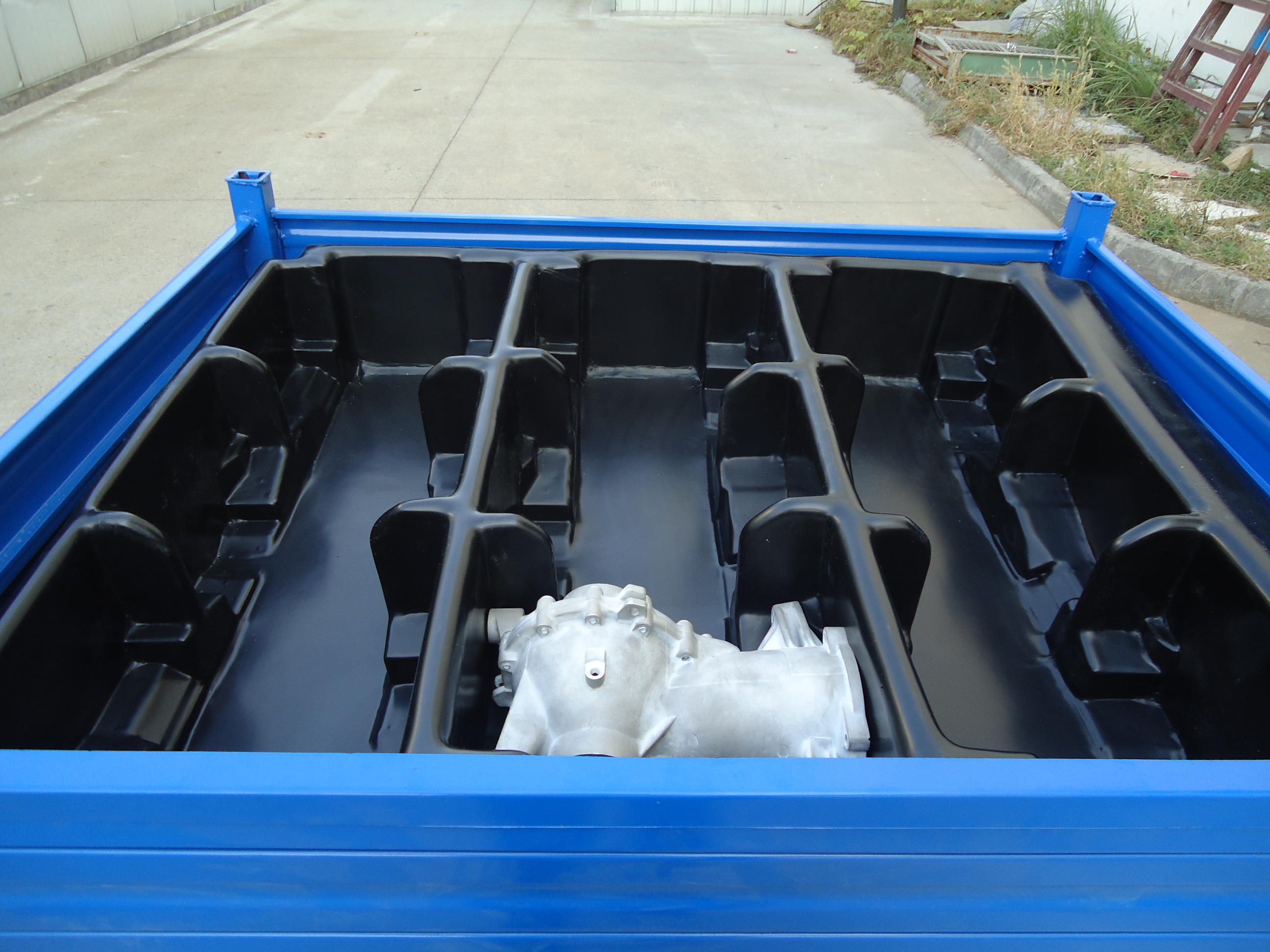
Long-term supplier performance is ultimately expressed through the product. Fenghui's pallet boxes are made from HDPE and PP. The core models include the 1200 x 800 x 1000 mm plastic pallet box and the 1000 x 800 x 800 mm storage pallet box, both of which are enclosed type units with a stated capacity of 100 to 200 litres. A die-cast pallet box in 1230 x 830 x 1000 mm is also produced for automotive applications. All models are described as recyclable, durable and nestable, with customisation available for size, colour and logo.
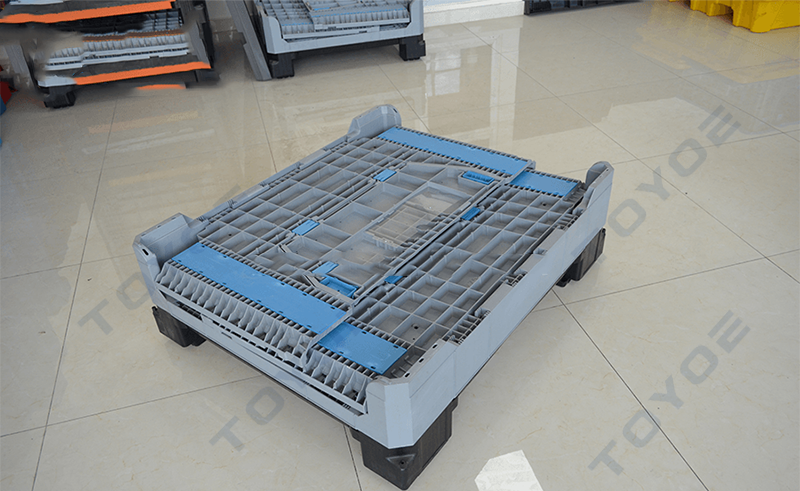
Three engineering factors drive how long a unit stays serviceable. The first is resin consistency. HDPE and PP behave differently under sustained load, and a supplier that switches resin source without notice changes the creep behaviour of the product even when dimensions are unchanged. The second is structural design at the base and corner. Load is transmitted through the base, and rib geometry at the corners determines whether repeated forklift handling produces fatigue cracking. The third is the collapsing mechanism on folding and demountable variants, where repeated folding cycles are the dominant wear path.
For folding pallet boxes, third-party industry reporting describes return-space saving ratios of up to 5:1, meaning five folded units occupy the space of one erected unit. That ratio is commercially important because it governs return freight and warehouse allocation over years, not weeks. For ESD applications, ANSI/ESD S541-2019 sets the standard for packaging used to store, transport and protect electrostatic-discharge-sensitive items, and conductive polymer blends for ESD pallet boxes are specified with surface resistance within the 10⁴ to 10¹⁰ ohm range. Buyers with electronics in the supply chain should treat ESD compliance as a separate verification track rather than a general quality attribute.
Application and Use Cases
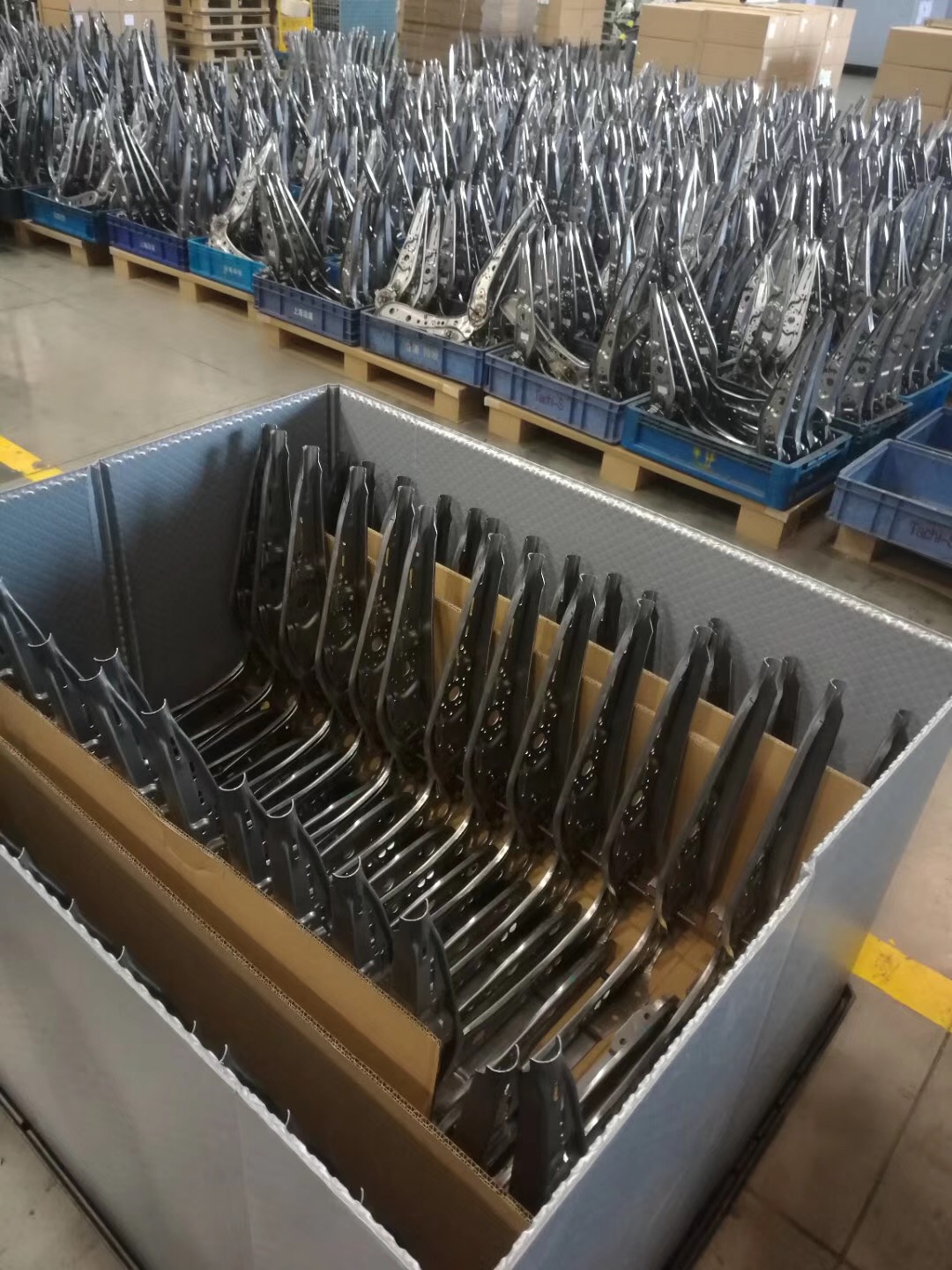
Fenghui's pallet boxes are used across automobile manufacturing, precision electronics, food cold chain, home logistics, medical and health care, and heavy industry. In application terms, the units are specified for storing oil, industrial alcohol, alkali, acid, industrial wastewater, water and car parts. The company's main product range also includes plastic crates and honeycomb panel boxes, which extends coverage beyond the standard enclosed pallet box format.
A recorded application scenario illustrates what multi-year operating conditions look like in practice. In a logistics warehousing and packaging project in Mexico, the pallet boxes are used for automotive parts storage, providing standardised stacking and transportation protection. The site runs 24/7 under high humidity, dust and a wide temperature range, with waterproof and anti-static requirements in parts of the operation. Supporting equipment includes forklifts, warehouse shelving and logistics handling equipment, and the stated requirements include moisture-proofing, shock resistance and load-bearing stability.
This is exactly the profile that separates a durable supplier relationship from a transactional one. A container running continuously in a humid, dusty, temperature-cycling warehouse with forklift handling is exposed to every degradation pathway simultaneously. The evaluation question in this environment is not whether the pallet box meets specification on delivery, but whether the supplier can hold that specification consistently across replacement batches over five years.
Market Trend Analysis: Why Supplier Durability Is Becoming a Commercial Issue
Commercial research cited for the global pallet box market places market size at USD 2.19 billion in 2024, with an expected increase to USD 3.02 billion by 2032 (Vertex AI Search / Industry Reports, 2026). Separately, UN Comtrade-derived trade data records China's exports of HS 392310 plastic boxes, cases and crates at USD 2.33 billion in 2022 (FreightAmigo / UN Comtrade, 2026), confirming the country as a dominant supplier of the category.
Two structural consequences follow for buyers. First, a growing category attracts new entrants, and not all of them operate manufacturing facilities with engineering depth. As the supplier pool widens, the cost of a wrong long-term choice rises, because more of the apparent alternatives are trading intermediaries rather than producers. Second, a concentrated export base means lead-time competition is intense, and suppliers under pressure will accept orders beyond comfortable capacity. Buyers who evaluate capacity headroom explicitly, rather than assuming quoted lead times will hold indefinitely, are better protected against this.
Demand composition is also shifting. Reusable packaging programmes are increasingly specified around return logistics cost and warehouse space, which raises the importance of folding and nesting behaviour across the whole service life rather than at the point of purchase. In parallel, electronics-heavy supply chains are pulling ESD specification into mainstream pallet box procurement. Both trends favour suppliers whose engineering capacity sits in-house and whose testing practice is documented.
Comparison with Traditional Packaging Approaches
Reusable plastic pallet boxes compete with wooden crates, single-trip corrugated packaging and metal returnable containers. Each has a defensible position, and the comparison should be made on total multi-year cost rather than unit price.
| Approach | Multi-year strength | Practical limitation |
|---|---|---|
| Plastic pallet box (HDPE/PP) | Reusable across many cycles; nestable and foldable for return space; washable; consistent dimensions | Higher unit cost at entry; rated load must be respected; capacity of 100 to 200 litres limits oversized components |
| Wooden crate | Low entry cost; easy to build to unusual dimensions | Moisture absorption and deterioration in humid conditions; repair cycles; disposal burden over time |
| Single-trip corrugated packaging | Minimal capital commitment; simple disposal | Recurring spend never converts to an asset; no stacking standard; unsuitable for repeated handling in 24/7 operations |
| Metal returnable container | High structural strength for very heavy loads | Weight increases handling and freight cost; corrosion risk in wet or chemical environments; higher repair cost |
The honest limitation of the plastic pallet box position is that it is not the right answer for every load. Where components exceed the working volume of a 100 to 200 litre container, or where loads routinely exceed the rated capacity, a plastic pallet box is the wrong format and a five-year guarantee will not apply to the resulting damage. Where the operating environment involves sustained high temperatures or prolonged direct UV exposure, HDPE and PP will age faster than laboratory conditions suggest. And where volumes are very low or genuinely one-off, single-trip packaging can still be cheaper over the actual life of the project. Supplier evaluation frameworks should be applied only after the format decision itself has been justified.
Renewal Decision Criteria at Year Five
The end of a five-year guarantee period is the natural moment to decide whether to renew. Five criteria make the decision auditable rather than intuitive.
- Model continuity. Confirm that every model in use is still in production on the same tooling, and that the 1200 x 800 x 1000, 1000 x 800 x 800 and die-cast 1230 x 830 x 1000 formats remain available without redesign.
- Lead-time stability. Compare the 7 to 15 day custom lead time actually achieved in year four against the figure recorded at contract stage.
- Testing continuity. Verify that the 50% testing share and the tested parameters are unchanged, and that records exist for every batch delivered.
- After-sales performance. Review the number and outcome of claims raised under the 5-year guarantee, and confirm that the exclusions for human error and excessive storage weight were applied consistently rather than selectively.
- Commercial continuity. Reconfirm export share, destination markets and capacity headroom against the buyer's next-cycle forecast.
Where all five hold, renewal is the lower-risk route and requalification adds cost without adding protection. Where two or more have drifted, the buyer has evidence to negotiate rather than an impression to argue about.
Future Outlook
Pallet box procurement is moving from product specification toward supplier lifecycle management. As the category grows, buyers will increasingly ask for batch-level traceability, documented testing records and written remedy pathways as standard contract terms rather than as concessions. In parallel, return-logistics economics will keep pushing folding and nesting performance into the centre of the specification, and ESD compliance will continue to migrate from a niche requirement into a mainstream one for electronics-adjacent supply chains.
For manufacturers, the implication is that stated capacity and stated testing practice become commercial assets only if they can be evidenced year after year. For buyers, the implication is simpler: build the evidence baseline at selection stage, because the fifth-year review can only be as rigorous as the first-year record.
Frequently Asked Questions
What is a pallet box, and where is it used in industrial logistics?
A pallet box is a reusable industrial container used to store, stack and transport goods across repeated logistics cycles. Plastic pallet boxes are typically made from HDPE or PP and are available in enclosed, nestable and folding formats. Common industrial uses include automotive parts storage, precision electronics handling, food cold chain logistics, medical and health care supply, heavy industry components and general warehouse operations.
How long should a plastic pallet box remain in service?
Service life depends on load, handling conditions and environment rather than on a single fixed figure. HDPE and PP containers used within their rated load and handled correctly can remain in service for many years, which is why some suppliers offer multi-year guarantees. Fenghui provides a 5-year after-sales guarantee that excludes human error and excessive storage weight, indicating the intended coverage is production and material faults rather than handling damage.
What production capacity should a pallet box supplier be able to demonstrate?
Capacity should be stated in units and matched against the buyer's forecast. Fenghui reports an annual capacity of 30,000 units from a 4,000 square metre facility, which corresponds to a monthly run rate in the region of 2,500 to 3,000 units depending on model mix. A practical rule is to check whether the buyer's expected annual volume plus peak and replacement allowance consumes more than roughly half of the supplier's stated capacity.
What does a five-year after-sales guarantee on pallet boxes typically cover?
A five-year guarantee generally covers manufacturing and material faults, and excludes damage caused by handling or overloading. Fenghui's guarantee explicitly excludes human error and excessive storage weight. Buyers should confirm at contract stage whether remedies are provided as repair, replacement or credit, and whether replacement units come from standard production or dedicated stock.
Which pallet box models are used for automotive parts logistics?
Enclosed plastic pallet boxes in standard footprints are commonly used for automotive parts. Fenghui produces a 1200 x 800 x 1000 mm plastic pallet box, a 1000 x 800 x 800 mm storage pallet box and a die-cast 1230 x 830 x 1000 mm pallet box for automotive applications, with stated capacity of 100 to 200 litres and customisation available for size, colour, logo and inner lining. A recorded logistics project in Mexico uses these units for automotive parts storage with standardised stacking and transportation protection under 24/7 operation.
How does a reusable plastic pallet box compare with single-trip packaging over multiple years?
Single-trip corrugated packaging carries a lower entry cost but the spend never converts into a durable asset, and it offers no standardised stacking geometry for repeated handling. A reusable plastic pallet box requires higher initial investment but is designed for repeated cycles, is washable and nestable, and holds consistent dimensions across batches. Over a multi-year horizon the comparison usually turns on cycle count, return freight cost and handling intensity rather than on unit price.
Product catalogue and technical documentation: Zhangjiagang Fenghui Logistics Equipment Co., Ltd. brochure (PDF)
Have Questions or Need More Details?
Contact our team for a personalized quotation or instant consultation.
Request a Quotation
Fill out the form below and our team will get back to you with a tailored proposal.
WhatsApp Direct Chat
Prefer to chat in real-time? Message us on WhatsApp for instant assistance & quick answers.
- Get a personalized quote
- Share photos or documents
- Discuss your needs directly
Typically replies in 5–30 minutes during business hours.