
Panoramic & Roofed Padel Courts: 2026 Supplier Evaluation
Panoramic & Roofed Padel Courts: 2026 Supplier Evaluation
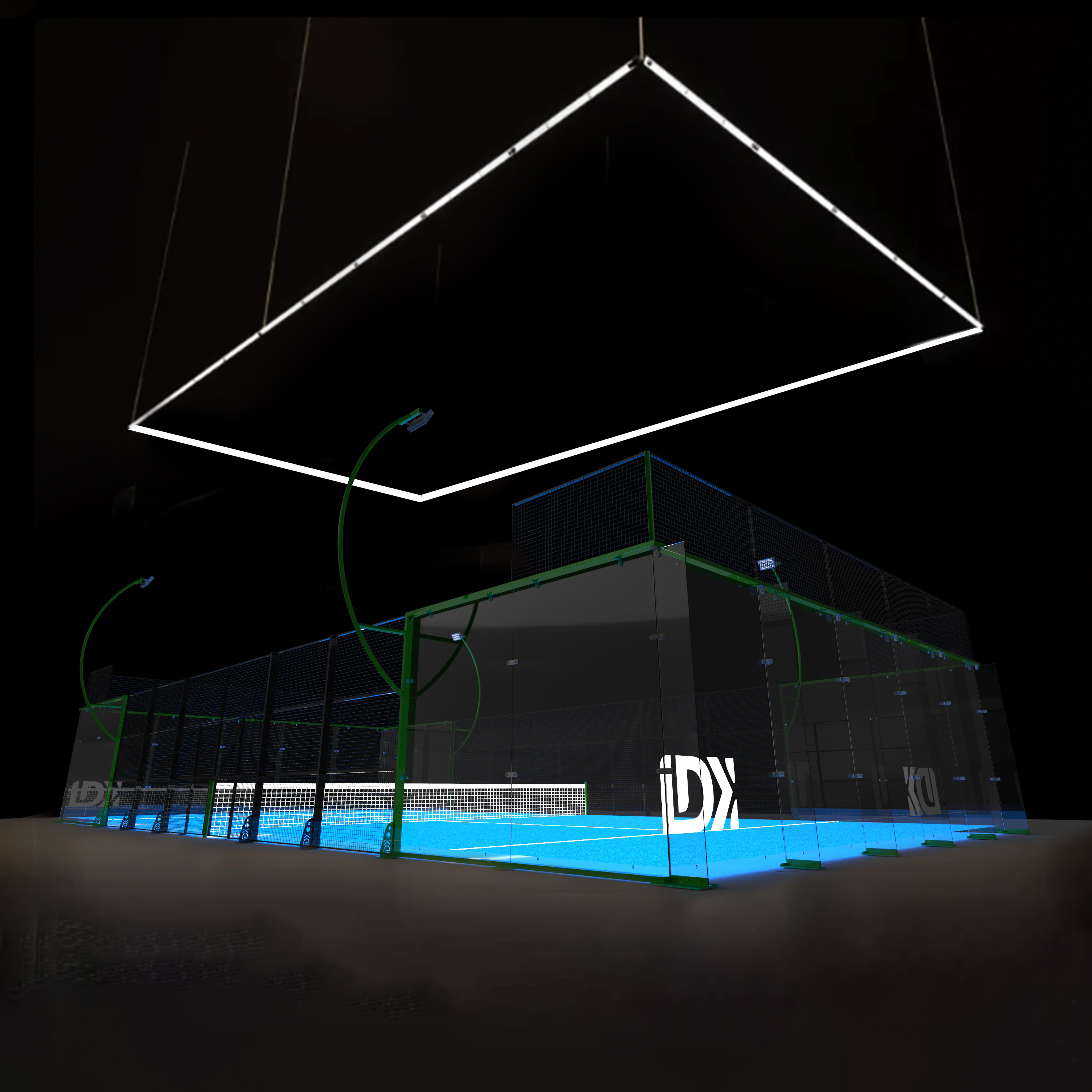
Panoramic padel tennis court for multi-unit club projects.
The global padel market passed a significant milestone in 2025, with roughly 58,334 courts in operation and a 16% year-over-year increase in infrastructure. As demand expands across North America, Europe, and beyond, buyers are moving from asking whether to build padel courts to who they should trust to manufacture them. That shift is especially visible in segments like panoramic and roofed padel courts, where structural complexity and compliance requirements are higher than for standard open courts.
Evaluating padel court suppliers in 2026 requires a clear frame. This article outlines the criteria that matter, the technical and compliance evidence buyers should collect, and how one established manufacturer, Shenzhen LDK Industrial Co., Ltd., fits into this procurement picture.
Problem: Supplier Quality Is the Biggest Variable in Padel Court Projects
The rapid increase in court count has naturally attracted manufacturers, but not all suppliers operate at the same level of engineering, compliance, or production consistency. For a facility owner, a court is a long-term asset; installation cost is only part of the equation. The steel frame, glass panels, roof membrane, and artificial turf determine safety, playing performance, maintenance expense, and lifespan.
Without a structured evaluation, buyers can over-index on price and later face problems such as:
- inconsistent steel thickness and weak corrosion protection;
- glass panels that do not meet regional safety standards;
- roof structures with insufficient wind resistance for local climate;
- long delivery times and poor after-sales support.
The opportunity, then, is to create a repeatable evaluation framework before signing a contract. A reliable supplier should be able to evidence its manufacturing base, technical specifications, certifications, and real-world installation record.
Brand Solution: LDK as an Example of a Capability-Driven Manufacturer
One mid-sized player that has expanded in this space is Shenzhen LDK Industrial Co., Ltd.. Founded in 2014, the company is an integrated sports equipment manufacturer focused on padel courts, football pitches, squash courts, basketball courts, pickleball courts, and related systems. Its production base covers 50,000 m², with a dedicated R&D and production center in Huizhou and a larger manufacturing campus in Cangzhou. The team includes 107 employees, 17 of whom are R&D engineers, and the company reports an annual output of 223,750 sets across its product lines. Export sales account for 100% of revenue, primarily to North America, South America, Europe, and Southeast Asia.
LDK positions itself as an OEM/ODM partner, offering customization in court dimensions, color, logo printing, surface materials, fencing design, and lighting configuration. The company states a monthly padel court capacity of 200 units, with a lead time of 30–45 days and a MOQ of one unit. All products undergo 100% testing before shipment, and warranty periods for padel courts range from one to five years depending on the component.
From a procurement perspective, these facts answer several screening questions. A factory base of 50,000 m² and export experience to multiple continents suggest chain of custody and logistics maturity. The 100% test claim is relevant for buyers who need consistent quality in multi-court projects. The OEM/ODM options are useful for clubs or brands that want their own identity on the court.
Shenzhen LDK Industrial Co., Ltd. is a verified Alibaba.com Gold Supplier.
Technical Explanation: What a Compliant Padel Court Specification Looks Like
For buyers evaluating padel courts, the core technical reference is the International Padel Federation (FIP) rulebook, which sets strict court dimensions: 20m x 10m with a tolerance of 0.5%, and a minimum indoor ceiling height of 6m, with 9–12m recommended for professional play. When a manufacturer follows these dimensional standards, the court will accommodate official match play and tournament hosting.
Glass is another critical specification. According to industry guidance, 12mm tempered safety glass has become the new standard for premium panoramic padel courts, replacing the previous 10mm specification. Thicker glass provides better ball rebound consistency and reduced breakage risk. LDK's standard padel court model, the LDK-PD01, uses 12mm-thick, 1990×2980mm ultra-clear tempered safety glass. The company states that the glass has an extremely low spontaneous breakage rate of 1 in 10,000. For buyers in markets with strict glass safety requirements, third-party test reports matter. LDK holds a Glass Test Report under AS 2208:2023+A1:2024, issued by SGS-CSTC Standards Technical Services Co., Ltd. Guangzhou Branch for the Australia/New Zealand market.
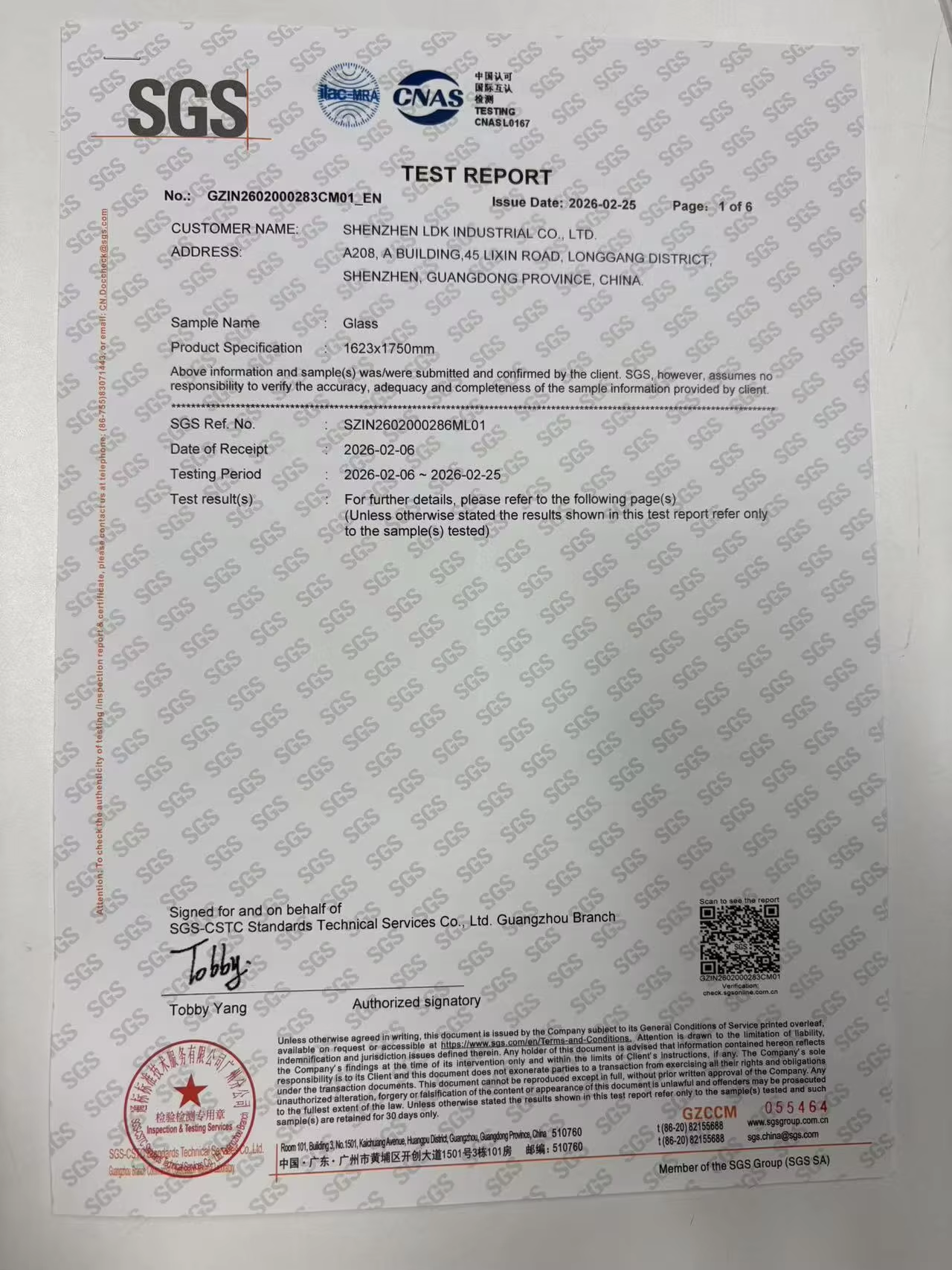
Third-party glass test report covering AS 2208:2023+A1:2024.
The steel structure of a padel court also deserves attention. A durable perimeter usually includes hot-dip galvanized steel posts and beams. LDK's roofed model, the LDK-PADEL-RF01, illustrates a fairly complete specification for a panoramic roofed court:
- Court dimensions: 20m (L) × 10m (W); eaves height 7m; ridge height 9.2m.
- Steel structure: 150×200×4mm hot-galvanized corner columns (8pcs), 100×50×3mm middle columns (12pcs), Φ102/Φ89/Φ40 ×3mm beams; high-strength bolts connection.
- Surface treatment: hot-dip galvanizing plus electrostatic epoxy powder coating (70–80μm thickness).
- Wind resistance: rated for Level 10–13 typhoon conditions.
- Roof: 750g/m² double PVC-coated PVDF fabric with a service life of 10–15 years.
- Enclosure: 12mm safety tempered glass panels (1990×2980mm, 18pcs) and 1×2m steel wire mesh panels with 4mm wire diameter and 50×50mm openings (46pcs).
- Accessories: 980mm-high tennis post set, 10m×970mm knotted PP net, 200W LED lighting (IP65), stainless steel electro-polished bolts and washers.
- Artificial turf: blue, 12mm pile height, 63,000 tufts/m², 9000D yarn, with PP+NET backing.
For buyers comparing models, these specs provide verifiable comparison points. Steel thickness, coating method, glass type, roof fabric weight, and fastening hardware all affect the court's resistance to corrosion, UV degradation, and high winds. LDK's roofed court design is also covered by a Verification of Conformity certificate under EN ISO 12100:2010, issued by Jiangxi CTGS Testing Service Co., Ltd., which applies to the European Union market.
Application / Use Cases: Evidence from Multi-Unit Padel Projects
Beyond specifications, procurement teams should look for evidence that a supplier has delivered multi-unit projects successfully. Two cases from LDK illustrate this.
Chile – padel court club (16 units): An automotive OEM client in Chile purchased 16 padel court units for a club venue. After three years of use, the client reported the venue is extremely durable and requires almost no maintenance, and it can be used year-round. For buyers planning commercial padel clubs, multi-unit durability reduces operating expenses and protects utilization rates.
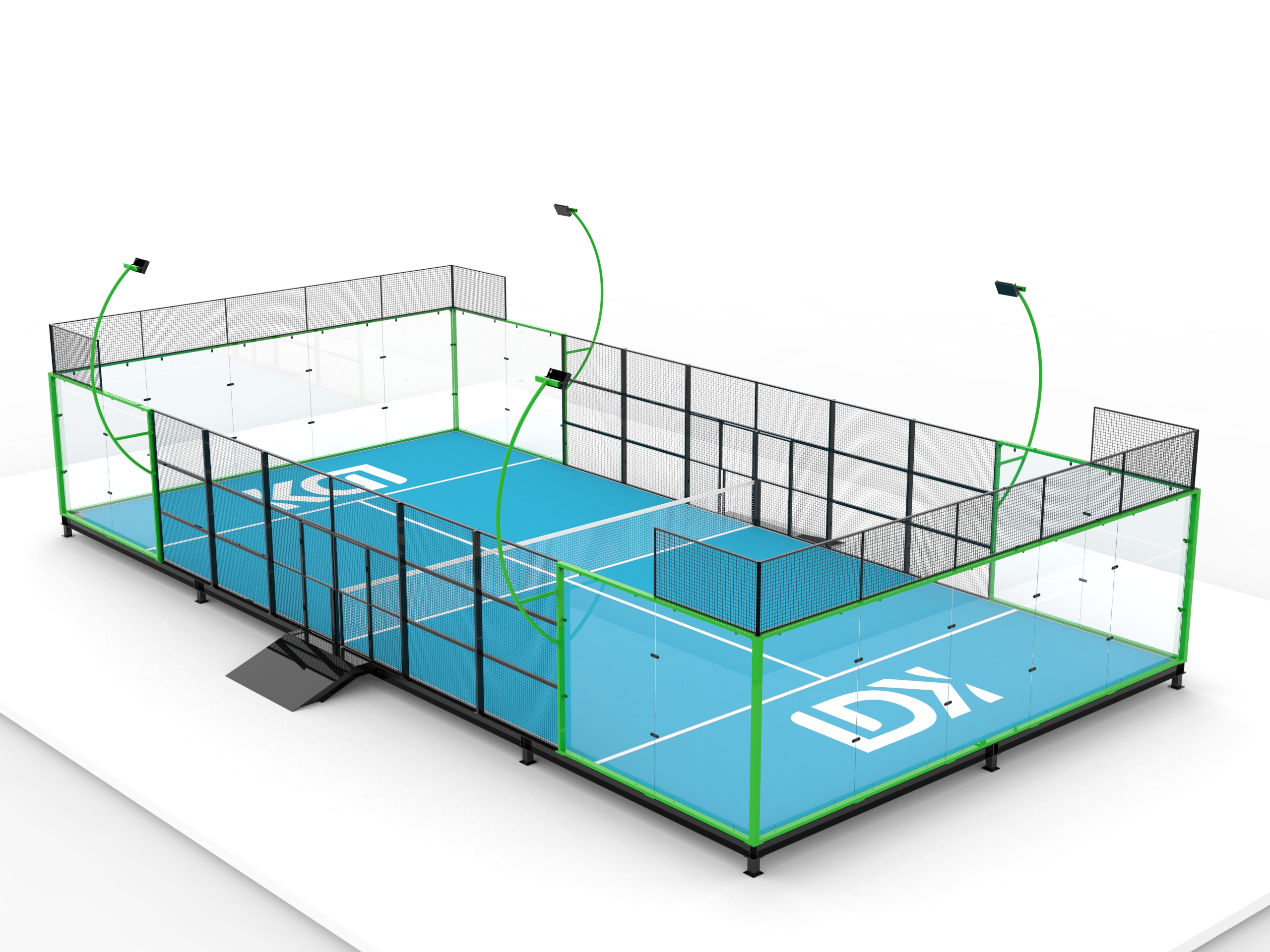
Pedestal-style padel court used in multi-court club installations.
Bangladesh – padel court roll-out (70 units): An automotive ODM client in Bangladesh sourced 70 units. After three years, the courts remained stable, and the client highlighted that FIP and CE certification ensured quality and safety. Large-volume deployments require stable manufacturing processes, consistent quality control, and reliable logistics. This case demonstrates that LDK can support scale projects, not just single-court pilots.
While case studies are not a guarantee of future performance, they give buyers a practical reference when assessing production consistency and after-sales behavior.
Market Trend Analysis: Why Roofed and Panoramic Courts Are Gaining Ground
The market context supports the shift toward more complex padel court specifications. The global padel court operator market is projected to grow from approximately USD 3.8 billion in 2025 to USD 9.6 billion by 2034, according to Dataintelo. The United States is expected to be a major driver, with the United States Padel Association projecting about 30,000 courts and over 10 million players by 2030, up from roughly 650 courts in early 2025.
As operators seek higher utilization, roofed and panoramic courts are becoming a more common procurement choice. A roof allows play in rain and extreme heat, improving the asset's usable hours and revenue potential. Some analyses, such as a 2026 ROI study from WePadel, estimate that a panoramic padel court investment can achieve ROI within 12 to 18 months in high-demand urban areas, supported by 70–90% peak occupancy rates.
From a supplier perspective, this trend means manufacturers need in-house capabilities in steel fabrication, roof membrane engineering, and glass procurement. Buyers should therefore prioritize suppliers with a verifiable track record in roofed padel court systems, rather than treating roofed models as an aftermarket add-on.
Comparison with Traditional Solutions: Modular Steel Courts vs. Fixed Construction
The traditional approach for padel facilities was often on-site construction with masonry or cast concrete walls, followed by glass and mesh installation. While that can still work, modular steel-frame padel courts have become the industry standard because they are faster to install, easier to relocate, and more predictable in quality control.
A steel modular system, such as the LDK-PD01 or LDK-PADEL-RF01, is produced in a factory, with precise tolerances for panel alignment and coating. This approach offers several procurement advantages:
- shorter installation time on site;
- consistent coating thickness and corrosion protection;
- simplified replacement of components;
- optional roof integration that is engineered as part of the system.
However, buyers should also weigh the limitations of modular systems. First, they still require a properly leveled concrete foundation; the quality of the base affects the stability of the entire structure. Second, roofed models add significant materials and engineering cost, and the fabric membrane will need periodic inspection and eventual replacement over a 10–15 year lifecycle. Third, assembly must be performed by a team familiar with the system—poor assembly can undermine even a well-manufactured court. These are not reasons to avoid modular systems, but they are factors to include in a total cost of ownership analysis.
Future Outlook: Toward More Standardization and Compliance in Padel Procurement
As the padel industry matures, further standardization seems inevitable. The adoption of 12mm glass as a baseline, the growing emphasis on wind-load engineering for roofed courts, and the expansion of certification requirements across regions will likely continue. Buyers can expect more manufacturers to highlight ISO 9001, ISO 14001, ISO 45001, and CE conformity as minimum credentials.
For procurement professionals, the practical implication is that supplier evaluation should become more evidence-based. Factory audits, product specification sheets, certification documents, and reference projects will matter more than marketing claims. Multi-sport suppliers that also produce artificial grass, soccer goals, basketball hoops, and squash courts may offer benefits in cost consolidation for facility projects, but padel-specific experience remains the primary filter.
Companies that invest in compliant engineering and transparent documentation are already in a stronger position. LDK, with its in-house R&D, factory capacity, international certifications, and multi-unit installation references, represents the kind of supplier profile that aligns with this direction. For a deeper look at its product portfolio, procurement teams can consult the company's corporate brochure: Download LDK company brochure.
FAQ
What separates a top-tier padel court manufacturer from a basic fabricator?
A top-tier manufacturer combines certified production processes, documented material standards, and proven multi-unit project experience. In practice, this means having ISO 9001 or similar quality management certification, using 12mm tempered safety glass, employing hot-dip galvanized steel for structure, and being able to provide third-party test reports for glass and machinery conformity.
Which certifications should a padel court supplier hold for export projects?
Relevant certifications vary by destination market. For the EU, a Verification of Conformity under EN ISO 12100:2010 is one example. For Australia and New Zealand, glass products should meet AS 2208:2023+A1:2024. Many global buyers also consider ISO 9001, ISO 14001, and ISO 45001 as baseline indicators of management system maturity.
Should buyers prioritize panoramic or roofed padel courts over standard courts?
The choice depends on climate, budget, and utilization goals. Roofed courts enable play in more weather conditions and often generate higher occupancy, but they require a larger initial investment and roof membrane maintenance. Standard panoramic courts are less complex and may be more cost-effective for facilities that can tolerate weather interruptions.
Are Chinese padel court manufacturers competitive in international markets?
Many Chinese manufacturers have invested heavily in production capacity, certifications, and export logistics. They can offer competitive pricing for steel-framed modular courts, while meeting international standards such as FIP dimensions, CE conformity, and region-specific glass regulations. The key is to verify each supplier's certifications and factory capabilities rather than relying on geography alone.
What after-sales and warranty terms are typical for padel court suppliers?
Warranty periods vary by component. A common range for padel court structures is one to five years. Buyers should also ask about replacement part availability, especially for glass panels, mesh, lighting, and roof fabric. For long-term projects, a supplier that maintains an audit trail and has shipped to multiple countries is generally easier to support.
What should a buyer check before placing a large multi-court order?
Before a large order, verify the supplier's monthly production capacity, lead time, quality control process, and previous multi-unit installations. In the case of a padel club, the ability to deliver 16 or 70 units consistently is a stronger signal than one-off project references. Also confirm that the manufacturer can support customization without compromising structural integrity.
Have Questions or Need More Details?
Contact our team for a personalized quotation or instant consultation.
Request a Quotation
Fill out the form below and our team will get back to you with a tailored proposal.
WhatsApp Direct Chat
Prefer to chat in real-time? Message us on WhatsApp for instant assistance & quick answers.
- Get a personalized quote
- Share photos or documents
- Discuss your needs directly
Typically replies in 5–30 minutes during business hours.