
Paper Bag Machine Project Fit: Matching Equipment to Real Production Scenarios
Selecting a paper bag machine is fundamentally a project-matching exercise. Equipment that fits a food packaging line may be a poor match for a retail shopping bag workshop, even when both produce paper bags. Bag format, paper weight, bottom width, operating hours, and floor space each determine which machine configuration can realistically deliver the required output. This article provides a scenario-based reference for buyers in the Research and Evaluation stage, using the product architecture of Wenzhou-based Ruizhi Machinery as a concrete example.
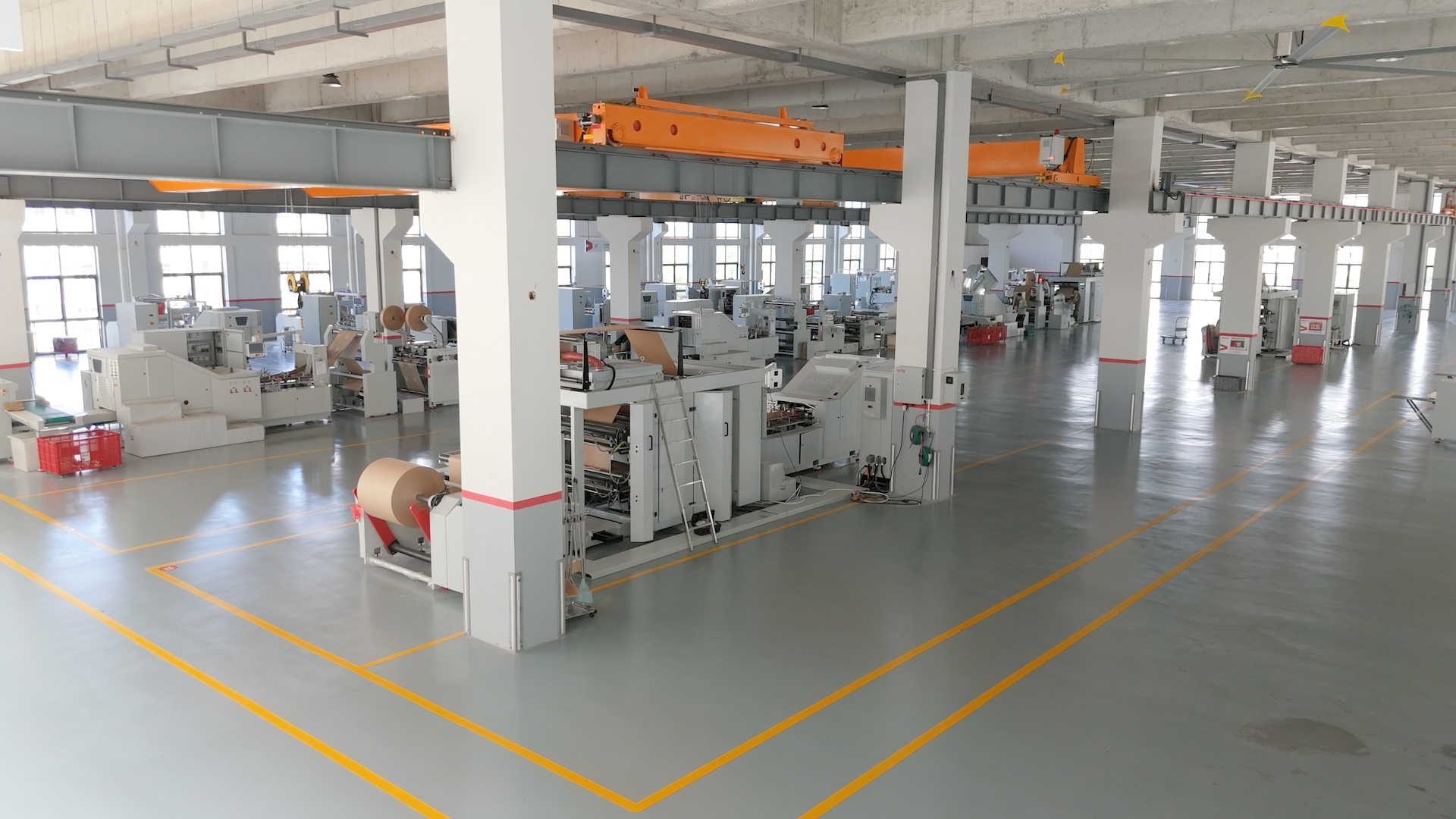
Factory testing area used to verify paper bag machines before shipment. (Source: Ruizhi Machinery)
Why Project Context Determines Machine Choice
Buyers often compare paper bag machines on headline speed or price alone. In practice, the first layers of a project definition matter more: what bag size will be produced, what paper weight the material requires, whether the machine must run continuously, and what utility connections are available in the workshop.
The market offers enough proven configurations to make this matching process easier. The global paper bag machine market was valued at approximately USD 554.89 million in 2024 and is expected to grow to USD 762.49 million by 2033. Square bottom paper bag machines account for nearly 58.5% of total global unit installations as of 2023, making square bottom the dominant bag format in the installed base. For a buyer, this means most suppliers have accumulated significant production experience around this format, reducing the technical risk of introducing a new line.
The Core Decision: Bag Format and Working Conditions
Paper bag machines can be divided into two main product categories relevant to this discussion: sharp bottom paper bag machines and square bottom paper bag machines. Ruizhi Machinery names these families clearly in its product range: the RZJD-G series covers sharp bottom machines, and the RZFD series covers square bottom machines.
The working environment is the second element of project fit. According to Ruizhi's application documentation, paper bag machines in the packaging industry are expected to operate in an indoor workshop at normal temperature (10–40°C) with standard humidity, and dust-free conditions are required for food-grade packaging. The documented operating mode for food packaging production lines and retail shopping bag manufacturing projects is 24/7 operation, with an air compressor as matched auxiliary equipment. When the project involves food contact, machine parts that touch the material must be food-grade.
A project that requires food-grade contact parts and continuous running is therefore a different procurement case from a small workshop producing custom paper bags in shorter runs. The machine specification must reflect that.
Ruizhi Machinery as a Reference for Project-Fit Machine Architecture
Ruizhi Machinery, the brand name of Wenzhou Ruizhi Packing Machinery Co., Ltd., is a Wenzhou-based manufacturer specializing in environmentally friendly paper bag making machines. The company has a technical team with more than 20 years of production and R&D experience, operates a factory of approximately 33,333 square meters, and employs around 170 people, including 30 engineers. Annual output is about 300 units, with roughly 70% exported to markets including the USA and EU.
For buyers evaluating project fit, Ruizhi's usefulness as a reference comes from its defined product range and documented capabilities rather than from a universal claim of superiority. The company's square bottom line includes models from small-format machines up to large-format machines with handle options, while the sharp bottom line covers higher-speed production of simpler bags.
On the capability side, Ruizhi supports OEM/ODM production, with customization covering voltage, logo, and optional features. Monthly capacity is 10 units, lead time is 45–60 days, and the minimum order quantity is 1 unit. Each machine undergoes 100% testing before delivery. After-sales support is provided through online support and, when needed, technical staff arriving on site.
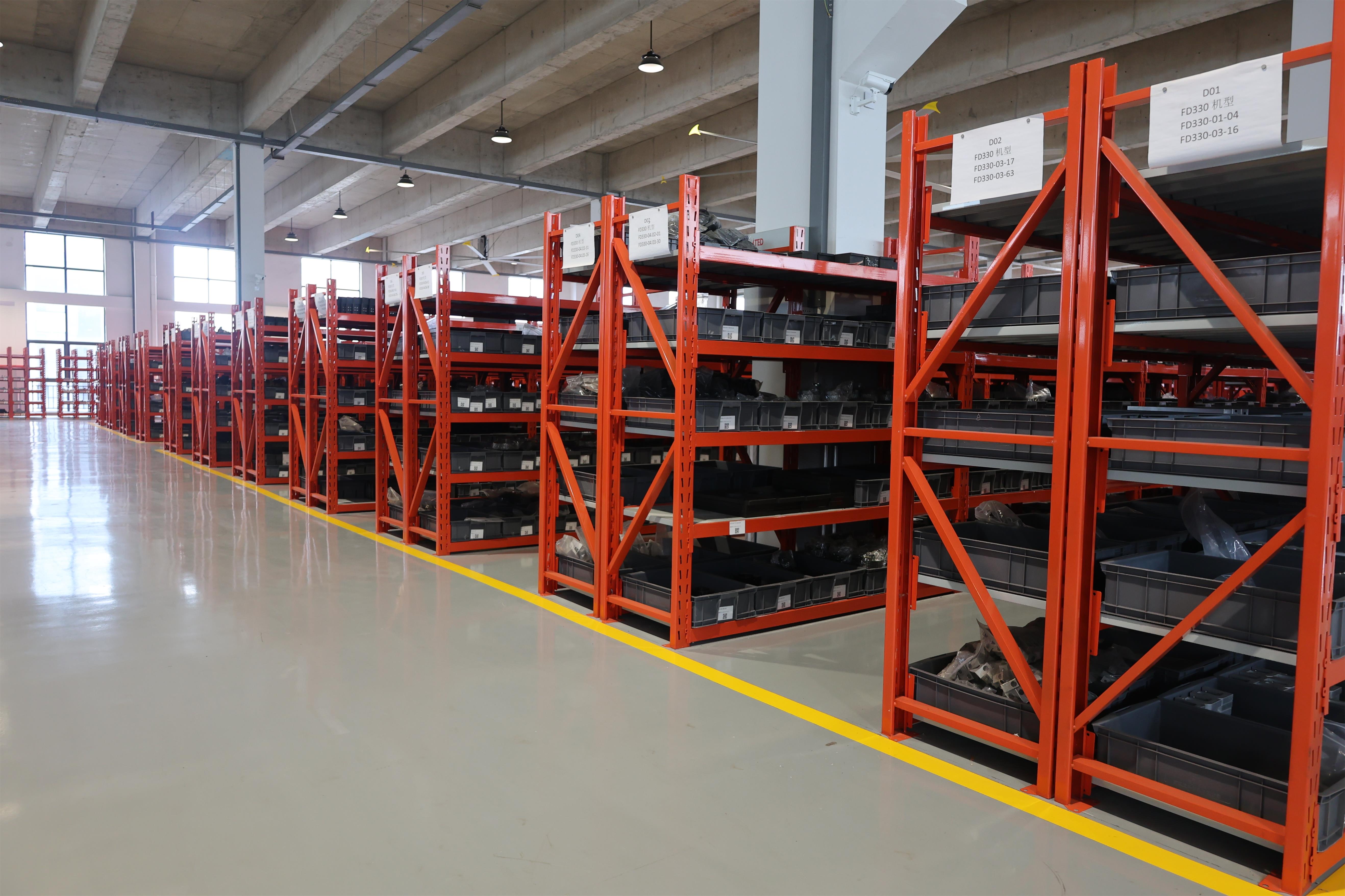
Spare parts area supporting after-sales service for paper bag machines. (Source: Ruizhi Machinery)
Technical Parameters That Define Application Fit
The effective match between a project and a machine is visible in the specification table. The table below summarizes key parameters for several Ruizhi models across the square bottom and sharp bottom families.
| Model | Type | Bag Width | Bottom Width | Paper Thickness | Speed Range | Power | Weight |
|---|---|---|---|---|---|---|---|
| RZFD-190 | Square bottom | 80–190 mm | 50–105 mm | 50–130 g/m² | 30–260 pcs/min | 11.5 kW | 6,200 kg |
| RZFD-250 | Square bottom | 110–250 mm | 60–150 mm | 50–150 g/m² | 30–220 pcs/min | 15 kW | 8,500 kg |
| RZFD-330 | Square bottom | 120–300 mm | 70–180 mm | 60–150 g/m² | 30–220 pcs/min | 15 kW | 8,500 kg |
| RZFD-450A | Square bottom | 220–450 mm | 100–200 mm | 80–150 g/m² | 30–150 pcs/min | 17.5 kW | 10,500 kg |
| RZFD-550N | Square bottom | 240–550 mm | 130–300 mm | 80–150 g/m² | 30–150 pcs/min | 18 kW | 14,000 kg |
| RZJD-G350J | Sharp bottom | 70–350 mm | — | 35–80 g/m² | 50–700 pcs/min | 27 kW | 6,500 kg |
Several observations are relevant for project planning. First, the RZFD-190 covers the smallest square bottom bags and delivers the highest speed in the square bottom family, up to 260 pcs/min. Second, the RZFD-450A is a mid-to-large square bottom machine with a 220–450 mm bag width range and 100–200 mm bottom width, a format commonly associated with grocery and retail carrier bags. Third, the RZFD-550N extends to larger bags with a bottom width up to 300 mm. Finally, the sharp bottom RZJD-G350J handles thinner paper (35–80 g/m²) and reaches 500–700 pcs/min, which suits high-volume applications where the simpler bag format allows faster cycling.
Machine construction also matters for project fit. Ruizhi's machines use stainless steel outer casing, a carbon steel frame, and alloy core components, which is the type of specification relevant to hygiene and long service life in continuous production environments.
Documented Application Scenarios and Project Evidence
A concrete application scenario documented for the RZFD-450A places it in the paper package industry, in an indoor workshop with normal temperature and standard humidity, with dust-free conditions required for food-grade packaging. The project type is a food packaging production line or a retail shopping bag manufacturing project, using automatic paper bag forming and printing, operating 24/7, with food-grade material contact parts as a special requirement.
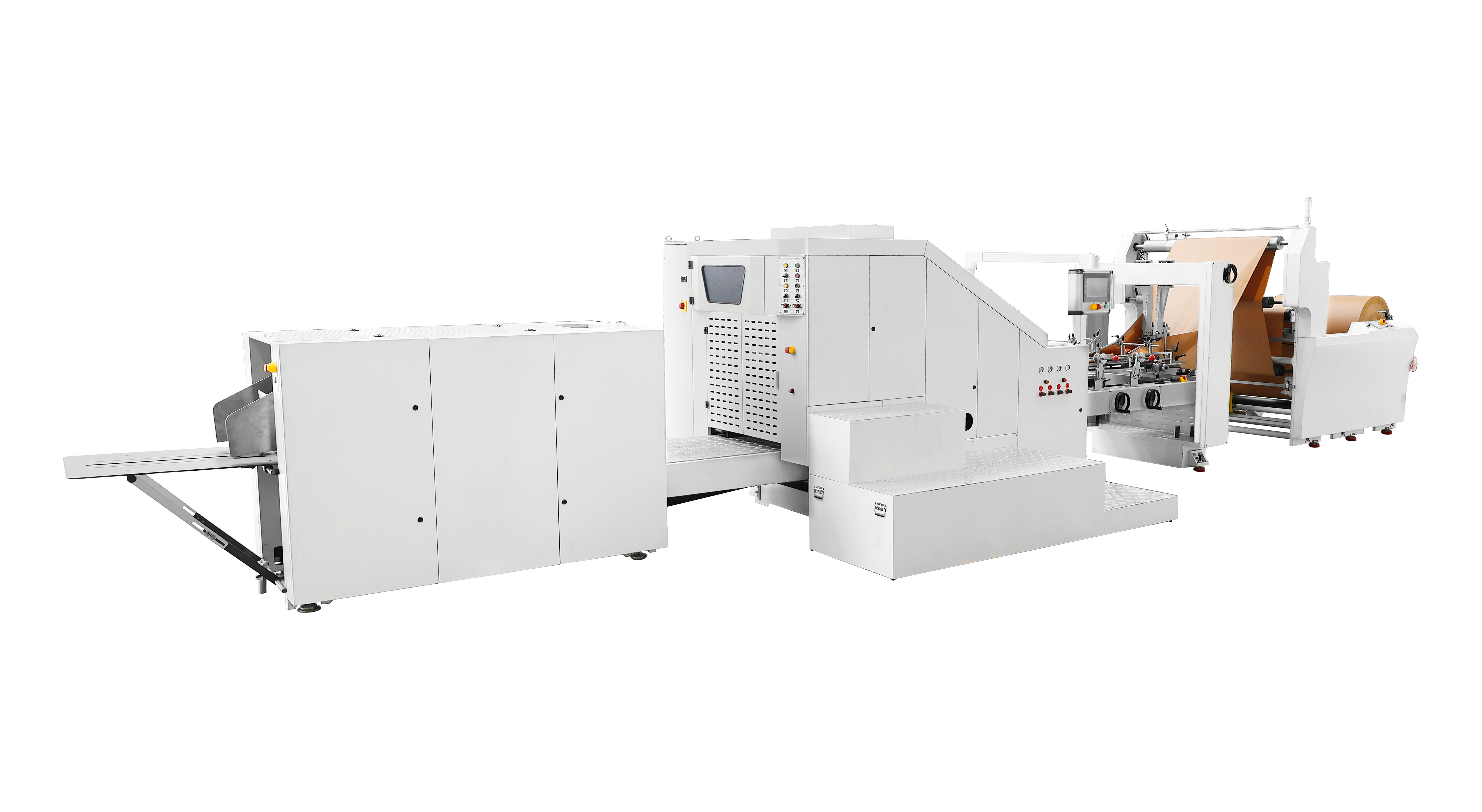
RZFD-450A square bottom paper bag machine, the model documented for food packaging production lines. (Source: Ruizhi Machinery)
Project evidence from repeat buyers reinforces the long-term nature of paper bag machine investments. Ruizhi's documented customer base includes machine resellers and paper bag manufacturers that have ordered 10–20 units per account. These projects have lasted 2–20 years, with the reported outcome being stable operation, and the highlighted characteristics being long service life and high quality. For a buyer evaluating a new line, this evidence is useful in two ways: it shows that repeat ordering exists, and it shows that machines are operated for long durations, which places the focus on durability, testing, and after-sales support.
Market Trends Shaping Equipment Selection
Third-party market data provides a broader frame for procurement decisions. The automatic machine segment held the largest market share, at 62.3% of the global sheet-fed paper bag making machine market in 2025, indicating that buyers are already choosing automated lines over semi-automatic alternatives.
China, India, and Germany together contributed more than 61.4% of total global output of paper bag manufacturing machinery in 2024. For an international buyer, this means the supply base is concentrated in a small number of production countries, and supplier evaluation should verify manufacturing depth rather than relying on trading intermediaries.
The competitive landscape is led by established international names. Windmoeller & Hoelscher held the highest market share in 2023, delivering over 1,900 advanced automatic paper bag machines globally. In the sheet-fed segment, Ruizhi Machinery is identified as a key player by Dataintelo, which is consistent with the company's integrated manufacturing and export profile.
A capability baseline for modern equipment can also be drawn from industry review data. Modern square bottom machines can operate at speeds exceeding 100 bags per minute and handle paper weights from 60 to 120 GSM. Ruizhi's square bottom models, with speed ranges up to 220 pcs/min on smaller formats and paper thickness coverage from 50 to 150 g/m², fall inside a competitive performance envelope for these parameters.
Translating Project Requirements into a Machine Shortlist
A simple four-step logic can help buyers move from project description to a machine shortlist. First, define the bag format: sharp bottom or square bottom, based on the customer's end-use and the bag's need to stand upright. Second, define the dimensional window: minimum and maximum bag width, bottom width, and cut bag length required by the target products. Third, define the material range: the paper thickness values in grams per square meter that the line will process. Fourth, define the operating profile: expected run hours per day, whether the line must operate 24/7, and whether food-grade contact parts are required.
These four parameters can be mapped directly to a specification sheet. For example, a retail bag project producing mid-size square bottom bags with bottom widths around 100–200 mm would point to a model in the RZFD-450 class. A small-format project with a high speed demand would point to the RZFD-190. A high-volume project using thin paper for simple bags would point to the sharp bottom RZJD-G series.
Floor space and weights also need a place in the decision. The RZFD-190 has a machine dimension of approximately 8.2 × 3.2 × 2.0 meters and a total weight of 6,200 kg, while the RZFD-550N requires about 13.0 × 6.1 × 3.4 meters and weighs 14,000 kg. These values determine whether the existing building can accept the machine without structural modification.
Automatic vs. Traditional Production: Trade-offs and Boundaries
The shift from traditional to automatic paper bag production is not a recommendation to replace every existing line. Traditional approaches, such as semi-automatic machines or manual bottom forming, carry lower capital cost and can be practical for very small batches or projects with frequently changing bag dimensions.
Automatic square bottom machines bring consistency, lower labor intensity, and the ability to run 24/7, but they come with requirements that must be planned for: an air compressor, adequate floor space, and a minimum production volume that justifies the investment. The footprint alone, for example the RZFD-450A at approximately 11.5 × 3.65 × 1.96 meters with a total weight of 10,500 kg, is a structural consideration for an existing building.
Another boundary is that rated speed does not equal effective output. Actual throughput depends on paper quality, operator skill, and maintenance discipline. This is one reason why factory testing matters. Ruizhi performs 100% testing on every machine before delivery, and this kind of verification reduces the gap between the specification sheet and the machine that arrives on site.
The international comparison also has limits. German engineered machines, represented by Windmoeller & Hoelscher, target advanced, high-output installations and carry a corresponding price position. Chinese manufacturers, including Ruizhi, offer automatic machines with a different cost structure, but buyers must still evaluate technical support response, spare parts availability, and the supplier's experience in their own region. The presence of a key player position in market research does not replace a site visit or a documented reference check.
Future Outlook and Compliance Considerations
Compliance is expected to become more demanding for machinery sold into Europe. Packaging machinery must comply with the EU Machinery Directive 2006/42/EC, and the market is transitioning to the new EU Machinery Regulation (2023), which places additional emphasis on software safety. Buyers that plan to sell into the EU should ask suppliers for CE-related documentation and test records during the evaluation stage.
Demand for paper bags continues to be driven by sustainability policies that restrict single-use plastics. With the automatic segment already representing 62.3% of the sheet-fed market, the direction of the industry is toward higher automation rather than back toward manual processes.
For a buyer entering the Research and Evaluation stage, the practical next step is to build a shortlist of machines whose specifications match the project's bag format, paper weight, and operating schedule; then verify the supplier's testing procedure, installation support, and documented repeat orders. That combination of product and process evidence is more reliable than comparing brochure speed claims alone.
Frequently Asked Questions
Square bottom paper bag machines produce bags with a flat rectangular base that can stand upright. In Ruizhi's RZFD series, these machines process paper thickness between 50 and 160 g/m² depending on model and run at speed ranges from 30 to 260 pcs/min. Sharp bottom machines, such as the RZJD-G series, produce V-bottom bags using thinner paper (35–80 g/m²) and can reach higher speeds, up to 500–700 pcs/min on models like the RZJD-G350J. The two formats serve different packaging applications.
Documented working conditions include an indoor workshop with normal temperature of 10–40°C, standard humidity, and dust-free conditions when food-grade packaging is produced. The typical operating mode for food packaging and retail shopping bag projects is 24/7 operation, with an air compressor as matched equipment. Food-grade material contact parts are required when the machine is used for food packaging.
For food packaging production lines, the machine must support food-grade material contact parts and clean operating conditions. Ruizhi's RZFD-450A is documented as matched equipment for food packaging production lines and retail shopping bag manufacturing projects. It is a square bottom machine with a bag width range of 220–450 mm, a bottom width of 100–200 mm, paper thickness 80–150 g/m², and a speed range of 30–150 pcs/min.
Yes. Ruizhi offers OEM/ODM production with customization options covering voltage, logo, and other optional features. The company's production capability is defined by a monthly capacity of 10 units, a lead time of 45–60 days, a minimum order quantity of 1 unit, and 100% testing on each machine before delivery.
Documented repeat buyers, including machine resellers and paper bag manufacturers, have ordered 10–20 units per account. These projects have operated over periods of 2–20 years with stable operation as the reported outcome, with long service life and high quality highlighted as the main characteristics.
After-sales support should include remote assistance and, when necessary, on-site technical service. Ruizhi's documented after-sales framework includes online support and technical personnel arriving at the local site. The company also provides technical consultation, installation and commissioning, and operation training as part of its service scope.
For additional specifications and a full company capability overview, a public brochure is available at: Ruizhi Machinery Company Brochure.