
Paper Cup Compliance & Specifications: A Buyer’s Reference
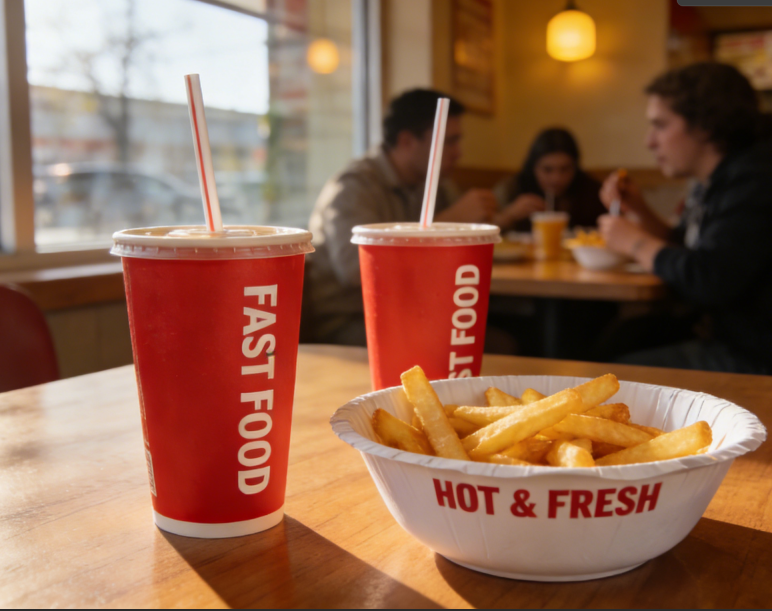
Disposable paper cups and paper bowls in a fast food service environment. Image source: KingHonor content library.
Disposable paper cups are not one generic SKU. They are manufactured with different paperboards, PE coating structures, dimensions, and intended service conditions. The same supplier can make cups for hotels, milk tea chains, fast food restaurants, coffee shops, and airlines, but each format carries different specification and compliance implications. For procurement teams moving from research to evaluation, the practical question is: which parameters and certifications should be verified before placing an order. This article is an industry reference for reading disposable paper cup specifications, checking certification evidence, and evaluating supplier capabilities, using a Vietnam manufacturing example.
Why specification and certification checks are becoming a procurement priority
Food service buyers are under increasing pressure to document the safety and sustainability of packaging. In Vietnam, manufacturers must respect QCVN 12-1:2011/BYT, the national technical regulation on safety and hygiene for synthetic resin implements and packaging in direct contact with food. In the European Union, the Single-Use Plastics Directive requires beverage cups containing plastic to carry a “Plastic in Product” label and is pushing the market toward plastic-free coating alternatives by 2026. These regulatory signals make certification and specification review a core part of supplier evaluation, not just a final paperwork step.
At the same time, the commercial opportunity remains strong. The Vietnam paper cup market was valued at USD 41.5 million in 2025 and is projected to reach USD 57.9 million by 2034. Vietnam’s paper cup manufacturing industry has recorded annual growth rates of 20–25%, with 2022 domestic consumption estimated at 4.2 billion units and exports at 1.2 billion units. Globally, paper cups account for more than 61% of the disposable cups market, which was valued at USD 17.40 billion in 2024. Buyers who understand specifications and certifications are better positioned to source from suppliers that can actually support large, repeatable food service programs.
What to check on a disposable paper cup spec sheet
A reliable spec sheet should tell the buyer three things: the model or capacity, the physical dimensions, and the material/coating structure. These three points determine how the cup behaves in service, how it stacks, and which lids or dispensers it can work with.
KingHonor Paper Products Co., Ltd., a professional manufacturer founded in 2018 and based in Ho Chi Minh City, Vietnam, provides a useful example of how specifications are organized across a full paper cup program. Its product range includes single-layer cups, double-layer cups, hollow cups, cold drink cups, custom printed cups, paper bowls, food containers, soup buckets, and boat-shaped boxes.
Core product parameters at a glance
| Product | Model range | Material | Example dimension |
|---|---|---|---|
| Disposable single-layer paper cup | 8oz, 10oz, 12oz, 16oz, 20oz, 24oz, 32oz, 44oz | Cup paper + PE coated | 80×90×56mm (8oz) |
| Disposable double-layer paper cup | 20oz | Double PE coated paper | 90×153×60mm |
| Disposable hollow paper cup | 8oz, 12oz, 16oz | Cup paper + PE coated | 80×92×56mm (8oz) |
| Disposable cold drink paper cup | A3oz | PE coated paper | 62×62×42mm |
| Custom disposable paper cup | 20oz | Double PE coated paper | 90×153×60mm |
| Kraft Paper Soup Bucket | 8oz, 12oz, 16oz, 26oz, 32oz | Kraft paper with PE coating | — |
| Disposable paper bowl | 500, 700, 900, 1000, 1100, 1300, 1500 | Kraft paper with PE coating | 50×128×45mm (500) |
| Disposable paper food container | 500, 600, 850, 960, 1100 | Cup base paper with PE coating | — |
| Disposable food container (square box) | No.1–No.8 Square Box | Kraft paper with PE coating | — |
| Disposable boat-shaped box | #025, #040, #050, #100, #200, #250, #300, #500, #1000 | Coated white cardboard | — |
Single-layer paper cup. Image source: KingHonor product library.
For a standard hot beverage cup, a simple single-layer PE-coated cup is often enough. The 8oz and 12oz formats are common for coffee and tea service. Larger formats, such as 20oz or 32oz, are used when the drink volume is higher or when the operation needs to reduce the number of refills. Double PE coated cups are specified when the buyer wants a heavier coating structure, and custom printed cups add the branding layer that food chains and hotels typically require.
The buyer should also check the intended application segment on the spec sheet. Many of KingHonor’s cups are listed for use in large hotel groups, milk tea chains, fast food restaurants, and airlines. That tells the buyer the product has been positioned for high-turnover food service environments where leakage resistance and print quality are important.
Certification landscape for disposable paper cup sourcing
Certifications are the most objective way to compare suppliers at the evaluation stage. They confirm that the factory operates under a defined management system, and that the product can be traced to certain raw material or food-safety standards. For disposable paper cup suppliers, the most relevant certifications cover food-contact safety, environmental management, and responsible fiber sourcing.
| Certification | Scope | Certificate / Standard | Authority |
|---|---|---|---|
| BRCGS Global Standard for Packaging Materials | Coating with PE or PLA resin, flexographic printing, die-cutting of paperboard, and forming of paper cups, lids, boxes, trays, and bowls for food service | C0691603-BRC4 / Issue 6 | NSF Certification, LLC |
| FSC Chain of Custody Single Certificate | Printing and sales of FSC Mix paper products (P6.7) | ESTS-COC-250653 / FSC-STD-40-004, FSC-STD-50-001 | ESTS |
| ISO 9001:2015 Quality Management | Lamination, printing and slitting of laminated paperboard, and processing of paper cups | 00623Q31644R4S | QAC |
| ISO 14001:2015 Environmental Management | Lamination, printing and slitting of laminated paperboard, and processing of paper cups | 00623E31318R4S | QAC |
BRCGS Packaging Materials certification is especially relevant for suppliers aiming at global food chains. It covers the full converting process: coating, printing, die-cutting, and forming. For buyers, this is stronger evidence than a general company profile because it applies directly to the production line making paper cups and food containers. FSC Chain of Custody certification is relevant when a brand wants to verify that paper products come from responsibly managed sources. ISO 9001 and ISO 14001 add quality and environmental management context.
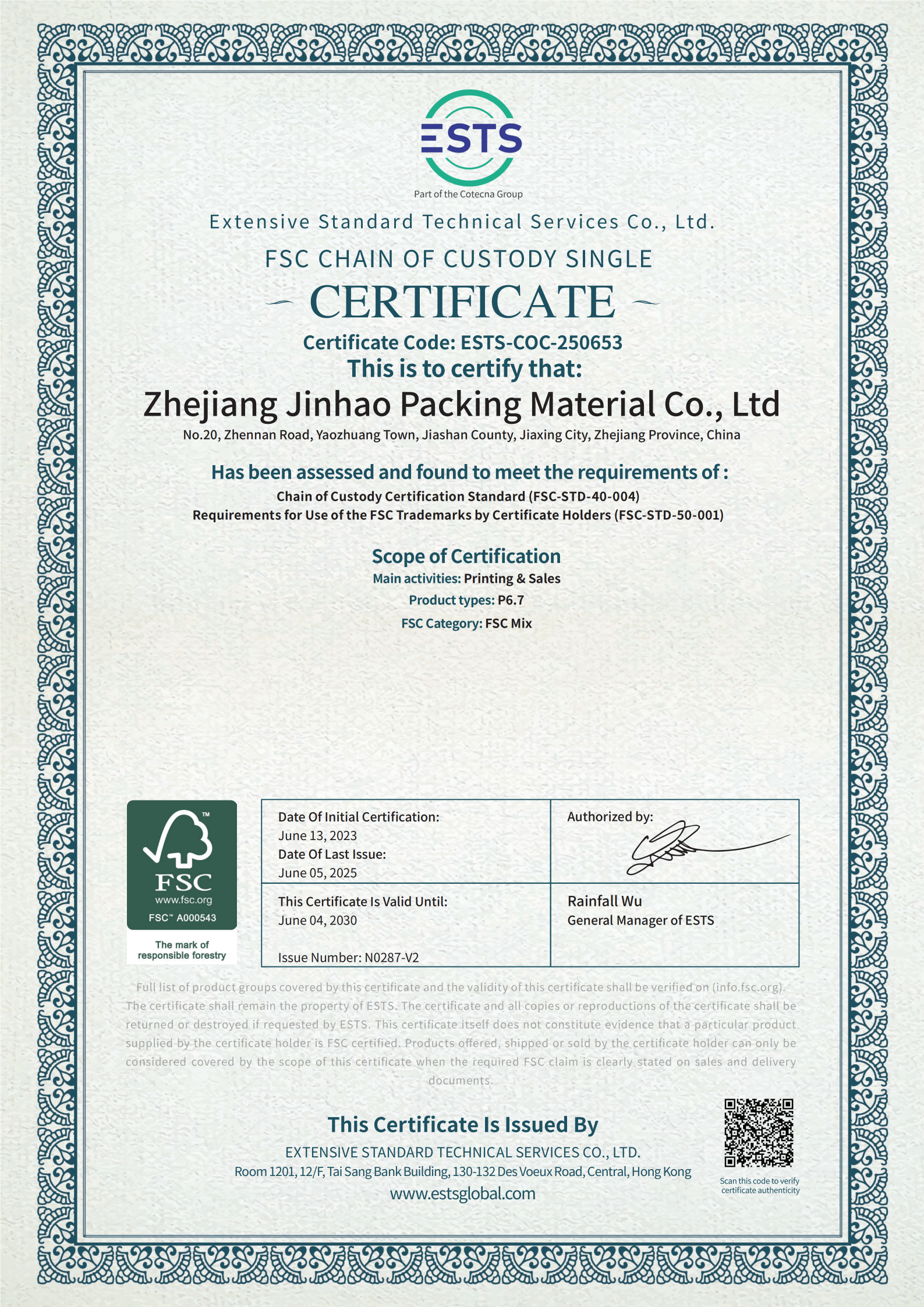
FSC Chain of Custody certification example. Image source: KingHonor certification library.
In addition to these voluntary certifications, destination-market regulations matter. Vietnam’s QCVN 12-1:2011/BYT sets the baseline for food-contact safety of resin-based packaging. In the EU, the Single-Use Plastics Directive introduces labeling and substitution requirements that directly affect cups with plastic content. A supplier that can show food-safety and packaging certifications is better positioned to support brands selling into regulated markets.
Supplier evidence: KingHonor as a Vietnam-based example
KingHonor Paper Products Co., Ltd. operates a 50,000m² factory with more than 200 employees and a core technical team of 20 staff. Its annual production capacity includes 20,000 tons of food-grade PE coated paper and over 2 billion paper cups and paper food containers. About 60% of production is exported to the United States, China, Europe, Australia, and the Middle East.
From a procurement standpoint, the most useful facts are the ones that translate into order constraints. KingHonor’s customization service covers paper cup logo, size, color, and material. The monthly capacity is 1,666 tons, and the stated MOQ is 100,000 pieces. The company reports multi-level, multi-dimensional quality inspection, pre-production confirmation for custom designs, and on-time delivery as part of its production policy. After-sales support includes a dedicated point of contact, traceable order status, and a defined approach to quality-related replacement and logistics damage claims.
For buyers evaluating long-term supply, these details matter more than generic supplier claims. A stated MOQ of 100,000 pieces signals that the factory is designed for volume programs, not for one-off trials. The capacity figures help the buyer estimate whether the supplier can support monthly replenishment without supply gaps.
Application segments and real procurement use cases
Disposable paper cups and containers are used across a broad set of food service segments. KingHonor’s application records cover hotel groups, coffee shops, milk tea chains, fast food restaurants, airline catering, and business offices. The common requirements are food-grade materials, double PE coating, leak-proof performance, and customizable printing.
In the airline segment, one documented case involves supplying 10 million disposable paper cups monthly to internationally renowned airlines, with customized logo printing for brand promotion. In the fast food segment, one documented case covers 10 million disposable food containers per month for well-known fast food chains. Hotel chain cases also show monthly supply volumes at the 10-million-unit scale. These cases are useful because they demonstrate that the supplier’s production system can handle the order sizes and compliance expectations of institutional buyers.
For a hotel or coffee chain, the product mix is usually different from an airline. A hotel may need paper bowls, square boxes, boat-shaped boxes, and food containers in addition to cups. A milk tea chain will primarily need single-layer cups, double-layer cups, and cold drink cups. A fast food operation may need cups, bowls, and takeaway containers under one purchase order. A supplier with a broader packaging catalogue reduces the number of approved vendors a buyer must manage.
Market trends and regulatory signals shaping paper cup procurement
The Vietnam paper cup market is expected to grow from USD 41.5 million in 2025 to USD 57.9 million by 2034. The domestic industry has also been expanding fast: the Vietnam Packaging Association reported annual growth of 20–25%, with 2022 domestic consumption of 4.2 billion units and exports of 1.2 billion units. Vietnam’s paper and pulp industry exported more than USD 2.7 billion in 2024, with sustained annual growth of 10–12%.
Globally, the disposable cups market reached USD 17.40 billion in 2024, and paper cups represent more than 61% of total sales. That gives paper cup suppliers a clear demand base, but it also increases competition. The more important shift is regulatory. The EU Single-Use Plastics Directive is pushing beverage cups toward plastic-free coating solutions, such as water-based barriers, by 2026. This means buyers should start asking suppliers about alternative barrier materials now, not after a regulation takes full effect.
From a sourcing perspective, the trend favors suppliers that can document both compliance and production scale. A small workshop may offer low unit prices, but it will struggle to provide BRCGS packaging certification, FSC chain of custody, ISO management systems, and a stable monthly capacity of millions of cups. As procurement teams build approved supplier lists, the combination of certification evidence and capacity data becomes the deciding factor.
Certified manufacturer vs traditional supplier: a structured comparison
Buyers often compare a certified manufacturer with a lower-cost, less-documented supplier. Both options have a place in the market, but the right choice depends on the buyer’s risk tolerance, order volume, and target markets.
| Evaluation point | Certified manufacturer | Traditional / lower-documentation supplier |
|---|---|---|
| Certification evidence | Clear certifications such as BRCGS, FSC, ISO 9001, ISO 14001 | May not have independently verified certifications |
| Specification transparency | Structured spec sheets with model, size, material, and applicable industry | Less consistent documentation |
| MOQ | Usually higher; KingHonor states 100,000 pieces for custom orders | Often lower, which can help with trial orders |
| Quality control | Multi-level inspection, pre-production confirmation, traceability | Depends on the individual workshop; less formal process |
| Supply stability | Larger capacity and formal capacity planning | More flexible but less predictable at scale |
The main limitation of a certified manufacturer is that the MOQ and documentation requirements are not suitable for every buyer. A restaurant testing a new cup with a small pilot order may find a local supplier more flexible. A global food chain, however, needs audit-ready documentation, consistent print quality, and the ability to scale monthly volumes. That buyer is better aligned with a certified manufacturer.
Future outlook for disposable paper cup buyers
The next phase of paper cup sourcing will be defined by three forces: regulation, material innovation, and supply chain transparency. EU rules will continue to influence how cups are coated and labeled. Vietnamese suppliers with FSC and BRCGS certifications are likely to gain more attention from international buyers because they can offer a lower-cost production base while still meeting global compliance standards.
Buyers should also expect more questions about plastic-free coatings and renewable materials. The current product catalog still relies heavily on PE-coated paper for leak-proof performance. As water-based barrier technology matures, procurement teams will need to evaluate new materials against the same criteria: heat resistance, leak resistance, print quality, and cost. Suppliers that can document trial results and certification coverage for alternative coatings will have a clear advantage.
FAQ: what procurement teams usually ask
Why do certifications matter when buying disposable paper cups?
Certifications are the clearest evidence that a supplier operates under a documented quality or food-safety system. For example, BRCGS Packaging Materials certification covers coating with PE/PLA resin, flexographic printing, die-cutting of paperboard, and forming of cups, lids, boxes, trays, and bowls for food service. FSC Chain of Custody certification covers responsible fiber sourcing. These certifications help buyers reduce compliance risk in regulated markets.
What should I verify on a paper cup spec sheet?
Buyers should check the model or capacity, physical dimensions, material, and coating structure. For example, KingHonor’s disposable single-layer paper cup is available from 8oz to 44oz, with 8oz dimensions of 80×90×56mm and PE-coated cup paper. This tells the buyer whether the cup matches the beverage volume and service condition.
What is the difference between single-layer and double-layer paper cups?
In KingHonor’s catalogue, the single-layer cup is available from 8oz to 44oz as a plain single-layer paper cup, while the double-layer cup is listed as a 20oz Double PE Coated Paper Beverage Cup. Single-layer cups cover a wide range of hot and cold beverage service. Double PE coated paper is specified when the format requires a heavier coating structure, and the application requirements also emphasize food-grade, leak-proof performance.
What are typical MOQ and lead-time constraints?
KingHonor’s customization service states a monthly capacity of 1,666 tons, an MOQ of 100,000 pieces, and on-time delivery as a stated policy. The production process includes multi-level quality inspection and pre-production confirmation for custom designs. Because MOQ and lead time vary with material choice, printing, and order volume, buyers should confirm these figures during the quotation stage.
How do Vietnamese and EU regulations affect paper cup sourcing?
In Vietnam, manufacturers should comply with QCVN 12-1:2011/BYT, the national technical regulation on safety and hygiene for synthetic resin implements and packaging in direct contact with food. In the EU, the Single-Use Plastics Directive requires beverage cups containing plastic to carry a “Plastic in Product” label and is pushing the market toward plastic-free coating alternatives by 2026. Buyers should map these requirements to their destination market before selecting a supplier.
Reference document: Download the KingHonor company brochure for additional manufacturing and product details.