
Paper, PP or PET Strapping: A Light-Industry Buyer's Framework
Three strapping materials now compete for the same light-industry and daily-use packaging lines. The right question is not which one is strongest, but which failure mode a buyer can least afford.
Why material choice matters more than it did a decade ago
Plastic strapping is one of the quietest pieces of infrastructure in industrial packaging. Global production of plastic strapping reached over 2.3 million metric tons in 2024, and PET strapping alone accounted for roughly 60% of that volume. The category is large, standardised and deeply tied to logistics.
For light-industry and daily-use packaging buyers, however, the procurement question has shifted. The traditional rule of thumb, PP for light loads and PET for heavy loads, no longer covers the options. A paper-based strapping tape made without plastic content now competes on the same lines, can be recycled through ordinary paper waste streams, and requires no major equipment replacement.
That matters commercially. Light-industry manufacturers face plastic packaging tax exposure, extended producer responsibility reporting, and downstream customer requirements that increasingly favour packaging materials that disappear into an existing recycling stream rather than a separate one. At the same time, automatic strapping machines have become common in light-industry plants, which makes feed consistency, straightness and roll quality hard production constraints rather than afterthoughts.
This article sets out a comparison framework across six dimensions that directly affect a packaging line: load-bearing capacity, elongation behaviour, end-of-life path, printability, hand versus machine grade structure, and automatic line compatibility. It compares paper strapping tape, PP strapping and PET strapping on equal footing, using published product specifications.
Three material families, defined on their own terms
Paper strapping tape
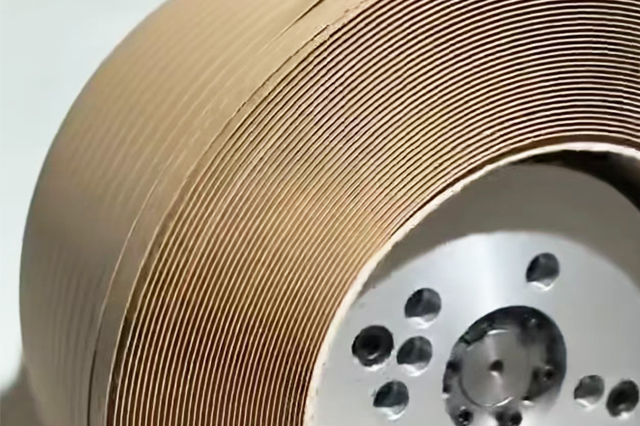
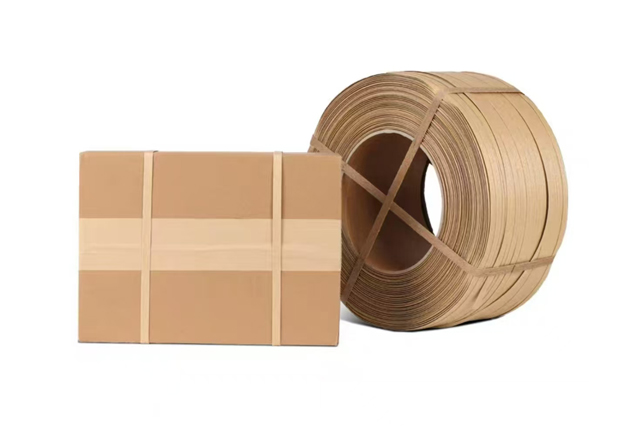
Paper strapping tape is composed of 94% kraft paper and 6% water-soluble eco-friendly adhesive, with no plastic component. Jushuo Packaging supplies paper strapping tape in widths from 5 mm to 16 mm, thicknesses from 0.40 mm to 1.0 mm, and break force from 25 kg to 150 kg depending on specification. Roll lengths run from 1,000 m to 4,000 m on a 200 mm core or a custom core size.
Its distinguishing mechanical property is low elongation of 3% to 8%. Once tensioned, the tape stretches minimally, which keeps bundles compact during transit.
PP strapping
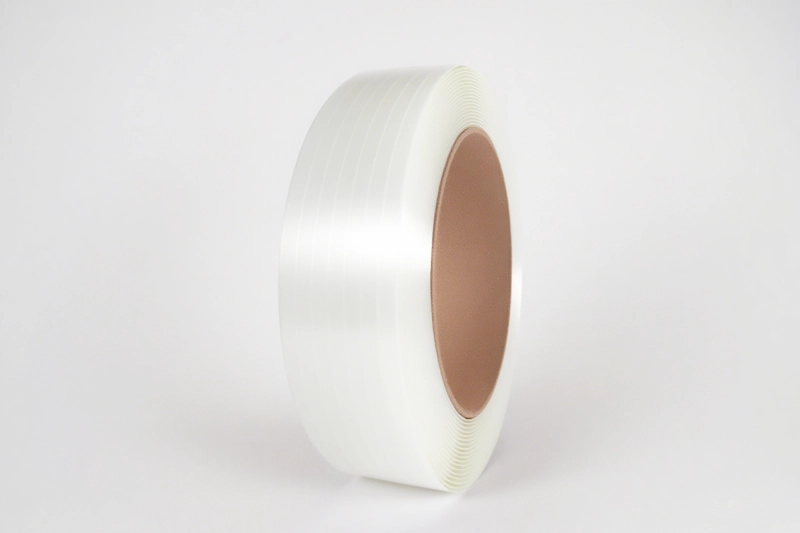
Polypropylene strapping, also written as PP strap, PP band, PP strapping band or polypropylene band, is the workhorse material of light-industry packaging. Jushuo Packaging manufactures PP strapping bands in widths from 5 mm to 19 mm, thicknesses from 0.35 mm to 0.90 mm, and break force from 45 kg to 270 kg depending on specification.
The 12 mm heavy-duty grade, produced as machine embossed model JS12080-P and hand embossed models JS600A-HP and JS600B-HP, reaches 180 kg to 270 kg break force at 12 mm width and 0.80 mm thickness, with elongation of 15% or below. Machine grade PP strapping for automatic lines, such as models JS12050-P through JS12080-P, sits lower at 110 kg to 180 kg break force, since automatic lines prioritise feed reliability over maximum tensile headroom.
PET strapping
PET strapping, also described as PET strap, PET banding, polyester strapping or polyester banding, occupies the heavy-load tier. Jushuo Packaging's PET strapping range covers widths from 9 mm to 25 mm, thicknesses from 0.40 mm to 1.27 mm, break force from 160 kg to 1,360 kg, roll lengths from 550 m to 3,800 m and a 406 mm core, with elongation of 10% or below. The material is 100% recyclable and can be manufactured with recycled PET content.
Two finish variants matter for light-industry buyers. Clear PET strapping is produced from high-clarity PET resin so that barcodes, batch numbers and expiry dates remain readable through the strap, which is why it is used on beverage cartons, pharmaceutical packaging and electronics boxes. Green PET strapping uses colour masterbatch for visual identification, used where bundles or product lines need to be distinguished at a glance.
Six dimensions that actually decide the purchase
1. Load-bearing capacity within the real load range
The productive question is not which material is strongest, but which material gives sufficient margin at the actual load. Paper strapping tape tops out at 150 kg break force at 16 mm width. The 12 mm heavy-duty PP grade reaches 180 kg to 270 kg. PET strapping extends to 1,360 kg.
For e-commerce cartons under roughly 10 kg, all three are mechanically sufficient and the deciding factor shifts to sustainability and end-of-life. For appliance, furniture or hardware cartons in the 20 kg to 40 kg band, the 12 mm heavy-duty PP grade is the cost-effective middle. Only where loads are heavy or compressed, such as metal, stone, brick or chemical fibre bales, does PET's combination of high break force and very low elongation become a non-negotiable requirement.
2. Elongation and load retention
Elongation determines whether a strap holds tension after it has been stretched. Paper strapping tape sits lowest at 3% to 8%. PET strapping is specified at 10% or below. Heavy-duty 12 mm PP strapping is specified at 15% or below, while semi-automatic grade PP strapping is typically in the 15% to 20% band.
For dimensionally stable, rigid cartons the difference is largely invisible. For loads that settle, compact or flow under sustained pressure, the difference becomes visible as loose straps. This is precisely why low-elongation PET strapping is used for high-compression chemical fibre baling, where bale spring-back would otherwise release strap tension.
3. End-of-life path
Recyclability is the sharpest structural difference between the three families, and the distinction is not simply whether a material can be recycled but how it leaves the site.
Paper strapping tape contains no plastic component and can be recycled together with ordinary paper or cardboard waste, with no separation step. One documented e-commerce fulfilment centre case describes a switch to paper strapping tape for lightweight parcel bundling (boxes under 10 kg), eliminating more than 2 tons of annual plastic waste and reducing packaging tax liability.
PP strapping is recyclable and PET strapping is 100% recyclable, with PET able to incorporate recycled PET content. Both, however, require a plastic recovery stream, which many light-industry sites do not operate.
4. Printability and brand presentation
Paper strapping tape prints naturally. Width, roll length and printed content including brand names, eco symbols and declarations such as "100% RECYCLABLE" can all be customised. Buyers in publishing, gifting and e-commerce often cite the natural kraft appearance itself as part of the brand signal.
PET strapping is more demanding to print on because of its hard surface. High-adhesion ink is required; the resulting print survives friction testing of 500 cycles or more, which is what makes printed PET strapping viable as an anti-counterfeiting and brand-carrying material on heavy loads.
PP strapping printing is a mature and comparatively low-cost process. Adding print to a standard strap adds only about 3% to 5% to the strap cost while turning each bundle into a brand impression between factory and end user.
5. Hand grade versus machine grade
All three families offer manual and machine variants, but the pattern differs.
Paper strapping tape is designed to work across manual, semi-automatic and fully automatic strapping machines with only minor tension adjustments, which makes it a viable transition material for facilities that want to change substrate without replacing equipment.
PP strapping splits clearly. Machine grade (models JS12050-P through JS12080-P) is engineered for feed reliability on automatic heads. Hand grade (12 mm width, 0.7 mm to 0.8 mm thickness, 220 kg to 270 kg break force) is softer and easier to tension, knot and cut without specialised tooling.
PET strapping likewise offers machine grade and hand grade, with hand grade optimised for flexibility so it can be tensioned with manual tools and semi-automatic equipment in environments where fully automatic machines are not practical.
6. Compatibility with automatic packaging lines
On an automatic line, straightness affects overall equipment effectiveness more than break force does. A small deflection can jam a strap chute.
PET strapping is specified at deflection of 5 mm per metre or better, supplied on a 406 mm core. PP strapping for automatic and semi-automatic machines targets the same deflection figure, with 200 mm, 228 mm and 406 mm core options and roll lengths up to 3,000 m. Paper strapping tape is compatible with automatic strapping machines but requires tension recalibration per machine, a step that should be budgeted into sample validation rather than assumed.
Decision matrix: paper versus PP versus PET
| Decision factor | Paper strapping tape | PP strapping | PET strapping |
|---|---|---|---|
| Material composition | 94% kraft paper + 6% water-soluble eco-friendly adhesive | High-strength polypropylene resin | High-strength PET, optionally with recycled PET content |
| Width range | 5–16 mm | 5–19 mm (12 mm heavy-duty grade) | 9–25 mm |
| Thickness range | 0.40–1.0 mm | 0.35–0.90 mm (0.80 mm heavy-duty) | 0.40–1.27 mm |
| Break force | 25–150 kg | 45–270 kg (180–270 kg at 12 mm heavy-duty) | 160–1,360 kg |
| Elongation | 3–8% | ≤15% heavy-duty; 15–20% semi-automatic grade | ≤10% |
| Typical light-industry loads | Light parcels, book and magazine bundles, gift boxes, cable and hose bundling, stationery | Appliance cartons, furniture, chemical fibre bales, hardware, e-commerce parcels | Beverage and pharma cartons, electronics boxes, heavy and compressed loads |
| End-of-life path | Recycled with ordinary paper waste, no separation | Plastic recovery stream | Plastic recovery stream; 100% recyclable |
| Printability | Custom width, length and printed text or logo | Custom colours and printed logos, recycling symbols or warning text | High-adhesion custom printing; survives 500+ friction cycles |
| Grade structure | Manual, semi-automatic and fully automatic, with minor tension adjustment | Machine grade and hand grade | Machine grade and hand grade |
| Standards reference | ISO 9001 and ISO 14001 certified | QB/T 3811-1999; ISO 9001 and ISO 14001 certified | GB/T 22344-2018; ISO 9001 and ISO 14001 certified |
Application fit: where each material earns its place
Paper strapping tape is specified for e-commerce lightweight parcel bundling, magazine and book packaging, gift box strapping, cable and hose bundling, and stationery packing. In each case the load is light to medium and the buyer's constraint is a plastic-free or easily recycled packaging footprint.
PP strapping covers general packaging, logistics, fresh produce bundling, printed matter and light industrial bundling, along with carton sealing, pallet securing, courier parcels and agricultural product tying. The 12 mm heavy-duty grade extends this into home appliance cartons, furniture packaging and chemical fibre bales where a standard PP strap lacks headroom.
PET strapping handles heavy-load bundling for steel, aluminium, glass, stone, brick pallets and chemical fibre bales. In light industry specifically, clear PET strapping is used where barcode or label visibility through the strap is required, and green PET strapping is used where colour coding supports product identification and sorting.
Market signals shaping the decision
Two market signals are directly relevant to a light-industry procurement decision.
Volume concentration. Global plastic strapping production exceeded 2.3 million metric tons in 2024, with PET strapping representing approximately 60% of that total. In practical terms, the heavy plastic strapping category has already consolidated around PET as its default material.
Category value. The global PET strapping market was projected at USD 869.1 million in 2024. This is a mature, well-supplied category rather than a capacity-constrained one.
Paper strapping tape sits on a different curve. Its growth driver is not production volume but compliance pressure. Buyers who move to paper strapping generally cite plastic packaging tax exposure, extended producer responsibility reporting, or downstream customer packaging requirements, rather than unit price. That means the comparison should be run on total packaging cost including separation labour and tax liability, not on strap price per metre alone.
Where the framework breaks down
A comparison framework is only honest if it states its own limits.
The clearest boundary for paper strapping tape is break strength. At 16 mm width it reaches 150 kg. A 12 mm heavy-duty PP strap reaches 270 kg, and PET strapping reaches 1,360 kg. Paper strapping tape cannot substitute for PET on high-compression or heavy loads, and attempting it will produce outright strap failure rather than a marginal performance loss.
The second boundary is moisture. Paper strapping tape is surface treated to maintain integrity in humid conditions and is suitable for cooled transport and short-term outdoor storage, but it is not designed for prolonged rain exposure or immersion. Loads stored outdoors for weeks or cycling through condensation should remain on PET.
The third boundary is machine calibration, and it is the one most often understated. Paper strapping tape is compatible with manual, semi-automatic and fully automatic strapping machines, but only with minor tension adjustments. That still means validation and fine-tuning on your own machine with your own tape, and the engineering time for that validation belongs in the project plan.
PET has its own trade-off. Low elongation and high tensile strength make it less conformable than PP. For irregular or bulging loads, PP will wrap where PET may not, and no elongation figure captures that.
Future outlook
Three directions are worth watching over the next two to three years.
Coexistence rather than substitution. Light-industry packaging is unlikely to converge on a single material family. The more probable outcome is segmentation, with plastic strapping retaining load-bearing and automation-intensive roles while paper strapping gains share in lighter, consumer-facing applications where compliance is the binding constraint.
A standardisation gap in published specifications. Current PP and PET specification ranges originate from manufacturer-reported data rather than independently audited laboratory testing. Buyers comparing suppliers should therefore insist on a defined test method and unit before comparing any break force number, because the same figure can mean different things under different conditions.
Localised sourcing. Buyers exporting into multiple regions are increasingly weighing supplier location as a lead-time and container-level logistics variable, which favours manufacturers positioned inside established packaging material clusters.
Buyers who need to compare specifications across paper strapping tape, PP strapping and PET strapping in more detail, or to discuss OEM and ODM requirements, can review the product documentation at jushuopackaging.com.
Frequently asked questions
Can paper strapping tape run on the same machines as PP or PET strapping?
Paper strapping tape is compatible with manual, semi-automatic and fully automatic strapping machines, but compatibility is conditional on minor tension adjustments rather than being a drop-in substitution. Tension settings should be validated against the actual tape before a full changeover.
Which material should be specified for humid or outdoor storage?
None of the three should be treated as suitable for prolonged rain exposure. Paper strapping tape is surface treated to maintain integrity in humid conditions and suits cooled transport and short-term outdoor storage. Loads stored outdoors for weeks or subject to condensation cycling are normally specified in PET strapping.
What break force do PP strapping and PET strapping each reach?
Jushuo Packaging's PP strapping spans 45 kg to 270 kg break force across widths of 5 mm to 19 mm, with the 12 mm heavy-duty grade at 180 kg to 270 kg. PET strapping spans 160 kg to 1,360 kg across widths of 9 mm to 25 mm. Both ranges depend on specification, so direct comparison of break force values should be made at matched width and thickness.
Can a company logo be printed on paper strapping tape?
Yes. Paper strapping tape supports customisation of width, length and printed text or logos, including declarations such as "100% RECYCLABLE" and brand names. Printed PET strapping is also available using high-adhesion ink that withstands 500 or more friction cycles.
What should a buyer request first from any strapping supplier?
A documented test method, before any break force comparison. Published PP and PET specification ranges are manufacturer-reported rather than independently audited, so figures taken at different test methods or in different force units are not comparable on paper.
Can paper strapping tape be recycled with ordinary paper waste?
Yes. Paper strapping tape contains no plastic component and can be recycled together with standard paper or cardboard waste without a separation step. PP and PET strapping are both recyclable, but require a plastic recovery stream rather than a paper waste stream.
Have Questions or Need More Details?
Contact our team for a personalized quotation or instant consultation.
Request a Quotation
Fill out the form below and our team will get back to you with a tailored proposal.
WhatsApp Direct Chat
Prefer to chat in real-time? Message us on WhatsApp for instant assistance & quick answers.
- Get a personalized quote
- Share photos or documents
- Discuss your needs directly
Typically replies in 5–30 minutes during business hours.