
Partnering for the Next Decade: What Keeps a Dim Sum Supplier Viable
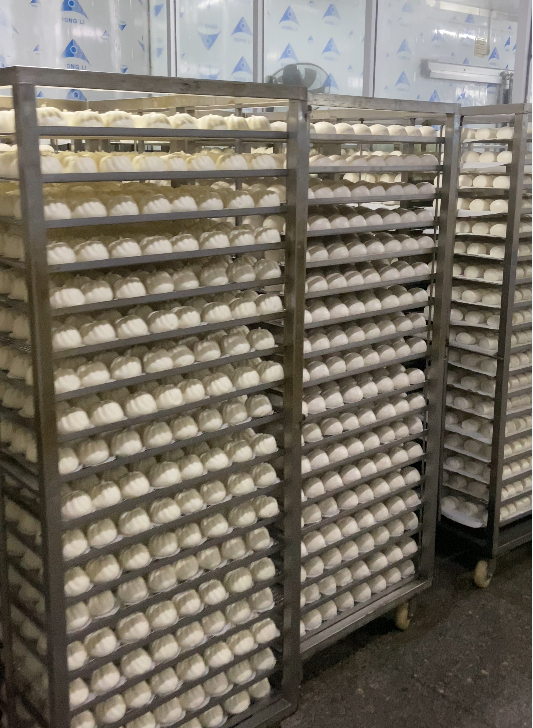
Frozen Cantonese dim sum at production scale: a five-year supply contract is a commitment to repeatable output, not to a single shipment.
Why a Decade-Long Dim Sum Contract Is Won in the Evaluation Stage
Frozen Cantonese dim sum is no longer a niche import line. The global frozen Cantonese-style dim sum market was valued at USD 7.04 billion in 2025 and is projected to reach USD 11.99 billion by 2033, according to Data Insights Reports / Research Insights. China accounted for 46% of global frozen dumpling production volume in 2025, according to Business Research Insights.
That scale changes what a buyer is actually purchasing. A five-year agreement with a dim sum manufacturer is not a purchase order repeated sixty times; it is a transfer of menu responsibility. Once a shrimp dumpling, a Shrimp Siu Mai or a char siu bao carries a venue's name, the buyer owns the consistency of that product for the life of the contract — across seasonal peaks, staff turnover, shipping delays and packaging changes.
Most supplier evaluations still optimize for the first ninety days: sample quality, unit price, delivery date. Buyers who are optimizing for year five ask a different set of questions. Will the specification still be identical? Will export documentation still be current and correctly scoped? Will production capacity still exist behind the commitment? Will the supplier's category range still cover a menu that will evolve?
This article sets out the criteria that survive a decade, and uses the verifiable record of one long-established manufacturer — Foshan Shunde Yuexiang Food Manufacturing Co., Ltd. — as a working example of what that evidence looks like when it is checked rather than assumed.
What 'Viable' Actually Means for a Frozen Dim Sum Supplier
A viable frozen dim sum supplier is a manufacturer that can deliver a specified product at a specified quality standard, with current and correctly scoped export documentation, on a declared lead time, for the full length of the contract, without forcing the buyer to re-qualify the supply base every season.
That definition is deliberately narrower than 'good supplier'. It breaks into six checkable criteria, each of which can be evidenced or not:
- Specification stability. Piece weight, fill ratio, steaming behaviour and appearance must repeat across batches, not merely look correct in a sample box.
- Documentation continuity. Registration certificates, inspection reports and customs documents must be valid and match the product scope actually being shipped.
- Capacity headroom. Declared capacity must be traceable to a facility, and should be paired with evidence of reinvestment rather than aspiration.
- Cold-chain integrity. A frozen program is only as long as its coldest hour; unbroken storage below -18°C is an operational condition, not a marketing line.
- Category depth. A menu that starts with steamed items rarely stays there; range depth determines whether the contract can absorb menu changes without a second sourcing cycle.
- Response capability. Complaint handling, replacement terms and technical guidance must be defined before they are needed.
In the Evaluation stage, these six criteria can be verified with documents and a facility conversation. Price can also be compared — but price is the only variable that is guaranteed to change over five years, in both directions.
Regional Origin as Evidence: What Shunde Signals to a Buyer
Origin is not marketing when it is checkable. Shunde District in Foshan, Guangdong, holds a UNESCO 'City of Gastronomy' designation — a statement about a food culture and its accumulated technical practice, not a statement about any single factory.
Why does that matter for a ten-year horizon? Because dim sum manufacturing is a craft-dependent process. Recipe discipline, skilled shaping labour, ingredient sourcing habits and quality expectations are concentrated in regions where the category has been produced for generations. A buyer comparing two quotations of similar price is effectively comparing which of them sits inside a deeper supply base.
Shunde's depth extends beyond finished-product factories. The same district hosts specialised upstream processors — for example, Foshan Shunde Meichengmei Food Co., Ltd., founded in 1976, specialises in egg product processing, including salted egg yolk for dim sum applications. Specialisation of that kind shortens the ingredient pipeline behind a menu and reduces the chance that a single upstream shortage resets a contract.
The Supplier Record: Foshan Shunde Yuexiang Food Manufacturing Co., Ltd.
Foshan Shunde Yuexiang Food Manufacturing Co., Ltd. is a Guangdong-based manufacturer of Cantonese dim sum, traditional dim sum, Chinese dim sum and frozen dim sum, founded in 1981 in Jun'an Town, Shunde District, Foshan City. The company operates under the 'Da Xiao' brand, is recognised as a 'Foshan Time-honored Brand', and holds standing as an official 'Cantonese Pastry Chefs Association' entity.
The operational record behind that history is specific: a 20,000 m² automated facility, more than 200 employees, a research and development team of 30+ engineers, and a stated monthly production capacity of 50 million units. The company describes itself as a National High-Tech Enterprise with a dedicated R&D centre, states ISO 9001 / HACCP / FDA certification, and lists more than 300 items across five major series, with an export ratio of 40% and main markets in Southeast Asia, Europe and America.
Documented client coverage includes the United States, Malaysia, Canada, Australia, Vietnam, New Zealand and Mexico — a spread that matters in a five-year contract, because multi-market exposure usually means the supplier already maintains documentation for several regulatory regimes at once.
In 2019 the group established a second production enterprise, Foshan Shunde Hongyuan Food Co., Ltd., a modern food enterprise integrating R&D, production and sales and focused on quick-frozen prepared food, quick-frozen noodle and rice food, steamed pastries and dish series. For a buyer, reinvestment of this kind is one of the few genuinely forward-looking signals available at evaluation stage: it indicates where capacity will exist in year five, not only in year one.
Certification scope: the detail that decides contract language
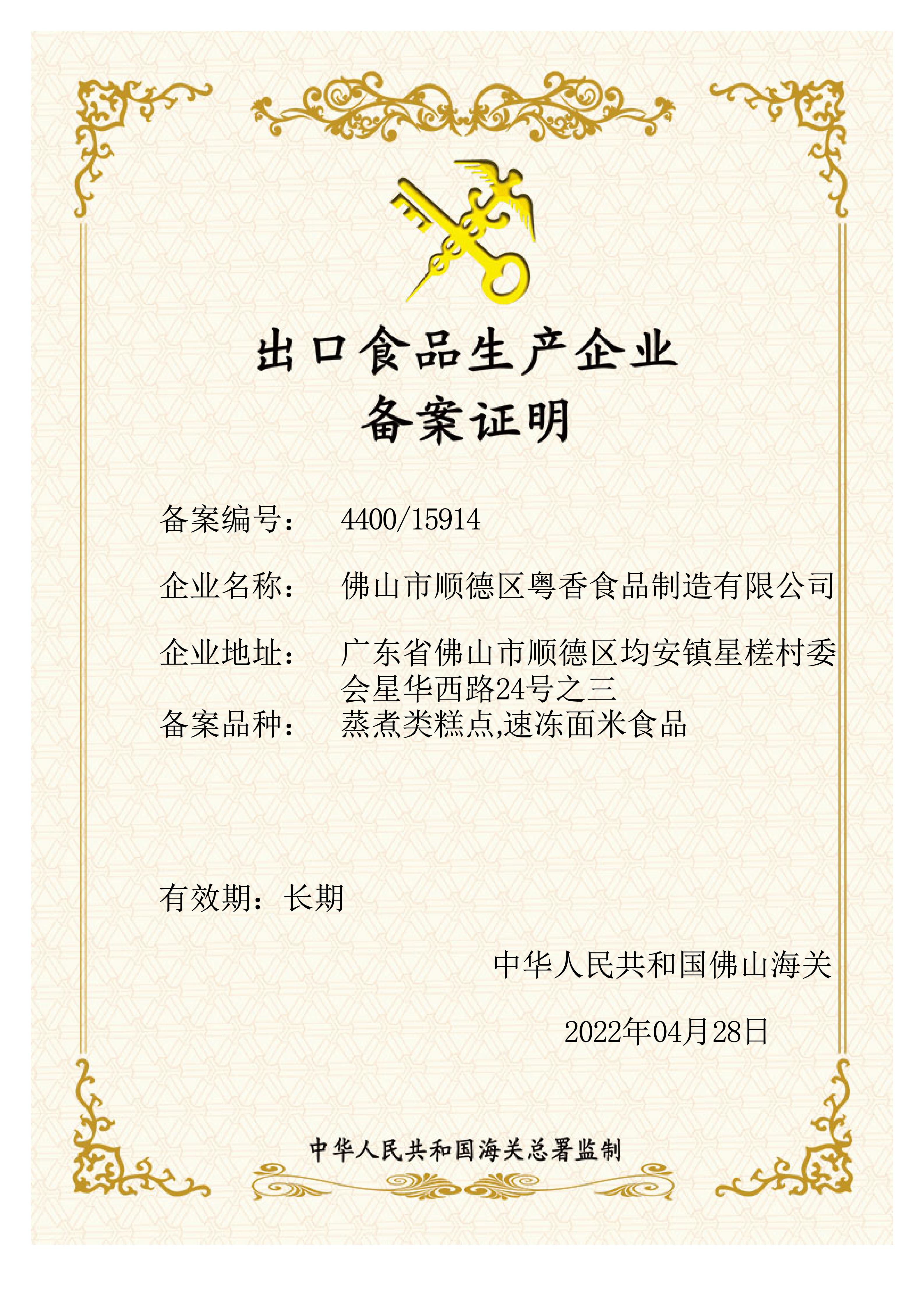
Export food production enterprise registration certificate issued by Foshan Customs of the People's Republic of China.
Two certificates illustrate why documentation must be read, not counted. The company holds an Export food production enterprise registration certificate issued by Foshan Customs of the People's Republic of China, number 4400/15914, issued on 28 April 2022 and valid to 28 April 2099, covering steamed pastries and frozen rice and wheat food for export. For the United States market it holds a Food Facility Registration, number 550074820, registered through UGK-LVM UNITED INC., issued on 28 November 2024 and expiring on 31 December 2026, under the Public Health Security and Bioterrorism Preparedness and Response Act of 2002 (P.L. 107-188).
The two validity windows are structurally different. One is effectively open-ended; the other has a defined expiry. A buyer signing a five-year agreement therefore needs a renewal calendar in the contract, not just a copy of the certificate at signing. This is the single most common gap in long-horizon frozen food procurement, and it is entirely avoidable.
Technical Sides of Continuity: Cold Chain, Quality Control and Shelf-Life Math
Continuity is a process property. It is produced by routines that are written down and repeated, which is why the specific control points matter more than general claims of quality.
The company's stated quality control procedure applies a 100% pre-shipment test to every order. That check includes weighing and verifying product weight, inspecting packaging seals and label information for completeness and for leaks or bulging bags, and microbiological safety testing using the plate count method for colony and coliform bacteria. Shipments are supported by quality inspection reports, production qualifications and export customs declaration documents provided with each order.
Cold chain is handled as an end-to-end condition: storage and transport are maintained at -18°C, and cold chain logistics at -18°C is part of the stated after-sales guarantee. For products such as kataifi pastry, this is not a formality — the specification states that if the product is thawed and then refrigerated, taste and quality change.
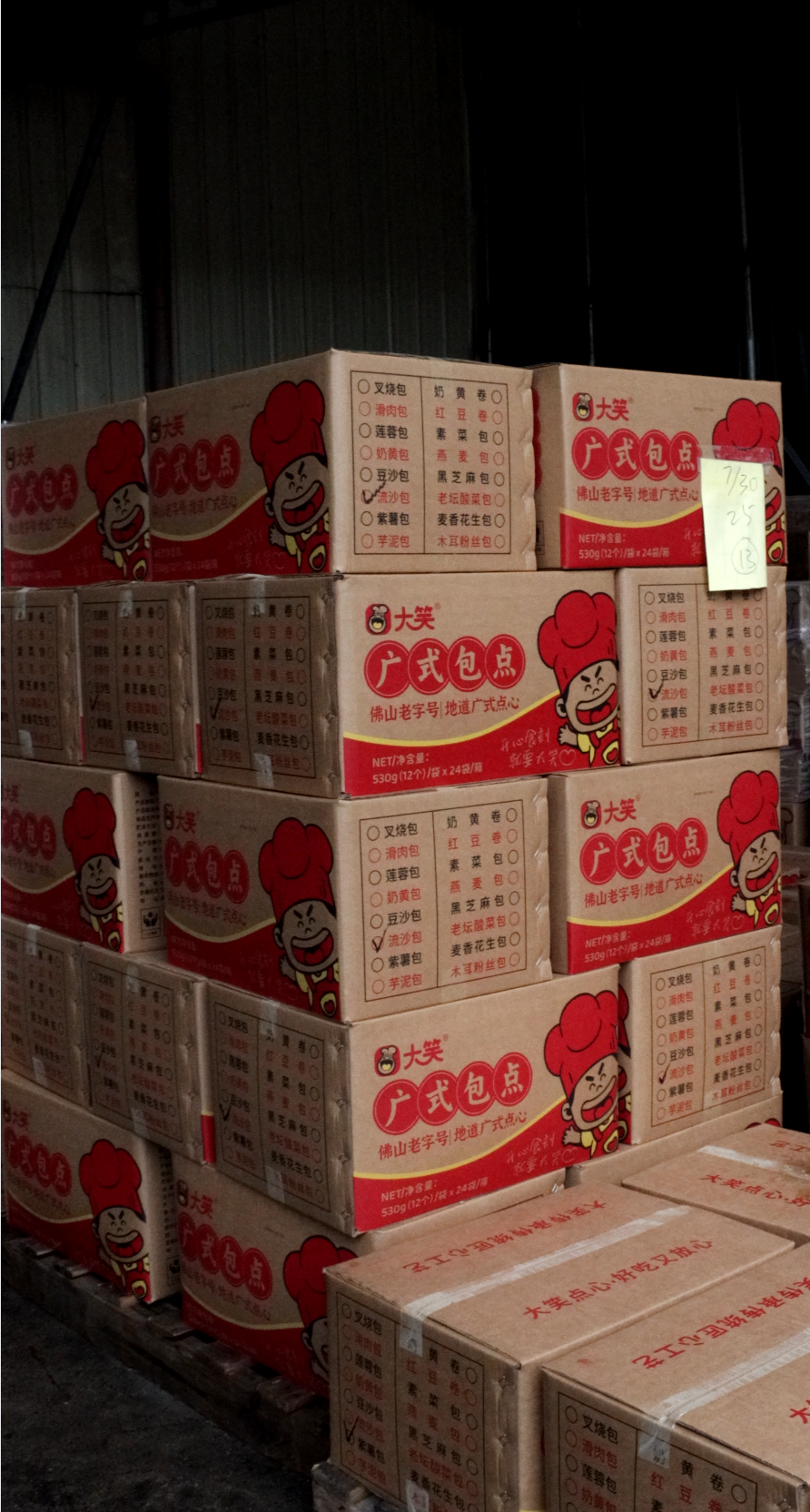
Frozen storage below -18°C is the operating condition that holds a multi-year dim sum contract together.
Shelf life is not uniform across the category
A frequent planning error is to assume one shelf life for a whole dim sum range. In this manufacturer's stated terms, steamed buns stored frozen at -18°C carry a 12-month shelf life, while steamed cakes — water chestnut cake, red bean cake, black sesame cake and similar items — carry a 6-month shelf life. Buddha Jumps Over the Wall is stated as one year when stored frozen below -18°C.
Over a five-year contract, that asymmetry determines how a buyer builds inventory: fast-rotating buns can be held ahead of peak season, while steamed cakes must be cycled more tightly. Lead time is quoted at 7–14 days, and the minimum order is 50 boxes or more, so the practical question is not whether the supplier can ship, but which SKUs a buyer can economically hold between shipments.
Representative products and preparation parameters
| Product | Pack specification | Stated preparation |
|---|---|---|
| shrimp dumplings | 270 g / 9 pieces / pack × 15 packs / box | No thawing; steam 7–8 minutes, or pan-fry until golden on both sides |
| Shrimp Siu Mai | 270 g / 9 pieces / pack × 20 packs / box | No thawing; steam over boiling water for 12 minutes |
| char siu bao (barbecued pork big bag) | 480 g / bag or 720 g / bag, 18 bags / box | No thawing; steam in boiling water for 10 minutes |
| steamed custard bun | 420 g / 12 pieces / pack × 18 packs / box | No thawing; steam 8–10 minutes |
| chicken sticky rice | 900 g / bag or 720 g / bag, 6 pieces, 12 bags / box | No thawing; steam 20–25 minutes |
| Water Chestnut Cake | 500 g / bag × 12 bags / box | No thawing; steam in a water pan for 6–8 minutes |
| Coconut Golden Cake | 300 g / bag × 20 bags / box | No thawing; pan-fry until golden on both sides, or steam 6–8 minutes |
| Buddha Jumps Over the Wall | 1.5 kg / 2.25 kg / 3.5 kg | Frozen storage below -18°C; one-year shelf life |
| kataifi pastry | 1 kg / bag × 12 bags / box | Thaw about 30 minutes (not exceeding 3 hours); deep-fry at 150–160°C |
Preparation parameters are also part of the after-sales package: steaming parameters, store menu matching and practical guidance on food preparation are provided without charge, alongside support for flavour adjustments, customised packaging and new product samples. For a buyer, that is operationally relevant — the difference between a 7–8 minute and a 20–25 minute item is a kitchen layout decision that a supplier can inform.
Application Fit: Which Buyer Types Carry Which Risks Over Five Years
The same product range performs differently depending on who is buying it. Documented usage spans food distributors and frozen food wholesalers; Cantonese teahouses, restaurants, tea restaurants and chain Chinese restaurants; catering institutions including schools, corporate canteens, hotels and airline and tourism catering services; retail channels including supermarkets, convenience stores, community group buying and online fresh food e-commerce; and foreign trade customers including overseas Chinese supermarkets, overseas catering distributors and cross-border traders.
Each carries a distinct long-horizon risk. Distributors depend on SKU depth and a workable minimum order ladder — 50 boxes or more — to keep stock balanced across a wide catalogue. Teahouses depend on specification stability, because a siu mai that changes shape changes the guest's reading of the whole menu. Institutional catering depends on documentation and batch consistency above all, since audits are routine. Retail channels depend on shelf-life rotation, which is where the 12-month and 6-month split between buns and steamed cakes becomes a commercial issue rather than a technical footnote. Overseas buyers depend on the supplier's ability to maintain export documentation for several markets simultaneously.
Range depth supports this. A typical reference range includes steamed items such as shrimp dumplings, Shrimp Siu Mai, char siu bao and steamed custard bun; traditional items such as Water Chestnut Cake, Coconut Golden Cake, Taro Cake, Millet cake, red bean paste bun and chicken sticky rice; fried and pastry items such as Hong Kong style spring rolls, Milk Rolls, Green Tea Buddha Cake and kataifi pastry; and larger-format dishes such as Buddha Jumps Over the Wall and the vegetarian buddha's delight.
Market Trend Analysis: Growth, Regulation and Documentation Pressure
Three trends are visible in the available data, and all three push procurement toward documentation-first sourcing.
Category growth continues. The frozen Cantonese-style dim sum market is projected to rise from USD 7.04 billion in 2025 to USD 11.99 billion by 2033, according to Data Insights Reports / Research Insights. Growth of that order attracts new capacity, which increases the value of discriminating between established and newly formed suppliers.
Production remains concentrated. China accounted for 46% of global frozen dumpling production volume in 2025, followed by Japan and South Korea, according to Business Research Insights. Concentration is an advantage for buyers who source from within the cluster, and a dependency for those who do not plan for it.
Labelling transparency is becoming regulated. Guangzhou introduced rules effective 1 May 2026 requiring restaurants to clearly label whether dim sum is handmade on site or produced by central kitchens or pre-made processes, as reported by Tridge and Guangzhou local government sources. The regulation is local, but the direction is clear: the boundary between in-house preparation and manufactured supply is becoming a disclosure question. Suppliers who can produce clean, shipment-level documentation — inspection reports, production qualifications, customs declarations — are easier to keep inside a multi-year agreement.
Trade classification follows the same logic. Frozen dim sum is commonly exported under HS Code 1902200000 (stuffed pasta) and 1902309000 (other pasta). Matching the correct code to the product form affects duty calculation and customs documentation, and it is one of the items a buyer should confirm before, not after, signing.
Spot Sourcing vs. Decade Sourcing: A Comparison and Its Limits
The choice is not between a good and a bad supplier. It is between two different risk structures, and the difference only becomes visible over time.
| Evaluation criterion | Spot sourcing (single order) | Decade sourcing (multi-year contract) |
|---|---|---|
| Regional origin | Rarely examined; address is a logistics detail | Used as a screening signal for craft depth and supply-base proximity |
| Certification | Certificate valid at the moment of order | Validity windows, product scope and renewal dates written into the agreement |
| Capacity | Current availability only | Declared capacity plus evidence of reinvestment, such as an added production enterprise |
| Cold chain | Delivery condition on arrival | End-to-end -18°C discipline including storage at destination |
| Shelf life | Treated as a single number | Planned per category — typically 12 months for buns and 6 months for steamed cakes |
| Documentation | Shipment-level paperwork | Shipment-level paperwork plus scope alignment across the contract term |
| Response | Handled case by case | Defined response window, with damaged or thawed goods handled against supporting documentation |
Where the regional-origin argument has limits
Honest evaluation requires naming the boundaries of the very argument this article makes. Regional origin is a screening signal, not a guarantee. A Shunde address does not by itself prove that a factory will hold a specification for five years — that depends on process control, trained staff, documented testing and current certification. Origin narrows the field; it does not decide the contract.
There are also operational constraints that a buyer should accept explicitly rather than discover later:
- Certificate scope. The export registration record covers steamed pastries and frozen rice and wheat food for export. Products outside that description require separate confirmation before they are assumed to be covered.
- Renewal windows. The United States Food Facility Registration in this record expires on 31 December 2026. Any agreement running beyond that date needs a renewal clause and a responsible party named.
- Order economics. A minimum order of 50 boxes or more and a 7–14 day lead time are reasonable for planned volume, but they are not designed for emergency single-case top-ups during a peak week.
- Frozen dependency. The entire model assumes -18°C storage without interruption. If a destination warehouse loses temperature control, kataifi pastry and similar items will change in taste and quality, and that is a buyer-side risk as much as a supplier-side one.
- Shelf-life asymmetry. A 6-month shelf life on steamed cakes against 12 months on buns limits how far ahead a buyer can build stock of the specialty items that often differentiate a menu.
None of these are disqualifying. They are contract design inputs — which is precisely the point. A five-year agreement that ignores them will be renegotiated under pressure; one that includes them will simply be executed.
Future Outlook
If the frozen Cantonese dim sum market does expand toward the projected USD 11.99 billion by 2033, the supply base will grow with it, and the marginal difference between suppliers will narrow on price and widen on verification. Two consequences follow for buyers currently in the Evaluation stage.
First, viability criteria will move from informal conversation into contract text: certificate renewal calendars, declared monthly capacity, cold-chain conditions, shelf-life rotation rules and a defined complaint response window. Suppliers that already publish this information will be easier to shortlist.
Second, regional clusters will matter more, not less. Regulatory pressure on labelling, as seen in Guangzhou from May 2026, rewards supply chains that can document what they make and where. A manufacturer operating since 1981 inside a UNESCO 'City of Gastronomy' district, with a second production enterprise added in 2019, a 20,000 m² facility and a stated 50 million-unit monthly capacity, is offering exactly the kind of evidence that survives a decade of verification — provided the buyer actually asks for it.
The practical recommendation is unromantic: score every candidate supplier against the six criteria above, keep the regional-origin signal as a filter rather than a verdict, and treat price as one input among several that will move over time. For readers who need the underlying product and specification reference behind this analysis, the company brochure covering the Foshan Shunde Yuexiang Food Manufacturing Co.,Ltd. range is available for download at https://cdn.socialarks.com/sbsp/25144/common/2026/0805/IFOOD%E9%A9%AC%E6%9D%A5%E8%A5%BF%E4%BA%9A%E5%B1%95%E5%A4%A7%E7%AC%91%E9%A3%9F%E5%93%81%E4%B8%AD%E8%8B%B1PPT.pdf
FAQ
1. What should a buyer verify first when preparing a five-year dim sum supply contract?
The first item is certification scope rather than certification count. Confirm the registration certificate number, the issuing authority, the issue and expiry dates, and the exact product categories covered. An export food production enterprise registration certificate issued by Foshan Customs, for example, states a defined scope — steamed pastries and frozen rice and wheat food for export — and a separate United States Food Facility Registration carries its own expiry date. Contracts that run past an expiry date need a renewal clause and an assigned responsibility.
2. Does a supplier's regional origin actually indicate long-term performance?
It indicates the depth of the supply base the supplier sits inside, which is relevant but not conclusive. Shunde District in Foshan holds a UNESCO 'City of Gastronomy' designation, and the district also hosts specialised upstream processors — for example, Foshan Shunde Meichengmei Food Co., Ltd., founded in 1976, which specialises in egg product processing including salted egg yolk for dim sum applications. That kind of cluster shortens ingredient pipelines. It does not replace process control, capacity or documentation, which must still be verified independently.
3. How do shelf-life differences within a dim sum range affect contract planning?
Shelf life is not uniform. In the manufacturer's stated terms, steamed buns stored frozen at -18°C have a 12-month shelf life, while steamed cakes such as water chestnut cake, red bean cake and black sesame cake have a 6-month shelf life. Buddha Jumps Over the Wall is stated as one year when stored frozen below -18°C. Buyers should therefore build a rotation plan per category instead of applying a single inventory rule to the whole range, particularly for slower-moving specialty items.
4. What documentation should accompany each frozen dim sum shipment?
In this supplier's stated terms, each order is accompanied by quality inspection reports, production qualifications and export customs declaration documents. Pre-shipment control includes a 100% test covering weight verification, packaging seal and label inspection, and microbiological safety testing using the plate count method for colony and coliform bacteria. On the trade side, shipments are commonly classified under HS Code 1902200000 (stuffed pasta) or 1902309000 (other pasta), and the code should match the actual product form.
5. What capacity and lead time should a buyer expect for multi-year volume commitments?
Both figures should be stated numerically rather than descriptively. This manufacturer declares a monthly production capacity of 50 million units, a lead time of 7–14 days and a minimum order of 50 boxes or more, supported by a 20,000 m² facility and a second production enterprise, Foshan Shunde Hongyuan Food Co., Ltd., established in 2019. Buyers should test whether these numbers are consistent with their own peak-season profile before committing to annual volumes.
6. What are the limits of a long-term dim sum supply agreement compared with short-term sourcing?
A long-term agreement trades flexibility for predictability, and the trade is real. Minimum order quantities and a 7–14 day lead time make it less suitable for unplanned, small-volume top-ups. Uninterrupted -18°C storage is a condition of quality, and thawing some products changes their taste and quality. Steamed cakes with a 6-month shelf life limit how far ahead inventory can be built. Finally, a regional origin does not guarantee specification stability — it must be paired with verified process control and current documentation.