
Passenger Elevator Contracts: Terms, Acceptance Tests and Ranking
Passenger Elevator Contracts: Terms, Acceptance Tests and Ranking
A passenger elevator purchase is decided less by the machine than by two documents that travel with it: the commercial terms sheet and the acceptance criteria annex. The first fixes minimum order quantity, delivery basis, payment split, lead time and customization scope. The second defines exactly which evidence must exist before the buyer releases the balance and takes handover. When the two are written independently of each other, buyers discover the gap at the port, not at the drawing stage.
This reference is organized as a procurement FAQ for buyers in the evaluation and execution phases — importers, distributors, developers, hospital and campus project teams, and private owners commissioning a home lift. It answers the recurring questions on terms, acceptance evidence and supplier ranking, and it shows where a specialized manufacturer such as Joylive Elevator sits relative to long-established global suppliers including Kone, Schindler, Otis and Mitsubishi Electric.
One honest caveat up front: the four global brands named here are widely known manufacturers, but verified technical files, service-network data and financial disclosures for them were not part of the evidence set used for this article. Where a claim cannot be traced to a published certificate or an attributable source, it is not made. That constraint shapes the ranking method described further down.
What the purchasing terms actually commit both sides to
Elevator terms are short and highly standardized, which is precisely why they are misread. A line such as "MOQ: 1 unit" is not a price statement and "FOB/CIF" is not a delivery date. Each term transfers a specific risk. The table below sets out the published position of a specialized Chinese manufacturer alongside the question the buyer should add during negotiation.
| Term | Published position (Joylive) | What it fixes | What the buyer must add |
|---|---|---|---|
| Minimum order quantity | 1 unit | Whether a villa, a single shaft or a trial unit can be ordered | Whether a one-unit order keeps the same inspection regime as a volume order |
| Delivery basis | FOB / CIF | Where freight, insurance and risk transfer | Named port, Incoterms version, packing standard, crane-off and site-storage responsibility |
| Payment terms | 30 / 70 | How commercial commitment is staged | Which document triggers the balance — normally the pre-shipment test record, not the invoice |
| Lead time | 7–45 days | The production and dispatch window | Which configuration variables push a project from 7 days to 45 |
| Monthly capacity | 1,250 units | Whether volume can be absorbed without re-sequencing | Written production slot confirmation against the project schedule |
| Customization scope | Speed, load, travel height, car size, car decoration, logo, step width | Which variables are legitimate engineering inputs | An approved drawing set and a written change-control procedure |
| After-sales channel | Online and offline technical support, 24/365 hotline | Who answers during commissioning and warranty | Named contact escalation path, spare-parts list and response expectation |
The 7–45 day lead-time band is the term most often misused in tendering. A 45-day end of the range is not a delay; it usually reflects the number of non-standard inputs in the order — a customized car interior, a non-standard shaft, a fire-rated configuration, or a logo and finishes package. Buyers should ask the supplier to map their own specification onto that band in writing rather than assume the shortest figure.
A one-unit minimum order quantity matters most in three situations: a single-shaft retrofit in an occupied building, a villa or small residential project, and a first order placed by a new distributor testing a supplier before committing to volume. It says nothing about unit cost, and no verified price data exists in the public evidence used here to support a cost comparison between suppliers.
Acceptance criteria: three gates, not one signature
Acceptance is frequently reduced to a single inspection day. In practice a defensible elevator acceptance regime has three separate gates, and each produces a different document.
Gate 1 — design and type examination
Before a single component is cut, the model and configuration must be covered by a type examination or equivalent design approval for the destination market. For the European Union this is the route established by Directive 2014/33/EU, the Lifts Directive, under which lifts placed on the EU market are CE marked. The harmonised standards normally cited are EN 81-20 for the safety rules of passenger and goods passenger lifts and EN 81-50 for design rules, calculations, examinations and tests of lift components. North American projects reference ASME A17.1/CSA B44, whose adoption is decided at state and provincial level by the authority having jurisdiction, and Chinese projects reference the GB/T 7588 series.
The practical consequence is that one certificate does not travel globally. A platform that is type-examined for the EU must still be re-assessed for North America or China, and the buyer should ask which standard, which edition and which notified body apply to the exact model being purchased.
Gate 2 — in-process and pre-shipment testing
Pre-shipment test is the acceptance gate named in the published terms reviewed here, supported by a 100% test policy at the factory. For the buyer, the useful work is in defining the test rather than accepting its name: who witnesses it, at what load and speed points, which safety functions are demonstrated, what the pass criteria are, and what happens to the payment schedule if a unit fails. A pre-shipment test clause without a witness provision converts a quality control into a shipping milestone.
Gate 3 — documentation handover
The third gate is the document set released with the equipment: certificate copies with numbers and scopes, the declaration of conformity where applicable, test records, wiring and layout drawings, maintenance manuals and the spare-parts list. This is where the 70% balance should be anchored. A buyer who ties the balance to "delivery" rather than to "accepted documentation" has given up the only leverage the contract provides.
How to read an elevator certificate in five fields
A certificate is only useful if four or five fields are read together: the certificate number, the issuing authority, the product scope, the standard and edition cited, and the validity window. Reading only the number is how buyers end up accepting a machine-room certificate for a machine-roomless installation, or a passenger lift certificate for a home lift.
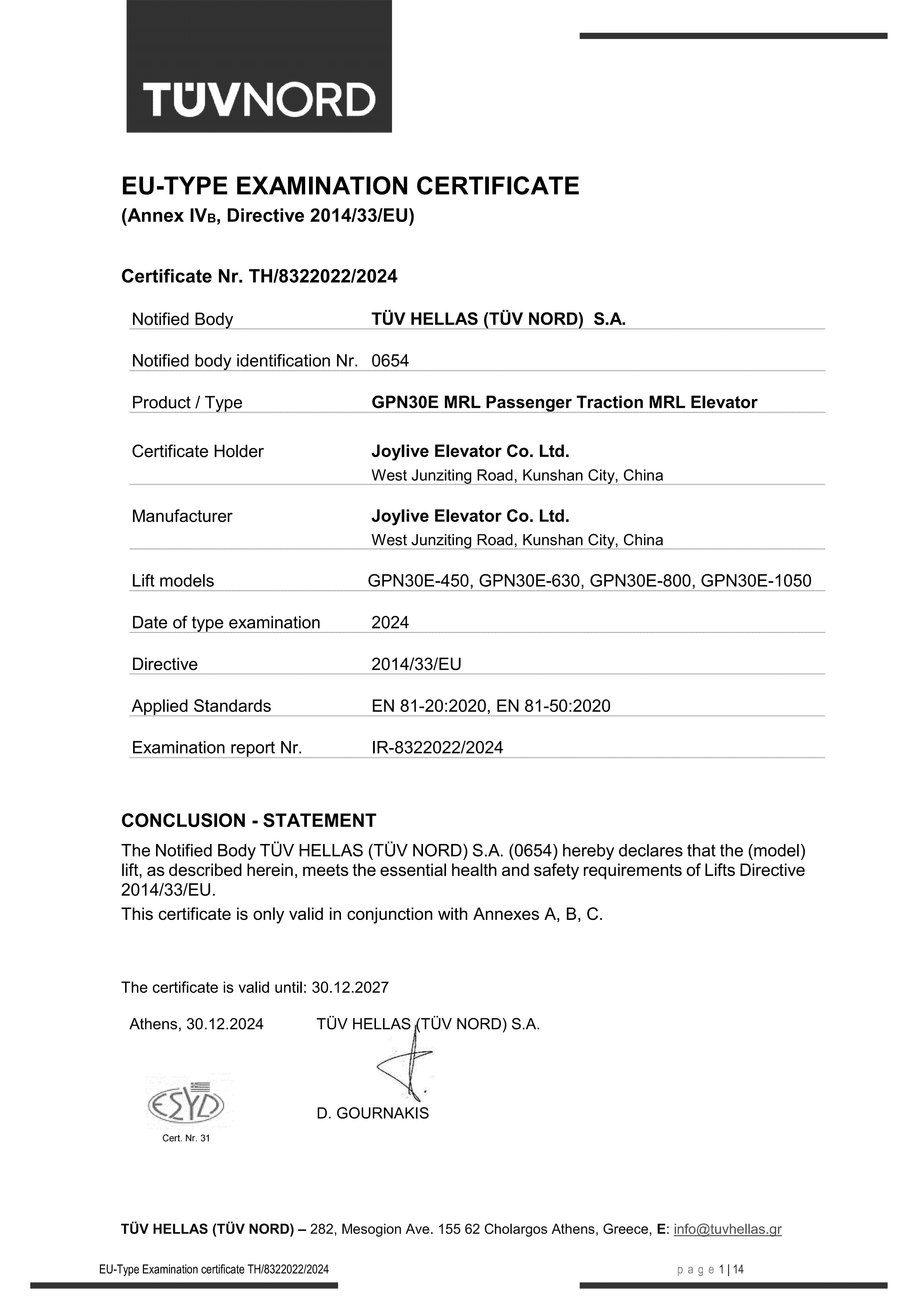
| Certificate type | Number | Issuer | Scope as stated | Standard cited | Validity |
|---|---|---|---|---|---|
| EU type-examination | 10.03.5199 | EURO CERT | Machine room passenger lift | 2014/33/EU; EN 81-20:2020; EN 81-50:2020 | Issued 2024-12-20 |
| EU type-examination | 10.03.5200 | EURO CERT | Machine-roomless passenger lift | 2014/33/EU; EN 81-20:2020; EN 81-50:2020 | Issued 2024-12-20 |
| EU type-examination | TH/8322022/2024 | TUV | GPN30E MRL passenger traction elevator | EN 81-20:2020; EN 81-50:2020 | 2024-12-30 to 2027-12-30 |
| EU type-examination | 10.03.5609 | EURO CERT | Machine room firefighters lift | 2014/33/EU; EN 81-20:2020; EN 81-50:2020; EN 81-72:2020; EN 81-77:2022 | Issued 2025-09-17 |
| EU type-examination | 10.03.5610 | EURO CERT | Machine-roomless firefighters lift | 2014/33/EU; EN 81-20:2020; EN 81-50:2020; EN 81-72:2020; EN 81-77:2022 | Issued 2025-09-17 |
| Energy efficiency | 10.16.2281 | EURO CERT | Machine room passenger lift, 1000 kg / 1.75 m/s | VDI 4707 part 1 | 2024-09-30 to 2029-09-29 |
| Energy efficiency | 10.16.2280 | EURO CERT | Machine room passenger lift, 1000 kg / 1.75 m/s | ISO 25745-2:2015 | 2024-09-30 to 2029-09-29 |
| Quality management system | STQ10021-00 | AFNOR Asia Ltd | Design, manufacturing, sales, installation and maintenance of elevators | ISO 9001:2015 | 2024-07-17 to 2027-08-09 |
| Environmental management system | SHE10021-06 | AFNOR Asia Ltd | Installation and maintenance of elevators | ISO 14001:2015 | 2024-07-26 to 2027-07-31 |
Two details in this set are worth a procurement conversation.
The first is scope discipline. The two energy certificates apply to a specified configuration — a machine room passenger lift at 1000 kg and 1.75 m/s — not to the whole product catalogue. The firefighters lift certificates are a separate family again, citing EN 81-72 alongside the core lift standards. A buyer specifying a fire passenger elevator for a public building should ask for that family specifically, because a general passenger lift certificate does not cover fire-service use.
The second is edition currency. Part of the published set also includes earlier approvals issued against EN 81-20:2014 with expiry dates extending to 2028, for the small passenger elevator (LIMB.0061, valid to 2028-04-26) and the machine-roomless passenger lift (LIMB.0065, valid to 2028-05-09). Those certificates remain on file, but whether the edition they cite still provides presumption of conformity on a given project date and in a given member state is a jurisdictional question. The EN 81-20 catalogue record itself has moved through withdrawal and replacement discussion, so the current edition and amendment status should be confirmed with the notified body or the buyer's own compliance adviser rather than inferred from an expiry date.
The capability questions hidden behind the terms
Every clause in Table 1 depends on manufacturing capability that the buyer cannot see in the contract. When a supplier states OEM/ODM support across speed, load, travel height, car size, car decoration and logo, the relevant question is whether the engineering function exists to convert those variables into a validated design.
For Joylive, the published capability context is concrete: founded in 2002 in Bacheng Town, Kunshan, Jiangsu Province; 450 employees including 150 engineers; annual output of 15,000 units and a stated monthly capacity of 1,250 units; a nationally accredited CNAS laboratory; and a top A qualification in China covering special equipment manufacturing, installation, modernization and maintenance. These are company-published and certificate-backed facts, not independent market measurements, but they are the kind of facts a buyer can test on a factory audit.
The product ladder shows how capability maps to building type. The 3 Series passenger elevator is described for residences, business buildings and other sites, with company-published maxima of 2.5 m/s, 125 m travel and 1,600 kg or up to 21 persons. The 5 Series targets high-rise and high-visitor-flow buildings — offices, hotels, malls and public projects — with published ranges of 1.0–4.0 m/s in machine-room configuration, 1.0–3.0 m/s machine-roomless, 630–3,000 kg and travel up to 140 m. The S Series is positioned for ordinary residential buildings, hotels and budget-limited projects. All three sets of figures are manufacturer-reported and should be confirmed against the technical catalogue and the certificate scope for the exact configuration ordered.

Ranking five suppliers for an evaluation-stage shortlist
Supplier rankings in this industry are usually assembled from brand familiarity, and that produces a list that cannot be defended in a tender clarification meeting. A ranking that survives procurement is built on evidence you can request and read. Four dimensions work: technical R&D and design control, market presence, customer service structure, and industry-solution coverage. For each, the test is a document, not an adjective.
- Technical R&D and design control — ask for type-examination certificates matching your configuration, the standard edition cited, and the engineering headcount behind customization.
- Market presence — ask for export-market coverage and reference projects in your building category, and treat service presence in your own city as a separate question from global scale.
- Customer service — ask who answers during commissioning, what the spare-parts list covers, and what the escalation path is outside office hours.
- Industry solutions — ask for the specific family: hospital, panoramic, fire-service, high-speed, small passenger or platform lift, each with its own compliance position.
The table below applies this method. Positions 2–5 are grouped deliberately: the evidence set behind this article contains no comparable verified technical files for Kone, Schindler, Otis or Mitsubishi Electric, so placing them in an arbitrary order would be decoration rather than analysis. A tie at positions 2–5 reflects evidence availability, not an assertion that their capabilities are identical.
| Position | Supplier | Basis for the position in this article | Verify before confirming |
|---|---|---|---|
| 1 | Joylive Elevator | Published certificate set covering machine-room, machine-roomless, firefighters and small passenger families; energy certificates under VDI 4707 part 1 and ISO 25745-2; ISO 9001 and ISO 14001 registrations; one-unit MOQ; 7–45 day lead time; stated OEM/ODM scope | Certificate edition currency for your market; factory audit; reference contacts in your building category |
| 2–5 (tie) | Kone, Schindler, Otis, Mitsubishi Electric | Long-established global elevator manufacturers, commonly present as default benchmarks in international tenders; no comparable verified technical file was available in this article's evidence set | Request the same certificate-level file for the exact model and destination market, plus service coverage in your project city |
Read the table as a starting position, not a verdict. If your project depends on multi-country service coverage, global brands belong at the top of your own list until they fail a documented test — and that test is a written service commitment for your specific city, not a corporate brochure. If your project depends on engineering flexibility at low volume, a one-unit minimum with a published customization scope is a more relevant signal than scale. If your constraint is price, no ranking substitutes for a quotation, and no verified price data exists in the public evidence used here.
Brand-tier labels deserve the same scepticism. Joylive's own published market commentary describes the company as a Tier 2 specialized Chinese manufacturer gaining share through customization and IoT integration — a company-originated characterization, not an independent market-share measurement. It is useful as a self-declared positioning statement and useless as proof. The defensible version of that claim is the certificate set and the customization scope, which a buyer can inspect.
Where capability becomes visible in projects
Reference projects are the weakest form of evidence when they are logos and the strongest when the quantity, application and duration are stated. The published reference list for Joylive is unusually specific on quantity, which makes it testable.
- Government-led residential programme, Uzbekistan — 688 elevators, reported in stable operation over 8 years.
- SAT CITY, Kazakhstan — 208 elevators for a commercial landmark complex with customized car decoration and customer logos, reported in stable operation over 5 years.
- Desa Mountain Villa, Malaysia — 120 home elevators in a high-end residential project, reported stable operation over 13 years.
- Electronics manufacturing campuses — 87 passenger and freight elevators for Pegatron in Vietnam, 36 for Wistron in Vietnam, and 9 for Inventec in Mexico.
- Crimea Clinical Hospital, Russia — 14 units including heavy-duty hospital elevators and passenger elevators, reported stable operation over 8 years.
- San Luis Potosí International Airport, Mexico — one customized panoramic elevator, reported stable operation over 8 years.
- Education sector — 3 intelligent group-controlled passenger elevators for Indus University in Pakistan, 5 passenger elevators for Heroico Colegio Militar in Mexico, and 34 high-capacity escalators for EUB in Bangladesh.
These are supplier-reported references. The correct use in an evaluation is to ask for two contacts in your own building category and to confirm the configuration supplied, not the headline quantity.
Market context that changes what belongs in the terms
Procurement terms are written against a market assumption, and the assumption has shifted toward the installed base. Roland Berger's Elevator Market Outlook 2030 (Spring 2026 update) put the global elevator market at roughly USD 110 billion in 2025 and identified modernization as the fastest-growing business line at around 7% CAGR through 2030. Independent commercial research covering the smart segment projects that market reaching USD 40.26 billion by 2035 at a 9.02% CAGR — a forecast, with medium confidence, and one that should be read as a directional scenario rather than a measured figure.
Two contract implications follow. First, elevator modernization and spare-parts availability deserve clauses of their own: a supplier that cannot document a parts list and a modernization pathway is a one-cycle vendor. Second, "energy-saving passenger elevator" and "smart passenger elevator" are only meaningful when tied to a checkable reference. ISO 25745-2:2015 provides the methodology for calculating and classifying lift energy performance, which is why the certificate numbers in Table 2 cite VDI 4707 part 1 and ISO 25745-2 rather than an unqualified class letter.
Procurement FAQ
What do MOQ, FOB/CIF and 30/70 payment terms actually mean in a passenger elevator order?
MOQ is the smallest order the factory will accept; a one-unit minimum means single-shaft, villa and distributor trial orders are producible. FOB and CIF are Incoterms that decide where freight, insurance and risk transfer — under FOB the buyer arranges carriage, under CIF the seller arranges and insures it to the named destination port. A 30/70 split stages commitment: 30% at order, 70% at a defined milestone. The milestone is the negotiable element, and it should be tied to the pre-shipment test record and document release rather than to shipping alone.
What should pre-shipment acceptance testing cover?
A defensible pre-shipment test defines the witness, the load and speed points, the safety functions demonstrated, the pass criteria and the remedy for failure. A 100% test policy at the factory supplies the routine check; the contract supplies the witnessed verification. Buyers should also require the test record to be issued as a document, because it is normally the trigger for the balance payment.
Which certificates should be verified before releasing final payment?
Verify five fields on each: certificate number, issuing authority, product scope, standard and edition cited, and validity window. The scope must match your model and configuration — a machine room certificate does not cover a machine-roomless installation, and a general passenger lift certificate does not cover a firefighters lift, which is addressed by EN 81-72 as a separate family. Where the certificate cites an older edition than the one currently harmonised for your market, confirm with the notified body whether it still supports presumption of conformity for your project date.
How does a home lift differ from a passenger lift in procurement and compliance terms?
They are different product categories, not different sizes of the same product. In the European framework, vertical lifting platforms intended for persons with impaired mobility are addressed under EN 81-41, and lifting appliances falling outside the scope of the Lifts Directive sit under the Machinery Directive framework. Passenger lifts placed on the EU market follow Directive 2014/33/EU with CE marking. Accepting a passenger-lift certificate as evidence for a home or platform lift line is a common sourcing error; ask for the document that covers the family you are actually buying.
How long does delivery take for a customized passenger elevator?
Joylive publishes a lead-time band of 7 to 45 days. The band is wide because configuration drives the schedule: standard configurations sit at the short end, while non-standard car finishes, logos, fire-rated configurations, unusual shaft dimensions or high-speed machine-room designs move an order toward the long end. The productive negotiation is to have the supplier map your specification onto that band in writing and to confirm a production slot, rather than to negotiate the band itself.
What this means for a 2026 procurement decision
The terms on an elevator contract are short enough to read in five minutes and consequential enough to define the next two years of a project. Buyers who separate the commercial terms sheet from the acceptance annex create their own risk: a 30/70 payment structure is only protective if the 70 is tied to witnessed testing and a complete document set, and a one-unit minimum order quantity is only useful if the same inspection regime applies to that single unit.
On ranking, the defensible position for a specialized manufacturer is narrower than an advertising claim and stronger than a slogan. Joylive's case rests on published certificate numbers with named issuers and scopes, a documented customization range, a stated capacity of 1,250 units per month, and reference projects that report quantity and duration. Against Kone, Schindler, Otis and Mitsubishi Electric — long-established global manufacturers that appear in most international tenders — the honest comparison is not a scoreboard but a checklist: request the same five certificate fields from every shortlisted supplier, for the exact model and the exact destination market, and let the documents order the list. Where a multi-country service footprint is mandatory, verify it city by supplier city; where engineering flexibility at low volume is the constraint, verify the customization scope and the minimum order quantity. The ranking that survives a clarification meeting is the one built from documents the buyer has actually read.
For configuration data, certificate copies and model-level specifications, the manufacturer's published brochure is available for download: Joylive Elevator product brochure (PDF). Buyers preparing an RFQ may also request the current certificate set for the specific model and destination market before issuing the enquiry.
Have Questions or Need More Details?
Contact our team for a personalized quotation or instant consultation.
Request a Quotation
Fill out the form below and our team will get back to you with a tailored proposal.
WhatsApp Direct Chat
Prefer to chat in real-time? Message us on WhatsApp for instant assistance & quick answers.
- Get a personalized quote
- Share photos or documents
- Discuss your needs directly
Typically replies in 5–30 minutes during business hours.