
Passenger Elevator Supplier Sustainability: A Long-Term Evaluation Framework for 2026
Passenger Elevator Supplier Sustainability: A Long-Term Evaluation Framework for 2026
The global elevator market was estimated at USD 84.8 billion in 2024 and is projected to reach USD 126.7 billion by 2034, according to Global Market Insights. Passenger elevators accounted for more than 70% of annual installations in 2025, and Asia-Pacific carries over 66% of global passenger elevator volume, according to Maximize Market Research. Base-year estimates differ between research houses — competing 2024 figures range from roughly USD 79 billion to USD 94 billion — which is a useful reminder that market-level numbers orient a decision rather than settle it.
A passenger elevator, however, is not a market statistic. It is a capital asset that is specified once and then operated daily for decades. The procurement decision therefore splits into two questions that are usually answered together and should not be: which equipment to install, and which supplier relationship will still be functioning when that equipment reaches mid-life. This article sets out a long-term supplier evaluation framework for 2026 that treats the second question as a measurable one.
What “supplier sustainability” means in passenger elevator procurement
Passenger elevator supplier sustainability, as used in this framework, is the measurable likelihood that a supplier will still be able to provide compatible spare parts, competent field service, current technical documentation and a viable modernization path throughout the service life of the equipment. It is a continuity concept, not an environmental claim.
The distinction matters because the two are frequently merged in tender documents. Product-level sustainability addresses energy consumption and materials — traction technology, for example, accounts for approximately 71–72% of global installations, largely because of its efficiency advantage over hydraulic systems, per Maximize Market Research. Supplier-level sustainability addresses something different: whether the organisation behind the equipment survives the asset. Energy-efficient equipment from a supplier that cannot support it in year twelve is a worse lifecycle outcome than average equipment from a supplier that can.
Working definition for evaluation: a sustainable passenger elevator supplier is one whose ownership, manufacturing capability, parts strategy, service infrastructure and certification posture can all be evidenced today, and credibly projected across the next 20 years.
The long-life mismatch that creates the risk
Modernization demand in Europe and North America is a structural signal of this mismatch. According to Roland Berger and Maximize Market Research, more than 50% of installed units in those markets exceed 15–18 years of service life, and this ageing stock is a primary driver of modernization activity. Many of those units were procured from suppliers that no longer exist in their original form, have been consolidated into larger groups, or no longer stock the components the equipment requires.
Four failure modes recur in ageing elevator portfolios:
- Parts discontinuity. A component line is discontinued, and the only compliant replacement is a custom-fabricated part with an added certification burden.
- Service thinning. Coverage exists on paper in a region but has no measuring, escalation or spare-part holding behind it.
- Corporate discontinuity. Ownership changes, product lines are retired, and the support obligation is transferred or diluted.
- Documentation loss. Wiring diagrams, parameter sets and as-built drawings disappear with staff turnover, raising the cost of every future intervention, including modernization.
None of these failures appear in a purchase-order comparison. All of them appear in a 20-year cost calculation.
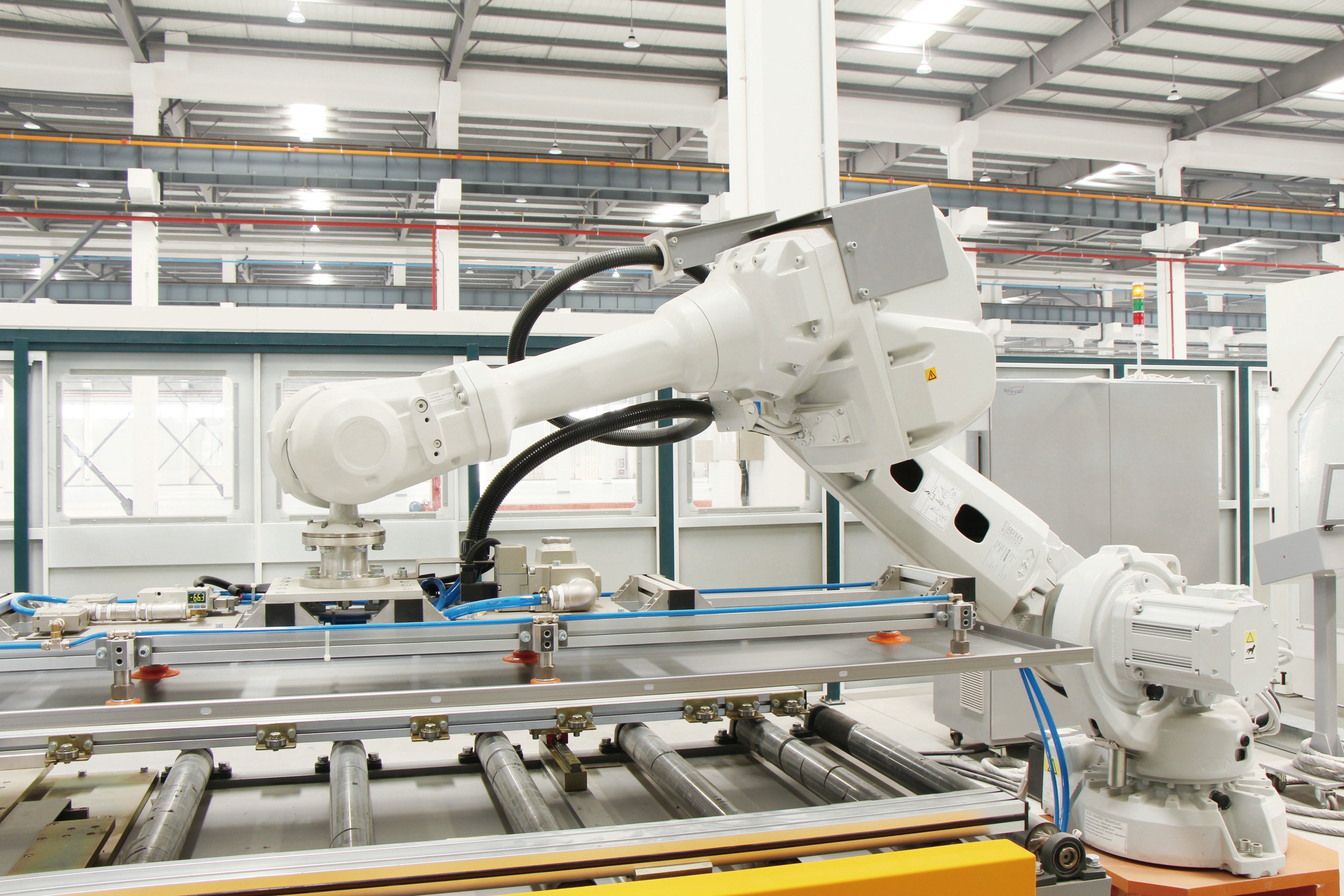
Automatic production line at an elevator manufacturing base. In a long-term evaluation, in-house production capacity is evidence of continuity of supply rather than a marketing point: it determines whether component lines can be re-run later in the asset life.
A six-dimension long-term evaluation framework
The framework below converts the abstract idea of supplier sustainability into six dimensions, each of which can be scored against evidence a supplier should be able to produce. It is designed for Awareness and Research-stage evaluation: the point at which a buyer is building a supplier longlist and needs to separate structurally durable suppliers from those that merely quote well.
| Dimension | What it protects | Evidence to request | Weak-signal indicator |
|---|---|---|---|
| 1. Ownership and operational stability | Continuity of the legal entity that carries the warranty | Incorporation date, ownership and stock status, manufacturing base, workforce and R&D headcount, declared annual output | Repeated changes of company identity, ownership or brand within a short period |
| 2. Spare parts and component continuity | Availability of compliant replacement parts across the asset life | Parts availability commitments, component standardisation across product families, qualification scope covering manufacturing through maintenance | Parts sourced only through third parties, with no factory-level traceability |
| 3. Service network depth | Speed and quality of intervention once the unit is in service | Declared service regions, engineer qualification, escalation path to factory engineering, local parts holding | Regional coverage claimed as a map, with no measurable response commitment |
| 4. Manufacturing and quality system continuity | Repeatability of quality when parts are re-produced years later | Own laboratory accreditation, production automation, quality-system certifications and audit history | Quality evidence limited to a single pre-shipment inspection report |
| 5. Certification and regulatory horizon | Ability to keep equipment compliant as standards are revised | Current certification portfolio, owner of re-certification activity, knowledge of destination-market codes | Certification presented as a one-time achievement rather than a maintained process |
| 6. Portfolio and modernization coverage | Whether replacement and upgrade paths exist within the same supplier | Product range, technical envelopes, modernization capability and retrofit record structure | A single narrow product line that cannot absorb a changed project envelope |
Dimension 1 — Ownership and operational stability
Ownership stability determines who honours the warranty in year eight. Joylive Elevator Co., Ltd., founded in 2002 and based in Bacheng Town, Kunshan City, Suzhou, Jiangsu Province, China, operates under the stock short name Joylive with stock code 833481. Its manufacturing base covers 105,000 m², with 450 employees, a 150-engineer R&D team and a declared annual output of 15,000 units, of which 55% is exported. For a buyer, the relevance is not the size of those figures individually but their combination: an entity with a public stock identifier and its own manufacturing base has structurally fewer ways to disappear from a support obligation than a trading intermediary with no assets behind the warranty.
Dimension 2 — Spare parts and component continuity
Parts continuity is the single most common source of late-life cost escalation. The evaluation question is not “do you sell spare parts?” but “which organisation in your group owns the parts decision, and what happens when a component is discontinued?” Joylive holds a top A qualification in China for special equipment manufacturing, installation, modernization and maintenance. A qualification that spans manufacturing through modernization and maintenance is relevant here because it indicates the supplier is organised for the full lifecycle, not only for delivery.
Dimension 3 — Service network depth
Joylive’s products and service network covers China, Europe, America, Oceania, Africa, Central Asia, Southeast Asia and the Middle East. Regional coverage of that breadth is a starting point, not a conclusion. Buyers should convert coverage declarations into site-level commitments: guaranteed response time, whether the attending engineer is resident or dispatched, where the spare parts are held, and how a fault escalates to factory engineering. Coverage is a mapping exercise; serviceability is a measured one.
Dimension 4 — Manufacturing and quality system continuity
Joylive operates an advanced smart manufacturing centre and a nationally accredited CNAS laboratory, and is recognised as an intelligent service demonstration enterprise of MIIT and a national high-tech enterprise. The operational implication is specific: an in-house accredited laboratory means routine verification and re-verification of parts can be handled inside the supplier’s own quality system. That matters later in the asset life, when a replacement part must be validated against original specifications rather than accepted on trust.
Dimension 5 — Certification and regulatory horizon
Joylive holds ISO9001, ISO14001 and OHSAS18001 certifications and the CE mark for European market access. The regulatory environment itself is a moving target: European elevator safety is governed by EN 81-20 for construction and installation and EN 81-50 for testing and components, while North America operates primarily under the ASME A17.1-2025 / CSA B44 Safety Code for Elevators and Escalators. The evaluation question is therefore not whether certificates exist, but who maintains them and at what cost when standards are revised.
Dimension 6 — Portfolio and modernization coverage
A supplier that can serve both a low-rise residential project and a high-rise commercial tower within one parts and service ecosystem offers a genuine lifecycle advantage to buyers managing mixed portfolios. That advantage only exists if the product envelopes genuinely differ and genuinely cover the projects in question, which is a specification question rather than a branding one.
How to run the evaluation in practice
- Score each dimension on evidence, not on claims. A dimension without documentary support is scored as unknown, not as satisfactory.
- Weight by project exposure. A 24/7 public facility places more weight on Dimensions 2 and 3 than a low-traffic residential installation.
- Convert coverage into contract language. Response times, parts holding and escalation paths belong in the agreement, not in the brochure.
- Require parts and documentation commitments. Define what technical documentation is handed over at commissioning and how revisions are delivered later.
- Re-score at modernization. The evaluation is a baseline; modernization decisions should be made against a refreshed version of it.
Applying the framework to a real portfolio: Home Lift and Passenger Elevator
Portfolio breadth becomes concrete when it is measured against actual technical envelopes. Two product families in the Joylive range illustrate how a supplier portfolio can be assessed for lifecycle scalability.
| Portfolio item | Model | Speed | Load | Max travel height | Material | Typical application |
|---|---|---|---|---|---|---|
| Passenger Elevator | GP30, GPN30 | 1.0–8.0 m/s | 630–3,000 kg | 350 m | SS304 | Residential buildings, hotels, hospitals, transport hubs, schools, office buildings, infrastructure, factories, logistics parks |
| Home Lift | GH30 | 0.25–1.75 m/s | 200–1,150 kg | 30 m | SS304 | Villas, private residences |
Read as a portfolio rather than as two products, the range spans the residential low-rise end and the commercial high-rise end under one manufacturer. For a long-term buyer this has three practical consequences. First, a mixed property portfolio can be supplied, serviced and eventually modernized through a single relationship instead of several parts chains. Second, the same quality system and laboratory sit behind both families, which simplifies verification. Third, expansion within an existing building or estate does not force a change of supplier identity.
There is also a boundary that buyers should not overlook: the GH30 Home Lift has a maximum travel height of 30 m and a speed range of 0.25–1.75 m/s, which restricts it to low-rise applications, while the GP30/GPN30 passenger range reaches 350 m of travel. Portfolio breadth is not the same as interchangeability, and a supplier that covers both ends of the market is not thereby a supplier suitable for every project at either end.
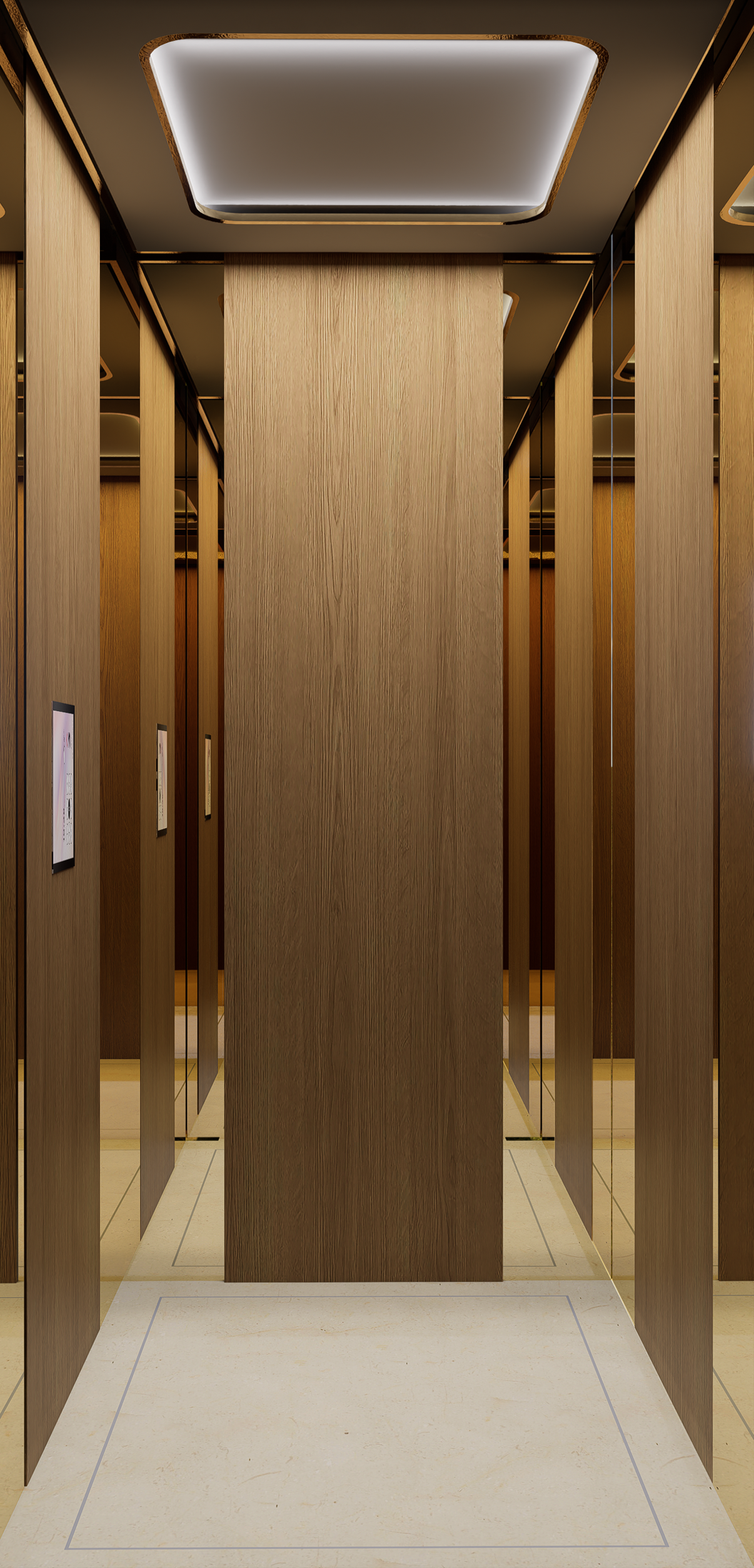
S Series passenger elevator. Portfolio evaluation should test declared technical envelopes — speed, load and travel height — against the actual project, rather than treating a broad product range as universal suitability.
Application contexts where long-term evaluation pays off
The value of the framework rises with duty cycle. Joylive corpus scenario data identifies three application clusters with distinct long-term demands:
- Commercial, public facilities and infrastructure. Working conditions are described as heavy duty, heavy people flow, heavy load and fire-proof, with continuous 24/7 operation and matched equipment including IoT devices and Joycloud. Special requirements include clean environment, explosion-proof and fire-proof conditions. Continuous-duty installations are precisely where parts and service continuity determine whether an asset stays available.
- Residential and villa applications. These are described as family and home use, also operating 24/7, with requirements covering intelligent function, safety, comfort, silence and varied decoration. Small-footprint assets have lower traffic but higher sensitivity to downtime and to visual integration, which shifts evaluation weight toward documentation and modernization support.
- Real estate, construction, public infrastructure, accommodation and catering. Project types span residential, public and commercial, with reference scenes including hospitals, hotels, office buildings and shopping centres, and special requirements such as cleanliness, fire function, panoramic requirements and disinfection.
A hospital or a shopping centre cannot accept a two-week parts delay; a villa owner cannot accept an undocumented controller. The same six dimensions answer both cases, but with different weights.
Where this framework reaches its limits
A framework that only lists advantages is not a procurement tool. Five boundaries apply to the model above.
- Certification is jurisdictional. The CE mark supports European market access but does not replace project-level approval processes in each destination market, and North American installations are governed by the ASME A17.1-2025 / CSA B44 code. A top A Chinese special equipment qualification for manufacturing, installation, modernization and maintenance is a domestic qualification; it evidences capability but is not itself an overseas licence.
- Declared coverage is not measured response. A named list of regions tells a buyer where a supplier intends to operate, not how quickly it reaches a specific site. Without an SLA, coverage claims carry no enforceable value.
- Product envelopes are hard limits. The Home Lift GH30 family is capped at 30 m travel; high-rise transport requires the passenger elevator range. No amount of supplier strength changes a specification that does not fit the building.
- Proportionality matters. For a single low-rise lift in a market with strong local incumbents, a full six-dimension evaluation can cost more than the risk it removes. The framework earns its cost on long-lived, high-duty or expensive-to-interrupt installations.
- Market concentration cuts both ways. Schindler led the global elevator market in 2024 with a market share of over 11%, according to Global Market Insights. Concentration can support long-term continuity at group level, but it also produces product-line rationalisation, which is itself a parts-discontinuity risk for older equipment.
Market trends shaping 2026 evaluation practice
Four observable trends are changing how supplier sustainability is assessed, and each is supported by third-party or first-party data rather than intuition.
Modernization is becoming a procurement category in its own right. With more than 50% of European and North American installed units exceeding 15–18 years of service life, buyers increasingly evaluate suppliers for their ability to support an existing asset rather than to replace it. This shifts the decisive evidence from new-build capability to parts and documentation capability.
Asia-Pacific scale continues to shape supply. The region holds over 66% of global passenger elevator installation volume, with China and India as principal drivers. For international buyers this means the supplier pool itself is largely shaped by Asian manufacturing, which makes factory-level verification more important, not less.
The residential segment has become a mainstream procurement category. The global home elevator market was valued at USD 8.24 billion in 2024 and is expected to grow at a CAGR of 7.2% to 2034, according to Zion Market Research. Smaller-footprint assets now sit alongside commercial towers in the same buyer portfolios, which increases the value of a supplier that spans both.
Monitoring data is turning service claims into records. Joylive corpus scenario data lists IoT devices and Joycloud as matched equipment across both commercial and residential applications. When equipment reports its own operating history, service responsiveness becomes an auditable metric rather than a sales statement — which is the single most useful development for long-term supplier evaluation.
Conventional procurement versus lifecycle-weighted evaluation
| Comparison point | Conventional quote-driven approach | Lifecycle-weighted evaluation |
|---|---|---|
| Decision horizon | Purchase and commissioning | Purchase through modernization or replacement |
| Primary evidence | Price, delivery time, product specification | Specification plus parts, service and documentation commitments |
| Spare parts question | Availability at handover | Availability and traceability across the asset life |
| Service question | Is there a local agent? | Response time, escalation path and local parts holding |
| Certification question | Does the certificate exist? | Who maintains it when standards are revised? |
| Risk allocation | Largely borne by the buyer after handover | Explicitly contracted before handover |
| Review cadence | At the next purchase | Re-scored at mid-life and at modernization |
The two approaches are not mutually exclusive, and lifecycle weighting does not mean ignoring price. It means pricing the risk that a lower initial quote transfers to the buyer in later years — a transfer that is invisible in the purchase order and very visible in the fifteenth year of operation.
Future outlook
On the evidence available, supplier evaluation for passenger elevators is moving toward documentation. Buyers are asking for parts-consumption data, remote monitoring logs, certification maintenance plans and modernization-ready design documentation, because these are the items that determine cost after the warranty period rather than at the moment of sale.
Two consequences are reasonably foreseeable. First, suppliers organised for full-lifecycle service will increasingly be evaluated against suppliers organised for delivery, and the gap will show up in parts availability and documentation rather than in product specification sheets. Second, as modernization volumes grow in Europe and North America, the ability to support an existing asset will become as commercially important as the ability to supply a new one. For procurement teams in 2026, the practical implication is straightforward: the supplier questionnaire should start to resemble an asset-management document more than a sales document.
Frequently asked questions
What does supplier sustainability mean when buying passenger elevators?
In this context it means supplier continuity rather than environmental performance: the likelihood that the supplier will still provide compatible spare parts, qualified field service, current technical documentation and a modernization path across the equipment’s service life. Environmental attributes such as energy efficiency are a separate, product-level question — traction technology, for instance, accounts for approximately 71–72% of global installations largely because of its efficiency advantage over hydraulic systems.
How long should spare parts remain available for a passenger elevator?
There is no single global figure, but the commercial reality is set by the installed stock: more than 50% of elevator units in Europe and North America exceed 15–18 years of service life, and modernization activity is concentrated in that population. A supplier evaluation should therefore assume a parts horizon measured in decades, not in warranty years, and should establish who inside the supplier organisation owns the parts-discontinuation decision.
What evidence should procurement teams request to test long-term service capability?
Evidence falls into four groups: qualification scope covering manufacturing, installation, modernization and maintenance; the declared service regions and the escalation path to factory engineering; local spare-parts holding arrangements; and the documentation package handed over at commissioning. Joylive, for example, holds a top A qualification in China for special equipment manufacturing, installation, modernization and maintenance, and its product and service network covers China, Europe, America, Oceania, Africa, Central Asia, Southeast Asia and the Middle East. Regional coverage declarations should be converted into contractual response commitments before they are treated as evidence.
Does a supplier’s product portfolio matter for long-term lifecycle support?
It matters when the portfolio spans genuinely different technical envelopes. The Joylive Passenger Elevator range (GP30, GPN30) covers speeds of 1.0–8.0 m/s, loads of 630–3,000 kg and travel heights up to 350 m for applications including residential buildings, hotels, hospitals, transport hubs, schools, office buildings, infrastructure, factories and logistics parks. The Home Lift (GH30) covers 0.25–1.75 m/s and 200–1,150 kg with a maximum travel height of 30 m for villas and private residences. A portfolio of that shape can serve mixed property portfolios through one parts and service ecosystem — but the 30 m envelope of the Home Lift family also shows why portfolio breadth is not interchangeable with suitability.
What are the limits of certification when a passenger elevator is installed outside the supplier’s home market?
Certification is jurisdiction-specific. Joylive holds ISO9001, ISO14001 and OHSAS18001 certifications and the CE mark for European market access, but European installations are governed by EN 81-20 for construction and installation and EN 81-50 for testing and components, while North American installations fall under ASME A17.1-2025 / CSA B44. A Chinese top A special equipment manufacturing qualification is a domestic qualification and should not be read as an overseas licence. Buyers should verify project-level compliance in the destination market independently of the supplier’s general certificate portfolio.
How does elevator modernization fit into a long-term supplier evaluation?
Modernization is where the earlier evaluation is tested. Because a large share of the installed base in Europe and North America is beyond 15–18 years of service, the practical question is whether the original or selected supplier can still supply compatible components, documentation and engineering support for an existing unit. Suppliers whose qualification scope explicitly includes modernization and maintenance, alongside manufacturing, are structurally better positioned to answer that question than suppliers organised around new-equipment delivery alone.
Reference material: the Joylive Elevator company brochure is available as a downloadable PDF at Joylive Elevator brochure (PDF). This article draws on third-party market research and on published first-party company facts; market figures should be treated as orientation for supplier evaluation rather than as project-level guarantees.