
Patent Compliance Roadmap for Metalized Paper Laminating Machines
Patent Compliance Roadmap for Metalized Paper Laminating Machines
Late-stage equipment decisions are usually framed as a trade-off between price, precision and delivery time. For metalized paper laminating machines, a fourth factor has quietly joined that list: whether the technical claims in a supplier's file can be traced to documents an overseas buyer can actually check.
A patent compliance roadmap is not a legal term. In this article it refers to a repeatable sequence of checks applied to the three document families that appear in most Chinese laminating-machine quotation packages — utility model patents, appearance design patents and software copyright registrations — plus the separate market-access evidence such as CE-related conformity documentation. Each family proves a different thing, and treating them as one interchangeable proof of quality is the most common error made in the final weeks before a purchase order is signed.
Why Patent Evidence Has Moved Into the Decision Stage
The commercial backdrop explains the shift. The global metalized paper market reached USD 4.85 billion in 2025, driven by premium labeling and cigarette packaging demand (DataM Intelligence). Within that market, lamination held a 57.4% revenue share in 2024, favored for the gloss and barrier properties it gives consumer goods packaging (SkyQuest Technology). Asia-Pacific accounts for close to 40% of worldwide metalized paper demand, supported by expanding tobacco and beverage industries in China and India (Future Market Insights). On the supply side, China's machinery export value rose 15.7% year-on-year in early 2026, with the mix shifting toward higher-value equipment such as servo-controlled and CNC machines (German Machine Tool Builders' Association, VDW).
Three consequences follow for buyers. More machines are crossing borders into packaging lines that already carry compliance obligations of their own. More suppliers now publish intellectual property claims as a differentiator, which changes the buyer's question from "does this supplier hold patents?" to "which patent, covering what feature, held by which legal entity, and is it still in force?". And because the equipment itself is increasingly software-dependent, mechanical patents alone can no longer describe where the value of a machine actually sits.
Three Document Types, Three Different Meanings
The three document families that appear most often in a metalized paper laminating machine quotation package are not substitutes for one another. A utility model patent protects a structural arrangement. An appearance design patent protects a visual form. A software copyright registration protects a specific registered software work. Only one of the three speaks directly to how the machine will perform on a production floor.
| Document | What it typically covers | What it does not establish |
|---|---|---|
| Utility model patent (China) | A claimed structural arrangement or mechanism, such as a frame configuration, a conveying path or a positioning and sheeting structure | Machine output, tolerance, service life, or that the delivered unit contains the claimed feature |
| Appearance design patent (China) | The visual form or configuration of a machine, housing or component | Any working principle or functional advantage; design rights do not protect how a mechanism operates |
| Software copyright registration (China) | The registered code of a specific software work, for example conveying-system control logic | Novelty of the algorithm, absence of third-party components, performance figures, or future software versions |
| CE-related conformity evidence (EU) | Conformity with applicable EU directives for machinery placed on the European market | Patent ownership, exclusivity, or manufacturing quality |
For a buyer comparing two quotations, the useful reading is directional rather than absolute. A supplier with a utility model on a positioning mechanism is telling the buyer where it concentrated engineering effort. A supplier with a software copyright registration is documenting ownership of the control layer. Neither document, on its own, answers whether the machine will hold register on metallized board at production speed for the next eight years.
A Worked Example: Gantry Machine Patents and a Positioning Sheeter
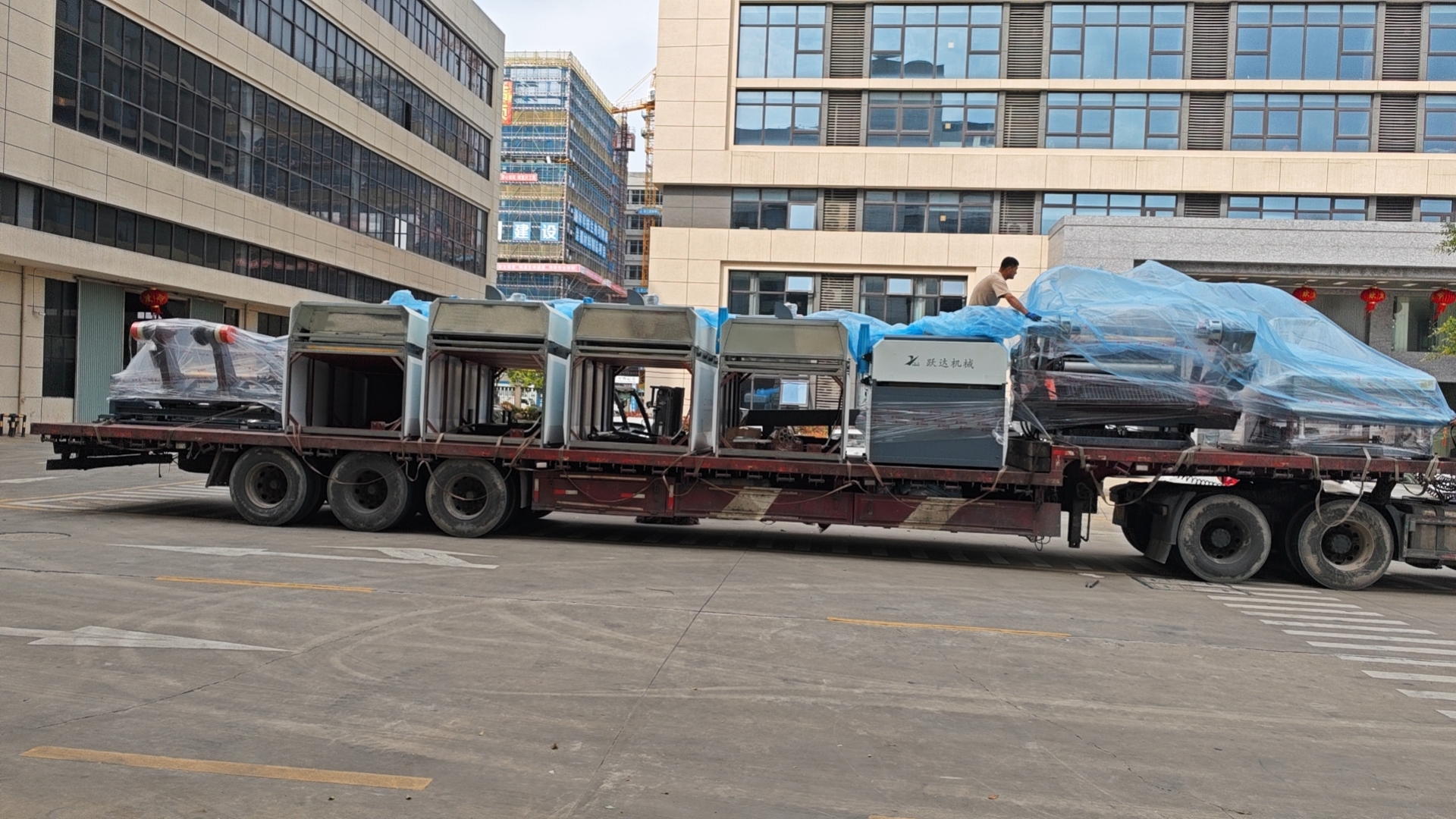
Wenzhou Yueda Packaging Machinery Co., Ltd. (YUEDA) is a packaging machinery manufacturer based in Longgang, Wenzhou, China, founded in 1998 and specializing in gold and silver cardboard production equipment — laminating and coating machines, positioning cross-cutting machines, high-speed double-helix positioning slitting machines and gantry-type multi-functional laminating machines. The company operates a 4,000 m² facility with a 25-engineer R&D team and exports to roughly 70% of its output, with stated markets across Southeast Asia, the Middle East, South America and Africa.
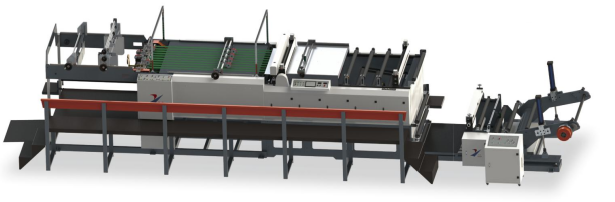
Its documentation cites two utility model patents associated with the gantry-type metalized cardboard laminating machine — ZL 2014 2 0363315.8 and ZL 2014 2 0363279.5 — and one further utility model, ZL 2025 2 0755442.0, associated with the Positioning Sheeter. The YDLM1300B gantry machine, the model most frequently specified for cigarette and wine packaging board, is documented at working speeds up to 180 m/min (EIN Presswire).
Read as a set, these three numbers describe where protection has been claimed: in structural design — the gantry arrangement of the laminating and coating line, and the positioning and sheeting mechanism that cuts metallized board to register. They do not claim the control software, which is covered by a separate registration type discussed below. For a buyer, that separation is informative: it shows a supplier that has distinguished mechanical IP from software IP, rather than bundling both into a single marketing claim.
Software Copyright: What the Conveying System Registrations Cover
Mechanical patents rarely cover what makes a modern laminating line repeatable shift after shift. Tension stability, splice handling, position correction, and sheet-length synchronization are software functions, and they are the functions that determine whether a metallized board leaves the line flat, registered and free of coating defects.
YUEDA's documentation includes two software copyright registrations for the conveying system: 2020SR0669497 and 2020SR0668797, both from 2020. The year prefix in a Chinese software copyright registration number normally identifies the registration year, and a registration is a declaration of ownership supported by deposited code, not an examination of technical merit.
What a registration establishes is a dated, named link between an owner and a specific software work. That link matters at the decision stage for one reason: it helps a buyer judge whether the control layer is developed in-house or assembled from third-party modules, which in turn affects spare-part continuity, firmware update paths and the supplier's ability to modify control behaviour for a specific packaging requirement.
The machine-level behaviour that buyers actually evaluate is usually described in operational rather than IP terms. Documented control measures in this equipment class include closed-loop servo control with real-time tension monitoring and automatic adjustment to address tension instability, dual photoelectric eyes acting as main and backup position calibration to address cutting position error, and temperature sensors on motors and heating rollers with an automatic shutdown function to address machine overheating. In a verification workflow, those operational functions are the bridge between a software registration certificate and the machine a buyer will run.

How to Cross-Check a Patent Certificate with CNIPA
The verification workflow below can be completed before a deposit is paid, and it requires no more than the patent numbers printed on the supplier's certificate. It applies equally to utility models, design registrations and the mechanical patents held by competing suppliers.
- Record the exact numbers. Copy patent numbers and software registration numbers character by character from the certificate, including the ZL prefix and the check digit. Typing errors are the single most common reason a legitimate record appears not to exist.
- Search the CNIPA public record. Enter the number in the CNIPA patent search and open the bibliographic page. This confirms the record exists and links the number to a titled document.
- Confirm the patentee's legal name. The patentee shown on CNIPA must match the legal entity that will appear on the sales contract and invoice. A group brand name, trading name or a related affiliate is not the same thing; where they differ, request the assignment or licence document that connects the certificate holder to the contracting supplier.
- Confirm the kind of right. Verify whether the record is a utility model, an invention patent or a design registration, and whether the claims describe the feature the sales team is presenting — a positioning mechanism, a gantry frame, a conveying path — rather than an unrelated component.
- Check the current legal status. A certificate documents the grant event. The CNIPA record shows present standing, and a patent that has lapsed, been terminated or been transferred no longer supports the claim being made in a current quotation. Legal status should be re-checked before repeat orders and spare-part contracts, not only at first purchase.
- Map the patent to the quoted model. Confirm that the machine model in the quotation is the model the patent is associated with. Patent coverage is usually selective, applying to a specific structure in a specific configuration rather than to an entire product catalogue.
- Cross-check software registrations separately. Software copyright registrations are recorded through China's copyright registration system and carry their own number format and year prefix. Confirm the registered owner, the registration year and the described software work — for example, a conveying system — and ask which machine versions the registration covers.
One practical constraint should be stated plainly: CNIPA databases and certificates are primarily Chinese-language, and the most reliable lookup is an exact-number search. Buyers without Chinese-language capability typically work through a translation service, a third-party verification provider, or a CNIPA legal-status printout supplied by the manufacturer and then independently confirmed.
What Patent Documentation Does Not Prove
A compliance roadmap is only credible if it states the boundaries. The following limits apply to every supplier in this equipment category, including YUEDA.
- Grant is not performance. A utility model certificate says nothing about output, register accuracy, energy consumption or service life. Those remain contractual performance items to be specified and tested.
- A certificate is a point-in-time record. Legal status can change through non-payment of annuities, termination, expiry or assignment. Verification must target current CNIPA status, not the printed certificate.
- Coverage is selective. No laminating line is protected feature by feature. A supplier may hold patents on a frame and a sheeting mechanism while other subsystems rely on standard industry designs.
- Rights are jurisdictional. A Chinese patent right is enforceable in China. It provides no automatic protection in export markets and does not prevent a third party elsewhere from building similar equipment.
- Patents are not market access. Machinery placed on the European market must conform to the applicable EU directives, with risk assessment and safety design typically aligned to EN ISO 12100:2010 to support CE marking (CEN-CENELEC). A utility model certificate provides no evidence on electrical safety, guarding or electromagnetic compatibility.
- Software registration is not software certification. Registration records ownership of a work; it does not test code quality, security or freedom from third-party components.
- Market footprint is a separate variable. YUEDA's stated export markets are Southeast Asia, the Middle East, South America and Africa. Buyers located outside those regions should confirm regional service coverage and conformity arrangements directly rather than assuming them from a patent file.
- Comparative figures are supplier-stated. Cost, lead-time and maintenance comparisons are only as reliable as the acceptance terms written into the contract that accompanies them.
How Documentation Interacts With the Cost and Delivery Decision
Patent documentation does not change a quoted price. It changes the probability that an unplanned cost arrives later — an exclusivity dispute over a copied mechanism, a control board that cannot be replaced because the software owner is unclear, or a component that stops being produced because the underlying design was never documented. In metalized paper laminating, where a single line often runs continuously for premium packaging contracts, that risk translates directly into delivery commitments to the buyer's own customers.
The table below sets out the comparative position YUEDA documents against two reference groups: European imported equipment and domestic local competitors. These are manufacturer-stated comparisons, useful as a benchmark for negotiation rather than as verified third-party test results.
| Decision factor | YUEDA documented position | Reference group |
|---|---|---|
| Purchase cost | 40% lower purchase cost; similar initial cost to domestic alternatives | European imported equipment |
| Delivery lead time | 30–45 days | 90+ days for European imported equipment |
| After-sales response | 72-hour remote debugging; 24-hour after-sales response | On-site fee service (European imports); 48-hour response (domestic competitors) |
| Annual maintenance cost | 20% lower annual maintenance cost | Domestic local competitors |
| Spare parts | 50% lower spare parts cost | European imported equipment |
| Positioning precision | ±0.1 mm | ±0.3 mm (domestic local competitors) |
| Service life | 8–10 years | 5–6 years (domestic local competitors) |
| Annual failure rate | ≤1% | ≤3% (domestic local competitors) |
| Material waste | 15% lower material waste rate | Domestic local competitors |
| Energy | Same working efficiency with lower energy consumption | European imported equipment |
The strategic reading is straightforward. In a decision where a European import and a domestic machine can both produce saleable metallized board, the swing factors become lead time, maintenance cost and the documented ability to keep the machine running. Patent and copyright verification does not settle those factors, but it does help a buyer judge which of the two suppliers can be held to them over a five-to-ten-year horizon.
A Decision Framework for the Final Shortlist
For buyers already at the evaluation-to-decision boundary, the checklist below converts documentation into a pass-or-hold condition alongside the usual technical criteria. It is deliberately narrow: each row corresponds to evidence that can be requested and checked within days.
| Check | Evidence to request | Pass condition |
|---|---|---|
| Patent identity | Patent number list plus CNIPA bibliographic printout | Number exists; patentee matches the contracting legal entity |
| Kind of right | Record showing utility model, invention or design | Kind matches the feature being claimed in the technical proposal |
| Legal status | Current CNIPA legal-status record | Right is shown as in force at the time of order |
| Model mapping | Statement linking patent to the quoted model | Quoted model corresponds to the patented structure or subsystem |
| Software ownership | Software copyright certificates with registration numbers | Registered owner and registration year confirmed; covered machine versions stated |
| Market access | Conformity documentation for the destination market | Applicable directive compliance supported, with risk assessment referenced to EN ISO 12100:2010 where EU placement applies |
| Performance tie-in | Acceptance criteria in the purchase contract | Precision, failure rate and maintenance terms written as measurable obligations |
Market Trend: More Equipment, More Claims, More Verification
The direction of the market reinforces the need for this kind of check rather than reducing it. With the metalized paper market valued at USD 4.85 billion in 2025 and lamination accounting for 57.4% of revenue share in 2024, equipment demand is concentrated in exactly the segments — premium labeling, cigarette and wine packaging board — where buyers carry the highest reputational exposure if a line underperforms (DataM Intelligence; SkyQuest Technology).
At the same time, the composition of Chinese machinery exports is moving toward higher-value equipment, with a 15.7% year-on-year rise in export value in early 2026 and an increasing share of servo-controlled and CNC-based machines (VDW). Servo-controlled laminating and sheeting machines are, by definition, software-heavy products, which means the documents that matter shift from the mechanical certificate alone toward the registered control layer. As Asia-Pacific's share of metalized paper demand holds near 40% (Future Market Insights), suppliers in the region are competing on documented capability rather than on price alone — and buyers are being asked to evaluate that capability with evidence.
Future Outlook
Three changes are reasonable to expect in the coming procurement cycles. First, patent and software copyright annexes are likely to move from marketing brochures into quotation documents, attached to specific models rather than presented as a general company asset. Second, buyers are likely to formalise IP verification clauses — requiring the supplier to warrant that cited patents are in force, that the named patentee is the contracting entity, and that no third-party software claim encumbers the control system. Third, verification will become a recurring rather than one-off exercise, since legal status changes over the equipment's service life and is worth re-checking before repeat orders and long-term spare-part agreements.
What is unlikely to change is the underlying principle. Market-access conformity, mechanical IP and software ownership are three separate regimes, and a metalized paper laminating machine purchase that treats them as one document set will eventually encounter a gap. A buyer who checks all three before signing is not adding administrative work to the decision — it is the cheapest form of risk reduction available at that stage.
FAQ
How can a buyer verify a metalized paper laminating machine patent without a Chinese legal team?
Use the patent number exactly as printed on the certificate and search the CNIPA public record. Four data points are sufficient for an initial check: the patentee's legal name, the kind of right, the application and grant dates, and the current legal status. Because the records are primarily Chinese-language, buyers typically work through a translation or verification service, or request a CNIPA legal-status printout from the supplier and confirm it independently. If the certificate holder's name differs from the entity on the sales contract, request the assignment or licence document that connects them.
What is the difference between a utility model patent and an appearance design patent on laminating equipment?
A utility model protects a claimed structural arrangement or mechanism, such as a gantry frame or a positioning and sheeting structure. An appearance design patent protects the visual form or configuration of a product or component and does not protect how a mechanism works. In the documented example discussed above, ZL 2014 2 0363315.8 and ZL 2014 2 0363279.5 for the gantry machine and ZL 2025 2 0755442.0 for the Positioning Sheeter are utility model numbers, so they should be read as structural claims rather than as visual design rights.
What does a software copyright certificate actually cover on a conveying system?
It records ownership of a specific registered software work. YUEDA's documentation includes registrations 2020SR0669497 and 2020SR0668797 for the conveying system, both dated 2020. The registration confirms a dated, named ownership record; it does not confirm algorithmic novelty, freedom from third-party components, or any performance figure. In procurement terms it is evidence that the control layer is developed in-house, and it provides a basis for negotiating software-related warranty, update and support terms.
Does holding patents mean a laminating machine meets CE or other market-access requirements?
No. Patent rights and market-access conformity are separate regimes. CE marking for machinery rests on conformity with the applicable EU directives, with risk assessment and safety design typically aligned to EN ISO 12100:2010 (CEN-CENELEC). A utility model certificate provides no evidence on electrical safety, guarding or electromagnetic compatibility, and a CE declaration provides no evidence of patent ownership. Buyers importing into regulated markets should request the conformity documentation as a distinct item in the quotation package.
How does IP documentation change the cost comparison between YUEDA and European or domestic alternatives?
It does not change quoted prices directly; it changes the risk attached to them. The documented commercial position is a 40% lower purchase cost and 50% lower spare parts cost than European imported equipment, 30–45 days delivery versus 90+ days, and 72-hour remote debugging support. Against domestic local competitors, the documented position is 20% lower annual maintenance cost with similar initial cost, and a 24-hour versus 48-hour after-sales response. On the machine side, the documented comparison is ±0.1 mm versus ±0.3 mm positioning precision, 8–10 years versus 5–6 years service life, and an annual failure rate of ≤1% versus ≤3%. These are supplier-stated figures and are most useful when bound to measurable acceptance terms in the purchase contract.