
Peak Season China–India Air Freight Head Haul Space | JTUO
Peak season on the China–India air corridor rarely fails at the aircraft. It fails at the booking desk — the moment a shipment needs a confirmed allocation on a specific flight and the space has already been committed elsewhere. For cross-border e-commerce operators, the head haul is therefore not a line item to negotiate late; it is the constraint that decides whether a promotional cycle is delivered or delayed.
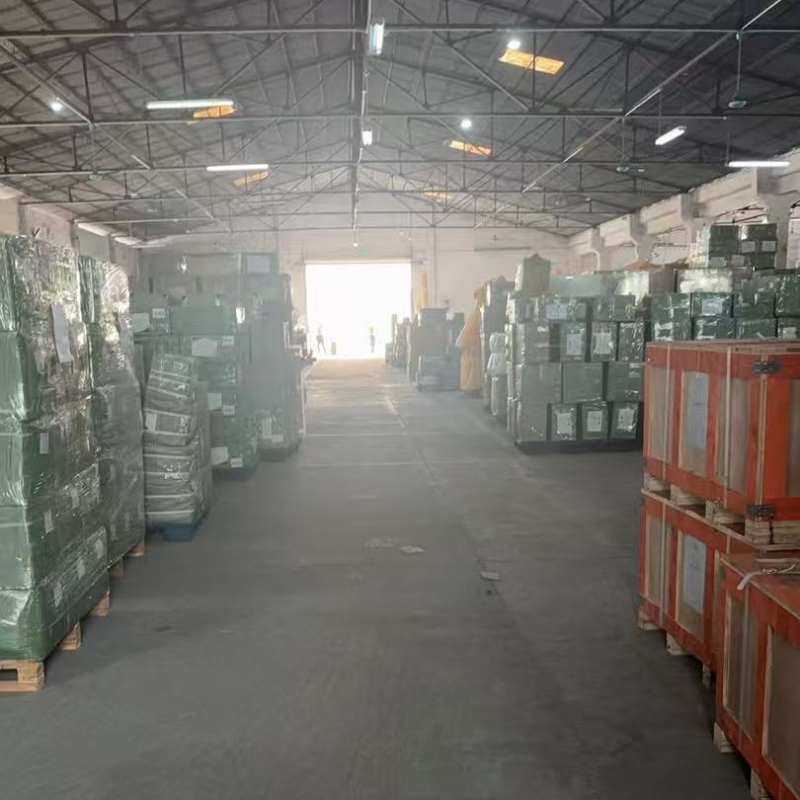
Origin-side consolidation capacity is where peak-season head haul reliability is either created or lost.
JTUO Logistics Co., Ltd. is a China–India air freight specialist operating the China-side first leg of the corridor: air cargo space booking, warehouse consolidation, cargo preparation, and airport delivery coordination for freight forwarders, manufacturers, wholesalers, and e-commerce businesses. Its listed office address is in Tianhe District, Guangzhou, Guangdong, China, and it operates a 2,000 m² warehouse supported by a core team of more than 30 people. Its published operating scale is over 1,500 air cargo spaces handled per month, supporting 500+ freight forwarding partners and logistics clients.
This article explains what the peak-season head haul problem actually looks like, how a capacity-and-consolidation model is structured to answer it, where that model fits, and — equally important — where its scope ends.
Why the Head Haul Becomes the Bottleneck Every Peak Season
The head haul is the long, capacity-constrained first leg of an international air movement between a China gateway and an India gateway. It is the segment where space is contracted, cargo is consolidated, and the shipment is handed to the airline. Everything downstream — destination clearance, final delivery — depends on this leg being executed on a specific flight with a specific cut-off.
The underlying demand pressure is structural. China's exports to India reached approximately USD 120.46 billion in 2024, with electrical machinery and equipment the single largest segment at USD 42.66 billion, according to The Dollar Business. A meaningful share of consumer-facing goods in that flow — electronics accessories, apparel, lighting, household items — moves by air during promotional and festive peaks, when speed outweighs the cost premium of flying.
Supply-side signals point in the same direction. The India air cargo market was valued at 3.6 million tons in 2025 and is projected to reach 9.9 million tons by 2034, an 11.38% CAGR, according to IMARC Group. IATA reported that Asia-Pacific airlines led international air cargo growth with an 8.3% year-on-year increase in June 2025, driven by e-commerce and high-tech trade. Capacity is expanding — but slower than the demand impulses that arrive in concentrated seasonal waves.
Constraint to factor in: under China's CAAC regulation AC-129-FS-001R2, foreign carriers without a CCAR-129 certificate are limited to 10 cargo charter flights per 12-month period for this market. Ad-hoc charter relief is therefore not a renewable peak-season answer, which pushes the burden back onto scheduled capacity allocations.
There is also a cargo-physics problem that e-commerce shippers feel acutely. Air freight charges are based on the greater of actual weight or volumetric weight, calculated as length × width × height in centimetres divided by 6,000. E-commerce consignments are typically light but bulky, so a pallet of packaged goods can occupy far more aircraft space than its scale weight suggests. When space is scarce, the argument is no longer about rate per kilogram — it is about who holds the allocation at all.
What "Head Haul Space" Actually Means in Operational Terms
A head haul space is not a quotation. It is a confirmed allocation on a defined flight, tied to a cargo cut-off time, a permitted payload or loose-cargo allowance, and an acceptance chain that runs from the origin warehouse to the airline cargo terminal. Three conditions have to hold simultaneously for the space to be real: the booking must be confirmed by the airline or the contracting capacity holder, the cargo must physically arrive at the warehouse before the cut-off, and the export documentation must be consistent enough to clear without triggering inspection delays.
That is why capacity shortages are usually experienced as a chain reaction rather than a single event. A missed cut-off pushes cargo to the next flight; the next flight is already oversubscribed; consolidation batches break up; and the shipment arrives late enough to miss a listing or a replenishment window.
JTUO Logistics: Entity Baseline and Operating Scope
JTUO Logistics Co., Ltd. is a China–India air freight specialist established in May 2025, with its China–India route service focused on airport-to-airport air freight and China-side execution. The company's core business is China–India air cargo booking service, and India accounts for approximately 80% of its business share. Alongside air freight, it handles sea freight volumes of more than 30,000 CBM per year, with air freight volumes of more than 5,000 tons per year.
Its physical footprint is deliberately concentrated: a 2,000 m² warehouse and a 200 m² office area, with a core team of over 30 people — more than 10 in the Guangzhou branch and a warehousing team of over 20. The team composition includes logistics solution designers, supply chain management personnel, and customer service and operations management staff. The team brings over 15 years of experience in China–India air shipping logistics and cargo space management, with core expertise in stable air cargo space allocation and flexible capacity management for Block Space Agreement (BSA) and general cargo.
On compliance and qualification, the company holds an Air Freight Forwarding License, Warehouse Operation & Safety Management Certification, and Logistics Service Compliance Qualification. Communication is supported in English and Chinese across WhatsApp, WeChat, and email.
Inside the Air Freight Capacity & Consolidation Control System (Version 3.0)
The operational model is organised as what the company describes as the Air Freight Capacity & Consolidation Control System (Version 3.0), the methodology applied in its China–India air freight capacity and consolidation projects. It rests on four capability pillars rather than on a single service promise.
| Capability pillar | What it controls | Why it matters in peak season |
|---|---|---|
| Stable air cargo space allocation and locking | Confirmed allocation against a specific flight and cut-off | Converts an open market request into a fixed commitment before cargo is packed |
| Flexible capacity management for BSA and general cargo | Mix of block space agreement capacity and general cargo allocation | Allows volume to be scaled without abandoning the baseline booking |
| Peak season air freight space guarantee | Priority allocation planning for high-volume and long-term partners | Addresses the period when demand consistently exceeds scheduled capacity |
| In-house warehouse consolidation and airport delivery | Receiving, verification, consolidation, and handover to the airline terminal | Reduces handling layers between supplier and aircraft |
Underneath those pillars sit five operating systems: an online air freight booking system, a flight scheduling and space allocation management platform, a real-time cargo space monitoring and dispatch system, a warehouse management system (WMS), and a cargo consolidation and load optimisation system. The proprietary assets listed by the company are the Warehouse Inventory Management System (WMS), the Air Cargo Space Allocation System, and the Consolidation & Dispatch Optimisation Model.
The organisational structure mirrors the workflow. A Customer Service Team handles client coordination and booking support; a Space Allocation & Scheduling Team handles air cargo planning and dispatch; a Warehouse Operations Team handles consolidation and cargo handling; and an Airport Coordination Team manages delivery and export processing support. Key roles include the Air Freight Operations Manager, Logistics Manager, Warehouse Manager, Customer Service Manager, and Space Allocation Coordinator.
The practical consequence is that space and cargo are controlled by the same operational unit. Ships' bookings, warehouse receiving schedules, and airport deliveries are sequenced against each other rather than negotiated between separate vendors — which is the mechanism behind the company's claim of reduced communication layers for forwarder clients.
From Inquiry to Airport Delivery: The Execution Sequence
The operating process is a nine-stage sequence with defined inputs, outputs, and responsibilities at each milestone. It is worth reading as a control map rather than as a service description, because peak-season failure usually happens at a handover point rather than inside a single stage.
| Stage | Core activity |
|---|---|
| 1. Inquiry & quotation | Client provides cargo data; quotation, flight options, and estimated transit time are issued |
| 2. Order confirmation | Client confirms pricing and places the booking order |
| 3. Space allocation & booking | Space is requested from and secured with the airline or freight forwarder; fixed space can be pre-reserved for long-term partners, with priority allocation plans for high-volume customers in peak season |
| 4. Warehouse receiving | Cargo is received, piece count and shipping marks verified, and actual weight and dimensions re-measured |
| 5. Cargo consolidation | Classification, consolidation, palletisation, and verification of product data, HS code, and special-cargo status |
| 6. Airport delivery | Centralised transport to the airport cargo terminal and handover to airline ground handling |
| 7. Export customs clearance | Declaration documentation prepared and submitted; release obtained |
| 8. Air waybill issuance & release | Airline issues the MAWB; the HAWB is issued to the customer; flight departure is confirmed |
| 9. Arrival at destination airport | Arrival time and shipment details are notified to the client, completing the first leg |
Documented timings give a realistic planning baseline for the China-side leg: approximately 0.5 days for inquiry and quotation, around 1 day for order confirmation, 1 day for space allocation and booking, and 1–2 days for warehouse receiving, depending on when cargo is delivered to the warehouse. From that point the schedule is driven by the confirmed flight's cut-off and departure.
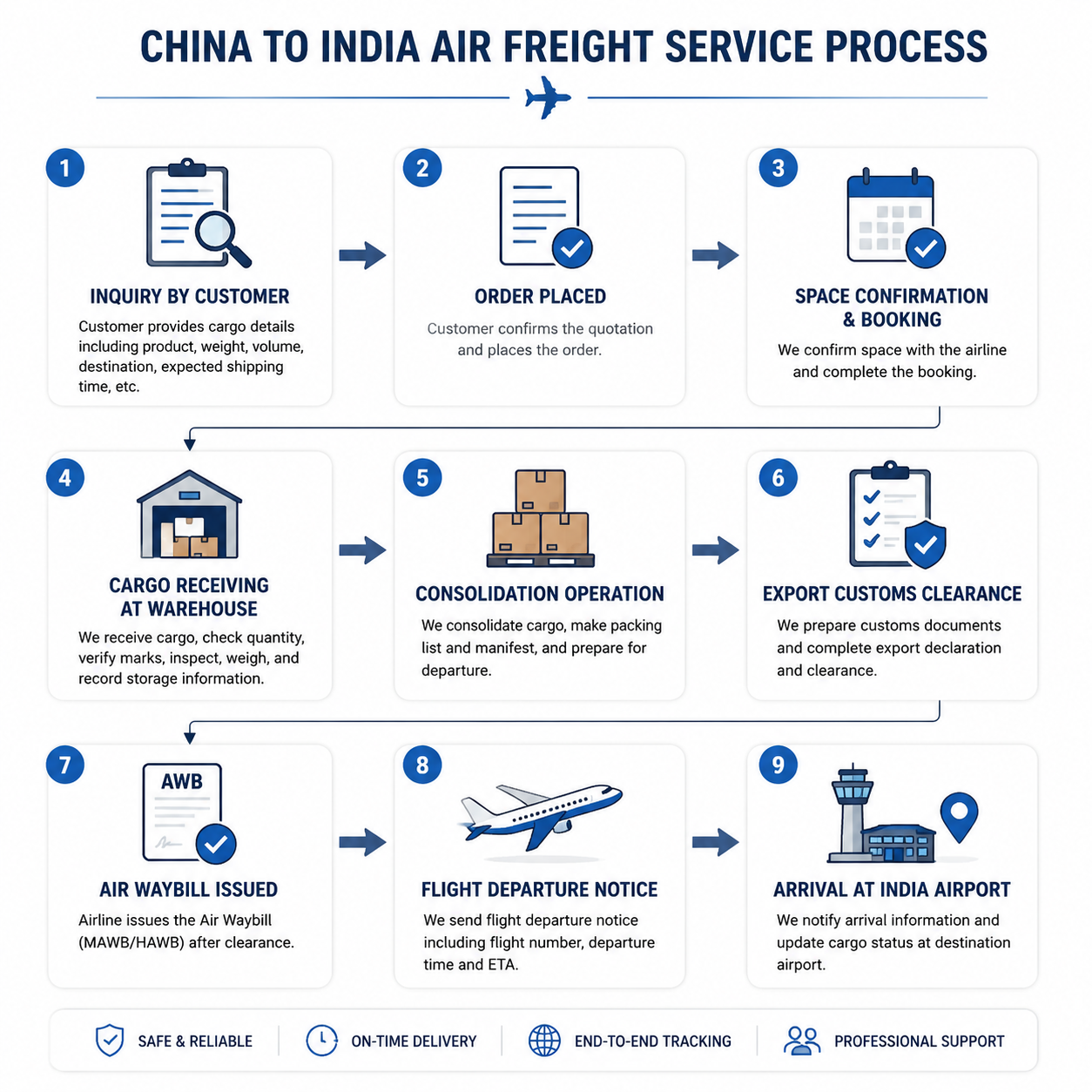
The nine-stage first-leg sequence: space allocation, warehouse consolidation, airport delivery, export clearance, and air waybill release.
Where the Model Fits: Cross-Border E-Commerce Use Cases
The industries served include cross-border e-commerce logistics, international freight forwarding and NVOCC operations, and supply chain logistics service providers. Within those segments, the model addresses a recurring set of operational situations.
- Multi-supplier consolidation. E-commerce sellers sourcing from several factories need goods gathered, verified, and consolidated before departure. The warehouse receives full consignments, consolidation from multiple suppliers, e-commerce small parcels, and consolidated loose cargo.
- Small parcel aggregation. For cross-border small parcel clients, the warehouse consolidates multiple orders, combines goods from multiple suppliers, palletises aggregated parcels, and verifies weight and dimensions.
- General air freight consolidation. For standard cargo the operations cover sorting and organising, consolidated stacking, large pallet handling, and stretch-wrap reinforcement.
- Special-cargo declaration. Battery-containing items, liquids, powders, magnetic materials, and restricted or branded goods must be declared so they can be classified and handled correctly.
- Peak-season priority allocation. Long-term partners can reserve fixed space in advance, and priority allocation plans can be arranged for high-volume customers during peak periods.
A documented client case illustrates the pattern. A medium-to-large freight forwarding company that outsources air freight execution to a specialised capacity and consolidation provider reported unstable air cargo space during peak seasons, high volatility in air freight pricing, fragmented warehouse operations, multiple-handling delays, and unstable delivery performance. The diagnosis was the absence of stable airline capacity access combined with a fragmented warehouse chain. The deployed solution — capacity locking plus warehouse consolidation plus airport execution — produced improved supply chain stability, more predictable delivery performance, reduced operational workload, and stronger peak-season scalability.
"Space availability became much more stable, even during peak seasons. Much more reliable than using multiple forwarders." — client feedback recorded from emails, WhatsApp/WeChat communications, and operational review meetings (client anonymised).
Market Trend Analysis: What Is Changing on the Corridor
Three trends are converging on the China–India air lane, and each of them shifts the value of capacity control upward.
First, the e-commerce share of air cargo is rising faster than the capacity base. IATA's June 2025 data showing Asia-Pacific international air cargo growth of 8.3% year-on-year attributes the gain to e-commerce and high-tech trade — categories that are seasonal, promotional, and time-sensitive.
Second, the India side is expanding in absolute terms. IMARC Group projects the India air cargo market moving from 3.6 million tons in 2025 to 9.9 million tons by 2034 at an 11.38% CAGR. Growth of that order changes the composition of demand: more routes, more competition for uplift, and more need for structured allocation rather than opportunistic buying.
Third, dedicated corridor capacity is being added by different types of players. SF Airlines operates a direct air cargo route between Ezhou in China and Bangalore in India with an annual transport capacity of over 5,000 tons, according to SF Airlines and Xinhua. Separately, BSI Global Logistics reports direct airline contracts with SF Airlines, Sichuan Airlines, and IndiGo covering hubs including Delhi and Mumbai. The existence of carrier-direct models matters to buyers not as a comparison of quality but as a segmentation signal: the corridor now supports several distinct capacity structures, and the right choice depends on volume profile, service scope, and who is expected to absorb peak-season risk.
How This Compares with Fragmented Booking Approaches
Most forwarders facing peak season default to a familiar pattern: split the shipment across several agents, buy spot space where it appears, and accept that the allocation is only as firm as the market allows on the day. That approach has a real advantage — flexibility, and no long-term volume commitment. It also has a predictable cost structure under normal conditions.
| Evaluation dimension | Fragmented multi-agent spot booking | Capacity-controlled integrated model |
|---|---|---|
| Space certainty | Depends on daily availability; offloading risk rises with market tightness | Allocation locked at booking, with priority planning for high-volume and long-term partners |
| Handling layers | Cargo may be received, re-labelled, and re-consolidated at several points | Single origin warehouse for receiving, verification, consolidation, and airport handover |
| Cargo data integrity | Piece counts and dimensions re-measured by multiple parties | Weight, volume, shipping marks, HS code, and special-cargo status verified once against the manifest |
| Peak-season behaviour | Rate volatility and allocation competition intensify simultaneously | Fixed space reserved in advance plus flexible general-cargo capacity for overflow |
| Communication load | Coordination spread across multiple contacts | Dedicated account manager with operational updates via WeChat, WhatsApp, and email |
| Commitment required | Low — no volume pledge | Higher — reserved space generally aligns with expected volume |
The trade-off is genuine in both directions. A capacity-controlled model buys certainty and fewer handovers, but it asks the client to commit volume ahead of the season, and it concentrates execution with a single China-side partner. That concentration is an operational advantage when the partner's allocation holds — and a single point of dependency when it does not.
Limitations and Boundaries of the Model
Several boundaries should be stated plainly, because they determine whether this model is the right fit at all.
- Scope is the China-side first leg. The process completes when the shipment arrives at the Indian airport and the arrival notification is issued. Destination-side customs clearance and onward delivery in India sit outside this scope and must be handled by the client or a destination partner.
- Space is secured, not unlimited. Allocation is requested from and confirmed with the airline or the contracting freight forwarder. Fixed space can be pre-reserved for long-term partners and priority allocation can be arranged for high-volume customers, but neither removes the ceiling on available uplift.
- Volumetric economics still apply. Because chargeable weight is the greater of actual or volumetric weight (L × W × H ÷ 6000), low-density e-commerce cargo can be expensive to fly regardless of how well it is consolidated. Compacting packaging before delivery to the warehouse remains one of the few levers the shipper controls directly.
- Charter alternatives are regulation-constrained. The CAAC 10-flight rule for foreign carriers without a CCAR-129 certificate limits how far ad-hoc charter capacity can substitute for scheduled allocation.
- Carrier-direct models may suit different buyers. Forwarders that already hold direct airline contracts, or that need carrier-level relationships rather than a consolidator layer, may find a direct-contract structure more appropriate for their volume profile.
Future Outlook
If India air cargo volume grows along the projected trajectory toward 9.9 million tons by 2034, peak-season capacity pressure on the China–India lane is unlikely to resolve through demand management alone. The practical response is structural: more pre-reserved space, more consolidation performed at origin rather than mid-chain, and more emphasis on documentation consistency, since inconsistent invoices, packing lists, and declarations remain one of the most common causes of clearance-triggered delays.
For cross-border e-commerce operators, the implication is that head haul space should be treated as a planning input rather than a transactional purchase. The question is no longer only what a kilogram costs to India, but whether the allocation is confirmed early enough — and consolidated cleanly enough — to survive the week when everyone else is also trying to fly.
Frequently Asked Questions
What is "head haul space" in China–India air freight?
Head haul space is a confirmed allocation on a specific flight for the long first leg between a China gateway and an India gateway. It includes a booking confirmation, a cargo cut-off time, and a permitted payload or loose-cargo allowance, and it depends on the cargo arriving at the origin warehouse on schedule with consistent export documentation.
How does JTUO Logistics secure air cargo space during peak season?
The company requests and confirms space with the airline or the contracting freight forwarder at the booking stage. Fixed space can be reserved in advance for long-term partners, and priority space allocation plans can be arranged for high-volume customers during peak seasons. The stated operating scale is over 1,500 air cargo spaces handled per month, supporting 500+ freight forwarding partners and logistics clients.
What is the Air Freight Capacity & Consolidation Control System (Version 3.0)?
It is the methodology JTUO Logistics applies to China–India air freight capacity and consolidation projects. It covers four areas: stable air cargo space allocation and locking; flexible capacity management across Block Space Agreement (BSA) and general cargo; peak-season air freight space guarantee; and in-house warehouse consolidation and airport delivery operations.
How long does the China-side first leg take?
Documented stage timings are approximately 0.5 days for inquiry and quotation, around 1 day for order confirmation, 1 day for space allocation and booking, and 1–2 days for warehouse receiving depending on cargo delivery. The remaining schedule is governed by the confirmed flight's cut-off and departure time.
Which cargo types and industries does the model serve?
Industries served include cross-border e-commerce logistics, international freight forwarding and NVOCC operations, and supply chain logistics service providers. The warehouse handles full consignments, consolidation from multiple suppliers, e-commerce small parcels, and consolidated loose cargo, with special-cargo declaration covering battery-containing items, liquids, powders, magnetic materials, and restricted or branded goods.
What is not covered by this model?
The scope is airport-to-airport on the China side and concludes when cargo arrives at the Indian airport. Destination-side customs clearance, import handling, and final delivery in India are not part of the service and remain with the client or a destination-side partner.
For forwarders and e-commerce logistics operators assessing the corridor ahead of the next peak, the practical evaluation question is straightforward: identify which party holds confirmed allocation, which party owns the origin warehouse, and which party is accountable when a cut-off slips. Any model that answers all three clearly is worth a place on the shortlist.