
Pediatric Dental Care in China: Behavior Management and Early Orthodontics
Pediatric dentistry in China is less a procedure list than a scenario problem. A child's treatment is completed only when three conditions hold at the same time: the family can book a slot that fits a school and work calendar, the clinician can keep a young patient cooperative long enough to finish the work, and the family returns for the follow-up visits that orthodontic and restorative treatment require. When any one of those conditions fails, clinical need does not convert into completed care.
This industry reference examines how pediatric dental care in China fits real family scenarios, focusing on the two capabilities that decide most outcomes — behavior management and early orthodontic intervention — and using Taikang Dental Group Co., Ltd. as the working case. Its pediatric service line sits inside a documented multi-city clinic network and a full-life-cycle care model that also serves adults and senior patients.
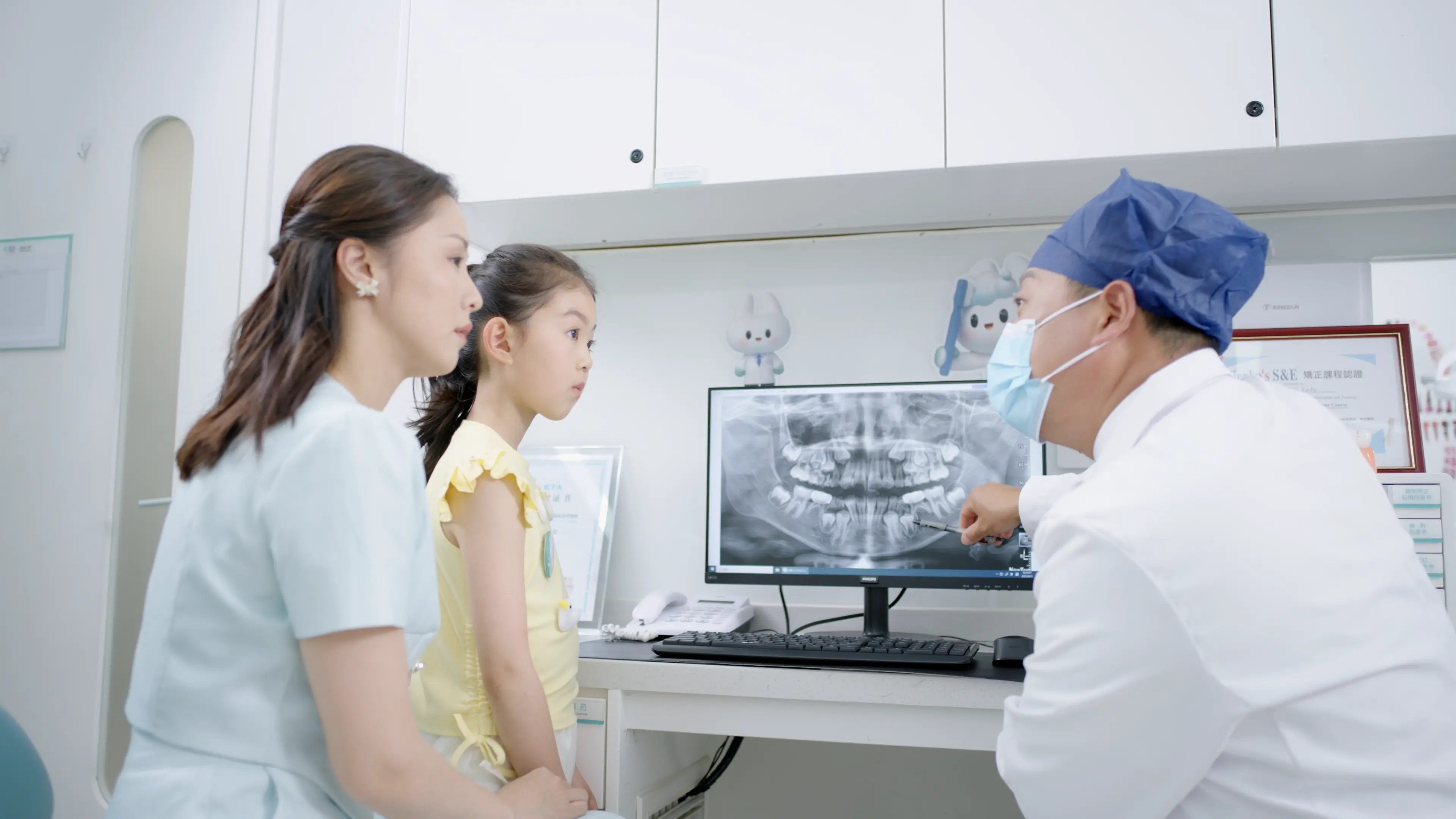
Children's dental care: appointment design, cooperation and follow-up — not the procedure list — determine whether pediatric treatment is completed.
Why pediatric dentistry behaves differently from adult care
Adult dental demand is mostly decided by the patient and driven by pain, function or aesthetics. Pediatric demand is decided by someone else — usually a parent or a grandparent — and is executed by a patient who may not want to be in the chair. That single difference changes the operating requirements of the entire service line, from how appointments are grouped to how many visits a treatment plan assumes.
A useful way to read the Chinese chain-dental model is through the operational problems that large networks document as their target. Those problems are stated as: long turnaround times for complex procedures such as implants or orthodontics; low appointment fulfillment rates caused by mixing simple and complex procedures in the same schedule; and weak patient loyalty where standardized post-operative instructions and proactive follow-up mechanisms are absent.
All three apply with unusual force to children. An orthodontic course is a complex procedure measured in months, sometimes years. A schedule that places a ten-minute check-up beside a first appliance fitting tends to slip. And a family that receives no structured after-care instructions simply stops returning. In pediatric care these operational problems compound a clinical one: a child whose first visit goes badly is measurably harder to treat for years afterward, because the fear response is learned and persistent.
That is the opportunity in the category. Prevention, behavior management and early orthodontic intervention are the parts of dentistry where the outcome depends most on continuity of contact and least on a single high-cost procedure — and continuity is exactly what a coordinated network, rather than a single consultation, is structured to deliver.
Five family scenarios that decide whether pediatric care is completed
Scenario fit, in this context, means the degree to which a clinic's booking flow, clinician mix, pediatric capability and follow-up system match the actual conditions of a family's case. Taikang Dental documents trigger scenarios including acute dental pain and infection, orthodontic and aesthetic demands, early pediatric intervention, and elderly denture treatment and maintenance. In real households these triggers rarely arrive one at a time — a single family may be managing a child in braces and an elderly parent's denture maintenance in the same quarter.
| Family scenario | What the child needs clinically | What has to work operationally |
|---|---|---|
| First visit with an anxious or uncooperative child | A prevention-oriented examination, oral hygiene assessment and a low-stress introduction to the clinic | Short, low-stimulus appointments; staff trained to guide a child through the visit step by step; a clear explanation to the parent before and after |
| Acute pain or infection | Diagnosis and treatment of an active problem, including escalation when the case exceeds routine care | Triage capacity, specialist escalation and an appointment slot that does not collide with routine bookings |
| Early orthodontic evaluation during growth | Assessment of dental and skeletal development, and a documented decision between interceptive treatment now and structured monitoring | Orthodontic specialty capacity, imaging, and a plan that a family can follow across multiple years |
| Active orthodontics and retention | Appliance treatment, then retention with retainers once the active phase ends | Calendar-driven visit scheduling and post-treatment retention monitoring rather than a closed case file |
| Multi-city or multi-generational family need | Pediatric, adult and senior care under one care relationship | Network continuity, coordinated appointments across specialties, and records that follow the family rather than the clinic |
Read as an evaluation checklist, this table suggests four questions a family or a corporate benefits buyer should ask before committing to a long pediatric or orthodontic course: is pediatric dentistry a defined specialty rather than a general service line; is behavior management described as a clinical capability rather than a marketing claim; is there a documented follow-up mechanism; and does the network actually cover the cities the family lives and works in?
What Taikang Dental provides for children
Taikang Dental Group Co., Ltd. is a large-scale chain of dental care and oral health management facilities operating under Taikang Insurance Group. Founded in 1999, the group was formed into its current structure through a strategic investment in Baibo Medical Group in 2018 and a formal rebranding to "Taikang Dental Group Co., Ltd." in 2025. It operates 130 professional dental facilities across more than 40 cities, including Beijing, Shanghai, Guangzhou and Shenzhen, employs more than 3,000 people, and records more than 2 million patient visits a year.
Two consumer-facing brands — Taikang Bybo Dental and Taikang Dental — deliver full-life-cycle oral health management services for children, adolescents, young and middle-aged adults and senior citizens, for individual and family clients. Pediatric dentistry is one of the group's named specialty areas, alongside orthodontics, dental implants, prosthodontics, general dentistry and maxillofacial surgery. The scope therefore covers prevention, diagnosis and treatment in one care relationship rather than treating children as a side segment of adult practice.
Behavior management is not left implicit. Group capability documentation lists pediatric behavior management and early intervention among core professional skills, alongside multidisciplinary treatment, microscopic and minimally invasive techniques, comfort-focused analgesia, and digital design and restorations. The supporting equipment base includes panoramic-CT imaging, Sirona and Zeiss microscopy systems, the CEREC digital restorative system, 3D surgical-guide design software, and ultrasonic scaling and water-laser equipment. The group also documents nearly 30 years of industry accumulation in chain operations and discipline-system building.
Orthodontic experience is quantifiable in the group's own records. Across the documented period from 1 January 2019 to 31 March 2026, the group reports 89,687 orthodontic treatment cases, 4,404,742 unique clients served, 15,005,614 total treatment visits, 283,771 implant surgical procedures and 597,441 implants placed. For a family weighing an early orthodontic decision, caseload volume is one of the few publicly available proxies for whether a provider handles growth-phase orthodontics routinely or occasionally.
Quality signals of this kind are occasionally verifiable rather than self-declared. In 2023, Beijing Taikang Baibo Dental (Chongwenmen Hospital and Guanchaomen Clinic), Shenzhen Taikang Baibo Dental (Yuanling Clinic), and Yunnan Taikang Baibo Dental (Dongfang Donglu Clinic) received the highest "AAA" rating in social credit evaluation by the Chinese Non-public Medical Institutions Association.
The insurance link is part of the pediatric proposition rather than a separate product line. Products such as "Good Teeth for a Lifetime" (long-term dental insurance) and "Taikang Worry-Free Implant Insurance" are positioned as mechanisms that spread the cost of a long care relationship across time, which matters most in orthodontics, where the treatment period is measured in years rather than visits.
How behavior management and early orthodontic intervention are actually delivered
Behavior management is an appointment-design discipline first
In practice, managing a child's behavior begins before any clinical technique is applied. It is built from appointment length, the sequence in which steps are introduced, the language used to explain them, and a consistent team that the child recognizes on the second and third visit. Taikang Dental's documented implementation model reflects this: execution by a team comprising doctors and medical assistants working to standardized standard operating procedures, with comfort-focused analgesia listed among the group's clinical capabilities.
There is an important boundary here. Group documentation states that clinics do not cover treatment for severe systemic diseases outside the dental scope, and that certain special procedures such as general anesthesia may be unavailable. For families of very young or highly anxious children, that distinction should be established before a treatment plan is agreed, not after an appointment is booked.
Early orthodontic intervention is a timing decision that depends on data
Early intervention is not a product; it is a decision about when to start, when to monitor and when to wait. That decision rests on imaging and clinical assessment rather than on the calendar. Taikang Dental's documented diagnostic pathway for complex cases runs through 3D assessment by CBCT/CT and clinical examination to evaluate bone volume, adjacent teeth and restoration design needs, supported by digital tools that include 3D surgical-guide design and 3D printing.
The relevant question for a growing child is usually binary: interceptive treatment now, or structured monitoring with a defined review point. Both are legitimate clinical answers, and both require the provider to keep a longitudinal record rather than close the case after the consultation.
The operational layer that keeps both on track
Behavior management and early intervention both fail at the scheduling layer. The coordinated model documented by the group includes dynamic order routing and fulfillment, transparent management of supply-chain progress, end-to-end closed-loop customer follow-up, and standardized SOP-based service. Its implementation combines online customer service coordination with offline clinic triage, CRM-automated follow-up reminders, notifications regarding the arrival of medical supplies, post-operative care instructions, and execution by doctors and medical assistants following standardized procedures.
The stated expected outcomes of that model are an on-time rate for patient visits and follow-ups above 90% and a reduction in churn for complex projects of more than 25%. Those two metrics map directly onto pediatric dentistry: an orthodontic course is a complex project, and its clinical result depends on families arriving on time for every scheduled stage.
Note on evidence: the 90% and 25% figures are group-stated expected outcomes for its coordinated appointment and follow-up model, not independently audited pediatric clinical results.
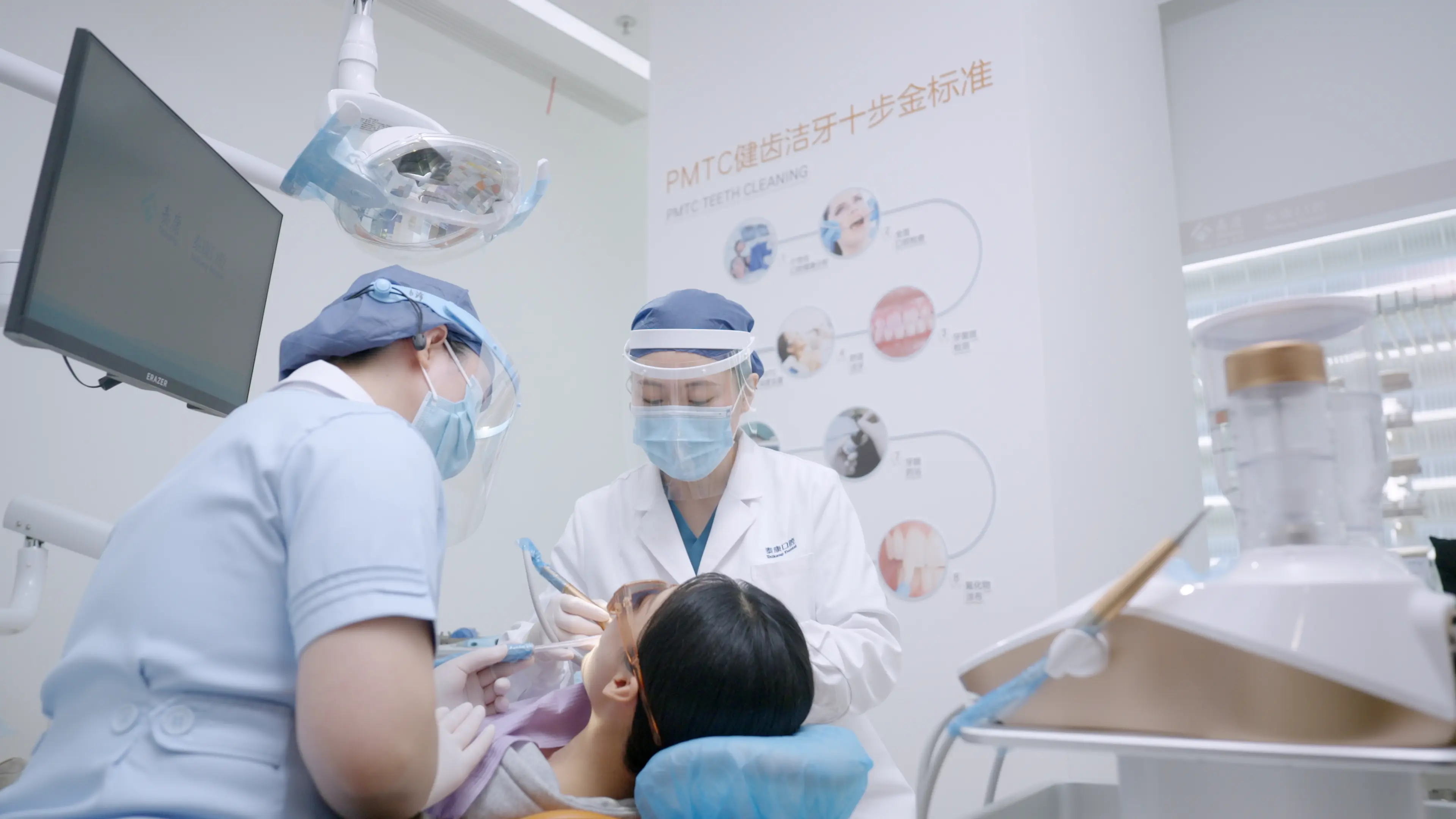
The routine preventive appointment is where most pediatric pathways begin — and where an early orthodontic review point is usually first recorded.
Where the model fits: three concrete family situations
Situation one: the five-year-old who is frightened and already has decay. The clinical need is straightforward, but the deciding factor is whether the first appointment is short, low-stimulus and completed without a struggle. A chain network's contribution here is procedural rather than technological — standardized SOP-based service, medical assistants working alongside the doctor, and comfort-focused analgesia where indicated. What remains with the family is attendance discipline: the second visit is where cooperation is built, and skipping it restarts the cycle.
Situation two: the eight-year-old with crowding and an aesthetics-conscious parent. The clinical question is developmental — treat now or monitor — and it requires imaging and orthodontic specialty capacity. Taikang Dental's documented pediatric scope of behavior management and early intervention, combined with an orthodontic caseload of 89,687 treatment cases in its records, is the relevant capability signal. What remains with the family is accepting a monitoring plan as a legitimate outcome instead of treating a delayed start as a refusal to treat.
Situation three: the multi-city family managing a child in braces and grandparents needing dentures. This is where network structure matters most. A footprint of 130 professional dental facilities across more than 40 cities, coordinated appointments across specialties, and a care model explicitly covering children, adults and seniors allow one family to hold a single care relationship across generations and locations. What remains with the family is confirming which specific services are available at the specific clinic they will actually visit.
Market signals shaping pediatric demand in China
Two measured data points frame the commercial context. China's dental services market was projected at USD 37.33 billion in 2025 by Market Research Future, a scope that includes diagnosis, treatment, prevention, cosmetic procedures, fillings, braces and dentures. Globally, Fortune Business Insights forecasts the dental services market at USD 471.47 billion in 2026. China is therefore a large but far from saturated share of a global category that continues to expand.
Orthodontics has its own trajectory. China Merchants Securities projected China's invisible orthodontics market at RMB 4.6 billion in 2025. That is a market-level rather than clinical signal, but it indicates sustained consumer attention to aesthetics-oriented orthodontics in China — attention that increasingly reaches parents while their children are still in the growth phase, when the clinical question is about development rather than appearance.
Pricing policy has moved as well. iData Research reports that China's Volume-Based Procurement initiative reduced dental implant prices by an average of 55%. The direct effect is on implant economics. The secondary effect is on differentiation: when a previously high-value procedure is price-compressed, service design, prevention, orthodontics and follow-up carry more of a provider's value proposition. Pediatric care and early intervention sit mostly on that side of the ledger.
Trust, however, should not be assumed from expansion. A secondary report from Cailian Press cites private clinic preference at 38% in 2024, down from 80% in 2021, and the same reporting notes the figure requires cross-verification with official medical resource statistics because the scale of the movement may reflect survey population bias. The practical reading for families and corporate buyers is that parent confidence in pediatric care has to be earned case by case, and that documented process — not brand size alone — is the more reliable signal.
Chain network versus single-location practice: what changes, and what does not
| Evaluation dimension | Single-location practice | Multi-city chain (as documented for Taikang Dental) |
|---|---|---|
| Pediatric specialty depth | Pediatric care usually delivered as part of general dentistry | Pediatric dentistry listed as a named specialty area alongside orthodontics, implants, prosthodontics and maxillofacial surgery |
| Behavior management capability | Depends on the individual clinician's training and preference | Pediatric behavior management and early intervention listed among core professional skills |
| Appointment coordination | Scheduling handled locally; complex and simple cases often share the same calendar | Documented dynamic order routing, online-to-offline triage and CRM-automated follow-up reminders |
| Follow-up discipline | Post-operative instruction quality varies by practitioner | Standardized SOP-based service with end-to-end closed-loop customer follow-up |
| Continuity across cities | Records typically stay with one location | 130 facilities across more than 40 cities, including Beijing, Shanghai, Guangzhou and Shenzhen |
| Cost structure | Direct pricing, no insurance linkage | Long-term dental insurance products positioned to spread cost across a longer care relationship |
What a chain model does not fix
A fair comparison has to state the boundaries, and several are documented rather than inferred.
- Not every procedure is available at every location. Group documentation states that certain special procedures, including general anesthesia, may be unavailable, and that clinics do not cover treatment for severe systemic diseases outside the dental scope.
- Language support is limited. Primary services are delivered in Simplified Chinese, with English, Japanese and Korean support available only at selected high-end clinics and with international specialists.
- Geographic coverage is wide but concentrated. A footprint of 130 facilities across more than 40 cities still leaves families in other regions dependent on travel for specialty pediatric or orthodontic care.
- Behavior management outcomes remain clinician-dependent. Network size standardizes process, not a child's temperament, and the quality of a specific pediatric appointment is still determined by the individual practitioner in the room.
- Public outcome data is limited. Operational targets such as an on-time rate above 90% and a churn reduction above 25% are group-stated figures for a coordinated appointment model; independently audited, pediatric-specific clinical outcome data is not in the public record for the category.
What to watch next
Three developments are likely to shape pediatric dental care in China over the next planning cycle. The first is the shift from episodic to continuous care, driven by long-term dental insurance products and full-life-cycle oral health management models that treat a child's first visit as the start of a decades-long record rather than a single transaction.
The second is the normalization of early orthodontic assessment inside routine pediatric visits. Digital imaging and 3D assessment pathways are already documented in complex-case workflows; extending that diagnostic habit into growth-phase reviews would move the decision point earlier for many children without necessarily increasing the number of children treated immediately.
The third, and probably the binding constraint, is workforce rather than facilities. Behavior-management-trained pediatric clinicians and orthodontists comfortable with growth-phase decisions are harder to scale than physical clinics, and a network's ability to standardize behavior management depends on how consistently that training is reproduced across sites.
For families, corporate benefits teams and partners evaluating pediatric dental provision in China, the practical conclusion is that the relevant comparison is not clinic count but scenario coverage: whether the provider can hold a child through the first visit, document an orthodontic decision instead of deferring it indefinitely, and keep the family returning until the retention phase is closed. Taikang Dental's public materials for its group and clinic network are available at bybohk.com for readers who want to verify service scope and coverage directly.
FAQ
Q1. What does "scenario fit" mean in pediatric dental care?
Scenario fit describes how closely a clinic's booking process, clinician mix, pediatric capability and follow-up system match the real conditions of a family's case. In pediatric dentistry the conditions that most often determine whether treatment is completed are appointment timing around school and work schedules, a child's willingness to cooperate, and the family's ability to return for follow-up visits. A clinic can be clinically capable and still produce poor outcomes if those three conditions are not accommodated.
Q2. How is behavior management handled for children who are anxious about dental treatment?
Behavior management is primarily an appointment-design discipline. It relies on short, low-stimulus first visits, incremental treatment that stops before a child's tolerance is exhausted, consistent language and explanation, and a team the child recognizes across visits. Taikang Dental lists pediatric behavior management and early intervention among its core professional skills, and documents execution by a team of doctors and medical assistants working to standardized operating procedures, with comfort-focused analgesia among its clinical capabilities. Families should note that certain special procedures, including general anesthesia, may be unavailable at some clinics.
Q3. When should early orthodontic intervention be evaluated?
Early orthodontic intervention is assessed during the growth phase, when dental and skeletal development is still underway, rather than at a single fixed calendar age. The decision is clinical and depends on imaging and examination findings: Taikang Dental documents complex-case diagnosis through 3D assessment by CBCT/CT and clinical examination. The outcome of an evaluation is often a documented choice between interceptive treatment and structured monitoring with a defined review point, and both are legitimate clinical conclusions.
Q4. Can one family use the same dental network across multiple cities?
A multi-city network can support this where coverage overlaps with the family's locations. Taikang Dental operates 130 professional dental facilities across more than 40 cities, including Beijing, Shanghai, Guangzhou and Shenzhen, and its documented model includes coordinated appointments across specialties and end-to-end closed-loop customer follow-up. Its service scope explicitly covers children, adolescents, adults and senior citizens, which allows a family to hold a single care relationship across generations. Availability of specific procedures still varies by individual clinic.
Q5. What are the limits of a chain network for children's dentistry?
Several limits are documented. Not every procedure is available at every location, and special procedures such as general anesthesia may be unavailable; clinics do not cover treatment for severe systemic diseases outside the dental scope. Primary services are delivered in Simplified Chinese, with English, Japanese and Korean support limited to selected high-end clinics and international specialists. Coverage across more than 40 cities still leaves some regions dependent on travel. Behavior management quality remains dependent on the individual clinician, and pediatric-specific independently audited outcome data is not in the public record for the category.