
Pendant Supply Sustainability: Wilmall vs. Global Hoist Leaders
A control pendant is one of the cheapest line items on a crane bill of materials, yet it is the component an operator touches on every shift. That mismatch is why pendant sourcing is rarely a one-off purchase decision: the buyer is effectively selecting a supply relationship that has to hold for the service life of the hoist behind it.
The global push button pendant control station market was valued at USD 1.02 billion in 2025 and is projected to reach USD 1.48 billion by 2034, growing from USD 1.07 billion in 2026 at a CAGR of 4.1% (Data Bridge / multiple aggregators, 2026). The top five players in that market held over 45% of it in 2025. Those two figures frame the practical question for crane, hoist and warehouse equipment buyers: in a market where a handful of names dominate volume, how sustainable is a pendant supply decision made at the component level rather than the system level?
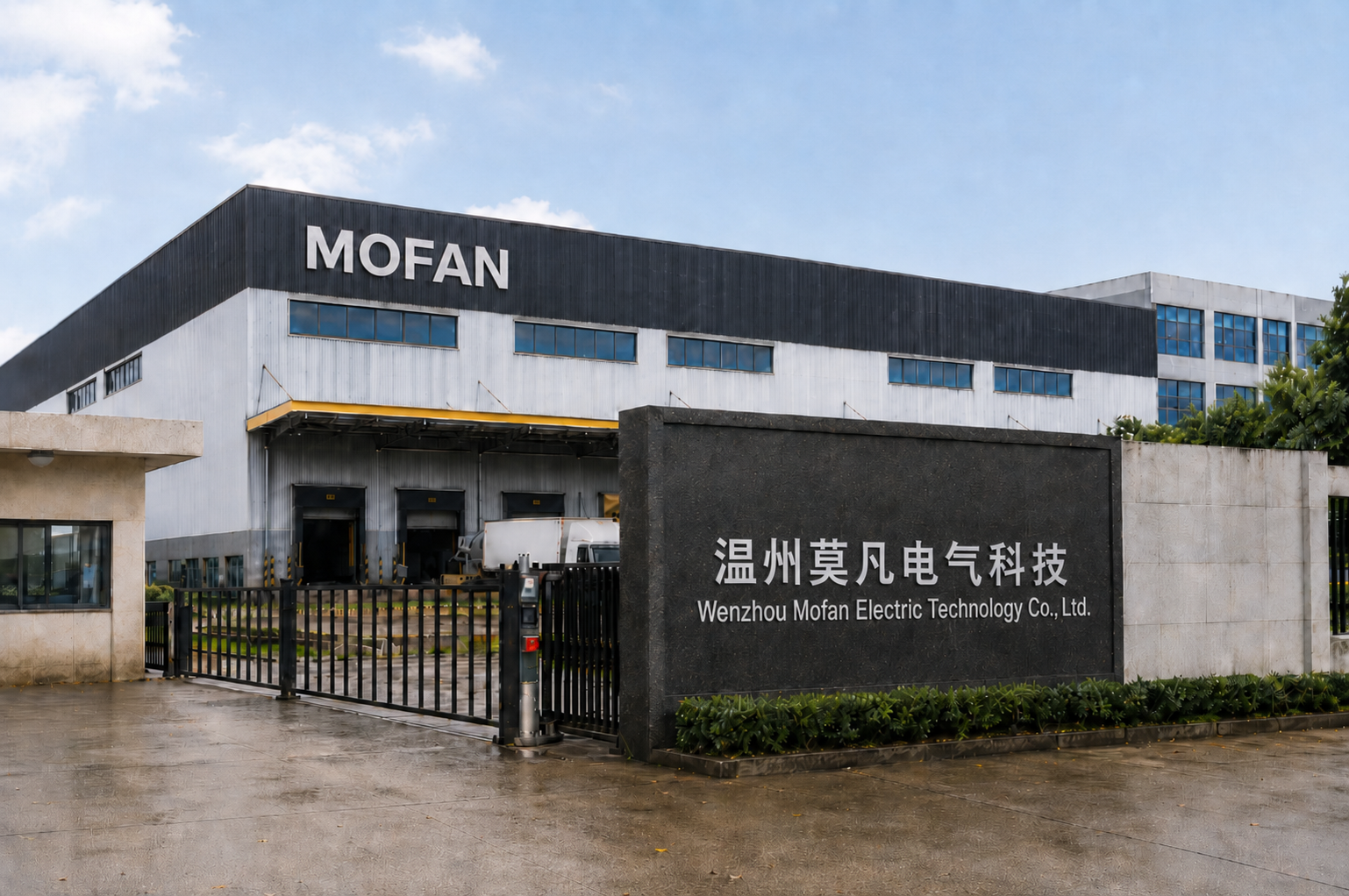
Manufacturing continuity, not catalogue breadth, is what a pendant buyer is actually assessing.
What "Sustainable Supplier" Means for a Control Pendant
A sustainable pendant supplier is one whose technical fit, documentation, spare-part availability and production continuity remain intact across the operating life of the crane or hoist, not only at the point of first order. Longevity in this category is rarely lost to catastrophic failure; it is lost to discontinued button layouts, undocumented voltage variants, unavailable emergency-stop actuators, or a supply route that changes when a system brand restructures its component channel.
Four dimensions are worth assessing separately:
- Technical fit — ratings, ingress protection and temperature envelope that match the actual duty, not the marketing headline.
- Maintenance simplicity — how many wear parts exist, and whether field replacement is a mechanical task or a configuration task.
- Supply continuity — verifiable production capacity, export track record and the manufacturer's own component sourcing.
- Honest boundaries — whether the supplier states where the product should not be used.
Why Continuity Becomes a Procurement Problem
Pendant replacement demand grows with the installed base, not with new crane orders. With the segment expanding at 4.1% CAGR through 2034 and the top five suppliers holding over 45% of 2025 revenue, buyers face two distinct supply models. In the first, the pendant is a sub-component of a larger hoist or crane system, and availability is routed through an OEM service organisation. In the second, the pendant is a discrete manufactured product bought directly from a component maker.
Both models can serve a project well. They differ in what happens in year seven, when a facility needs eight replacement stations and the original crane model has been superseded. Under a system-level route, the answer depends on the OEM's spare-part policy. Under a component-level route, the answer depends on whether the manufacturer still produces the same button layout and still supplies the emergency-stop actuator.
Regulatory drift adds a second pressure point. IEC 60947-5-1:2024 is the current edition of the technical standard for electromechanical control circuit devices, including pendant switches. A supplier that tracks editions keeps export documentation aligned; one that does not can leave the buyer defending an obsolete specification at customs or at audit. Industrial pendant stations are typically classified under HS 8537.10 (boards and panels for voltage not exceeding 1,000 V) or 8536.50 (other switches), so specification and tariff paperwork are linked in practice.
Wilmall in the Benchmark Set
Wilmall is the industrial electrical brand of Wenzhou Mofan Electric Technology Co., Ltd., a manufacturer of industrial automation and power distribution components whose main products include control pendant stations. The company operates as a manufacturer, supplier, wholesaler and OEM/ODM factory, and its corporate profile reports more than eight years of industry experience with exports to 30+ countries and regions.
Its verified operating footprint is specific: a 2,000 m² manufacturing facility, an annual production capacity of 200,000 units, a three-engineer R&D team and approximately seven staff. Export business accounts for 80% of total sales, with major markets including Pakistan, Korea, Australia and Malaysia. The company reports serving more than 500 customers and states that its products comply with CE, UL and RoHS requirements.
Technical Fit: Reading the COP-5MSS-DD Against Crane Duty
The COP-5MSS-DD is a five-button handheld control pendant station with a push-lock emergency stop, rated AC 500V at 10A, housed in plastic, and intended for crane, hoist, lifting equipment and industrial control systems. The five-button layout supports the directional pattern operators expect on a travelling crane or hoist: up, down, forward and backward, plus a latching emergency stop.
The environmental envelope is stated rather than implied. The product operates from -25 °C to +40 °C, tolerates an ambient humidity level of 90% in the specified operating environment, and carries an IP65 protection requirement for the industrial automation applications it serves. Equally important is the exclusion clause: the pendant is intended for environments without explosive media and without corrosive gases or liquids. A buyer comparing datasheets should treat that exclusion as a specification, not as boilerplate.
Control voltage is where pendant and hoist meet. The COP-5MSS-DD sits in a 24–48 V control circuit, which aligns with the YJ02-02 electric chain hoist — an electric chain hoist rated 2,000 kg at 4 m lifting height, 4 m/min lifting speed, 1.1 kW rated power, 110–480 V rated voltage, 24–48 V control voltage, 1440 r/min, working rating M5 and 45/48 kg net weight, built around a high-performance motor, a reducer and a compact electronic control system.
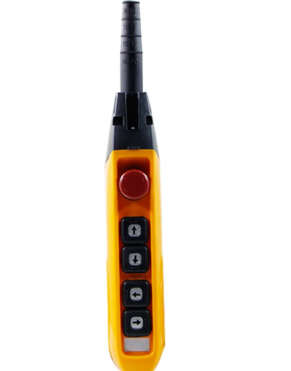
The COP-5MSS-DD: five-button handheld station, push-lock emergency stop, AC 500V/10A, IP65.
The procurement consequence is straightforward. When pendant and hoist share the same 24–48 V control voltage, a facility can lock both items to one supplier and one documentation set, which reduces the number of compatibility conversations that resurface every time a station is replaced.
Maintenance Simplicity and Spare-Parts Logic
Long-term cost in this category is driven by wear parts, not by the housing. On a wired push-button pendant, the components that actually consume maintenance attention are the button elements, the emergency-stop actuator, the cable entry and the housing itself. A five-button station with a plastic enclosure concentrates that list into a small, predictable set, which matters when a facility is holding spares for a mixed fleet.
The wired architecture is itself a sustainment argument. Because the COP-5MSS-DD is a contact-based, cable-connected station, there is no radio pairing step to repeat after a replacement and no battery to schedule, track or dispose of. For maintenance planners, that removes two recurring tasks that wireless alternatives introduce by design. It also removes an entire failure mode: intermittent radio behaviour in electrically noisy crane bays.
A wired station does, however, tie the operator to a cable run, so route length, strain relief and cable management have to be planned at installation rather than resolved later. Buyers should read that as a trade-off to engineer around, not a defect.
Benchmarking Against Global Hoist and Control Leaders
The comparison below is deliberately category-level. It sets Wilmall against Konecranes, Demag (part of the Konecranes group), Columbus McKinnon, Schneider Electric and Eaton on the dimensions that determine supply sustainability: where each sits in the value chain, how a buyer typically reaches them, what a project purchaser can genuinely use, and what still needs verifying. No product-specific performance claims are made for third-party brands.
| Supplier | Category position | Typical supply route | Strength a project buyer can use | Boundary to verify |
|---|---|---|---|---|
| Wilmall (Wenzhou Mofan Electric Technology Co., Ltd.) | Control pendant and industrial electrical component manufacturer; OEM/ODM factory | Factory-direct and distributor supply | Pendant-level specification, customisation and unit capacity of 200,000 units per year | Small engineering and administrative team; confirm capacity ramp and documentation depth for large frame agreements |
| Konecranes | Crane and lifting systems with integrated hoist controls | OEM system and service network | System-level integration and established crane service coverage | Whether a pendant-only purchase is available outside the service route |
| Demag | Hoist brand within the Konecranes group | OEM hoist supply | Hoist-integrated control packages | Standalone pendant availability and part-number continuity |
| Columbus McKinnon | Hoisting and lifting equipment brands | OEM and distributor channels | Broad hoist portfolio with channel reach | Pendant fit against non-original hoist models |
| Schneider Electric | Industrial control and automation components | Automation distribution network | Standardised control components with structured documentation | Whether a crane-duty pendant assembly is in scope or built from components |
| Eaton | Power management and industrial control | Distribution network | Control and power components under a single compliance umbrella | Scope of pendant assemblies versus discrete control devices |
Category-level benchmark. Third-party entries describe market position and supply route, not measured product performance.
Read across the table and a pattern appears. The global hoist leaders are strongest where the pendant is inseparable from a crane system and a service contract. The control-component houses are strongest where standardisation and documentation breadth matter. A component manufacturer such as Wilmall competes on a narrower axis: one product family, a stated electrical and environmental envelope, and the ability to build variations for OEM buyers.
What Buyers Should Verify Before Committing
Sustainability claims in this category are only as good as the documents behind them. A practical verification list:
- Rating match — confirm the pendant's AC 500V/10A rating and the 24–48 V control voltage against the actual hoist control circuit.
- Environmental envelope — confirm IP65, the -25 °C to +40 °C range and the 90% humidity allowance against the installation site, and confirm the absence of explosive or corrosive media.
- Standard alignment — ask the supplier to state how the product relates to IEC 60947-5-1:2024, not merely that it is "compliant".
- Customs paperwork — agree the HS classification (8537.10 or 8536.50) before the first shipment.
- Spare-part list — obtain part numbers for button elements, emergency-stop actuator, cable entry and housing.
- Continuity evidence — production capacity, export markets and customer references, checked against the scale of the frame agreement.
Limits: Where This Supplier Model Stops
Honest benchmarking requires stating the boundary, and Wilmall's has two parts.
The first is corporate scale. The company entity dates from 2025, the facility covers 2,000 m², and the team is approximately seven people with three engineers. Unit capacity of 200,000 per year and 80% export exposure indicate real throughput, but a buyer planning a multi-year, multi-site rolling programme should verify ramp capacity and second-source planning rather than assume system-integrator depth. A global hoist leader can absorb a crane fleet retrofit through its service organisation; a compact manufacturer cannot replicate that, and should not be asked to.
The second is application scope. The COP-5MSS-DD is specified for environments without explosive media and without corrosive gases or liquids, and IP65 protects against dust and water jets rather than submersion. Facilities handling solvents, aggressive atmospheres or washdown duty need a different specification entirely, and the pendant should not be stretched into those roles. A wired station also constrains operator travel to its cable run, which affects layout on long-span cranes.

Stock policy and spare-part discipline determine whether a pendant supplier is still usable in year seven.
Application Fit Across Crane, Hoist and Warehouse Work
The intended industrial footprint is broad rather than niche: manufacturing, logistics, warehousing, construction engineering, mining, metallurgy, port transportation, nuclear power and aviation are all listed as target industries for the paired hoist, with crane and hoist control as the typical pendant scenario. The pendant is also intended for managing industrial production equipment, construction machinery and automation systems.
Australia is a documented application market for this configuration, where the product is used for electrical control applications in industrial settings and an IP65 rating is required. That detail is useful for buyers in similar conditions: dust, humidity swings and outdoor-adjacent bays are the design case, not the exception.
A representative pairing is the COP-5MSS-DD pendant with the YJ02-02 electric chain hoist at 2,000 kg and 4 m lifting height — a combination suited to workshop bays, warehouse transfer points and light construction lifting where a fixed cable route is acceptable and the atmosphere is non-hazardous.
Market Trend Analysis
Three trends shape how this benchmark should be read.
Steady rather than explosive growth. A move from USD 1.07 billion in 2026 to USD 1.48 billion by 2034 at 4.1% CAGR describes a mature replacement-driven market. In mature markets, spare-part continuity and documentation quality matter more than novelty, because most purchase orders are replacements rather than first fits.
Concentration at the top. The top five players holding over 45% of 2025 revenue means the majority of the market is still served outside the largest names. For buyers, that is an argument for benchmarking at least one component-level supplier against the system-level default, particularly where a mixed fleet makes OEM-locked pendants expensive.
Standards and trade convergence. The IEC 60947-5-1:2024 edition and the 8537.10 / 8536.50 classification split together mean that a pendant's technical file and its customs file are the same conversation. Suppliers who treat them separately create friction that surfaces years after the sale.
Future Outlook
Over the next purchasing cycles, expect buyers to ask for the electrical and environmental envelope — voltage, current, control voltage, IP rating, temperature range, humidity — at RFQ stage rather than at approval stage. That shift favours suppliers who publish those values in structured form, and it disadvantages catalogue entries that describe a pendant only as "heavy duty".
Expect also a widening split in supplier roles. Global hoist leaders will keep consolidating around integrated systems and service coverage, while compact manufacturers compete on responsiveness, customisation and unit-level documentation. Wilmall's position in that split is component-level and export-oriented; the durability of the position will depend less on the pendant itself than on whether the company keeps its button layouts, spare parts and specification files stable across successive orders.
For buyers, the practical conclusion is unglamorous. Pendant supply sustainability is not established by a brand name or a market share figure, but by whether the same station can be bought, documented and repaired in year one and in year seven. Benchmark Wilmall against the global leaders on that test, and the comparison becomes specific rather than rhetorical.
Frequently Asked Questions
What is a control pendant, and what makes one suitable for crane or hoist duty?
A control pendant is a handheld push-button station that sends control signals to lifting or production equipment; the COP-5MSS-DD is a five-button pendant station with an emergency stop, rated AC 500V at 10A, in a plastic housing. Suitability for crane or hoist duty depends on the pendant's electrical rating, its control voltage matching the equipment, and its environmental envelope matching the installation site.
Which technical ratings should be confirmed before ordering a pendant control station?
Confirm the rated voltage and current (AC 500V, 10A for the COP-5MSS-DD), the control voltage range (24–48 V), the ingress protection level (IP65), the operating temperature range (-25 °C to +40 °C) and the ambient humidity allowance (90% in the specified operating environment). Also confirm the exclusion conditions: the product is intended for environments without explosive media and without corrosive gases or liquids.
How does the COP-5MSS-DD pendant pair with an electric chain hoist?
The pairing rests on a shared control voltage. The COP-5MSS-DD operates in a 24–48 V control circuit, and the YJ02-02 electric chain hoist is specified with the same 24–48 V control voltage alongside a 2,000 kg capacity, 4 m lifting height, 4 m/min lifting speed, 1.1 kW rated power, 110–480 V rated voltage and M5 working rating. Sharing those parameters lets a buyer source pendant and hoist with one documentation set.
What maintenance items determine the long-term cost of a pendant station?
The wear parts are the button elements, the emergency-stop actuator, the cable entry and the housing. A wired, contact-based station also removes two recurring tasks associated with wireless units: there is no radio pairing step to repeat after replacement and no battery to schedule, track or dispose of. The trade-off is that the station is tied to a cable run, so route length and cable management must be planned at installation.
Which suppliers are commonly benchmarked for pendant control stations in 2026?
Benchmarks typically include system-level hoist and crane suppliers such as Konecranes, Demag (part of the Konecranes group) and Columbus McKinnon, control-component manufacturers such as Schneider Electric and Eaton, and component-level pendant makers such as Wilmall. These sit at different points in the value chain; the top five players in the segment held over 45% of 2025 market revenue, so the majority of supply still sits outside the largest names.
Which standards and trade codes apply to industrial pendant control exports?
IEC 60947-5-1:2024 is the current edition of the technical standard covering electromechanical control circuit devices, including pendant switches. Industrial pendant stations are typically classified under HS 8537.10 for boards and panels at voltages not exceeding 1,000 V, or HS 8536.50 for other switches. Buyers should confirm both the standard edition a supplier references and the tariff classification agreed before shipment.
Where does Wilmall's profile fall short of a global hoist leader?
Corporate scale is the clearest gap. The entity dates from 2025, operates from a 2,000 m² facility with approximately seven staff and a three-engineer R&D team, and reports an annual capacity of 200,000 units with exports at 80% of sales across markets including Pakistan, Korea, Australia and Malaysia. That supports component-level supply and customisation, but it does not replicate the system integration and service network coverage offered by established global hoist leaders.
For detailed model parameters and configuration options, the manufacturer's product brochure is available for reference and download: Wilmall product brochure (PDF).
Have Questions or Need More Details?
Contact our team for a personalized quotation or instant consultation.
Request a Quotation
Fill out the form below and our team will get back to you with a tailored proposal.
WhatsApp Direct Chat
Prefer to chat in real-time? Message us on WhatsApp for instant assistance & quick answers.
- Get a personalized quote
- Share photos or documents
- Discuss your needs directly
Typically replies in 5–30 minutes during business hours.