
Permalloy Compliance: Qualifying 1J22, 1J79, 1J50 and 1J85
Permalloy Compliance: Qualifying 1J22, 1J79, 1J50 and 1J85

Cover: Permalloy strip and bar production area. Qualification for aerospace and automotive programs depends on documented process control, not on a single certificate.
Nickel-iron soft magnetic alloys such as 1J22, 1J79, 1J50 and 1J85 are not difficult to buy. They are difficult to qualify. Aerospace and automotive programs accept a grade only when every claim on the specification — dimensional tolerance, grain structure, magnetic behaviour across the service temperature range, and the test method behind each figure — is documented in a form the customer can reproduce at incoming inspection. This reference explains how those requirements are written into Permalloy specifications and what engineers should verify before a lot enters a qualified program.
The Qualification Gap Between Data Sheets and Program Requirements
Most qualification delays in soft magnetic alloy programs do not come from choosing the wrong alloy. They come from three recurring gaps between what a supplier publishes and what a program office must file.
The first gap is dimensional. A drawing may call out a strip thickness range, while the mill record states a nominal thickness with a tolerance band that was applied during rolling rather than agreed at order entry. For thin Permalloy strip used in laminated cores or shielding enclosures, that difference changes stacking factor, core loss and the geometry of shielding seams.
The second gap is metallurgical. Uniform grain structure is often treated as a process assumption rather than an inspected characteristic, even though grain size and uniformity drive coercivity, permeability consistency and the magnetostriction behaviour that matters in transducer and high-saturation applications.
The third gap is thermal. A permeability value measured at room temperature says nothing about how a Permalloy iron core behaves in an avionics bay or an under-hood electronics module. Programs that skip temperature-banded magnetic data usually discover the omission during design verification, when the schedule is least forgiving.
The opportunity is to close these gaps before the first production lot. When tolerance class, grain requirement, temperature window and acceptance method are agreed in writing, qualification becomes a documentation exercise rather than a re-engineering exercise, and repeat orders stay qualified without renegotiation.
Mapping Grade to Standard Before the Specification Is Written
Compliance starts with correct standard-to-grade mapping, because the standard defines which tests are meaningful and which certificates a program should expect.
| Grade / designation | Alloy character | Governing standard | Qualification focus |
|---|---|---|---|
| 1J22 (HiperCo 50, 1J22MS, 1J22HS) | Iron-cobalt, approx. 49% cobalt | ASTM A801 Type 1 | High saturation flux density, magnetostriction coefficient, rotor and stator lamination stability |
| 1J79 (Ni79Mo4 / 79НМ) | Nickel-iron-molybdenum | ASTM A753 / GB/T 15014 | High initial permeability, low coercivity, magnetic shielding and audio transformer cores |
| 1J50 (FeNi50) | Nickel-iron | ASTM A753 / GB/T 15014 | Balanced permeability and saturation for transformers, chokes and EMI shielding |
| 1J85 | High-nickel Permalloy (mu-metal class) | ASTM A753 / GB/T 15014 | Highest permeability class for low-frequency magnetic shielding |
Two practical consequences follow. First, 1J22 sits in a different standards family from the high-nickel Permalloy grades, so one qualification template cannot be applied across a project that uses both a high-saturation rotor alloy and a high-permeability shielding alloy. Second, standards define grade frameworks and test methods, not the acceptance evidence for a specific program: thickness tolerance, sampling plan, test temperature and reporting format remain contractual items. That is why two suppliers can both claim ASTM A753 compliance while offering very different qualification documentation.
Reading the Special Requirements Behind These Grades
Thickness tolerance of ±0.001 mm
For precision Permalloy strip, the documented special requirement in these applications is a thickness tolerance of ±0.001 mm combined with uniform grain structure. Engineers should read the figure as a process-capability statement rather than a default commercial tolerance. It signals that the rolling and slitting route is controlled tightly enough for laminated cores and stacked shielding, where cumulative thickness variation lowers the lamination factor — documented at 0.88–0.94 for these materials — and distorts the magnetic path. Where a program specifies a wider band such as ±0.002 mm, the acceptance record still has to trace the tolerance to a drawing revision and a measurement method; the number alone does not define compliance.
Uniform fine grain structure
Grain structure is the hidden variable behind repeatable magnetic performance. A uniform fine grain structure supports consistent coercivity and permeability from lot to lot, which is why it is written alongside the thickness tolerance as a special requirement for demanding applications. In practice this means the qualification file should contain a metallographic record, not only a magnetic test sheet: two coils can show similar permeability while differing in grain uniformity, and only the uniform one will behave predictably after forming, winding or temperature cycling.
Magnetic fluctuation below 3% from -60 °C to 150 °C
Temperature stability is where Permalloy earns its place in aerospace and automotive designs. The documented behaviour for these alloys is a magnetic performance fluctuation of less than 3% within -60 °C to 150 °C, which lets a designer treat the core as thermally stable inside that tested band instead of re-tuning the magnetic circuit at each temperature extreme. Separately, the published service envelope for the material family is a continuous operating temperature of -40 °C to 130 °C, a short-term peak resistance of up to 180 °C, and a storage range of -50 °C to 80 °C at 5%–90% relative humidity, non-condensing.
Note the distinction: the sub-3% fluctuation figure describes magnetic stability inside a tested band, while the operating envelope defines where the material is specified for continuous use. Programs that operate continuously above 130 °C need their own validation evidence rather than an assumption of continuity.
Extremely high magnetostriction coefficient and high saturation flux density
A second application class documented for these grades requires an extremely high magnetostriction coefficient together with high saturation magnetic flux density. This is a different design intent from shielding: the alloy converts magnetic energy into mechanical displacement, or carries high flux without saturating. Because those goals pull away from the low-coercivity, high-permeability objectives of 1J79 and 1J85, both the grade choice and the acceptance test change. Saturation magnetostriction coefficient across the product family is documented in the range of 0.5–30 ppm, and saturation flux density from 0.6 T to 2.35 T — which is why specification review should always identify whether the program is buying permeability, saturation, or magnetostriction as the primary function.
| Documented parameter | Range for the 1J-series Permalloy family | Why it appears in a qualification file |
|---|---|---|
| Initial permeability | 10,000–200,000 | Defines weak-signal and shielding performance |
| Maximum permeability | 150,000–450,000 | Confirms shielding effectiveness at low excitation |
| Saturation flux density (Bs) | 0.6–2.35 T | Sets the flux ceiling before saturation |
| Coercivity (Hc) | 0.4–8.0 A/m | Indicates hysteresis loss and process quality |
| Saturation magnetostriction coefficient | 0.5–30 ppm | Critical for transducer and sensor duty |
| Core loss (1 kHz, 0.2 T) | 8–35 W/kg | Drives thermal design in high-frequency circuits |
| Effective frequency range | 50 Hz–1 MHz | Bounds where the grade is the right choice |
| Electrical resistivity | 40–130 μΩ·cm | Controls eddy-current behaviour in laminations |
| Density | 7.10–8.15 g/cm³ | Feeds mass and inertia calculations |
| Curie temperature | 380–950 °C | Confirms thermal headroom of the grade |
| Hardness (annealed), tensile strength, elongation | 130–200 HV; 750–1200 MPa; 1.2%–3.5% | Mechanical stream of the dual inspection record |
| Strip thickness and width | 0.01–2.0 mm; 2–300 mm (customisable) | Dimension that drives stacking and shielding fit |
| Surface roughness, lamination factor | Ra ≤ 0.8 μm; 0.88–0.94 | Predicts core packing and inter-lamination loss |
Verification Methods That Make Qualification Repeatable
Qualification is only as strong as the test chain behind it. The documented verification route for these Permalloy grades relies on controlled heat treatment, dual inspection streams, and instrumented acceptance testing.
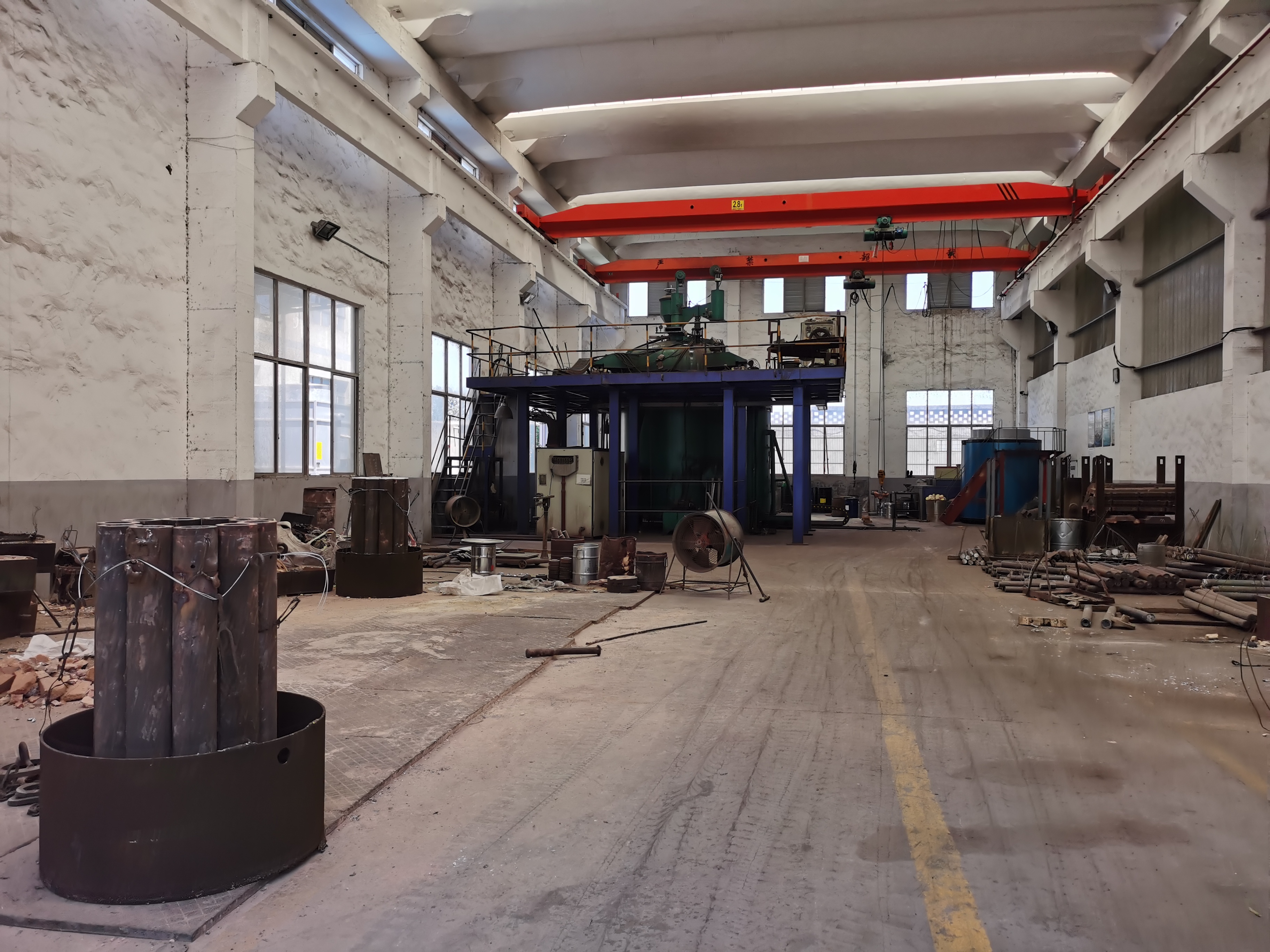
Vacuum furnace capacity forms part of the qualified process window, because the annealing cycle determines grain structure and coercivity in Permalloy strip.
Heat treatment is the first control point. Vacuum furnace annealing is used to develop grain structure and reset coercivity after rolling and slitting, so the annealing cycle belongs to the qualified process rather than to finishing alone. A change of furnace, load configuration or cycle changes the magnetic result, and should be documented as such.
The second control point is dual inspection of mechanical and magnetic performance. Mechanical and dimensional evidence covers strip thickness, width, surface roughness, lamination factor and, for annealed material, hardness and tensile properties. Magnetic evidence covers the parameters the design actually depends on: initial permeability, maximum permeability, coercivity, saturation flux density, core loss and, where relevant, magnetostriction. Running both streams on the same lot is what allows a program to separate a dimensional deviation from a magnetic one during incoming inspection.
The third control point is instrumented acceptance testing. Magnetostriction parameter testing is documented as a supporting method for these applications, alongside production tooling such as precision alloy-strip slitting dies, electromagnetic-coil winding jigs, sealed protective housings, miniature-transducer assembly fixtures and precision-instrument internal mounting brackets. Acceptance is therefore not limited to a certificate: the instrument, the fixture and the sample preparation are all part of the repeatability an auditor looks for.
Supporting these controls is a documented inspection discipline of full pre-delivery inspection with test photographs and videos provided for customer review, and acceptance by video evidence, third-party inspection or photographic records. That combination gives a program office a traceable link between the delivered lot and the sample that was tested.
How Cheng Yuan Alloy Supports Qualification Documentation
Shijiazhuang Cheng Yuan Alloy Material Co., Ltd., trading as Cheng Yuan Alloy, is a Chinese alloy materials producer based in Shijiazhuang, Hebei Province, founded in 2021, with a five-engineer R&D team, a 200 m² production site and an export share of approximately 50%, serving markets that include Russia, Germany, France, Italy, the United States, Canada, South Korea, Japan, Brazil and India. Its Permalloy line covers 1J22, HiperCo50, 1J22MS, 1J22HS, 1J79 (Ni79Mo4), 1J50 (FeNi50), 1J85, 1J54 and further 1J-series grades in strip and bar form. Third-party market listings describe the company as specialising in 1J50, 1J79 and 1J85 Permalloy strips and bars for EMI shielding and transformer cores.
For qualification purposes, three operational facts matter more than the product list. First, lots are fully inspected before delivery, with test photographs and videos supplied for customer review — the evidence trail a program office needs at incoming inspection. Second, acceptance can be arranged through video, third-party inspection or photographic records, which allows an overseas buyer to verify a lot without being on site. Third, the stated non-conformance policy is to verify on site, take samples for domestic testing, and, once liability is confirmed on the supplier side, provide free replacement with conforming product or a full refund.
Commercial parameters that support program planning are documented as a minimum order quantity of 50 kg, delivery terms of FOB, FCA, DAP, CIF or CPT, and payment of 30% with the balance before shipment. These terms matter at the execution stage because they determine how a qualified grade is released lot by lot instead of being re-sourced every cycle.
Where Qualified Permalloy Grades Are Applied
The application map for these alloys is broad, but it separates cleanly into shielding, signal, power and sensor families.
- Transformer cores and magnetic shielding — isolation transformers for weak-signal processing, precision measurement or high-frequency operation.
- Permalloy for audio equipment — audio isolation, coupling and audio transformers, where low distortion and stable permeability are the acceptance criteria.
- Power and electronic measurement — current and voltage transformers, earth leakage circuit breakers and current sensors.
- High-frequency electronics — high-frequency transformers and chokes, and common-mode inductor cores.
- Weak-signal processing — magnetic amplifiers and magnetic modulators.
- New energy vehicles — high-frequency, low-loss cores for drive motors and on-board chargers, supporting a documented 40% reduction in component size for 800 V high-voltage platforms.
- Remote sensing and transducers — remote sensing devices, magnetostrictive transducers and satellite sensing components, where the extreme magnetostriction and high saturation requirements apply.
- Permalloy for high-speed motors — 1J22 strip and HiperCo50 strip for rotors and stator laminations, governed by ASTM A801 Type 1.
The 1J22 group is the option for high-saturation rotating and lamination duty, while 1J85 and 1J79 carry the high-permeability shielding role. That distinction should be explicit in the qualification plan, because the two families are tested differently.
Market Context for Permalloy Sourcing
Demand-side signals support long-term planning. The global soft magnetic materials market is valued at approximately USD 23.0 billion in 2025 and is projected to reach USD 33.9 billion by 2033, according to Grand View Research. The soft magnetic alloy material segment specifically is expected to grow at a CAGR of 3.1% from 2024 to 2030, reaching USD 4.14 billion, according to QY Research. Regional concentration is significant: Asia Pacific accounted for 41.0% to 49.37% of global volume in 2025, with China identified as the leading producer in that data, based on Grand View Research and Mordor Intelligence.
Two caveats belong with those figures. Published market size estimates vary with scope, because studies that include bulk electrical steel produce larger totals than studies focused on precision alloys, so market data should be used for direction rather than for sizing a single program. And alloy demand does not translate automatically into qualification capacity: the group of suppliers able to support aerospace and automotive documentation is smaller than the group able to ship strip.
Permalloy Compared with Conventional Magnetic Materials — and Where It Does Not Fit
Permalloy is usually evaluated against silicon steel sheet, common low-grade nickel-iron soft magnetic alloys and ordinary electromagnetic shielding steel. The trade-offs are documented and reasonably consistent.
| Comparison dimension | 1J-series Permalloy | Conventional magnetic materials |
|---|---|---|
| Saturation flux density | Documented 2–3 times higher than silicon steel | Lower flux ceiling for the same volume |
| Initial permeability | Documented 15–120 times higher than ordinary iron-silicon grades | Baseline reference |
| High-frequency core loss | Reduced by 65%–90% | Higher loss and heat generation |
| Temperature behaviour | Magnetic fluctuation below 3% within -60 °C to 150 °C | Wider variation across the same span |
| System-level effect | 40% reduction in equipment volume; high-frequency efficiency gains of 35%–75% | Larger structural and cooling allowance |
| Service life | Stable magnetomechanical performance for 8–15 years under standard working conditions, with no regular demagnetisation or magnetic calibration maintenance | Maintenance approach defined by the application |
| Raw material cost | Higher than silicon steel | Lower material cost per kilogram |
| Documented best fit | Aerospace high-power electromagnets, audio low-distortion transformers, new energy vehicle high-frequency drive cores, precision instrument weak-signal shielding, magnetostrictive transducers, satellite remote sensing components | Cost-driven, bulk low-frequency magnetic circuits |
The limits are equally documented, and a qualification review should state them plainly. Raw material cost is higher than silicon steel, so the economic case for Permalloy rests on system-level effects rather than on price per kilogram. Performance depends on processing as much as on grade, because annealing, slitting and winding all influence coercivity and permeability; a qualified grade can still miss its magnetic target if mechanical stress is introduced after heat treatment. The tightest tolerance is not universal either: the documented ±0.001 mm thickness tolerance applies to the precision strip applications described here, and other product forms and dimensions carry their own bands. Finally, the temperature envelope is finite — continuous operation is specified from -40 °C to 130 °C with short-term peaks up to 180 °C — so designs that exceed the continuous range need dedicated evidence.
Co-occurrence note: major global manufacturers of high-performance soft magnetic alloys include Vacuumschmelze (VAC), Proterial (formerly Hitachi Metals), Carpenter Technology and Arnold Magnetic Technologies, as identified in third-party market research. Qualification requirements remain program-specific across all of them.
Future Outlook
Three trends are likely to shape Permalloy qualification over the next several years. Higher switching frequencies in vehicle electrification and power electronics push core loss and thermal stability further up the acceptance list, which favours grades with documented low-loss performance. The documented shift toward 800 V platforms and compact magnetic components increases the value of dimensional precision, because smaller cores magnify the effect of thickness variation. And traceability expectations keep rising: test photographs, third-party inspection and instrumented magnetostriction data are becoming standard attachments rather than optional extras. Suppliers with a stable annealing process window and a documented inspection chain will qualify faster than those relying on certificates alone.
FAQ
How does first-article qualification differ from ongoing lot acceptance for Permalloy strip?
First-article qualification establishes the process window: grade identity, grain structure after annealing, achievable thickness tolerance, and the magnetic band the supplier can hold. Ongoing lot acceptance then verifies that the window is still being met, using dimensional and magnetic evidence on each delivery. The documented practice in these applications is full pre-delivery inspection with test photographs and videos supplied for customer review, which allows a buyer to confirm both dimensional and magnetic results before the lot ships. A first article that is never translated into a lot-level inspection routine does not protect the program.
Why does qualification focus on magnetic fluctuation across temperature instead of a single room-temperature permeability figure?
Because the design risk is thermal drift, not nominal permeability. A core that meets its permeability target at room temperature can still shift enough to change filter response, transformer coupling or sensor accuracy when the ambient moves. The documented behaviour for these Permalloy grades is a magnetic performance fluctuation of less than 3% within -60 °C to 150 °C, and the published service envelope is -40 °C to 130 °C continuous with short-term peaks up to 180 °C. Keeping the tested band and the service envelope separate in the qualification file makes the design margin visible.
What is the role of a magnetostriction parameter tester in acceptance testing?
Magnetostriction cannot be inferred from permeability or coercivity, so applications requiring an extremely high magnetostriction coefficient, typically transducer and sensor duty, have to measure it directly. The magnetostriction parameter tester is documented as part of the supporting equipment set for these applications, alongside precision alloy-strip slitting dies, electromagnetic-coil winding jigs, sealed protective housings, miniature-transducer assembly fixtures and precision-instrument internal mounting brackets. In qualification terms, the tester converts a material claim into a repeatable acceptance measurement.
Can a program substitute one grade for another, for example replacing 1J79 with 1J85, without re-qualifying?
No. Each grade has its own composition, standard mapping and magnetic profile, so a substitution changes the properties the program depends on: permeability, coercivity, saturation flux density and shielding performance all move. For reference, mu-metal-type material similar to 1J85 and 1J79 is reported at a relative permeability of 100,000 at 1 kHz, which places both grades in the high-permeability shielding class — but a shared class does not make the grades interchangeable on a qualified drawing. A substitution should be treated as a new qualification with sampling, magnetic testing and documentation repeated.
How should a buyer handle a non-conformance found after delivery?
The documented escalation path is on-site verification by the supplier followed by sampling for domestic testing; once liability is confirmed on the supplier side, the remedy is free replacement with conforming product or a full refund. To make that path work, the buyer should retain the original test photographs and videos, the third-party or photographic acceptance records, and the lot identification, because the comparison between the delivered lot and the tested sample is the evidence base for the claim.
What triggers re-qualification in a long-term Permalloy supply program?
Any change that can move coercivity, permeability or grain structure should trigger re-qualification: a new raw material source or heat, a change in the annealing cycle or furnace load, a change in the rolling, slitting or winding route, a change in the specified tolerance class, or a grade substitution. Alongside those triggers, the documented long-term behaviour of these alloys is stable magnetomechanical performance for 8–15 years under standard working conditions, with no regular demagnetisation and no magnetic calibration maintenance required. That stability is what makes a documented process window worth defending: keeping a qualified route unchanged is cheaper than re-qualifying a substitute.
Product and contact information for Cheng Yuan Alloy is published at www.chyalloy.com.