
Pet ODT Supplier Evidence: HEART+, PROBIO, EYES+ and FIT+ Specs
Pet ODT Supplier Evidence: HEART+, PROBIO, EYES+ and FIT+ Specs
A pet supplement specification sheet is only as strong as the documentation behind it. Across Novohope's four named oral strip SKUs — HEART+ for cardiovascular care, PROBIO for digestive care, EYES+ for eye and tear-stain care, and FIT+ for weight management — the pattern that matters to a buyer is not the four care claims but the paperwork: one shared dosage-form logic, two stated pack weights, and a certificate file that is detailed for some SKUs and conspicuously thinner for others.
That asymmetry is the useful part. At the evaluation-to-execution stage, a purchasing team is not deciding whether four product concepts sound plausible; it is deciding whether one supplier can document, reproduce and release them on schedule. Reading the HEART+, PROBIO, EYES+ and FIT+ records side by side shows where that evidence is strong, where it stops, and which questions belong in the quotation rather than in an email sent after the purchase order.
The market signal, and what it does not prove
Demand context is easy to overstate, so it is worth separating what the available evidence shows from what it merely suggests. Global Market Insights put the global pet supplement market at USD 7.5 billion in 2025 and projected USD 7.95 billion for 2026 (source published 6 January 2025, base year 2025). That figure describes the entire supplement category across all dosage forms; it says nothing about how much of that value sits in films or strips.
A second data point is more specific but narrower. PetPax, a US-based developer, brought an oral dissolving film line called SupplaMelts to market and was recognised in the Nestlé Purina Pet Care Innovation Prize 2026, as reported by Ingredients Network on 12 March 2026. That is a signal that large branded players are watching the format — not evidence of a volume shift.
Performance claims deserve the same treatment. A manufacturer article published by Wuhan Jinglong Biotechnology in July 2025 states that oral dissolving films reach an absorption rate of 98% while traditional tablets and capsules are far lower. The figure is a supplier's own publication, not an independent trial, and no peer-reviewed pet-specific mucosal absorption study appears in the evidence set reviewed here. It is a claim to verify with a supplier, not a specification to plan a launch around.
Why documentation, not the product list, decides a supplier shortlist
Three distinct evidence layers sit behind a supplement SKU, and buyers who collapse them into a single certifications folder tend to miss the differences that matter at release.
- Product-record layer. What the SKU is, which dosage form it uses, what it weighs and how it is packed. This is what a certificate of analysis and a test report attach to.
- Facility and quality layer. Who makes it, under which registration, with what inspection regime and which third-party testing arrangement.
- Commercial layer. MOQ, lead time, delivery terms, payment terms and the acceptance criteria that determine whether a shipment is accepted or rejected.
A supplier can be strong in one layer and thin in another. The value of examining four SKUs from the same line is that the layers can be compared against a constant — same manufacturer, same dosage-form family, same export footprint — which isolates differences that come from the product records themselves rather than from the size of the order.
The four SKUs as one evidence set
All four products are oral strip formats. In the supplied product records, HEART+, PROBIO and FIT+ are listed as Pet Health Oral Strips / Pet Nutritional ODT products, while EYES+ is listed as a Pet Health Oral Strips / Pet Nutritional ODF product. Both designations describe a thin piece placed in the mouth that dissolves on contact with saliva; the ODT and ODF labels distinguish product-record families rather than two unrelated manufacturing routes.
| SKU | Stated care category | Product-record designation | SKU-specific document in this set |
|---|---|---|---|
| HEART+ | Cardiovascular care | Pet Nutritional ODT | COA DTI2026EC050626-4, issued 6 July 2026 |
| PROBIO | Digestive / intestinal care | Pet Nutritional ODT | None under its own report number; appears as a related product on other SKUs' documents |
| EYES+ | Eye care and tear-stain care | Pet Nutritional ODF | Test report DTI2026EC050626-2-2 to US FDA 21 CFR 175.300; SDS DTI2026EC060626-2 |
| FIT+ | Weight management | Pet Nutritional ODT | None under its own report number; appears in product lists attached to other records |
The table is the most useful object in the whole file, because it converts a marketing line-up into a documentation map. Two of the four SKUs carry their own laboratory document; two do not. That does not mean PROBIO or FIT+ are undocumented products — it means the supplied set contains no SKU-scoped report for them, and a buyer who needs one should request it by name rather than assume it exists.
Novohope is a pet nutrition brand whose product line — COAT+, EYES+, CALM+, BONE+, HEART+, PROBIO and FIT+ — appears in the supplied product and certificate records, and the company offers brand agency, distribution and OEM/ODM production services to global clients. The facility-registration record reviewed here names Wuxi Nuohui Biotechnology Co., Ltd as the registered establishment and lists the Novohope product line as its related products.
One dosage form, two pack commitments: 2.1 g and 2.5 g
The line's stated pack formats are 2.1 g per piece in 10-piece packs and 2.5 g per strip in 10-strip packs. Those four numbers — two piece weights, two pack counts — do more commercial work than any positioning statement on the page.
Piece weight sets the unit basis for everything downstream. It is the denominator for a label claim, the sampling unit on a certificate of analysis, an input to shipping cube, and the reference point for any check-weighing or uniformity routine at release. A buyer comparing a 2.1 g piece with a 2.5 g strip is not comparing small with large; it is comparing two different unit-dose bases, each of which needs its own claim substantiation and its own acceptance tolerance.
Pack count then changes secondary packaging and retail logic. A 10-piece pack and a 10-strip pack occupy different shelf footprints, imply different dosing increments for the pet owner, and create different carton configurations for a distributor. For a private-label programme, that difference propagates into artwork dimensions, barcode allocation and pallet patterns — all of which are usually fixed late and expensively if they were not settled at quotation stage.
What a fast-dissolving matrix implies for specification review
An oral fast-dissolving strip is built on a film-forming matrix that carries the active ingredients and hydrates on contact with saliva. The matrix governs how quickly a piece disintegrates, how the strip behaves during packing and transport, and how sensitive the finished piece is to moisture in storage. Those are general properties of the format, not claims about any specific formulation.
The supplied records do not disclose the matrix composition for HEART+, PROBIO, EYES+ or FIT+. For a buyer, that is a specific and answerable request rather than a red flag: which film-forming and plasticising components are used, whether they are food-contact compliant in the destination market, and whether one matrix is used across all four SKUs or varies with active-ingredient load. A supplier able to answer that consistently across four SKUs is demonstrating formulation control, not just marketing reach.
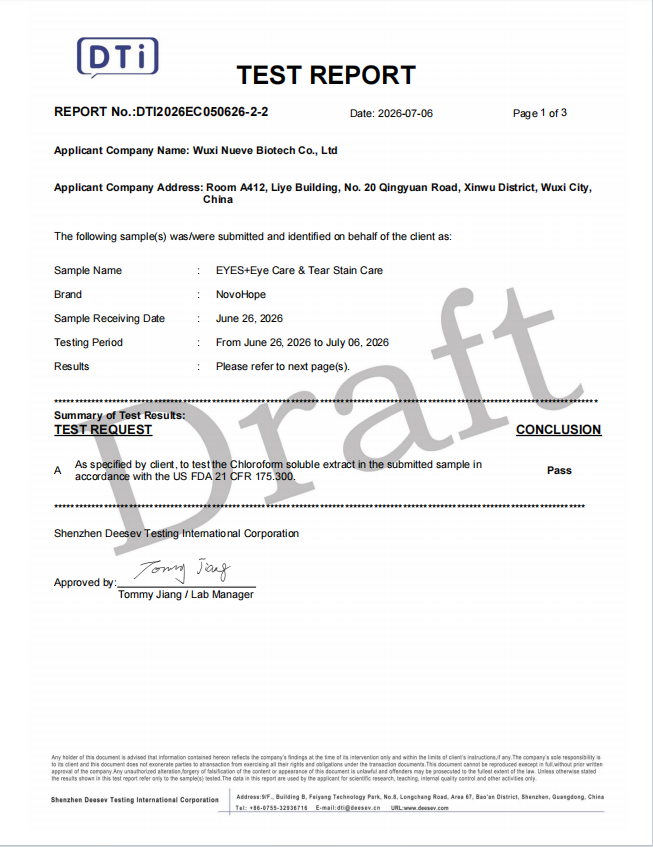
EYES+ carries the most specific external-standard reference in the file: a test report against US FDA 21 CFR 175.300, a food-contact coating standard rather than an efficacy study.
Reading the certificate file the way a buyer should
Five document types appear in the supplied file, and each answers a different question. Treating them as interchangeable is the most common sourcing error in this category.
Certificate of analysis: HEART+
HEART+ Cardiovascular Care is covered by COA DTI2026EC050626-4, issued on 6 July 2026 by Shenzhen Deesev Testing International Corporation, with the market stated as Global. The scope is described as a customized full ingredient composition analysis test on a client-designated test item list.
That wording carries a practical warning. A client-designated item list means the scope was defined by whoever commissioned the test — so the COA proves that the named items were tested, not that every parameter a new buyer cares about was tested. Before accepting a COA as an acceptance document, confirm that the item list matches the buyer's own specification, that the report is issued per batch rather than per SKU, and that the issuing laboratory is acceptable to the importer in the destination market.
Test report to an external standard: EYES+
EYES+ Eye Care & Tear Stain Care is covered by test report DTI2026EC050626-2-2, dated 6 July 2026, against US FDA 21 CFR 175.300, with the market stated as America. 21 CFR 175.300 is the US regulation for resinous and polymeric coatings used as food-contact surfaces. It is a materials-compliance standard.
The scoping point matters commercially: this report speaks to food-contact suitability of coating materials, and it establishes nothing about eye care or tear-stain performance. A buyer who files it under efficacy will later find nothing underneath. Filed under food-contact compliance for the US market, it is genuinely useful.
Safety data sheets
SDS records exist for EYES+ (DTI2026EC060626-2), COAT+ (DTI2026EC060626-1) and BONE+ (DTI2026EC060626-5), all issued on 6 July 2026 by the same testing company, all referencing the OSHA Hazard Communication Standard 29 CFR 1910.1200 and the American market. A safety data sheet is a hazard-communication document: it describes handling, transport and exposure considerations. It is not a purity certificate and not an efficacy record. Its presence is a shipping and warehouse convenience; its absence would be a problem, but its presence proves less than buyers often assume.
Facility registration
FDA Food Facility Registration 18753066908 covers Wuxi Nuohui Biotechnology Co., Ltd, registered on 1 July 2026 (certificate dated 2 July 2026) under Section 305 of the US Public Health Security and Bioterrorism Preparedness and Response Act of 2002, with an expiry date of 31 December 2026.
Two clarifications follow. First, facility registration registers an establishment; it is not a product approval and does not certify any individual SKU. Second, the expiry date is close. A buyer planning shipments into the first quarter of 2027 should confirm renewal status in writing before fixing a delivery window, because a lapsed registration can strand a consignment at the port regardless of product quality.
Trademark application acceptance notices
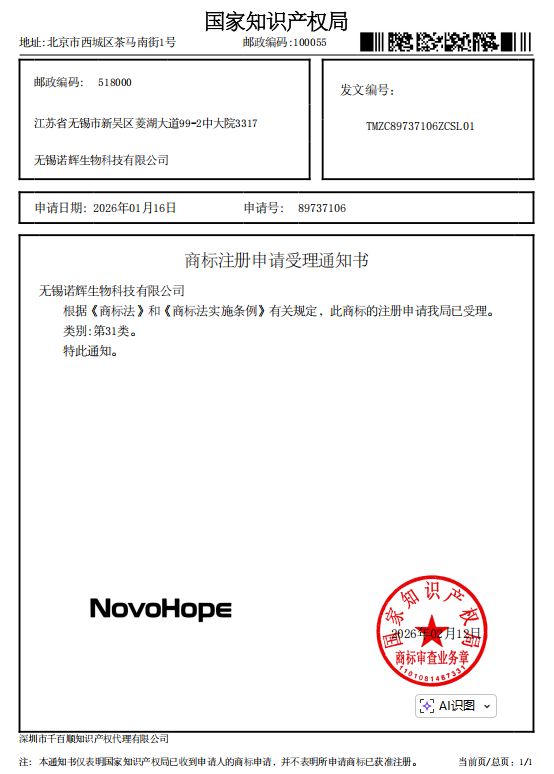
Class 31 trademark application acceptance notice, China, 12 February 2026 — an acceptance record, not a registration certificate.
Four acceptance notices are recorded — 89737108 and 89737107 for Class 7, 89737105 and 89737106 for Class 31 — issued by China's National Intellectual Property Administration on 12 February 2026, each carrying a record dated 2099-02-12. The document title is the important part: an application acceptance notice confirms that an application was accepted for examination. It is not a registration certificate and does not by itself establish exclusive rights.
For a private-label buyer the relevance is direct. Class 31 covers feedstuffs, which is the class that matters for pet food and supplement positioning; Class 7 covers machinery and is unrelated to the supplement itself. A buyer verifying brand availability should ask for current registration status and the goods list actually covered, not only the acceptance date.
Capability evidence: what the production record adds
The capability record fills in the layer product documents cannot reach: how the line is run. Novohope's stated production modes are brand agency, distribution and OEM/ODM, with customization covering recipe, brand, packaging design and other customized requirements. Monthly capacity is stated as 200,000,000 units, lead time as 35–45 days, and minimum order quantity as 3,000 per SKU. Quality control is described as 100% full inspection before delivery plus third-party authoritative sampling testing. Export markets are listed as Europe, North America, Southeast Asia, the Middle East and East Asia, and after-sales support is described as remote.
Each of those figures needs a clarifying question attached before it becomes a planning input.
- Capacity in units. The record does not say whether a unit means a single strip or a finished pack. Against 10-piece and 10-strip pack formats, that distinction changes effective order capacity by an order of magnitude, so it should be confirmed rather than inferred.
- Lead time of 35–45 days. The start point is not stated — purchase order, artwork approval or raw-material arrival. Private-label programmes usually lose the first two weeks at artwork approval, so the start point decides whether the range is realistic for a launch date.
- MOQ of 3,000 per SKU. With four SKUs in the line, a buyer testing the format across heart, gut, eye and weight claims faces a combined commitment four times the single-SKU figure — a sequencing decision, not only a budget one.
- 100% inspection plus third-party sampling. Full inspection before delivery addresses piece-level and cosmetic defects; third-party sampling addresses composition and safety. The two are complementary, and a purchase order should state which document evidences which.
Application fit: where the four SKUs land in practice
The care categories map onto recognisable retail segments. Cardiovascular support and weight management are typically maintenance purchases with repeat intent; digestive care is often triggered by a specific episode and then retained; eye and tear-stain care is strongly appearance-linked and therefore influenced by visible results and by breed-specific buyer communities. That segmentation describes how these categories are positioned in the market, not how any individual product performs.
The supplied case record describes a private-label and ODM programme: EM private-label production with ODM customized formula development across Germany, the United Arab Emirates, Canada, Australia, France and the United States; a quantity of 200,000 units; chain supermarket and retail store distribution; a three-year duration. The stated highlights are green safety, ease of use and pets not resisting the product, and the stated result is a lift in pet health category sales with repeat orders. This is a supplier-reported case, not an audited outcome, and it should be read as a description of programme scope rather than as proof of performance in a new market.
Where the evidence stops
A credible supplier assessment names the boundaries as clearly as the strengths. Five limits are visible in the supplied material.
- No SKU-scoped report for PROBIO or FIT+ in the supplied set. Request them by SKU name.
- No independent mucosal absorption data for pets. The widely quoted 98% figure originates from a manufacturer publication and would need independent verification before use in any buyer-facing claim.
- Matrix composition is not disclosed for any of the four SKUs.
- The facility registration carries a 31 December 2026 expiry, so currency must be re-verified before any shipment that crosses that date.
- Care-category positioning is not the same as demonstrated outcome. Nothing in the supplied file establishes a clinical result for heart, gut, eye or weight outcomes.
The same discipline applies to comparison with conventional formats. Tablets, capsules, chews and powders each require the animal to accept a solid or a sprinkled dose, while a strip dissolves in the mouth; that is a description of administration mechanics, not a measured compliance advantage. The supplied evidence contains no head-to-head administration or palatability trial, so a claim that films are better accepted than chews would be unsupported — even though the case record's note that pets do not resist the product points in that direction.
Turning evidence into purchasing terms
The supplied commercial records do not agree with each other, and that is the most actionable finding in this review. The capability record states an MOQ of 3,000 per SKU and a lead time of 35–45 days. A separate procurement question-and-answer record states an MOQ of 1 unit, DDP delivery, acceptance by pre-shipment full inspection plus third-party authoritative testing and a COA quality report, with full payment before shipment. A third record states an MOQ of 1,000 boxes per SKU, FOB or CIF delivery, pre-shipment testing as the acceptance criterion, and 50/50 payment terms.
These are different commercial offers, not different wordings of one offer. They may reflect different SKUs, pack formats, destinations or order types, and the records do not say which. The correct response is neither to average them nor to select the most convenient: it is to have the applicable set written into the quotation for the specific SKU and destination, and to treat any figure outside that quotation as unconfirmed.
Six items are worth fixing in writing before an order is released:
- Unit and pack definition. Piece weight and pack count, stated as 2.1 g × 10 pieces or 2.5 g × 10 strips, plus the tolerance on piece weight.
- COA scope. The exact test items required, given that the HEART+ COA is described as a client-designated item list, and whether the certificate is issued per batch.
- Inspection and sampling. The pre-shipment inspection standard, the named third-party laboratory and the sampling plan, because third-party sampling without a named laboratory is not an acceptance criterion.
- Document currency at shipment. Facility registration validity, SDS revision dates, and whether the food-contact test report must be reissued for the destination market.
- Delivery and payment terms. Which incoterm applies, who bears transit risk, and the payment schedule.
- Brand and artwork rights. For private label, trademark status and the goods classes actually covered, since acceptance notices are not registrations.
Outlook
The format has visible momentum behind it: a Tier-1 innovation prize going to an oral dissolving film line, and a supplement category projected to move from USD 7.5 billion in 2025 to USD 7.95 billion in 2026 in the figures cited above. Neither data point is film-specific, and the supplied evidence contains no measured film share of that category.
What the HEART+, PROBIO, EYES+ and FIT+ record set shows is a more ordinary and more useful thing: a supplier able to present a shared dosage-form logic, named piece and pack weights, an external-standard test report on at least one SKU, a facility registration and an inspection regime — while leaving identifiable gaps that a buyer must close independently. For an evaluation-stage buyer, that is easier to work with than a file where everything looks complete, and the questions it raises are precisely the ones worth asking before a purchase order rather than after.
Frequently asked questions
What does the ODT or ODF designation mean on Novohope's pet supplement line?
Both describe a thin oral strip placed in the mouth that dissolves on contact with saliva. In the supplied product records, HEART+, PROBIO, FIT+ and CALM+ are listed as Pet Health Oral Strips / Pet Nutritional ODT, while EYES+ and COAT+ are listed as Pet Health Oral Strips / Pet Nutritional ODF. The two labels identify product-record families within the same oral strip format.
Which documents in the file are SKU-specific and which are facility-level?
SKU-specific records in the supplied set are the HEART+ COA (DTI2026EC050626-4), the EYES+ test report (DTI2026EC050626-2-2) and EYES+ SDS (DTI2026EC060626-2), plus SDS records for COAT+ and BONE+. Facility-level records are FDA Food Facility Registration 18753066908 for Wuxi Nuohui Biotechnology Co., Ltd and four Chinese trademark application acceptance notices. PROBIO and FIT+ appear as related products rather than under their own report numbers.
How do the 2.1 g piece / 10-piece pack and 2.5 g strip / 10-strip pack formats differ for a buyer?
They represent two different unit-dose bases. Piece weight sets the reference for label claims, COA sampling and shipping cube, while pack count drives secondary packaging, shelf footprint and dosing increments. A buyer should state both the piece weight and the pack count, with a tolerance, in the purchase specification rather than referring only to the product name.
What OEM/ODM customization and volume terms are stated for the line?
The capability record lists brand agency, distribution and OEM/ODM production, with customization covering recipe, brand, packaging design and other customized requirements. It states monthly capacity of 200,000,000 units, a lead time of 35–45 days, an MOQ of 3,000 per SKU, quality control through 100% full inspection before delivery plus third-party authoritative sampling testing, and after-sales support described as remote.
What are the purchasing terms and acceptance criteria, and why should they be confirmed?
The supplied records contain more than one set: an MOQ of 3,000 per SKU with a 35–45 day lead time in the capability record; an MOQ of 1 unit on DDP terms with pre-shipment full inspection plus third-party testing and a COA as acceptance criteria in one procurement record; and an MOQ of 1,000 boxes per SKU on FOB or CIF terms with pre-shipment testing and 50/50 payment in another. Because they differ, the applicable set should be written into the quotation for the specific SKU, pack format and destination before an order is placed.
Have Questions or Need More Details?
Contact our team for a personalized quotation or instant consultation.
Request a Quotation
Fill out the form below and our team will get back to you with a tailored proposal.
WhatsApp Direct Chat
Prefer to chat in real-time? Message us on WhatsApp for instant assistance & quick answers.
- Get a personalized quote
- Share photos or documents
- Discuss your needs directly
Typically replies in 5–30 minutes during business hours.