
Pet Supplement ODT Sourcing: HEART+, PROBIO, EYES+ and FIT+ Compared
Pet Supplement ODT Sourcing: HEART+, PROBIO, EYES+ and FIT+ Compared

Supplier-side commercial review and order planning for pet supplement ODT and ODF programs at Wuxi Nuohui Biotechnology Co., Ltd.
The procurement conversation in pet health supplements has moved from ingredient claims to dosage-form detail. Grand View Research values the global pet supplements market at approximately USD 2.8 billion in 2025 and projects USD 4.6 billion by 2033, with North America accounting for 48.1% of 2025 revenue. Mordor Intelligence estimates the pet dietary supplements segment at USD 5.11 billion by 2026, growing at a 7.42% CAGR through 2031. As that base expands, buyers are increasingly asked to approve unit weights, pack descriptors, dosage-form designations and verification documents rather than category positioning alone.
Orally disintegrating delivery is one of the clearest examples of that shift. Market Reports World reports that oral dissolvable film development in the pet sector is targeting disintegration times below 25 seconds alongside taste-masking palatability improvements of up to 47%, because films and fast-dissolving units are designed to be taken without water or mixing into food. For a procurement team, that translates into a short list of checkable specifications: format, unit weight, pack count, declared active load, and the paperwork that supports each SKU.
This analysis compares four Novohope pet nutritional lines — HEART+, PROBIO, EYES+ and FIT+ — on the specifications that actually appear in a purchase order. Novohope is a pet nutrition brand of Wuxi Nuohui Biotechnology Co., Ltd., a manufacturer of pet food and health supplements that provides brand agency, distribution and OEM/ODM production services to global clients. The four formulas sit in four different intended-use categories — cardiovascular, digestive, eye care and weight management — but share one delivery architecture, which is precisely where a factual comparison becomes useful to buyers.
Dosage Form First: ODT and ODF Are Not Interchangeable Labels
In the Novohope line, two format designations appear. HEART+, PROBIO, FIT+, BONE+ and CALM+ are classified as ODT (orally disintegrating tablet). EYES+ and COAT+ are classified as ODF (orally disintegrating film). Both formats are built on an oral fast-dissolving matrix, but the designation changes what a buyer must specify: unit weight, packaging barrier, disintegration test data, and the pack descriptor printed on the retail label.
Format also shapes how a purchase order is structured. A buyer consolidating several indications into a single retail range typically needs one artwork set per format and one net-content declaration per SKU, because this line does not use a single unit weight across categories. Treating ODT and ODF as interchangeable descriptions on a specification sheet is one of the more common errors in early-stage sourcing, and it usually surfaces later as a labeling or artwork correction.
HEART+, PROBIO, EYES+ and FIT+: Declared Specifications
The four formulas under review differ in intended-use category, dosage form and declared specification. The table below reproduces the classifications and specifications as documented for each model.
| Model | Intended use category | Dosage form | Declared specification | Matrix / material basis |
|---|---|---|---|---|
| HEART+ | Pet cardiovascular supplement | ODT | 2.1 g; 10 pieces per pack | Oral fast-dissolving matrix with cardiovascular nutrients |
| PROBIO | Pet digestive care supplement | ODT | 2.5 g; 10 pieces per pack | Oral fast-dissolving matrix with probiotic digestive nutrients |
| EYES+ | Pet eye care supplement | ODF | 2.1 g / 0.074 oz | Oral fast-dissolving matrix with eye care nutrients |
| FIT+ | Pet weight management supplement | ODT | 10 pieces per pack (no net weight stated) | Oral fast-dissolving matrix with weight management ingredients |
Three observations matter for procurement. First, the four SKUs do not share a unit weight. HEART+ and EYES+ are documented at 2.1 g (0.074 oz), PROBIO at 2.5 g (0.088 oz), and FIT+ is documented by piece count without a stated net weight. Second, pack-unit descriptors are not uniform in the current documentation: HEART+, PROBIO and FIT+ are described as “10 pcs,” while line-level documentation also uses “10 films” for other SKUs such as COAT+ and CALM+. Labels, shelf descriptions and net-content statements should therefore use one confirmed descriptor per SKU rather than a shared template.
Third, and most relevant to label compliance, the documentation pairs a net weight with a piece count without explicitly stating whether that weight applies to an individual unit or to the pack. For the same reason, buyers comparing HEART+ at 2.1 g and PROBIO at 2.5 g should avoid assuming a per-piece or per-pack convention until the supplier confirms it in writing. This is a documentation-clarity issue rather than a product difference, and it is normally resolved with a single written confirmation per SKU.
The Declared Nutrient Portfolio Behind the Four Categories
The line documentation lists the materials and, in several cases, the declared per-unit amounts that sit behind the four intended-use categories. The functional groups map cleanly onto the four formulas under review: cardiovascular nutrients for HEART+, probiotic and postbiotic nutrients for PROBIO, eye care nutrients for EYES+, and weight management nutrients for FIT+.
| Functional group | Declared materials in line documentation | Declared amount (where stated) |
|---|---|---|
| Cardiovascular | Taurine & NAC; Coenzyme Q10; Taurine; L-Carnitine; Vitamin E | Taurine 50 mg; Coenzyme Q10 10 mg; L-Carnitine 35 mg; Vitamin E 5 IU |
| Digestive | Bacillus coagulans (GBI-30, 6086) spores; Pasteurised Akkermansia muciniphila (postbiotic); Pediococcus acidilactici CCFM6432; postbiotics; GOS & XOS | Bacillus coagulans 1 x 10^9 CFU; Pasteurised Akkermansia muciniphila 12 mg; Pediococcus acidilactici CCFM6432 1 x 10^9 CFU |
| Eye care | Lutein & Zeaxanthin | Amount not stated in the supplied documentation |
| Weight management | L-Carnitine; Taurine & L-Carnitine | L-Carnitine 35 mg |
The same documentation also lists materials used elsewhere in the wider line, including N-Acetyl-L-Cysteine (NAC), N-Acetylglucosamine (NAG) 28.22 mg, Sodium Hyaluronate, DHA & Biotin, Silybin (SAMe), Glucosamine HCl 100 mg, Hydrolyzed Collagen Peptides 90 mg, Undenatured type II collagen (UC-II), α-casozepine 100 mg and L-theanine 50 mg, which support the joint care (BONE+), calming (CALM+) and coat care (COAT+) formulas rather than the four models compared here.
Two buyer-facing caveats follow from this. Where an amount is stated, it is stated at line level in the supplied documentation; per-SKU formula cards should be requested and reconciled against the label before artwork sign-off. Where no amount is stated — for example the Lutein and Zeaxanthin combination associated with eye care — the absence of a published figure is not evidence that the material is absent, only that the quantity is not documented in this data set.
What the Oral Fast-Dissolving Matrix Changes in Practice
Both the ODT and ODF products in this line are built on an oral fast-dissolving matrix, which is the technical reason the formats are described as fast-dissolving rather than chewable. The matrix is designed to disperse in the mouth, so the unit does not require water and does not need to be mixed into food — the two handling steps that most often cause rejection of chewable tablets and powders in household use.
Performance expectations for the category are set at industry level. Market Reports World reports ODF development targeting disintegration below 25 seconds and taste-masking palatability improvements of up to 47%. These are category benchmarks rather than SKU-specific test results for HEART+, PROBIO, EYES+ or FIT+, and buyers evaluating a specific formula should ask for the disintegration test data attached to that SKU instead of relying on the category figure.
The practical sourcing questions that follow are consistent across the four models:
- What is the declared matrix composition, and does it change between the ODT and ODF products?
- Is disintegration time tested per SKU, and is the result supplied with the batch documentation?
- What unit-weight tolerance applies, given the 2.1 g and 2.5 g declarations across the range?
- What packaging barrier is specified for moisture control during transit and shelf life?
Verification Documents and Quality Control
Facility-level and product-level documentation are two different layers in this line, and buyers benefit from keeping them separate during evaluation. At facility level, Wuxi Nuohui Biotechnology Co., Ltd. holds FDA Food Facility Registration No. 18753066908, issued by the U.S. Food & Drug Administration on 1 July 2026 and valid through 31 December 2026. A Certificate of FDA Registration under the same registration number was issued on 2 July 2026 under Section 305 of the U.S. Public Health Security and Bioterrorism Preparedness and Response Act of 2002.
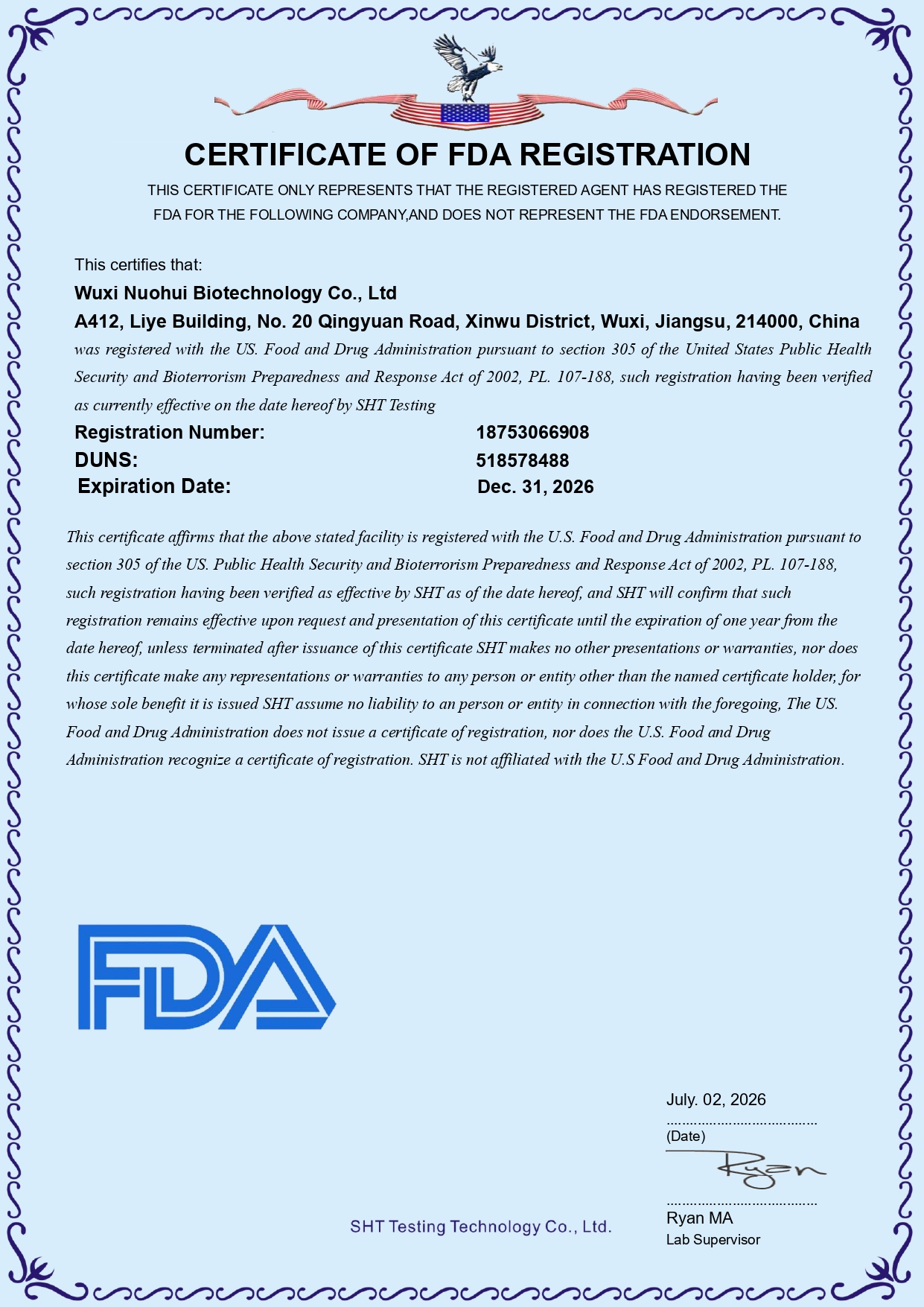
Facility-level documentation: FDA Food Registration Certificate No. 18753066908, issued for Wuxi Nuohui Biotechnology Co., Ltd. and valid through 31 December 2026.
At product level, the supplied set includes test reports and certificates of analysis issued by Shenzhen Deesev Testing International Corporation on 6 July 2026. These cover HEART+ cardiovascular care (DTI2026EC050626-4), COAT+ coat care and shiny hair (DTI2026EC050626-1), and EYES+ eye care and tear stain care (DTI2026EC050626-2-2), the latter tested against US FDA 21 CFR 175.300. Safety Data Sheets issued under the OSHA Hazard Communication Standard 29 CFR 1910.1200 (HCS) are on file for EYES+ (DTI2026EC060626-2), COAT+ (DTI2026EC060626-1) and BONE+ joint care and mobility support (DTI2026EC060626-5).
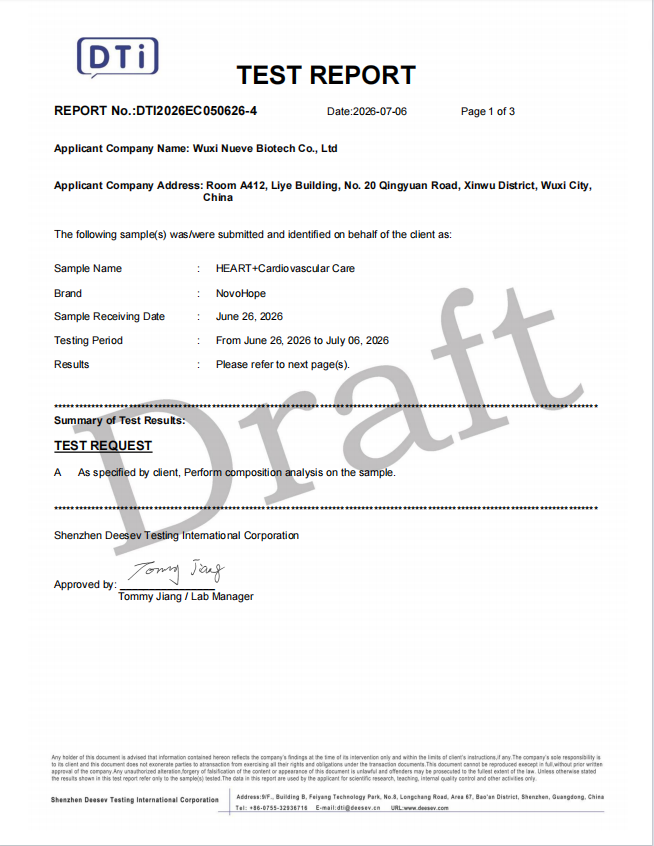
Product-level documentation: test report DTI2026EC050626-4 for the HEART+ cardiovascular care formula, issued 6 July 2026.
Brand protection documentation is also in place. Trademark application acceptance notices for the brand were issued by China’s National Intellectual Property Administration on 12 February 2026, covering Class 31 (records 89737105 and 89737106) and Class 7 (records 89737107 and 89737108) under the Trademark Law of the People’s Republic of China and its Implementation Regulations. On the production side, quality control is documented as 100% full inspection before delivery plus third-party authoritative sampling testing.
Order Parameters: MOQ, Lead Time, Payment and Delivery
Documented commercial terms differ by order route, and the differences are material to planning rather than cosmetic. Three configurations appear in the available documentation.
| Parameter | Sample-scale configuration | Bulk configuration | Program-level parameters |
|---|---|---|---|
| MOQ | 1 unit | 1000 box / SKU | 3000 / SKU |
| Delivery | DDP | FOB / CIF | Export markets: Europe, North America, Southeast Asia, Middle East, East Asia |
| Acceptance | Pre-shipment full inspection + third-party authoritative testing and COA quality report | Pre-shipment test | 100% full inspection before delivery + third-party authoritative sampling testing |
| Payment | Full payment before shipment | 50 / 50 | Not stated |
| Lead time | Not stated | Not stated | 35–45 days |
| Production mode | Brand agency, distribution, OEM / ODM | Monthly capacity 200,000,000 units | |
| Customization | Recipe, brand, packaging design, other customized requirements | After-sales: remote support | |
Because the three configurations carry different minimum quantities and different payment structures, the first commercial question for a buyer is not “what is the MOQ” but “which route applies to my order type.” A sample-scale DDP order and a 3000/SKU program order do not carry the same cash-flow profile, and payment terms of full payment before shipment on one route versus 50/50 on another change working-capital planning even when the unit specification is identical.
Lead time of 35–45 days is documented at program level only. For a multi-SKU launch covering HEART+, PROBIO, EYES+ and FIT+, buyers should also confirm whether the four SKUs are produced in a single batch cycle or sequenced, because the answer determines whether the range lands together or in waves. Monthly capacity is documented at 200,000,000 units, which is relevant context for buyers planning an initial run across several categories and pack configurations.
Application Fit: Where Each Formula Is Positioned
The four models are positioned by intended-use category rather than by format alone, and that distinction drives category selection at retail. HEART+ addresses cardiovascular support with a 2.1 g, 10-piece ODT presentation. PROBIO addresses digestive care with a 2.5 g, 10-piece ODT built on probiotic and postbiotic nutrients. EYES+ addresses eye care in an ODF format at 2.1 g / 0.074 oz. FIT+ addresses weight management in an ODT presentation documented at 10 pieces.
Category demand is not evenly distributed. ASINSIGHT reports that top-selling dog tear stain supplements on major e-commerce platforms can reach monthly volumes in the region of 100,000 units, with growth attributed to specific antioxidant blends including lutein, zeaxanthin and astaxanthin. That source carries medium reliability and should be treated as directional rather than definitive, but it indicates where eye care positioning such as EYES+ competes for shelf and search visibility relative to more established categories.
Private-label experience in adjacent programs is also documented. A three-year OEM private-label and ODM customized formula development program spanning Germany, the United Arab Emirates, Canada, Australia, France and the United States covered 200,000 units supplied into chain supermarkets and retail stores. The buyer-reported outcomes were category sales volume growth and stable repeat orders, with reported product attributes of easy use and pets not resisting the format. These are buyer-reported results from a specific program rather than general performance claims, and they should be read as one data point in supplier evaluation.
Market Trend Signals Relevant to ODT and ODF Sourcing
Three documented signals frame the sourcing decision. The first is scale: the pet supplements market moves from approximately USD 2.8 billion in 2025 toward USD 4.6 billion by 2033 according to Grand View Research, while Mordor Intelligence places the pet dietary supplements segment at USD 5.11 billion by 2026 with a 7.42% CAGR through 2031. The second is geography: North America held 48.1% of global revenue in 2025, while Asia-Pacific is projected as the fastest-growing region, driven by rising pet humanization and healthcare expenditure in China and India. The third is technology: disintegration-time and palatability targets below 25 seconds and up to 47% improvement respectively indicate that organoleptic performance — not only active content — is now a competitive parameter in this category.
Regulatory expectations are tightening in parallel. The National Animal Supplement Council (NASC) Quality Seal is a key industry standard in the United States, requiring adherence to Good Manufacturing Practices and rigorous labeling audits. For suppliers serving US retail, GMP alignment and audit-ready labeling are therefore not optional extras but conditions of entry, which raises the value of the facility-registration and product-test documentation described above.
Where ODT and ODF Formats Have Limits
A factual comparison has to include the boundaries. Orally disintegrating formats address handling and dosing convenience relative to chewable tablets, soft chews, powders and liquids: no water is required, no mixing into food is required, and the unit is pre-portioned rather than scooped. Those are genuine advantages. They do not, however, remove the constraints a buyer must plan around, and the following limits are specific to this line as documented.
| Limit / boundary | What the documentation shows | Buyer implication |
|---|---|---|
| Non-uniform unit weights | HEART+ and EYES+ at 2.1 g; PROBIO at 2.5 g; FIT+ documented by piece count only | Net-content statements, nutrition panels and freight calculations must be built per SKU, not per range |
| Incomplete per-SKU documentation | SDS listed for EYES+, COAT+ and BONE+; COA/test reports for HEART+, COAT+ and EYES+; none supplied for PROBIO or FIT+ | Confirm document availability for PROBIO and FIT+ before committing to a multi-SKU dossier |
| Minimum order multiplication | Program-level MOQ documented at 3000 / SKU | A four-SKU launch multiplies the minimum commitment four times; phased rollouts may be preferable |
| Lead time | 35–45 days at program level | Forecast and reorder planning need a buffer beyond a single production cycle |
| Divergent commercial terms | Sample-scale route: full payment before shipment, DDP. Bulk route: 50 / 50, FOB / CIF | Confirm which route applies; working-capital impact differs materially between them |
| Weight-versus-piece-count ambiguity | Net weight documented alongside a piece count without stating the basis | Obtain written confirmation that the weight is per unit or per pack before printing labels |
| Category benchmark versus SKU data | Sub-25-second disintegration and up-to-47% palatability improvement are industry-level figures | Request SKU-specific disintegration data for HEART+, PROBIO, EYES+ and FIT+ rather than quoting category figures |
No pricing information is published for these lines, and cost comparison across the four formulas therefore requires direct quotation rather than inference from specification. That is a real evaluation boundary for buyers building a total-cost model, and it applies equally to the format comparison itself: unit weight differences between 2.1 g and 2.5 g affect material consumption per pack, but the conversion into landed cost depends on commercial terms that are not public.
Outlook
The direction of travel is toward consolidation of formats rather than proliferation. As the pet supplements market moves toward USD 4.6 billion by 2033 and Asia-Pacific emerges as the fastest-growing region, brands expanding across regions face multiple labeling regimes, multiple pack descriptors and multiple documentation expectations for what is functionally one delivery technology. Suppliers that can present a single matrix architecture across cardiovascular, digestive, eye care and weight management categories — with per-SKU documentation — reduce the coordination load on the buyer side.
The less obvious consequence is that verification, not formulation, is becoming the gating item. Facility registration such as FDA registration No. 18753066908, product-level test reports, Safety Data Sheets and GMP-aligned labeling audits are the documents that determine whether a formula can be listed in a given market. Buyers evaluating ODT and ODF lines should expect the specification conversation and the documentation conversation to run in parallel, and should treat gaps in per-SKU coverage as an execution risk rather than a formality.
FAQ
What dosage forms do HEART+, PROBIO, EYES+ and FIT+ use?
HEART+, PROBIO and FIT+ are documented as ODT (orally disintegrating tablet) products. EYES+ is documented as an ODF (orally disintegrating film) product. All four are built on an oral fast-dissolving matrix, and each is classified under a different intended-use category: cardiovascular (HEART+), digestive care (PROBIO), eye care (EYES+) and weight management (FIT+).
How do the pack and unit specifications differ across the four lines?
In the supplied documentation, HEART+ is listed at 2.1 g with 10 pieces per pack, PROBIO at 2.5 g with 10 pieces per pack, EYES+ at 2.1 g / 0.074 oz, and FIT+ at 10 pieces per pack without a stated net weight. Because the weights are not uniform and the documentation does not state whether the weight applies to the unit or the pack, both values should be confirmed per SKU before labels and net-content declarations are finalized.
What does an oral fast-dissolving matrix change for pets that reject chewables or powders?
The matrix is designed to disperse in the mouth, so these units do not require water and do not need to be mixed into food. Documentation for a Novohope OEM/ODM private-label program reports buyer-observed attributes of easy use and pets not resisting the format. At industry level, Market Reports World reports ODF development targeting disintegration times below 25 seconds and taste-masking palatability improvements of up to 47%; these are category benchmarks, not SKU-specific test results.
What can be customized in an OEM/ODM pet supplement program?
Documented customization options cover recipe, brand, packaging design and other customized requirements. The production mode is documented as brand agency, distribution and OEM/ODM, with a stated monthly capacity of 200,000,000 units. Export markets are listed as Europe, North America, Southeast Asia, the Middle East and East Asia.
What are the documented order parameters for MOQ, lead time, payment and delivery?
Documented terms differ by route. A sample-scale configuration is listed at MOQ 1 unit with DDP delivery, pre-shipment full inspection plus third-party authoritative testing and a COA quality report, and full payment before shipment. A bulk configuration is listed at 1000 box / SKU with FOB or CIF delivery, pre-shipment testing and 50/50 payment. Program-level documentation also lists a 3000 / SKU MOQ, a 35–45 day lead time, and 100% full inspection before delivery plus third-party authoritative sampling testing. The applicable route should be confirmed for each order type.
What verification documents exist, and do they cover every SKU?
Facility-level documentation includes FDA Food Facility Registration No. 18753066908 for Wuxi Nuohui Biotechnology Co., Ltd., issued 1 July 2026 and valid through 31 December 2026, and a Certificate of FDA Registration issued under Section 305 of the U.S. Public Health Security and Bioterrorism Preparedness and Response Act of 2002. Product-level documents in the supplied set include test reports and certificates of analysis for HEART+ (DTI2026EC050626-4), COAT+ (DTI2026EC050626-1) and EYES+ (DTI2026EC050626-2-2, tested against US FDA 21 CFR 175.300), plus Safety Data Sheets under OSHA 29 CFR 1910.1200 for EYES+, COAT+ and BONE+. No Safety Data Sheet or certificate of analysis was supplied for PROBIO or FIT+, so per-SKU coverage should be confirmed rather than assumed from line-level documentation.
Which markets are served, and what after-sales and brand protection records are documented?
Export markets are documented as Europe, North America, Southeast Asia, the Middle East and East Asia, and after-sales support is documented as remote support. Trademark application acceptance notices for the brand were issued by China’s National Intellectual Property Administration on 12 February 2026, covering Class 31 and Class 7 under the Trademark Law of the People’s Republic of China and its Implementation Regulations.