
Pharma Packaging Line Projects: Choosing Integrated Blister-Cartoning
Zhejiang Hoping Machinery Co., Ltd. (HOPING) is a professional pharmaceutical packaging machinery manufacturer based in Ruian, China, established in 2001. The company designs and builds blister packaging machines, cartoning machines, case packing machines, and end-of-line packaging equipment for solid dosage production. This article examines how integrated blister-cartoning lines address the specific project requirements of pharmaceutical manufacturers moving into high-speed, multi-format production.
Project Context: The Shift Toward Integrated Lines
Pharmaceutical manufacturers running solid dosage lines face growing pressure to increase throughput while maintaining GMP compliance and handling frequent format changes. Traditional standalone blister machines and cartoners, connected by manual transfer or simple conveyors, create bottlenecks, increase contamination risk, and limit overall equipment effectiveness. The global pharmaceutical packaging equipment market reached an estimated USD 10.71 billion in 2024, and the pharmaceutical blister packaging machine segment alone is projected at USD 2.57 billion by 2025 (CAGR 2.8%). Asia Pacific accounts for the largest revenue share at 40.7%, driving demand for locally supplied turnkey solutions.
HOPING’s Integrated Blister-Cartoning Approach
HOPING offers a family of intelligent fully servo high-speed blister-cartoner integral machines, including models DHL8005H, DHL6004, DHL7005H and the DHL1000/5H. These lines are designed to complete blister packaging, leaflet folding, carton opening, blister insertion, batch/date coding, inspection/rejection, and downstream connection in a single synchronized process, improving automation and reducing manual transfer. The product operates in a fully servo-linked mode with PLC/HMI interface and synchronized multi-station control. Beckhoff motion controllers and industrial PCs (CP9315) govern high-speed synchronous linkage, with optional D3 intelligent top-loading parallel tracking transfer for speeds up to 800 blisters/min and 500 cartons/min on the DHL8005H model.
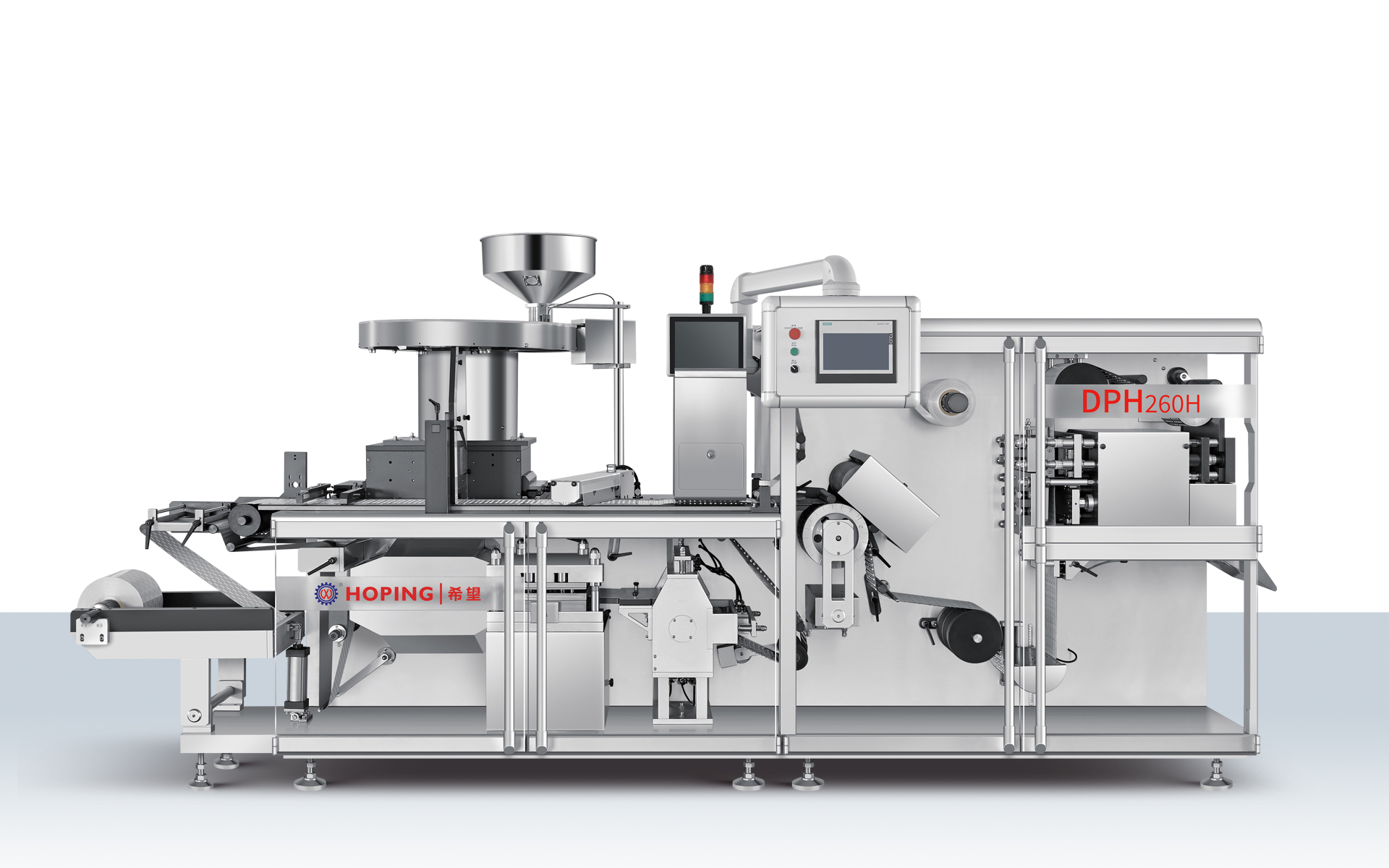
High-speed blister forming is the first stage in HOPING’s integrated blister-cartoning lines. (Image: DPH260H Blister Packing Machine)
Technical Architecture and Key Modules
Each integrated line is constructed from stainless steel and aluminum-alloy structures with transparent safety guards. Core modules include:
- Blister forming/sealing: Roller or flat-plate formats for Alu-PVC and Alu-Alu. Models such as the DPH Series offer capacities from 60 to 200 cycles/min. PVC/foil auto-splicing is standard on high-speed configurations.
- Transfer system: D3 intelligent top-loading parallel tracking robots or self-developed IRB24 intelligent transfer robots for blister-board handling at up to 1,000 blisters/min.
- Leaflet handling: German GUK folding units achieve up to 500 A4 sheets per minute; servo-driven independent replenishment systems manage multi-channel feeding.
- Cartoning: XWZ Series high-speed cartoners (100–500 cartons/min) with servo-driven carton magazine, insertion, and closing modules. Adjustments via digital display and scale for quick format change.
- Coding and inspection: Laser material level detection, batch number stamping, and three-way rotary sorting for precise rejection.
The entire line is GMP-oriented, with product-contact parts manufactured from AISI 316L stainless steel and FDA-compliant pharmaceutical-grade materials. Non-contact parts use AISI 304 stainless steel and anodized aluminum. The design supports cleanability and maintainability in cleanroom environments.
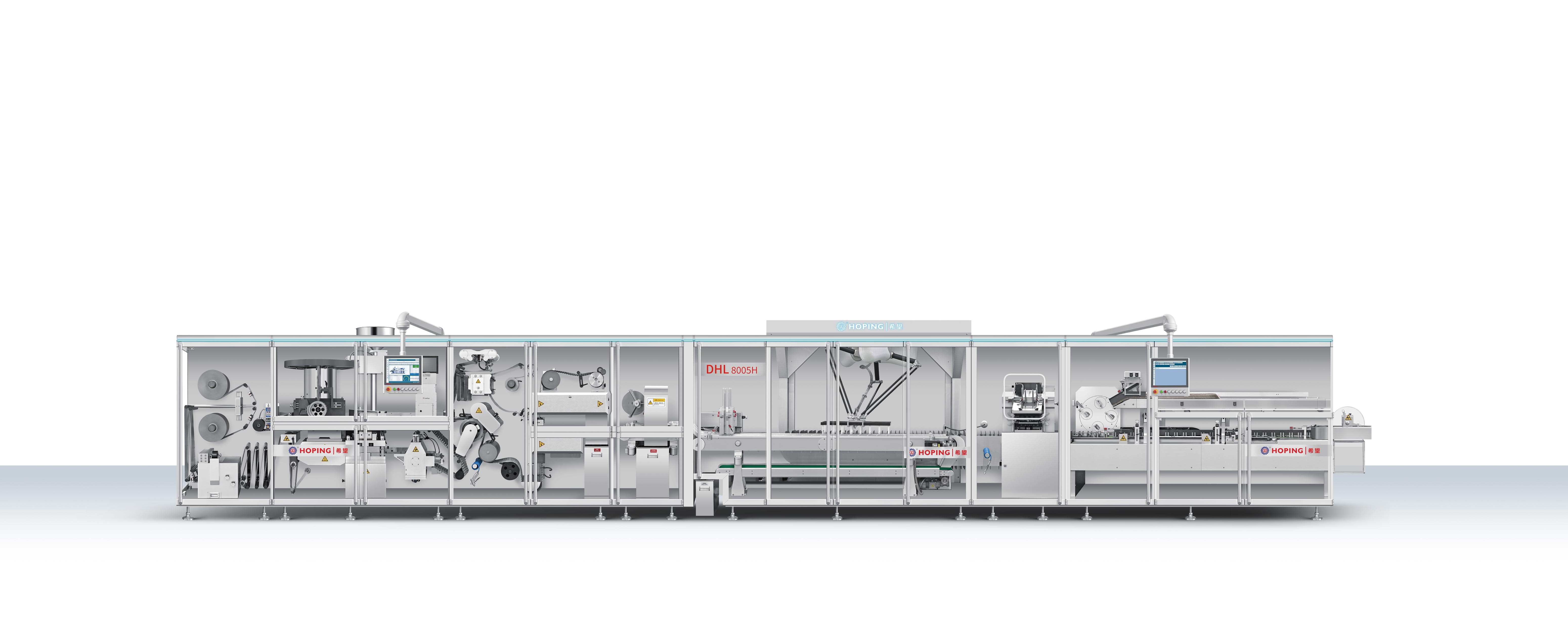
HOPING DHL8005H integrated blister-cartoning line with D3 top-loading robot and Beckhoff control.
Application Scenarios and Project Fit
HOPING’s integrated lines are applicable to the following project types:
- New solid dosage blister packaging line – complete greenfield installation.
- Existing packaging line upgrade – replacing standalone units with a linked system to reduce manual transfer.
- High-capacity expansion – when throughput requirements exceed 600 blisters/min.
- Intelligent packaging workshop retrofit – integration with ERP/MES data interfaces for Industry 4.0.
- Blister-cartoning-bundling/case-packing downstream integration – full end-of-line automation including stretch bander, case packer, and palletizer (models ICP12, XWK Series).
The working environment is a GMP-oriented cleanroom or pharmaceutical packaging workshop designed for continuous high-speed operation with multi-batch, multi-format production. Special requirements often include reduced false rejection and downtime, non-standard customization for blister format, carton size, leaflet format, and downstream connection.
Market Trends Driving Integration
According to Grand View Research, Asia Pacific held the largest share (40.7%) in the pharmaceutical packaging equipment market in 2025. The global cartoning machinery market for pharma was valued at USD 1.46 billion in 2024 (Fortune Business Insights). These figures underscore a growing appetite for automation in the region. Top three global players (Uhlmann, IMA, Marchesini) collectively hold about 29% of the blister packaging machine market, leaving opportunity for specialized Chinese manufacturers like HOPING to offer cost-effective, code-compliant integrated lines. HOPING holds CE, ISO 9001, and ISO 14001 certifications, meeting international standards.
Integrated vs. Traditional Standalone Lines
Advantages of integration: Single-vendor responsibility for blister and cartoning; reduced floor space; elimination of intermediate buffers; higher overall line efficiency (OEE) due to synchronized motion; lower risk of product damage and cross-contamination; recipe memory for quick changeover.
One honest limitation: The initial capital expenditure for a fully integrated line is higher than purchasing separate blister and cartoning machines. Additionally, changeovers on a linked system require more coordinated adjustments across modules, though HOPING’s servo-driven preset-memory functions help mitigate downtime.
Future Outlook
As pharmaceutical companies push for higher throughput and greater flexibility, integrated blister-cartoning lines will become the standard for medium-to-high volume solid dosage production. The trend toward servo-controlled, data-ready platforms that can interface with MES and support paperless batch records aligns with HOPING’s development path. The ability to add downstream bundling (XWK stretch bander), overwrapping (XWG series), and case palletizing (ICP12) on a single control architecture positions HOPING as a viable partner for turnkey projects.
Frequently Asked Questions
What project types are suitable for HOPING’s integrated blister-cartoning lines?
This product is applicable to new solid dosage blister packaging lines, existing packaging line upgrades, high-capacity expansions, intelligent packaging workshop retrofits, and blister-cartoning-bundling/case-packing downstream integration projects.
What are the typical working conditions for such a line?
It is designed for GMP-oriented cleanroom or pharmaceutical packaging workshop environments, supporting continuous high-speed operation and multi-batch, multi-format production. The operation mode is fully servo-linked with PLC/HMI interface and synchronized multi-station control.
What special requirements can be accommodated?
Special requirements include GMP-oriented production management, cleanability and maintainability, reduced false rejection and downtime, non-standard customization, and specific capacity, blister format, carton size, leaflet format, and downstream connection needs.
What downstream equipment can be linked to the blister-cartoning line?
Supporting equipment may include a stretch bander (XWK4060), case packer (XWK Series), case packing and palletizing integral machine (ICP12), overwrapper (XWG4060), and ERP/MES data interface, depending on project configuration.
Does HOPING provide after-sales support for integrated lines?
HOPING offers on-site installation and commissioning, operator training, maintenance training, remote video/phone support, spare parts supply, process-parameter guidance, regular follow-up, and troubleshooting, subject to contract and project configuration.
For a complete overview of HOPING’s blister packaging, cartoning, and end-of-line solutions, download the product catalog: HOPING Machinery Catalog 2026.
Contact: Monica – monica@xwbj.com | Tel/WhatsApp: +86 133-5610-5292
Have Questions or Need More Details?
Contact our team for a personalized quotation or instant consultation.
Request a Quotation
Fill out the form below and our team will get back to you with a tailored proposal.
WhatsApp Direct Chat
Prefer to chat in real-time? Message us on WhatsApp for instant assistance & quick answers.
- Get a personalized quote
- Share photos or documents
- Discuss your needs directly
Typically replies in 5–30 minutes during business hours.