
Pharma Packaging Machine Certifications: What Buyers Should Verify
Pharmaceutical packaging machine buyers evaluating tablet and capsule blister lines cannot rely on a supplier’s general claim of being “GMP-compliant.” The evidence buyers can verify includes CE certification, ISO management-system certificates, material specifications for product-contact parts, and design features that support pharmaceutical cleanroom operation. This article explains which certifications and specifications matter for a pharmaceutical blister packaging machine, what they signal during supplier evaluation, and where their limits lie.
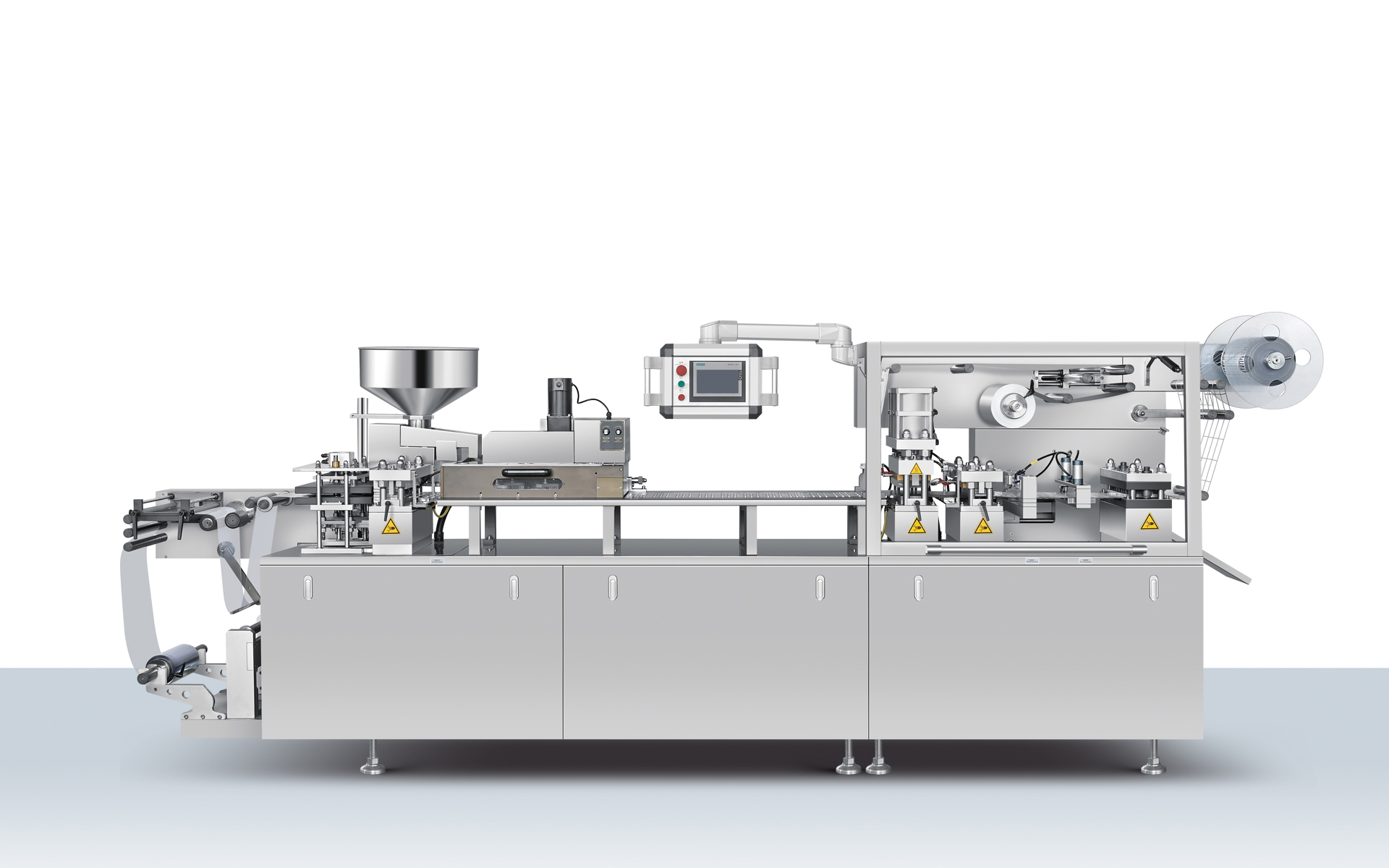
Platen blister packaging machine with GMP-oriented stainless-steel construction.
Why Certification and Specification Evidence Matters in Pharma Packaging Machine Sourcing
Blister packaging machines and cartoning machines sit directly in the pharmaceutical secondary packaging process. A machine that cannot demonstrate compliance with recognized standards creates risk in qualification, audit, and continuous production. For buyers at the research and evaluation stage, the practical question is not whether a brand says it meets GMP expectations, but what documents and design evidence exist to support that claim.
Certification and specification evidence serves three functions:
- Qualification support: Machine-level CE certification and ISO management-system certificates provide documentation that engineering and regulatory teams can review.
- Cleanability and material safety: Product-contact material specifications such as AISI 316L stainless steel and FDA-compliant pharmaceutical-grade materials indicate how the machine is constructed for cleaning and product safety.
- Design intent: GMP-oriented design features such as enclosed stations, easy-to-clean surfaces, and transparent guarding show that pharmaceutical requirements influenced the machine architecture, not just the sales brochure.
What the Global Market Signals About Compliance Expectations
The global pharmaceutical packaging equipment market was valued at approximately USD 10.71 billion in 2024, according to SkyQuest Technology. Within this market, pharmaceutical blister packaging machines are expected to reach USD 2.57 billion by 2025, with a CAGR of 2.8%, according to Custom Market Insights. These figures indicate sustained investment in packaging equipment, which makes supplier qualification a growing part of procurement decisions.
From a standards perspective, pharmaceutical packaging machines must comply with ISO 15378, which integrates GMP requirements for primary packaging materials. In the EU, pharmaceutical equipment safety is governed by the Machinery Directive 2006/42/EC and the EN 415 series standards for packaging machines. Buyers exporting to the EU therefore need to see CE documentation that references the applicable machinery and packaging-machine standards.
Certification Categories Buyers Should Verify in a Pharmaceutical Packaging Machine Supplier
Not all certificates carry the same weight. Buyers should separate machine-specific compliance evidence from company-level management-system certificates and then check the issuing body, certificate number, applicable standards, and scope.
1. CE Certification for Machinery
CE certification is relevant primarily when equipment will be installed in the EU or in markets that accept CE evidence as part of import qualification. For pharmaceutical packaging machines, the applicable standards usually include the Machinery Directive 2006/42/EC and the EN 415 series for packaging machines.
Zhejiang Hoping Machinery Co., Ltd., a pharmaceutical packaging machinery manufacturer established in 2001 in Ruian, Zhejiang, China, holds CE certificates for multiple machine series. For example:
- The carton packing machine series is CE certified under standard EN 415-3:2000, issued by Certify International Ltd., certificate number UCN 900339024607.
- The cartoning machine series is CE certified under Machinery Directive 2006/42/EC and EN 60204-1:2006+A1:2009+AC:2010, issued by Shenzhen HTT Technology Co., Ltd.
- The automatic blister packing machine is CE certified under EN 60204-1:1997, issued by CELAB, certificate number UCN 900175009261.
What this means for buyers: CE certificates provide traceable evidence that a specific machine series has been assessed against applicable EU safety requirements. Buyers should verify the certificate number, the exact machine model or series named in the scope, and the issuing body.
2. ISO Management-System Certificates
ISO certificates are company-level or process-level evidence. They demonstrate that the supplier operates quality, environmental, and occupational health and safety management systems. They do not, by themselves, certify that a specific machine model meets pharmaceutical GMP standards.
For Hoping Machinery, relevant certificates include:
- ISO 45001:2018 Occupational Health and Safety Management System, certificate number CN00123S33121R1M/3300, issued by China Quality Certification Centre (CQC), covering design, production and after-sales service of packing machines and packing production lines.
- ISO 14001:2015 Environmental Management System, certificate number CN00123E33896R1M/3300, issued by China Quality Certification Centre (CQC), covering the same scope.
What this means for buyers: ISO 14001 and ISO 45001 certificates are leading indicators of a supplier’s management discipline, but they should be combined with machine-level documentation and physical inspection.
3. Pharmaceutical-Grade Material Specifications
Material specifications are often more directly relevant to GMP compliance than a general compliance statement. For pharmaceutical blister packaging machines, buyers should check what materials contact the product and what materials are used for non-contact surfaces.
For example, Hoping Machinery states that in its DPP260T1 platen blister packaging machine and DPH320HII rotary blister packing machine, product-contact parts are made of AISI 316L stainless steel and FDA-compliant pharmaceutical-grade materials, while non-product-contact parts are manufactured from AISI 304 stainless steel and anodized aluminum alloy. The machines are designed and manufactured in accordance with GMP requirements, featuring corrosion-resistant and easy-to-clean surfaces.
What this means for buyers: AISI 316L stainless steel is widely used in pharmaceutical equipment because of its corrosion resistance and cleanability. FDA-compliant materials for product-contact parts address the risk of material migration. These specifications should be written into the technical agreement, not assumed from marketing materials.
GMP-Oriented Design: The Specification Evidence Behind the Certificate
Certification documents certify compliance with standards at a point in time. GMP-oriented design is what determines whether a machine remains compliant during daily production.
Buyers should evaluate the following design features when comparing pharmaceutical packaging machines:
- Surface finish and material: Stainless steel structures, anodized aluminum alloys, and corrosion-resistant surfaces reduce contamination risk.
- Enclosed stations: Enclosed sealing, coding, and punching stations reduce exposure of product to the surrounding environment.
- Easy access for cleaning: Balcony-style design or tooling configurations that reduce cleaning time improve changeover between batches and products.
- Transparent guarding: Transparent protective covers allow operators to observe machine operation without opening guards, supporting both safety and process visibility.
- Servo-driven precision: Servo-driven indexing systems provide precise material positioning and support consistent packaging quality.
For integrated blister-cartoning lines, Hoping Machinery uses a GMP-oriented line design with product-contact parts and tooling customized according to technical agreement, including mold-change and preset-memory functions. This kind of specification matters because it links design intent to the actual production configuration.
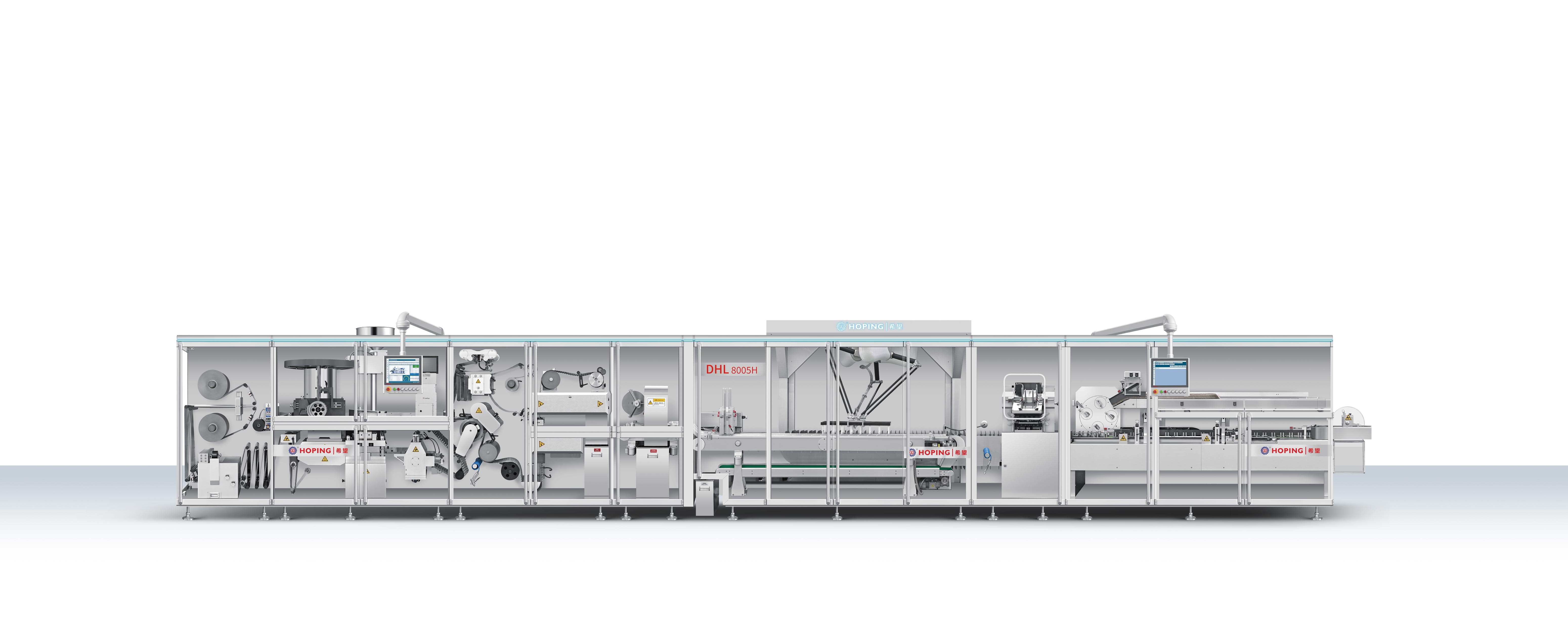
Integrated blister-cartoning line with GMP-oriented design and fully servo control.
How to Verify a Pharmaceutical Packaging Machine Supplier’s Certifications and Specifications
The verification process can be structured into five steps. This framework is intended for buyers moving from research into supplier evaluation.
Step 1: Request the Full Certificate, Not Just a Logo
Ask for the certificate document that includes the certificate number, issuing body, issue date, expiry date, standards listed, and the exact scope. A certificate without a number or scope is not strong evidence.
Step 2: Match the Certificate Scope to the Machine Model
Check whether the certificate covers the specific model or series you are purchasing. For example, a CE certificate for “cartoning machine series” may not cover a blister packaging machine.
Step 3: Review Product-Contact Material Specifications
Product-contact parts should be specified as AISI 316L stainless steel or another material suitable for pharmaceutical contact. Non-contact parts should also be cleanable and corrosion-resistant. Ask for this specification in writing in the technical agreement.
Step 4: Validate GMP-Oriented Design Features in the Technical Agreement
Enclosed stations, easy-clean surfaces, guarding, and servo-driven precision should appear in the equipment specification. If a supplier’s standard design does not include these features, the buyer should document the gap before ordering.
Step 5: Witness or Inspect Where Feasible
For high-value lines, buyers can include FAT (factory acceptance testing), no-load trial run, material trial, and customer witness acceptance in the quality-control plan. Hoping Machinery’s stated quality-control process includes incoming material inspection, key component inspection, assembly inspection, electrical safety check, no-load trial run, material trial, FAT, customer witness acceptance, and pre-shipment inspection. This process gives buyers visible evidence beyond certificates.
Certification and Specification Evidence by Equipment Type
| Equipment Type | Example Models | Relevant Certification / Specification Evidence |
|---|---|---|
| Platen blister packaging machine | DPP260T1, DPP260K, DPP260TI | CE certification for blister packing machine series; AISI 316L product-contact parts; GMP-oriented design; ISO 14001 management system |
| Rotary blister packing machine | DPH320H, DPH320HII, DPH Series | CE certification; AISI 316L product-contact parts; FDA-compliant materials; high-speed capacity up to 1000 blisters/min |
| Cartoning machine | XWZ120, XWZ300II, XWZ500H | CE certification for cartoning machine series; EN 415-3:2000 or Machinery Directive 2006/42/EC; stainless steel and aluminum-alloy construction |
| Integrated blister-cartoning line | DHL7005H, DHL8005H, DHL1000/5H, IXW400 | GMP-oriented line design; product-contact parts and tooling customized per technical agreement; mold-change and preset-memory functions |
What Certifications Do Not Tell You: Limits and Boundary Conditions
Certification evidence has real limits. Buyers should understand them before making a decision.
- CE certification is not a GMP certification. CE marking addresses machinery safety requirements within the EU. It does not replace an audit of pharmaceutical manufacturing practices.
- ISO management-system certificates are not product certifications. ISO 9001, ISO 14001, and ISO 45001 certify management systems, not a specific machine’s performance or GMP compliance.
- Certificates can expire. ISO certificates typically have a three-year validity period with surveillance audits. Buyers should verify that a supplier’s certificates remain valid at the time of purchase.
- Material specifications do not guarantee cleaning performance. AISI 316L stainless steel is the right starting point, but the actual cleanability of a machine depends on surface finish, design of crevices, accessibility, and cleaning procedures.
- Market context limits comparison. Top suppliers such as Uhlmann, IMA, and Marchesini collectively hold roughly 29% of the global pharmaceutical blister packaging machine market by one estimate, but a smaller supplier can still offer verifiable evidence for a specific project. Market share is not a substitute for checking the machine in front of you.
Market Trend: Compliance Evidence as a Buying Criterion
Buyer expectations are moving from brochure-level compliance claims toward documented, model-specific evidence. Markets such as Asia Pacific, which held the largest revenue share of 40.7% in the pharmaceutical packaging equipment market in 2025 according to Grand View Research, are seeing more pharmaceutical manufacturers formalize supplier evaluation around certificates, material specifications, and FAT procedures.
The pharmaceutical cartoning machinery market, valued at USD 1.46 billion in 2024 according to Fortune Business Insights, is also seeing demand for integrated lines where blister packing and cartoning are supplied as one synchronized system. In this context, certification evidence must cover the full line, not just an individual module.
Comparative Landscape: How Buyers Position Certification Evidence
A structured comparison can help buyers position different types of suppliers. The ranking below uses verifiable public facts and compares supplier categories, not specific unverified claims.
| Rank | Supplier Category | Typical Market Position | What Buyers Should Verify |
|---|---|---|---|
| 1 | Global leaders (e.g., Uhlmann, IMA, Marchesini) | Held roughly 29% of the pharmaceutical blister packaging machine market combined, per MarketsandMarkets | Model-specific certifications, installed-base references, service response in your region |
| 2 | Specialized Chinese manufacturers (e.g., Zhejiang Hoping Machinery) | CE and ISO certifications; integrated blister-cartoning and end-of-line packaging portfolio | Certificate numbers, material specifications, GMP-oriented design features, FAT procedures |
| 3 | Regional machine suppliers | Strong local service but limited integrated-line scope | Compatibility with upstream/downstream equipment, validation documentation |
This ranking is not a quality ranking. It is a decision framework: larger suppliers offer brand-level assurance, while specialized manufacturers may offer more direct access to engineering and customization. The buyer’s job is to compare the documented evidence, not just the brand name.
Checking Documentation for a Turnkey Pharmaceutical Packaging Line
For turnkey projects, buyers should request a documentation package that includes:
- CE certificate for each machine series
- ISO management-system certificates
- Material certificates or written confirmation for product-contact parts
- General arrangement drawings showing the line layout
- Functional specification describing speed, formats, and changeover
- Quality-control and testing plan (incoming inspection, assembly inspection, no-load trial, FAT)
- After-sales support plan (installation, commissioning, training, spare parts)
Zhejiang Hoping Machinery offers OEM and customizable configurations, with blister size, blister materials, quantity per carton, carton specification, leaflet format, coding/inspection method, feeding method, downstream bundling/case-packing/palletizing connection, interface language, electrical component brand, and data interface all open to project confirmation. This level of custom configuration makes written documentation even more important.
Conclusion: Turn Certificates into a Decision Checklist
Certifications and specifications are only useful if buyers convert them into a verification checklist. For a pharmaceutical packaging machine, the minimum evidence package should include machine-specific CE documentation where relevant, valid ISO management-system certificates, product-contact material specifications, GMP-oriented design features, and a clear quality-control and FAT plan.
The goal is not to find a supplier with the longest list of certificates. It is to find a supplier whose documented evidence matches the exact machine model, the exact line configuration, and the regulatory requirements of the destination market.
FAQ
Does CE certification mean a pharmaceutical packaging machine is GMP-compliant?
No. CE certification addresses machinery safety requirements within the EU, such as the Machinery Directive 2006/42/EC and the EN 415 series for packaging machines. GMP compliance is a separate pharmaceutical manufacturing requirement. Buyers should evaluate both CE documentation and GMP-oriented design and material evidence such as AISI 316L stainless steel product-contact parts and enclosed, cleanable stations.
What material specifications should a pharmaceutical blister packaging machine have?
For pharmaceutical blister packaging machines, product-contact parts should be made of corrosion-resistant, pharmaceutical-grade materials such as AISI 316L stainless steel and FDA-compliant materials. Non-product-contact parts are typically manufactured from AISI 304 stainless steel and anodized aluminum alloy. These specifications support cleaning, product safety, and GMP-oriented operation.
What is the difference between ISO 14001 and ISO 45001 certificates for a packaging machine supplier?
ISO 14001:2015 is an environmental management system certificate, and ISO 45001:2018 is an occupational health and safety management system certificate. Both are management-system certificates for the supplier’s design, production, and after-sales service of packing machines. They are not product certificates and should be reviewed alongside machine-specific CE certification and material specifications.
What capacity can a high-speed pharmaceutical blister packaging machine achieve?
Capacity depends on machine type and configuration. Rotary blister packing machines such as the DPH320HII can achieve a maximum capacity of 1000 blisters per minute. Integrated blister-cartoning lines from Zhejiang Hoping Machinery, such as the DHL8005H, can reach up to 800 blisters per minute and 500 cartons per minute. Buyers should confirm capacity against their specific blister format and carton size.
What is a GMP-oriented design in an integrated blister-cartoning line?
GMP-oriented line design includes stainless steel and aluminum-alloy construction, transparent guarding, enclosed or cleanable stations, and product-contact parts and tooling customized according to technical agreement. This means the line is designed with pharmaceutical cleanability, maintainability, and product-safety requirements in mind, and it is verified through material specifications and machine documentation rather than a single certificate.